.en-bref { max-width: 640px; margin: 2em auto; padding: 1.5em 1.8em; color: #78350f; font-family: “Inter”, “Segoe UI”, sans-serif; text-align: left; position: relative; box-sizing: border-box; background: #fffaf0; border: 1px solid #b45309; border-left: 6px solid #b45309; border-radius: 8px; box-shadow: 0 8px 24px rgba(251, 191, 36, 0.15); }
.en-bref h2, .en-bref .en-bref-header { font-size: 1.15em; font-weight: 700; margin-bottom: 0.6em; color: #b45309; }
.en-bref p, .en-bref li { font-size: 1em; line-height: 1.65; margin: 10px; }
.en-bref strong { color: #451a03; }
.key-takeaways { max-width: 640px; margin: 2em auto; padding: 1.5em 1.8em; color: #78350f; font-family: “Inter”, “Segoe UI”, sans-serif; text-align: left; position: relative; box-sizing: border-box; background: #fffaf0; border: 1px solid #b45309; border-left: 6px solid #b45309; border-radius: 8px; box-shadow: 0 8px 24px rgba(251, 191, 36, 0.15); }
.key-takeaways h2, .key-takeaways .key-takeaways-header { font-size: 1.15em; font-weight: 700; margin-bottom: 0.6em; color: #b45309; }
.key-takeaways p, .key-takeaways li { font-size: 1em; line-height: 1.65; margin: 10px; }
.key-takeaways strong { color: #451a03; }
.key-takeaways ul { list-style: none; padding-left: 0; }
.key-takeaways li { margin: 0.45em 0; padding-left: 0.2em; }
.mg-callout{margin:1.5em 0;padding:.9em 1.1em;border:1px solid;border-left-width:4px;border-radius:10px;font-size:.97em;line-height:1.65}.mg-callout>:first-child{margin-top:0}.mg-callout>:last-child{margin-bottom:0}.mg-callout__label{display:block;margin:0 0 .35em;font-weight:700;font-size:.82em;letter-spacing:.03em;text-transform:uppercase}.mg-callout__label::before{margin-right:.45em;font-size:1.05em;vertical-align:-.06em}.mg-callout–info{background:#eff6ff;border-color:#bfdbfe;color:#1e3a5f}.mg-callout–info .mg-callout__label{color:#2563eb}.mg-callout–info .mg-callout__label::before{content:”2139FE0F”}.mg-callout–tip{background:#f0fdf4;border-color:#bbf7d0;color:#14532d}.mg-callout–tip .mg-callout__label{color:#15803d}.mg-callout–tip .mg-callout__label::before{content:”1F4A1″}.mg-callout–warning{background:#fffbeb;border-color:#fde68a;color:#7a4a10}.mg-callout–warning .mg-callout__label{color:#b45309}.mg-callout–warning .mg-callout__label::before{content:”26A0FE0F”}.mg-callout–danger{background:#fef2f2;border-color:#fecaca;color:#7f1d1d}.mg-callout–danger .mg-callout__label{color:#dc2626}.mg-callout–danger .mg-callout__label::before{content:”1F6D1″}.mg-proscons{display:grid;grid-template-columns:1fr 1fr;gap:16px;margin:1.5em 0}@media(max-width:560px){.mg-proscons{grid-template-columns:1fr}}.mg-proscons__col{padding:.9em 1.1em;border:1px solid;border-radius:10px}.mg-proscons__title{display:flex;align-items:center;gap:.4em;margin:0 0 .5em;font-weight:700;font-size:.9em;letter-spacing:.02em}.mg-proscons__col ul{margin:.3em 0 0;padding-left:1.15em}.mg-proscons__col li{margin:.3em 0;line-height:1.55}.mg-proscons__col–pro{background:#f0fdf4;border-color:#bbf7d0;color:#14532d}.mg-proscons__col–pro .mg-proscons__title{color:#15803d}.mg-proscons__col–pro .mg-proscons__title::before{content:”2705″}.mg-proscons__col–con{background:#fef2f2;border-color:#fecaca;color:#7f1d1d}.mg-proscons__col–con .mg-proscons__title{color:#dc2626}.mg-proscons__col–con .mg-proscons__title::before{content:”274C”}.mg-steps{list-style:none;counter-reset:mgstep;margin:1.5em 0;padding:0}.mg-steps__item{counter-increment:mgstep;position:relative;padding:0 0 1.1em 3.2em;min-height:2.4em}.mg-steps__item:last-child{padding-bottom:0}.mg-steps__item::before{content:counter(mgstep);position:absolute;left:0;top:0;width:2.2em;height:2.2em;line-height:2.2em;text-align:center;border-radius:50%;background:#2563eb;color:#fff;font-weight:700;font-size:.95em}.mg-steps__title{margin:.15em 0 .3em;font-weight:700}.mg-steps__item>:last-child{margin-bottom:0}.mg-kpis{display:grid;grid-template-columns:repeat(auto-fit,minmax(140px,1fr));gap:14px;margin:1.5em 0}.mg-kpi{padding:1em .9em;border:1px solid #e5e7eb;border-radius:12px;background:#f9fafb;text-align:center}.mg-kpi__value{display:block;font-size:1.7em;font-weight:800;line-height:1.15;color:#111827}.mg-kpi__label{display:block;margin-top:.35em;font-size:.85em;color:#6b7280;line-height:1.35}
.wp-block-image,.ai-image{margin-bottom:1.75em}.wp-block-image>figcaption,.ai-image>figcaption{margin-top:.5em}
To improve the soundproofing of a bedroom, start by identifying the path taken by the noise: door, window, party wall, floor, or ceiling. The most accessible solutions often involve eliminating air leaks, adding absorbing materials, and reinforcing the most exposed surfaces, without demolishing the room.
This guide offers a step-by-step method to soundproof a bedroom, with reversible interventions for rentals and light work to go further. You will find diagnostic steps, the limitations of acoustic panels and soundproof curtains, budget examples, as well as a selection of solutions depending on the source of the noise.
In brief
- 🔎 First identify the source of the noise: a poorly sealed door is not treated like a party wall.
- 🚪 Seals, door draft stoppers, thick curtains, and rugs are the simplest and often reversible interventions.
- 🧱 Acoustic panels mainly improve indoor reverberation; they do not replace insulating cladding.
- 💶 Indicative budgets range from a few dozen euros for targeted treatment to about €50 to €120 per m² for more complete insulation, depending on the surface and materials.
Start by identifying the origin of the noise
Before buying a material, listen to the bedroom at different times of the day and note the apparent direction of the noise. A nuisance that increases when the door is open probably comes from the corridor or neighboring rooms; noise more present near the window calls for a different treatment. A good diagnosis avoids treating the entire bedroom when a single weak point is enough to let in a large part of the sound.
- Close the door and window separately, then compare the perceived noise level.
- Temporarily place a folded blanket against the door or exposed wall to see if comfort changes.
- Spot visible gaps around the frame, under the door, around the window, and near roller shutter boxes.
- Classify the noise: voices, television, traffic, footsteps impacts, vibrations, or equipment noises.
| Probable origin | Clue to observe | First action | Limit |
|---|---|---|---|
| Corridor or neighboring dwelling | Louder noise near the door | Seals and door bottom | A lightweight door may remain poorly insulating |
| Street or traffic | Noise concentrated around the window | Check seals and thick curtain | Glazing and ventilation can be the weak point |
| Party wall | Voices or television localized on one wall | Solid furniture or absorbing panels | Decorative solutions block little of the sounds transmitted by the structure |
| Upper floor | Impacts and footsteps heard on the ceiling | Reduce reverberation and request a diagnosis | Ceiling treatment generally requires work |
To reduce noise in a bedroom, first treat the surface through which the nuisance actually enters, then complement with absorbing elements.
How to improve the door’s airtightness?
To soundproof a door without replacing it, start with air leaks around the frame and under the door leaf. This intervention is inexpensive, quick, and suitable for a rental bedroom. It mainly reduces voices, corridor sounds, and airborne noises; however, it does not turn a lightweight hollow-core door into an acoustic door.
Install seals around the frame
Clean the surfaces, measure the four sides of the frame, and choose a seal compatible with the space to fill. A seal that is too thick may prevent proper closing, while a model too thin will let air and sound pass through. Install it on a clean surface, without covering the moving parts of the lock.
Reduce sound passage under the door
A removable door draft stopper is suitable for a rented dwelling. For a more consistent result, a threshold bar or a door bottom with brush can limit the lower gap, provided it does not hinder opening or create a tripping hazard. Do not block a ventilation grille integrated into the door.
Improving the door without replacing it
A heavy curtain placed on the bedroom side can add an absorbing layer in front of the door. It must widely cover the door leaf and extend on the sides to avoid direct sound passages. This solution remains complementary: if the noise is transmitted through the partition, the curtain will not be enough.
How to insulate a window from noise without modifying the home?
To insulate a window from noise, first check the condition of the seals and the closing of the openings. A multilayer soundproof curtain can reduce voices, traffic, and hallway noises, but its effectiveness varies depending on the fabric, installation, frequencies, and the quality of the glazing. A curtain does not compensate for a very leaky window or glazing unsuitable for a noisy street.
- Inspect the peripheral seals and replace only those that are crushed, detached, or visibly deteriorated.
- Install a curtain rod wide enough so that the curtain extends beyond each side of the window.
- Choose a thick, multilayer curtain, then let it hang as close to the floor as possible.
- Keep access to the handle, openings, and air inlets.
Some manufacturers claim high performance on specific products. For example, Nokomis’s Performance PLUS curtain is presented as tested in an accredited laboratory with a maximum performance of 28.2 dB on certain high frequencies. This value cannot be automatically applied to an entire bedroom: it depends on the tested product and measurement conditions.
A removable solution can also take the form of a rigid panel or acoustic screen placed in front of the window during noisy periods. It must never block an exit, prevent necessary ventilation, or hide safety equipment.
Which no-work solutions should be addressed first?
Self-adhesive acoustic panels made of foam, polyester, or 3D relief can be installed without drilling on a prepared surface. They are particularly suitable for a shared wall or a headboard when the goal is to limit reverberation in the room. They improve indoor sound comfort, but their effect on noise transmitted through a partition remains limited compared to a lining.
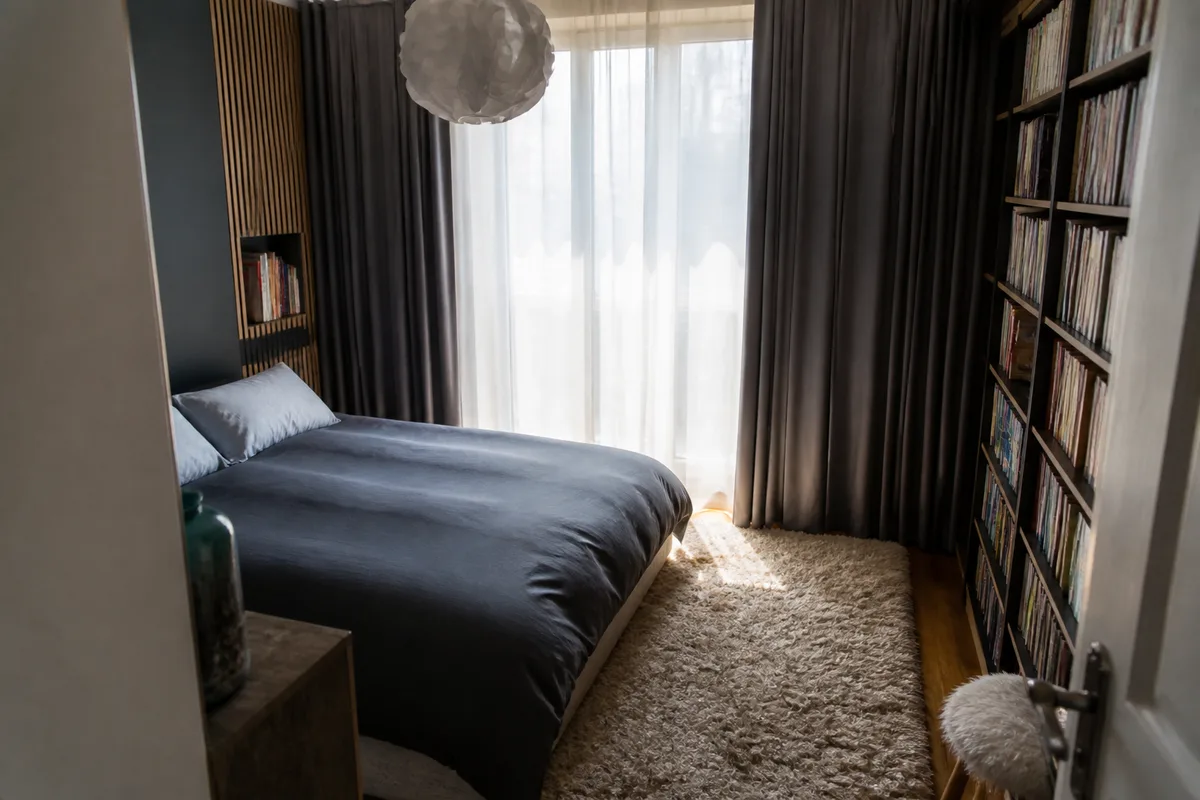
A bookshelf filled with books placed against the exposed wall adds mass and breaks sound reflections. It should not be considered as an insulating wall, but it can complement absorbing panels. In a child’s bedroom, prioritize properly fixed panels without small detachable parts or materials posing a safety risk.
Thick rugs, carpets, and bulky cushions absorb some sounds and limit the propagation of impact noises in the room. They are useful on a hard and resonant floor but will not eliminate vibrations coming from the building’s structure. For a flooring project, installing a linoleum floor must take into account the underlay and the transmission of footstep noises.
Acoustic correction makes a room less reverberant; soundproofing mainly aims to prevent noise from passing through a wall.
Which light renovation solutions are truly more durable?
When noise comes from a shared wall, removable solutions may reach their limits. A lining adds an insulating layer and new mass in front of the wall but reduces the available surface area. The following techniques are no longer simple DIY: they require preparation, careful implementation, and sometimes the intervention of a professional.
Glue-on lining
Glue-on lining combines an insulator and a plasterboard panel installed on the existing wall. Its average thickness can reach about 10 cm depending on the system used. Its indicative cost is often around €35 to €50 per m², excluding site-specific conditions and depending on sources consulted. Surface preparation and joint treatment strongly condition the result.
Drywall with a Frame
This method uses a metal frame, a flexible insulation between the studs, and one or more facing panels. It is based on a mass-spring-mass principle: the wall, the insulation, and the facing limit sound transmission when properly assembled. The budget can vary from about €20 to €100 per m², depending on the composition, finish, and installation.
The Decoupled Partition Wall
A second wall is built parallel to the party wall, with an air gap and insulation between the two. The decoupling limits direct transmissions, but this solution consumes more space and requires careful treatment of the joints with the floor, ceiling, and side walls. It should be considered when the noise is significant and persistent.
Avoid directly fixing heavy elements on a decoupled wall without checking the system used. Pass-throughs, electrical outlets, baseboards, and joints can create acoustic bridges that reduce the effectiveness of the drywall.
Which Materials to Choose for Walls, Floors, and Ceilings?
The material is not chosen solely based on its thickness or price. Rock wool, glass wool, wood fiber, and some recycled textiles are porous materials used in acoustic systems, but their performance depends on the whole: thickness, facing, frame, airtightness, and installation.
| Material or System | Common Use | Advantage | Point of Caution |
|---|---|---|---|
| Rock Wool | Wall, ceiling, drywall | Good absorption capacity in a suitable system | Does not work alone as a finished wall |
| Cellulose Wadding | Wall and ceiling | Bio-based insulation used to limit sound propagation | Sensitive to settling and dependent on installation |
| Wood Fiber | Wall and floor | Available in flexible or rigid panels | Check compatibility with the construction system |
| Expanded Cork | Floor and impact noise | Suitable for certain underlays | Does not alone treat airborne noise coming from a wall |
| Decorative Acoustic Panel | Wall, headboard | Quick installation and improvement of reverberation | Limited effect on structural noises |
For the ceiling, plant fibers, mineral wools, or synthetic insulations can be installed in the form of panels, boards, or loose materials. This intervention sometimes reduces transmissions from the upper floor, but it changes the ceiling height and may require moving a light fixture. In the presence of cables, spotlights, or ventilation, have compatibility checked by a professional.
What Budget to Plan to Improve the Sound Insulation of a Bedroom?
The budget mainly depends on the treated surface area and the type of noise. A targeted intervention on a door or window generally costs much less than a complete drywall. The amounts below are indicative orders of magnitude, not guaranteed prices: labor, finishing, condition of the support, and region can significantly alter the estimate.
| Indicative Budget | Possible Interventions | For What Objective? | Reversibility |
|---|---|---|---|
| Less than €50 | Seals, door draft stopper, rug, cushions, moved furniture | Reduce leaks and reverberation | Very good |
| €50 to €200 | Self-adhesive panels, thick curtain, larger rug | Treat a priority surface or opening | Good, depending on fixation |
| From about €23 per m² installed | Targeted insulation solution depending on material | Improve a wall or floor | Variable |
| €35 to €120 per m² | Bonded drywall, frame, or more complete treatment | Durably reduce transmission through a wall | Low |
| Up to about €150 | High-end soundproof curtain | Reinforce a window or door | Good |
An indicative example allows for comparing orders of magnitude: for 4 m² of wall, a glued lining estimated between €35 and €50 per m² would represent about €140 to €200, before any additional finishes. This calculation does not constitute a quote and does not take into account sockets, baseboards, repairs, or access constraints.
Public aid is not automatically available for a simple acoustic treatment of a bedroom. It more often concerns energy renovation work meeting specific conditions. Check the schemes on France Rénov’ before signing a quote, and beware of canvassing offers promising insulation “for €1”.
What mistakes to avoid when soundproofing a bedroom?
The most frequent mistakes come from confusion between aesthetics, absorption, and insulation. A solution can make the room more pleasant without preventing outside sounds from passing through it. The advertised performance of a product never guarantees the same result in the bedroom if leaks, joints, or other walls remain unchanged.
- Covering a wall with foam thinking to create an insulating partition: foam mainly reduces reflections and echo; it hardly blocks noise from a neighbor transmitted through the wall.
- Installing a curtain that is too narrow: lateral and upper gaps let sound through, especially in front of a window facing the street.
- Installing a seal without checking the closure: an excessively compressed seal can deform the door’s operation.
- Treating only the visible wall: sound can bypass the wall via the ceiling, floor, side walls, or ducts.
- Blocking ventilation to gain silence: this can create humidity and air quality problems; an air inlet must remain functional.
Which solution to choose depending on the situation?
To choose a bedroom acoustic insulation solution, start from the dominant nuisance and the level of work accepted. A tenant will favor removable devices, while an owner may consider a lining if the noise is structural and persistent. The best compromise is often a targeted combination rather than a single equipment.
Street or traffic noise
Start with the window: seals, closing of openings, multilayer curtain, and possible removable panel. Do not block air inlets and do not replace glazing or joinery without checking the condominium rules and housing constraints.
Noise coming from a neighbor
If voices or television pass through a party wall, first move a full bookshelf or install absorbing panels to reduce reverberation. If the problem persists, a framed lining or a decoupled false wall will generally be more coherent than an accumulation of small foams.
Footsteps or impact noises
A thick carpet can reduce reverberation and some impact noises in the bedroom. If the impacts come from the upper floor, the most effective treatment is often at the source, in the upstairs dwelling, or at the ceiling level with a solution designed for this use.
Rented bedroom
Favor removable seals, door draft stoppers, curtains, rugs, and repositionable furniture. For glued panels, test the adhesive compatibility on a discreet area and ask the landlord’s agreement if removal might damage the paint.
In a rental, a well-targeted reversible improvement is better than a quick fixing that damages the wall or compromises ventilation.
How to do it: steps to improve the sound insulation of a bedroom
Follow this progression to avoid unnecessary purchases. Each step must be evaluated before moving on to the next: if the noise already decreases after sealing the door, it is not necessary to immediately treat all the walls.
Step 1: map the nuisances
Close the door, window, and shutters successively, then note the area where the noise remains most present. Repeat the observation at several times to distinguish occasional traffic from a regular nuisance. The expected result is a clear priority: door, window, wall, floor, or ceiling.
Step 2: eliminate air leaks
Install the appropriate seals around the door and window, then add a door sweep if no air passage should remain in that area. Check the opening, closing, and ventilation. After this step, compare the sound comfort with the initial situation.
Step 3: add absorbing elements
Place a thick rug on a reverberant floor, a fully loaded bookshelf against the exposed wall, and curtains that broadly cover the window. Add acoustic panels if the echo remains significant. The expected result is a less resonant room, without promising the elimination of outside noise.
Step 4: treat the priority wall
If the nuisance remains strong, request a technical opinion on glued cladding, a frame with insulation, or a decoupled partition wall. Measure the loss of surface area, the connections with the floor and ceiling, as well as the impact on outlets and radiators before accepting a quote.
Step 5: check secondary points
After the main treatment, check the side walls, ceiling, floor, shutter boxes, and technical penetrations. An acoustic bridge may explain why a correct solution seems ineffective. For any intervention on a partition, an electrical network, gas, or structure, call on a qualified professional.
Useful sources to consult
ADEME: its information on acoustic comfort helps put reduction claims into perspective. Values of 7 or 8 dB should be understood as orders of magnitude related to specific configurations, not as a guarantee for every room.
Manufacturers’ technical documentation: look for a sheet indicating measurement conditions, tested frequencies, and the laboratory involved. A maximum value obtained at a given frequency does not necessarily describe the overall attenuation in a dwelling.
Public service and lease: before a fixed modification, check the rules applicable to the dwelling, co-ownership, and rental. An intervention affecting a window, ventilation, or facade may require prior approval. For humidity problems related to the envelope, also consult precautions related to facade waterproofing.
Key takeaways
- 🔎 Diagnose the surface actually responsible for the noise before buying equipment.
- 🚪 Start with seals, door sweeps, and curtains: these solutions are accessible and reversible.
- 🧱 Acoustic panels mainly correct echo; cladding is better suited for noise passing through a wall.
- 💶 Compare quotes based on treated surface, thickness, finishes, and acoustic bridges to be addressed.
- ⚠️ Never block ventilation and entrust interventions on electricity, gas, or structure to a professional.
Frequently asked questions
Is a soundproof curtain enough to insulate a bedroom?
A soundproof curtain can reduce noise coming from a window or door, especially if it is multilayered and wide enough. It is not always sufficient when the glazing, wall, or structure directly transmits the nuisances.
How to soundproof a door without replacing it?
Start by installing seals around the frame and an appropriate device under the door. A heavy curtain on the bedroom side can complement the treatment, but it will not eliminate sounds transmitted by a very light door.
Do rugs really reduce noise?
A thick rug reduces reverberation and some impact noises on a hard floor. It does not block voices or traffic noise passing through a window or wall.
What is the best solution without major work?
The best first action depends on the source: seals for a door, multilayer curtain for a window, rug for a resonant floor, and bookshelf or panels for a wall. If the noise passes through the structure, cladding will generally be more effective.
When should you call a professional?
Seek advice when the noise is significant despite simple solutions, when the ceiling or a shared wall is involved, or when a partition, window, ventilation, or network needs to be modified. A professional can also identify acoustic bridges and verify the system’s compatibility with the dwelling.
.magic-lb-overlay{position:fixed;inset:0;background:rgba(15,23,42,.92);display:none;align-items:center;justify-content:center;z-index:99999;cursor:zoom-out;padding:20px}
.magic-lb-overlay.open{display:flex}
.magic-lb-overlay img{max-width:95vw;max-height:95vh;object-fit:contain;border-radius:8px;box-shadow:0 8px 32px rgba(0,0,0,.5)}
.magic-lb-close{position:absolute;top:16px;right:20px;color:#fff;background:rgba(0,0,0,.5);border:none;width:40px;height:40px;border-radius:50%;font-size:24px;cursor:pointer;display:flex;align-items:center;justify-content:center}
.magic-lb-close:hover{background:rgba(0,0,0,.8)}
.wp-block-image img{cursor:zoom-in;transition:transform .15s ease}
.wp-block-image img:hover{transform:scale(1.01)}
.magic-img-link{display:inline-block;text-decoration:none}
(function(){
var ov=document.getElementById(‘magic-lb’);if(!ov)return;
var img=ov.querySelector(‘img’),btn=ov.querySelector(‘.magic-lb-close’);
function open(src){img.src=src;ov.classList.add(‘open’);document.body.style.overflow=’hidden’}
function close(){ov.classList.remove(‘open’);img.src=”;document.body.style.overflow=”}
document.addEventListener(‘click’,function(e){
var a=e.target.closest(‘a.magic-img-link’);
if(a){e.preventDefault();open(a.getAttribute(‘href’));return}
var i=e.target.closest(‘.wp-block-image img’);
if(i&&!e.target.closest(‘a’)){e.preventDefault();open(i.currentSrc||i.src)}
});
ov.addEventListener(‘click’,function(e){if(e.target===ov||e.target===btn)close()});
document.addEventListener(‘keydown’,function(e){if(e.key===’Escape’)close()});
})();