To find cheap gray tiles, you need to compare clearance and end-of-line offers based on the price per m², format, finish, minimum quantity, and available stock. The prices observed in the corpus are specific and must be verified before purchase.
A price displayed at €9.01 excl. VAT/m² may seem unbeatable, but a mandatory pallet, expensive delivery, or a shade impossible to complete can quickly change the total cost. The right purchase is therefore the one that truly covers your surface area, suits the room, and remains available until the installation is complete.
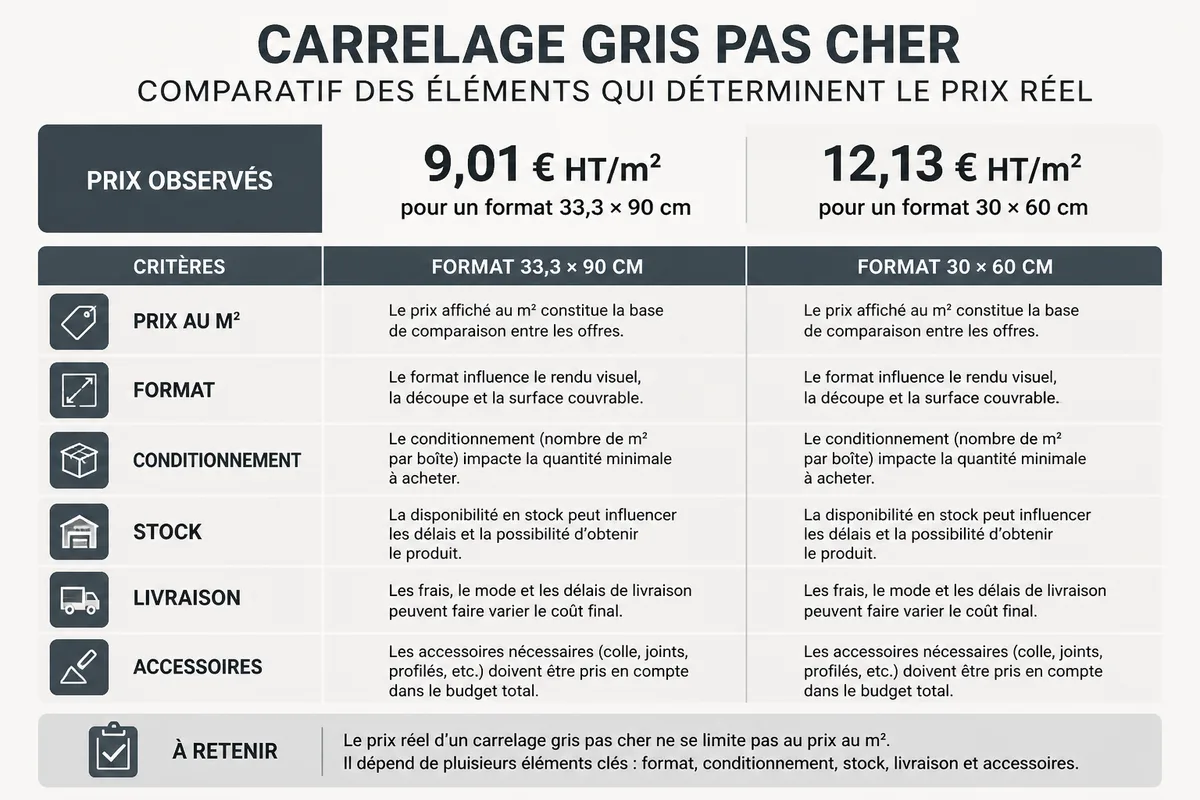
| 💶 | Observed prices: €9.01 excl. VAT/m² for a 33.3 × 90 cm reference and €12.13 excl. VAT/m² for a 30 × 60 cm reference in a consulted clearance catalog. |
| 📦 | Packaging: some references are sold by the box or pallet, with a minimum quantity to check before ordering. |
| 🎨 | Shade choice: light gray visually enlarges a dark room; anthracite absorbs more light and shows marks differently. |
| 🧱 | Material: porcelain stoneware is often suitable for floors, while earthenware is mainly intended for walls. |
| 🧰 | Real cost: glue, joints, profiles, delivery, waste, and installation must be added to the price of the tiles. |
| ⚠️ | Weak point: a lot that is too small or impossible to complete can cost more than a slightly more expensive product initially. |
What price should you expect for gray tiles per m²?
The price of gray tiles per m² cannot be summarized by a reliable range without specifying the material, format, and seller. The available observations show two specific clearance prices: €9.01 excl. VAT/m² for a 33.3 × 90 cm tile and €12.13 excl. VAT/m² for a 30 × 60 cm model.
These two values do not form an official market price. They only show the possible gap between two references within the same sales universe, with formats and finishes that are not identical. The displayed price must be checked at the time of order, clearly distinguishing the amount excluding taxes from the amount including all taxes.
A consulted clearance catalog also displayed 127 gray products, including 65 matte references, 24 advertised as non-slip, and 44 in porcelain stoneware. These numbers describe this specific catalog, not the entire offer available in France. However, they give an idea of the sorting to be done: color alone is not enough to compare.
The cheapest is not always economical.
A reference at €9.01 excl. VAT/m² sold by pallet may be less interesting for a small bathroom than a more expensive product sold by the box. Conversely, a pallet can become relevant for a large, perfectly measured surface, provided you can store the boxes safely and check their weight.
How to verify that an offer is truly economical?
An offer is truly economical when the price of the tiles, the imposed quantity, delivery, accessories, and losses remain consistent with your project. You must therefore relate each proposal to the usable surface, then check the stock, batch, size, and the possibility of completing the lot.
Clearance, big box store, or specialized trade: which option to choose?
Clearance is better placed to obtain a low price on an immediately available quantity, while a big box DIY store often facilitates the purchase of a supplement. Specialized trade becomes more relevant when the technical data sheet, usage classification, or color consistency matter more than the introductory price.
| Purchase channel | Main advantage | Limit to monitor | Suitable profile |
|---|---|---|---|
| Clearance | Reduced price on an available batch | Limited stock and uncertain replenishment | Measured large surface |
| DIY superstore | Local pickup and easier complementary purchase | Price and quality vary depending on the batch | Small project or emergency |
| Specialized trade | More detailed technical sheets and advice | Sometimes not the lowest introductory price | Demanding floor or durable project |
| Online sales | Wide choice and quick comparison | Delivery, returns and visible shade harder to assess | Buyer capable of verifying data |
However, the packaging can negate the interest of the price per m². The GLAMSTONE GRIS LIGHT reference mentioned in the catalog was indicated on a pallet of 60 m², with 50 boxes and a declared weight of 1,146 kg. Such data requires checking the truck access, unloading location, and the capacity of the floor or storage area.
- Ask if the price is expressed per m², per box, or per pallet.
- Calculate the actual quantity delivered, not just the number of boxes.
- Check transport costs and pickup conditions.
- Ask if the same batch or size can be ordered later.
- Keep the product sheet and return conditions before payment.
Which gray tile to choose according to material, finish, and format?
Porcelain stoneware is generally the most versatile choice for an interior floor, as its technical sheet allows verification of water absorption, wear resistance, and grip. Faience is mainly intended for walls, while natural or reconstituted stone requires precautions specific to the material and its maintenance.
Dry-pressed tiles are notably classified according to their water absorption: BIa up to 0.5%, BIb beyond 0.5% up to 3%, BIIa beyond 3% up to 6%, and BIIb beyond 6% up to 10%. These values are used to compare the announced porosity; they alone are not sufficient to authorize a specific use.
For a glazed tile intended for flooring, the PEI class ranges from 0 to 5 and informs about the surface abrasion resistance. Grip with shoes is compared with classes R9 to R13 according to the ramp test of standard DIN 51130:2014-02. A high wear class therefore does not replace grip information.
To delve deeper into the most common material, consult this file on gray porcelain stoneware. The product sheet remains a priority: do not deduce its purpose from the sole word “ceramic” printed on an advertisement.
Format, thickness, and substrate: the trio that can derail savings
A large format sometimes reduces the number of joints, but it requires a sufficiently flat substrate, proper handling, and an adapted installation method. A thick tile can also change the final height relative to a door, a baseboard, or an adjacent covering.
And an irregular room is not the ideal terrain for a cheap large format. Cuts around corners, pipes, or a siphon can multiply waste and slow down the project. Before buying, measure the actually usable lengths, check the thickness with the planned adhesive, and verify the flatness of the substrate.
For the difference between wall use and floor use, the file dedicated to gray floor tiles provides useful additional information. Confusing these two purposes is a false economy: a tile suitable for walls is not automatically designed to withstand floor traffic.
Light gray, dark gray or anthracite: which shade for which room?
Light gray is the safest choice in a small room or a poorly lit space, while dark gray and anthracite give more depth to a large well-lit room. The color of the joints also strongly modifies the result: a joint close to the tile calms the decor, a contrast highlights each line.
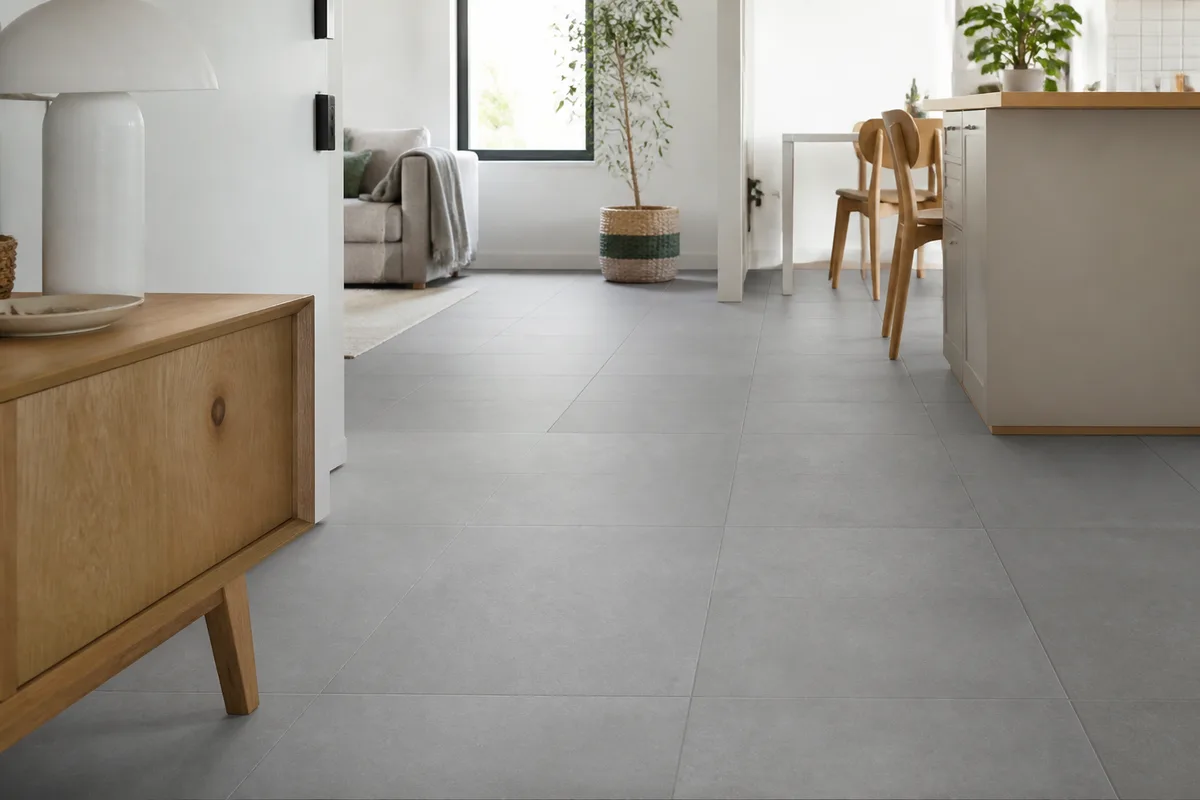
In a windowless bathroom, a medium or light grey generally avoids the effect of a dark mass. In a kitchen very exposed to light, anthracite can structure the floor, but it makes certain light dust and lime traces more visible when used in a wet area.
But the finish matters as much as the shade. Matte better masks certain reflections and gives a mineral look, whereas a glossy finish reflects light but more easily reveals marks and substrate defects. A non-slip finish may have a more gripping texture that is harder to clean: do not choose solely based on the catalog photograph.
Grey works well with wood, white fronts, and warm tones, provided not to accumulate cold greys in a room that is already poorly lit. A sample placed at different times of the day is better than a screen set too bright.
Maintenance: the material decides the product
Porcelain stoneware is cleaned with a product compatible with its finish, while natural stone may require protection and specific products. Grey never exempts reading the instructions: an overly aggressive cleaner, a greasy film, or an unsuitable product can dull the desired appearance.
To limit marks, remove grout residues after installation using the method provided by the manufacturer and avoid improvised mixtures. Very light joints require more vigilance in dirty areas; very dark joints can leave a visible veil on a matte and textured tile.
How to calculate the total budget without getting caught?
The total budget is calculated based on the surface to cover, the quantity actually sold, and the fees added to the price of the tiles. You need to include cuts and future replacements, then add adhesive, grout, profiles, delivery, and installation when the project is entrusted to a professional.
A simple example helps avoid mixing units. For exactly 20 m², at the observed rate of €9.01 excl. tax/m², the tiles represent €180.20 excl. tax before delivery fees, accessories, waste, and installation. With a reference priced at €12.13 excl. tax/m², the same surface represents €242.60 excl. tax. These amounts are not quotes and do not include cutting margin.
Installation, consumables price, and delivery are not provided in the available data. It would be dishonest to assign them a universal flat rate: a straight installation on a prepared substrate does not require the same resources as a diagonal installation, a leveling correction, or a large format.
To establish your own calculation, note separately:
- the net surface measured room by room;
- the necessary margin for cuts, waste, and reserve tiles;
- the number of boxes corresponding to this quantity;
- the adhesive, joint mortar, spacers, and profiles;
- transport, possible removal, and professional installation.
Common mistakes that turn a promotion into a useless expense
A low price loses its interest when the technical sheet, quantity, or sales conditions are misread. The most costly traps rarely appear in the product photo: they are found in the fine print of packaging and usage limits.
Moreover, a cheap tile that is not suitable for the room should remain in the warehouse. For a heavily trafficked floor, choose a reference whose technical sheet confirms the use; for a decorative wall, do not unnecessarily pay for a feature intended for heavy traffic.
DIY: compare batches, formats, and the real price. For compatibility with a deformed substrate, a complex humid room, or a heavy large format, have the project checked by an installer: no online sheet replaces the examination of the substrate in hand.
FAQ: buying cheap grey tiles
What is the difference between dark gray and anthracite?
Anthracite generally refers to a very dark gray, close to coal. The names are not perfectly consistent across manufacturers: compare the actual sample and the color reference rather than the commercial name.
Can you buy an end-of-series for gradual renovation?
Yes, for a surface that is fully measured and purchased at once. It is risky if you plan to expand the project later, as the same batch, size, or model may no longer be available.