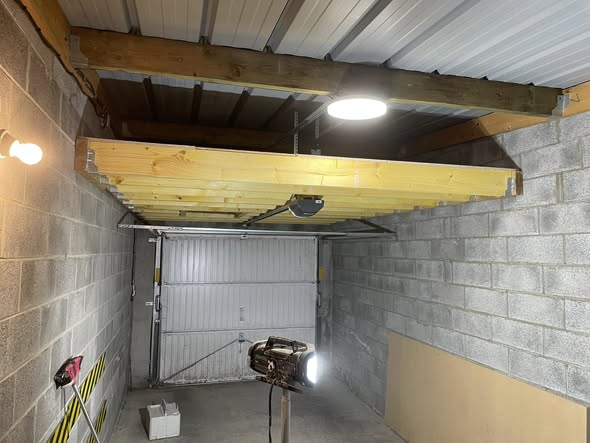

📋 The essentials at a glance: Personally, I consider that creating a mezzanine in a garage is one of the best solutions to gain up to 30% additional space. In most cases, everything depends on a solid structure and a good ceiling height. With suitable materials and a precise plan, the project can be completed in 1 to 2 days. It is an ideal option to optimize storage or create a workshop corner.
Compared to other rooms in the house, the garage is destined for countless uses. It is not only used to protect your car from the weather or theft. The space also allows you to store your tools and various useful materials.
If yours lacks enough space, the mezzanine is an excellent idea to have an additional room.
More and more households are opting for this structure to solve the space problem. If you are interested, we invite you to read this article.
So much important information is available to help you build your garage mezzanine with ease. But before diving into the heart of the matter, it is appropriate to provide its definition.
🗣️ My experience: During a garage renovation, I built a mezzanine to store tools and boxes. At first, I underestimated the total weight, and I had to reinforce the structure with additional beams afterward. Since then, I always calculate the loads before starting. The lesson is simple: anticipating the resistance avoids unpleasant surprises.
What is meant by mezzanine
🍀 Advantages
- Significant space gain
- Economical solution
- Modular layout
🔻 Limitations
- Requires good height
- Technical work
The mezzanine represents a platform that is installed on beams or joists supported by walls. Generally, these supports are very sturdy.
They are capable of bearing the weight of the structure. That is why it can simply be hung on these robust materials.
This layout constitutes an additional elevated space added within a room to gain a few square meters. To create it, the only condition is to have sufficient ceiling height.
The mezzanine can be made in any room with a ceiling height of at least 4 m. This margin allows maintaining a height of 1.90 m reserved for the structure. With this value, one can move around without difficulty.
Among the loft mezzanine, industrial mezzanine, mezzanine bedroom, garage mezzanine, the garage mezzanine continues to attract more and more people. It offers multiple advantages.
To go deeper, I recommend making a door which complements this topic well. custom shelving also provides useful leads. And to go further, solid wall mounting offers interesting insight.
What is a mezzanine used for in a garage?
A mezzanine is an excellent idea to enlarge your garage. Due to lack of space, it can only accommodate your vehicle, bike, or motorcycle.
However, many materials and tools do not have a fixed place in the house. With the expensive cost of an extension project, there is nothing more practical and affordable than adding a mezzanine in the garage.
Its construction in height certainly does not clutter the floor area. You just need to place it against the wall between the floor and ceiling. Thanks to this arrangement, you will gain more space to finally have a storage or shelving area.
You can store all your boxes, materials, or objects that are not used daily such as car wheels, trunks, gardening accessories, surfboards, suitcases, and many more.
You can also create a workshop or an office there. Others install a relaxation corner up high. It welcomes them whenever they need to take a nap. In any case, the mezzanine offers you countless uses.
Its dimensions can vary depending on the size of your garage. Large structures can reach 30 m² while small ones do not exceed 10 m².
In any case, creating this additional storage does not require major work. It is an affordable and very profitable investment.
For a project under 20 m², it does not require a building permit application.
)()The different types of garage mezzanines
There are two types of garage mezzanines. You can choose between the suspended model and the platform one.
The first category is the most common version. It is a good alternative when you do not have space for pillars on the floor.
To assemble it, you can fix it between two load-bearing walls. These must be sturdy enough to support the load of the entire structure. This option offers a huge space gain because it does not require any pillar that encroaches on the garage floor.
As for the platform mezzanine, it differs by having integrated legs serving as pillars. It is on these supporting beams that the floor will rest.
This arrangement is perfect when the room’s walls cannot support the entire load. It must therefore be accompanied by legs for more solidity.
It must be said that the platform mezzanine is more bulky compared to the suspended version. The cross braces take up floor space. However, its stability is remarkable. Moreover, it is easier to manufacture and install.
Whatever your choice, you should always plan for a good height below the ceiling before starting construction.
You should reserve 1.90 m of height for the mezzanine and 1.80 to 2 m under the structure. This allows you to move around standing freely and without discomfort.

What you need to know to build a mezzanine
🌍 Did you know?
A well-designed mezzanine can support between 150 and 300 kg per m² depending on the materials used and the chosen structure.
Once this height is respected, you can now create your garage mezzanine. But before you get started, you will first need to gather a few elements.
The elements that make up a mezzanine
A mezzanine is a very technical installation. It involves countless materials.
Joists are part of it and they play a crucial role in supporting the floor load. Whether you choose the platform mezzanine or the suspended model, this wooden framework should not be chosen lightly.
The same goes for the rafters. Their function is to distribute the weight of the frame components. They serve as a base to fix the different elements that make up the mezzanine.
As for the end beam, it is none other than the load-bearing beam installed at the edge of the frame. Whether made of wood or steel, it helps support the floor’s weight.
The wall beam, on the other hand, serves as an anchor. It is fixed along a wall of your garage. As for the frame bracket, it strengthens and secures your mezzanine. It allows the assembly of the frames.
The staircase is one of the essential elements that make up the structure. There are a variety of models available on the market. Between straight, turning, or spiral staircases, choose the practical and easy-to-use version.
For the platform mezzanine, it is generally accompanied by posts that support and bear the structure. The suspended mezzanine, on the other hand, requires metal cables.
Balustrades, false floors, soundproofing strips, beams or threaded rods, there are still countless elements to gather to build your mezzanine.
⚠️ Common misconception
Thinking that a mezzanine can be fixed only on the walls is a mistake. Without an appropriate load-bearing structure, the risk of sagging is real.
Drawing up the plan
When you have all the components of the mezzanine at your disposal, move on to the next step by taking the essential measurements.
To do this, use the instruments designed for this purpose. This phase helps you definitively define the place where you will position the structure.
On this occasion, remember to study the necessary clearance for each opening of the garage door. Once you have taken the correct measurements, you can draw the plans.
Since this is a tall construction, it requires numerous calculations to ensure the solidity of the structure and to properly locate the anchor points.
To achieve this, there is nothing better than entrusting this task to an architect. With their knowledge and experience, they will be able to calculate the loads accurately.
This study allows for detecting the measurements of the spacing, the anchoring zones, and the necessary structure to support the entire load.
After this step, you can choose the right materials for the garage mezzanine. If you plan to create a suspended model, you will definitely need the uprights used to hold it up.
For a platform category, the installation of pillars may be mandatory. It should be reminded that the fixings depend on the wall’s manufacturing materials. The anchoring of cinder blocks is different from that of concrete or brick.
Material selection
| Material | Average price | Resistance | Difficulty |
|---|---|---|---|
| Wood | 50 to 120 €/m² | Good | Medium |
| Steel | 100 to 250 €/m² | Very high | Difficult |
| Mixed wood steel | 120 to 200 €/m² | Excellent | Medium |
| OSB panels | 20 to 50 €/m² | Medium | Easy |
In the previous section, all the necessary materials have already been mentioned. Among them, the choice of joists and beams is of paramount importance. You must base yourself on precise calculations to avoid making a mistake.
These structural elements are supposed to support the entire load. Avoid using 16 mm thick OSB3 panels with a 60 cm spacing. Otherwise, your mezzanine lacks solidity.
To acquire them, almost all materials are easily found in specialized stores except for the wooden elements.
These require a prior order at a sawmill. Exact measurements of each piece of the framework must be provided.
In most cases, the structure of the suspended mezzanine is sometimes made of wood. This natural material is not only easy to work with but also robust. To prevent it from deforming over time, you can paint it with a suitable product.
The platform mezzanine, on the other hand, generally has a steel structure. But it can also be made of wood. Even though steel is prone to rust, it does not risk deforming. Moreover, builders sometimes use anti-rust treatment.
Whether it concerns the platform structure or suspended, the pillars are often made of metal, concrete, or wood. For the staircase, this part is designed either in wood or concrete.
Building the mezzanine
To start, install the rafters following the plan you established beforehand. To fix them, use your drill to bore the wall and the pillar.
Place the threaded rods and make sure to seal them firmly. Put the posts in place and use lag screws to attach them.
The next phase is to erect the wall beams. Use lag screws to secure them. Then install the front and central beams by cutting their notches, which facilitates the placement of the joists.
That said, arrange the mounting brackets and now screw the beams onto them. Lay the joists and make sure these framing elements are securely installed.
The floor construction begins with placing the first OSB panel or plywood sheet on the left side at the back.
Then proceed in the same way by installing all the panels one by one until you cover the surface of the structure. Attach these elements to the joists using nails.
All that remains is to install the railing and stairs. The latter must comply with standards to ensure your safety.
The passage width must not be less than 60 cm. The height of the guardrail is 90 cm.
From an aesthetic point of view, you have the option to paint the floor. Even though many people neglect the decor of the garage mezzanine, you can make yours original.
The cost of a garage mezzanine
Although it is still possible to create your own mezzanine, hiring a professional guarantees quality work.
Of course, the price does not necessarily fit all budgets. However, you will have an aesthetic, solid, and durable mezzanine after their intervention.
Since there are several types of mezzanines, costs vary depending on the model, the extent of the work, and the garage configuration.
If you hire a professional, the average price range is between 600 to 1,300 euros per m². This includes installation and materials.
It is also possible to purchase a mezzanine kit. This option gives you the opportunity to install it yourself without going through a specialist.
It must be said that it is comprehensive, as it includes almost all the necessary elements for assembling the structure on a supporting frame. However, its load capacity is limited.
If you plan to acquire one, its price ranges between 1,000 and 5,000 euros. This mezzanine offers you a surface area of 10 to 15 m².
FAQ
Why build a mezzanine in a garage?
u003cbr/u003eThis structure allows you to save space in a garage. Thanks to its layout, it can accommodate, besides your car, countless tools and objects that clutter your home.u003cbr/u003e
What materials are needed to build a mezzanine in a garage?
u003cbr/u003eSeveral elements make up the garage mezzanine. The beams, joists, large beams, posts, and brackets are among the essential components. To build a mezzanine, you need special wall or wood drills, a drill driver, metal anchors, and many others.u003cbr/u003e
What are the steps to build a mezzanine in a garage?
u003cbr/u003eStart by installing the rafters, then the wall beams, central beams, and front beams. Next, install the joists. After assembling the floor, put the staircase in place.