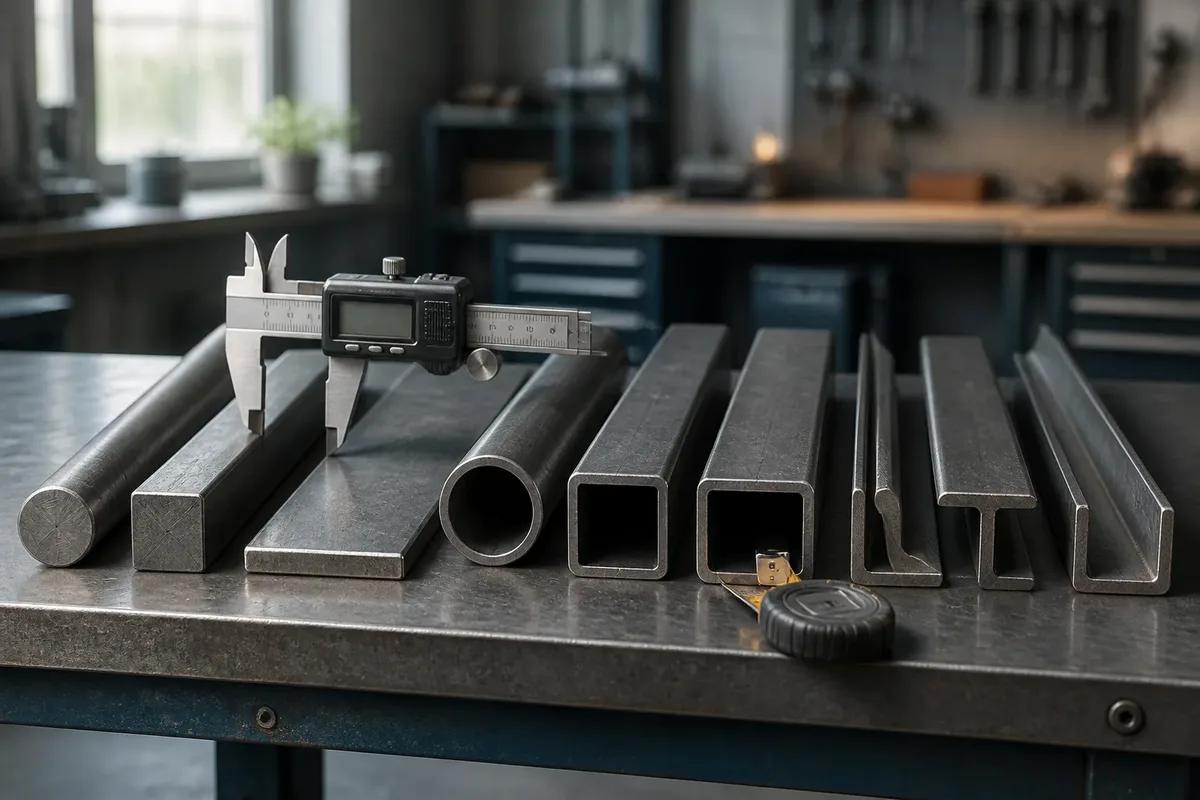
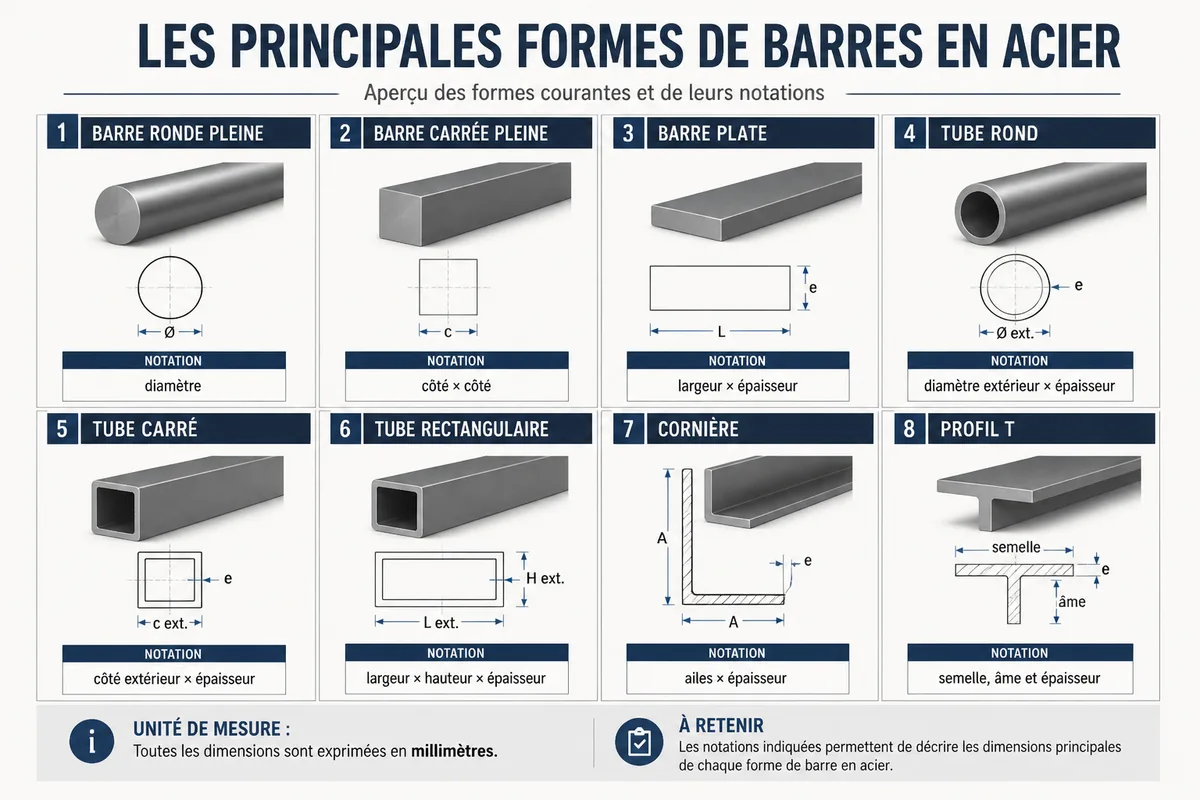
To choose a steel bar, start with the shape before looking at the price. The main shapes are round bar, square bar, flat bar, round, square, or rectangular tubes, as well as angles, T profiles, and U profiles. Dimensions are expressed in diameter for rounds, width × thickness for flats and angles, and width × height × thickness for tubes and hollow profiles.
The difficulty comes from the vocabulary of catalogs: a solid round bar of 20 mm is not a round tube of 20 mm, and a flat bar of 40 × 5 mm does not behave like a square bar of 40 mm. The section, thickness, length, grade, and intended use must remain clear up to the purchase order.
| 📐 | Common shapes: round, square, flat, tube, angle, T profile or U profile. |
| 📏 | Reading dimensions: diameter, width, height, and thickness do not mean the same thing. |
| ⬛ | Solid profile: the section is completely filled with material. |
| ▣ | Hollow profile: the external dimensions are accompanied by a wall thickness. |
| ⚖️ | Section choice: it depends on the force, orientation, space constraints, and assembly. |
| ✂️ | Order: specify shape, dimensions, length, quantity, grade, finish, and cut. |
What are the main shapes of steel bars?
A round bar is used when symmetry or rotation matters, a square bar when four flat faces facilitate assembly, and a flat bar when the bearing width must remain significant with little thickness. Tubes, angles, T profiles, and U profiles add geometries suited to different uses.
Round, square, and flat bar
The solid round bar is described by its diameter, for example Ø20 mm. The solid square bar is described by the length of one side, for example 20 × 20 mm. The flat bar is expressed by its width and thickness, like 40 × 5 mm; the first dimension usually indicates the face width, the second the small thickness.
A round can be drilled or turned around a regular geometry, while a square offers flat faces easy to position. The flat takes up less space in thickness and provides a practical surface for a tab, a flange, or a fastener.
For an overview of the characteristics of a raw flat bar and its uses, you can consult this file on raw steel bar cut to measure, provided you compare the section and finish actually sought.
Round, square, and rectangular tube
A round tube is noted by its outer diameter and thickness, for example Ø21.3 × 1.5 mm. A square tube combines the outer side and thickness, like 30 × 30 × 2 mm. A rectangular tube usually indicates width × height × thickness: 60 × 30 × 2 mm thus describes an outer contour of 60 by 30 mm with a 2 mm wall.
The distinction between solid and hollow immediately changes the mass, local stiffness, the way of drilling, and the preparation of the ends. A tube should not be equated with a solid bar of the same outer width: the material is distributed in a wall, with a cavity in the center.
Angle, T profile, and U profile
An angle has two legs meeting at a right angle. Its dimensions can be equal, like 40 × 40 × 4 mm, or unequal, like 60 × 40 × 5 mm; the third number here corresponds to the thickness. A T profile combines a web and a flange, while a U profile has two legs connected by a web.
These profiles are not chosen only by their apparent footprint. Their orientation changes how they bear a load, and their edges sometimes complicate painting, welding, or fitting an attached part.
How to read the dimensions of a steel profile?
To read a designation without error, first identify the product family: solid round, flat bar, tube, or rolled profile. Then, separate the outer dimensions from the wall thickness. This method prevents ordering a tube when solid is needed, or confusing a piece length with a sectional dimension.
The millimeter is the most practical unit for reading steel dimensions. A dimension of 25 means 25 mm, not 25 cm. Catalogs may also display a length in meters, but the section is generally expressed in millimeters.
The same sequence of numbers is never enough to identify a shape. The mention “30 × 30” can refer to a solid square bar or a square tube; the product sheet must specify the family, thickness, and surface finish.
However, the dimensions do not automatically provide information about tolerance. Two pieces announced at 30 mm may show a difference related to the manufacturing process, straightness, or cutting. For a tight assembly, request the dimensional tolerance and cutting precision specified in the product sheet; without this data, do not promise a tight fit.
Straightness and squareness of the ends matter as soon as several bars must form a frame. A rough cut may require deburring or rework before welding, especially if the piece must be positioned against a stop or receive a plate.
What dimensions are found according to the shape?
Commercial ranges are not identical from one supplier to another: the steel, shape, grade, process, and available length reduce or expand the choices. The values below are examples of dimensions displayed in catalogs, not an exhaustive list or a general availability standard.
| Family | Observed dimensions | Reading order | Point to check |
|---|---|---|---|
| Solid round | 6 to 40 mm | Diameter | Solid round or round tube |
| Solid square | 8 to 40 mm per side | Side × side | Solid section |
| Flat bar | 16 × 6 to 100 × 10 mm | Width × thickness | Orientation and flatness |
| Round tube | 14 to 60.3 mm diameter depending on ranges | Outer diameter × thickness | Useful inner diameter |
| Square tube | 15 to 100 mm per side; walls from 1 to 2 mm in an observed range | Outer side × thickness | Wall and corners |
| Rectangular tube | 20 × 10 to 100 × 50 mm in an observed range | Width × height × thickness | Height orientation |
| Angle iron or T profile | 20 × 3 to 60 × 30 mm for angle irons; 20 × 3 to 80 × 9 mm for T profiles | Flanges or base × thickness | Exact profile shape |
Another catalog highlights solid rounds of 6, 8, 10, 12, 14, and 16 mm, as well as square tubes from 16 × 16 to 30 × 30 mm. This difference with a wider range does not constitute a technical contradiction: the two sellers simply do not offer the same catalog depth.
Flat bar dimensions also appear under several ranges. Notably, from 20 × 3 mm up to 20 × 15 mm in one range, while another lists sections from 16 × 6 to 100 × 10 mm. Always compare the shape, grade, and length before comparing a price per meter.
And square tubes can be announced from 15 to 100 mm per side with thicknesses of 1, 1.5, or 2 mm in one range, while another catalog shows only 16, 20, 25, and 30 mm. Actual availability thus belongs to the complete reference, not the “square tube” family taken generally.
How to choose a steel bar dimension according to the project?
Choose the section based on the actual load, span, orientation, and assembly, never from a shape table alone. For a decorative piece or a small fitting, size and ease of drilling may dominate. For a load-bearing piece, calculation and support verification come before the catalog.
Shape comes before strength.
A flat bar oriented on edge resists bending better in one direction than when laid flat, because the material is further from the bending axis. This geometric observation does not provide an allowable load: the span, supports, holes, welds, and impacts change the result.
The moment of inertia describes the distribution of material around an axis and is involved in the study of bending. The section modulus complements this understanding by linking the geometry of the section to the bending stress. For a solid cylinder, the moment of inertia around a central axis is written I = π·D⁴/64; the diameter therefore plays a major role in this geometric property.
For an angle iron or a T-profile, the material is not distributed symmetrically as in a round bar. The bending axis, the center of gravity, and torsion become important, especially if the force is not applied in the favorable plane of the profile.
For a load-bearing application, do not choose from a catalog. A photograph, a nominal section, or a displayed grade is not enough to validate a beam, a guardrail, a bracket, or a support subjected to people. No text or photo replaces a hands-on verification by a competent person who knows the supports, assemblies, and forces.
- Light part to be fixed: prioritize the bearing surface, drilling, and the thickness actually needed.
- Frame or chassis: check straightness, angles, ease of welding, and deformation after assembly.
- Element exposed outdoors: include corrosion protection from the choice of surface finish.
- Element subjected to a force: have the section and assemblies determined by a competent person.
But a thicker bar is not automatically the best solution. It can become difficult to drill, too heavy to handle, incompatible with a hinge, or impossible to fit in the available clearance. The right choice is the one that fulfills the function with a verified section and a feasible assembly.
For a selection between tube, angle iron, and flat bar according to the assembly, the file on the custom steel profile provides a useful complement, especially when geometry matters as much as the material.
Custom cutting, grade, finish, and price
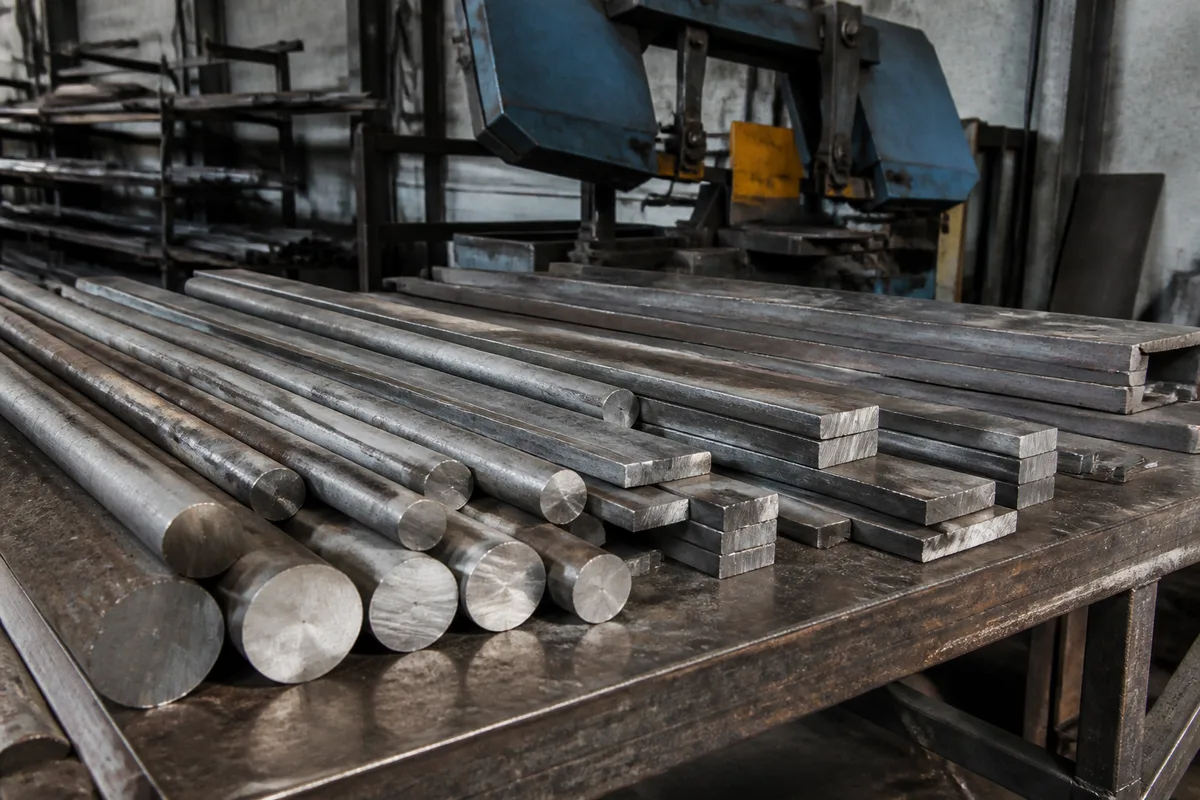
A standard bar is suitable when the available section and length correspond without significant trimming. Custom cutting becomes interesting when each piece must have a precise length, when there would be many offcuts, or when the ends must be prepared. It does not exempt defining the grade, thickness, and finish.
Standard length or cut to order?
Long products can be sold in long bars, while some references are offered already cut. A catalog, for example, shows crossbars of 2,000 mm. This value concerns the presented reference, not all steel bars on the market.
Cutting changes the final cost due to preparation, machine time, packaging, and sometimes minimum quantity. A cut piece must also be deburred if handled by hand or if it comes into contact with another piece.
For round bars, the guide dedicated to custom round steel bars allows distinguishing the diameter, length, and operations following the cut.
Steel grade and material certificate
The grade describes the composition and guaranteed properties of the material within the corresponding datasheet. Two bars of the same shape and dimensions can therefore be intended for different uses if their grade, metallurgical state, or material certificate do not match.
A designation like S235 should not be automatically transferred from one reference to another. The grade must be linked to the specific product, the technical data sheet, and the certificate provided when this material proof is required.
The grade matters for weldability, machining, the desired strength, and traceability. It does not replace the calculation of an assembly: good material poorly welded or poorly supported remains a bad assembly.
Raw steel, black, galvanized and protection
Raw or black steel has a surface resulting from manufacturing, with corrosion protection that is not that of a galvanized or painted product. The chosen finish must correspond to the environment and the preparation actually possible before painting.
However, a thin and closed tube is not protected like a flat bar accessible on all its faces. Cuts open the ends and may require additional protection; welds must be cleaned and treated according to the planned finishing system.
Why are prices not directly comparable?
A price per meter only makes sense with the shape, section, grade, finish, length, quantity, cut, and tax regime. A flat bar of 20 × 3 mm cannot be compared to a square tube of 20 × 20 × 2 mm, even if both display a 20 mm dimension.
Commercial prices vary with the supplier, stock, quantity, and date. No reliable price can be given here without a complete reference and consultation date; the amount visible on a product page should therefore not be transformed into a general price list.
What information should be included in a quote request?
An exploitable request must specify the shape, all section dimensions, the length of each piece, the quantity, the grade, and the finish. Add the cutting tolerance, any drilling, chamfering, or deburring expected. A phrase like “30 mm steel” still leaves too many doors open to trigger a correct order.
- Shape: solid round, solid square, flat, round tube, square tube, rectangular tube, angle, T or U.
- Section: diameter, side, width, height, and wall thickness in their explicit order.
- Length: unit length of each piece, not the total length of the order.
- Quantity: number of pieces and, if necessary, quantity tolerance.
- Material: requested grade, possible certificate, and welding or machining condition.
- Finish: raw steel, black, galvanized, painted, or other treatment indicated by the data sheet.
- Preparation: straight cut, deburring, drilling, chamfering, threading, or other operation.
Write for example: “4 pieces, rectangular steel tube, 60 × 30 × 2 mm, unit length 1,200 mm, straight cut, deburred ends.” This formulation finally separates the section, the wall, and the length; the seller knows what must be priced.
For a flat bar, also note the direction of the dimension: “width 40 mm × thickness 5 mm.” For an angle, indicate if the legs are equal or unequal. For a tube, explicitly ask if the announced dimensions are external.
The technical data sheet must remain attached to the quote, especially if the tolerance, grade, or weldability conditions the project. A catalog serves to identify a reference; it does not replace the technical description of that reference.
For an order where the width, thickness, and length must be adjusted piece by piece, you can also compare the criteria of a custom flat bar with those of a standard flat bar.
FAQ on steel bar dimensions
Why does a 30 mm tube not have a 30 mm inner diameter?
Because 30 mm generally refers to the outer diameter or outer side. The inside depends on the wall thickness: for a round tube, the inner diameter is approximately equal to the outer diameter minus twice the thickness, if manufacturing and tolerances allow.
Can a flat bar and a tube replace the same piece?
No, not without recalculation and assembly adaptation. The flat bar offers a wide face and low thickness, while the tube distributes its material around a cavity; their stiffness, masses, bearing surfaces, and drilling behaviors differ.
Does a steel bar of the same dimension always have the same mass?
No. A solid section contains more material than a hollow profile of the same external size, and the mass per meter also depends on the density of the steel used. For calculation purposes, a 10 mm HA steel bar is given as 0.617 kg per meter for a section of 0.790 cm²; this reference does not apply to a tube or another section.
To be done yourself for a fitting, a light frame, or a part whose forces are known. For a load-bearing element, a large span, or an assembly subjected to people, have the section and fastenings sized before ordering: this is where the chosen profile ceases to be a simple catalog matter.