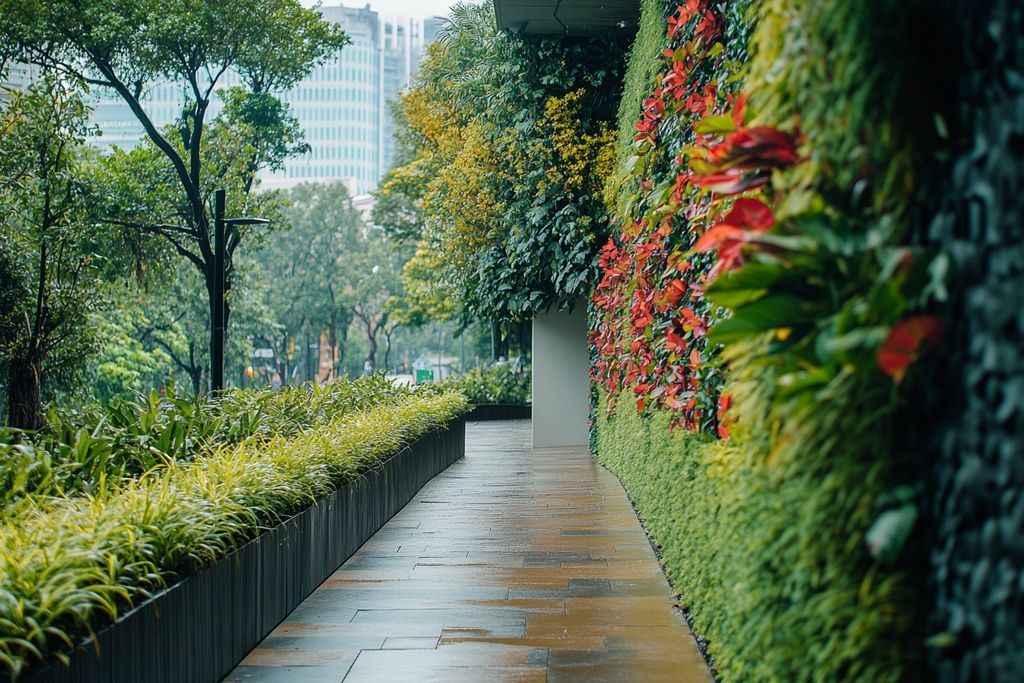
Having a nice green space is not only reserved for those who live in the suburbs or countryside. You can very well enjoy it even in the heart of the city. A city garden allows you to breathe fresh air daily and isolate yourself from a noisy atmosphere.
Despite its small size, it is entirely possible to arrange it to transform it into a true haven of peace. If you want to get more details on the subject, we suggest you discover this article.
📋 Key takeaways: Seven ideas for arranging a city garden turn a small space into an oasis. The key is to exploit vertical areas, textures, and plants suited to the urban climate. With careful planning, you can create a friendly space without compromising aesthetics.
How to arrange a city garden?
🌟 Les plus
• Quick maintenance compared to large suburban lawns
• High aesthetic impact and property value boost
• Creates an intimate sanctuary isolated from city noise
🔍 Réserves
• Limited soil volume requires frequent fertilizing
• Structural weight restrictions apply on rooftop balconies
During interior renovation, one wonders: how to check the state of plumbing? Otherwise, how to make a concrete access ramp? It must be admitted that this project proves to be a difficult task and requires a large budget.
As for improving a city garden, the operation is easy to accomplish, due to the variety of layout ideas. Here are 7 tips to easily but effectively structure your green space.
💬 Personal anecdote: On my urban balcony, I replaced the floor with a mix of composite wood and hanging plants. The result is warm and the maintenance remains simple, which helps me enjoy the space more without burdening myself with repetitive tasks. The lesson: favor compact and easy-to-maintain solutions for a lasting result.
Divide the space
When living in the city, space is often a problem. That is why our garden has a small size.
To give the impression of having a large bed, divide the surface by designing several areas, each with its own purpose. The choice of materials defines the style to adopt.
Choose wooden furniture for the rest area. This material gives a zen and natural spirit to the place. By the way, consider reading our tutorial on how to build garden furniture with pallets for 0 euro.
For the dining corner, it can be delimited by a paved floor. A pathway made of concrete slabs is also an excellent idea to distinguish the space.
Organize the plants beautifully
To enjoy a harmonious garden, it is important to know how to define planting areas. To do this, it is advisable to place the densest and tallest plants in the background. As for flower beds and low plants, they find their place in the foreground.
Do not hesitate to use various foliage such as textured, broad, cut, or fine leaves. Favor flowers that resist urban pollution.
Maximize the light
Lighting highlights your green space. Multifunctional, it not only decorates it but also helps you enjoy it in the evening.
It should be noted that a city garden differs by a lack of light. With the surrounding buildings, one rarely enjoys the sun even in the middle of summer.
To solve this situation, bring in as much brightness as possible. Thin out the trees and install spotlights under the plants. A luminous surface lights up the whole area.
Play with levels
Using a raised terrace is among the landscapers’ tips to make a garden appear larger. You install it on a platform and manage to compose different levels. Also, it is possible to place a jacuzzi or a raised mini-pool there. All these ideas help visually expand the space.
🧠 Do you know? Integrating dense foliage in a city garden can reduce surrounding ambient summer temperatures by up to 3°C due to natural evapotranspiration.
Use a shading device
Whether it is a gazebo or a pergola, these structures are a great help against prying eyes. Urban gardens are generally exposed to overlooking. To preserve privacy, nothing is better than using these protections. You can decorate them with climbing plants.
⚠️ Common mistake
Neglecting sunlight and available shade, which leads to poorly adapted plants and heavier maintenance.
Focus on colors
Colors are among the elements widely used by landscapers to bring depth. They particularly choose grayish, blue, or silver blooms and foliage. To brighten a dark area, they favor golden and variegated foliage. These combine very well with darker foliage creating a contrast effect.
Choose decorative objects carefully
More and more households use an outdoor rug beautifully dressing a garden lounge or a relaxation corner. This accessory is perfect for warming the garden atmosphere.
Besides that, mirrors help visually enlarge it. Their use is not limited to indoors. Many use them outdoors to make a green space appear immense.
How to make a landscaping plan?
To transform a city garden into a true paradise, start by creating a landscaping plan.
To achieve this, the first phase is to make an initial drawing of the site plan. You include constructions such as the shed, house, terrace, pool, or others.
Once done, create the circulation zones. If you plan to place paths, determine their location and purpose. For a sloping garden, retaining walls may be essential. They should also be noted on the plan.
The next step is to draw the plants. Start with the trees. Consider their mature size to respect the distance between them or from the wall. Then set up the perennial plants. Feel free to use colored pencils to observe their visual harmony.
💡 Practical tip
Favor durable materials adapted to the local climate, plan a small budget for maintenance, and optimize access to facilitate rotations and cleanings.
How to make a garden plan?
If you do not go through a landscaper, it is essential to make a plan of your future garden. This operation is divided into 3 phases.
First, make a basic plan. Sketch on paper the house, walls, terrace, fences, annex buildings, and other existing constructions.
Secondly, make a garden creation plan by working on a photocopy of the basic plan. All these elements must be shown. The same goes for new constructions such as paths, lawn, hedges, vegetable garden, flower beds, trees, orchard, and much more.
The last step is the development of the planting plan. It is preferable to make a plan for each garden element. Vary the heights, textures, and shapes of plants. Color the drawing to get an idea of the harmony.
How to make a free garden plan?
There are many garden design software easy to use. They allow you to draw your future green space freely and easily.
Moreover, even if some are paid, they generally offer a free trial to find inspiration.
Among the best known, Google SketchUp is the leading software attracting more and more individuals as well as professionals. This free software is very user-friendly. It allows you to create a garden of any size and style.
Otherwise, you can use Monjardin-ma Terrasse or Edificus Land. The latter is a professional landscaping software offering very practical topography options.
Urban Garden Potting Soil Calculator
Estimate the total liters of potting soil needed for your city garden containers.
Total potting mix required:
FAQ
<!– wp:rank-math/faq-block {"questions":[{"id":"faq-question-1664413345596","title":"Why create a garden in the city?","content":"This landscaping project is useful to fully enjoy the garden. With air pollution, it is practical to get some fresh air in a green space right in the city.","visible":true},{"id":"faq-question-1664413353851","title":"Who can create a garden in the city?","content":"With some gardening knowledge, you can very well do it yourself. However, if doubt arises or inspiration is lacking, it is better to call on a landscaper.”,”visible”:true},{“id”:”faq-question-1664413359243″,”title”:”How to create a garden in the city cheaply?”,”content”:”To limit expenses and find the best price, it is advisable to compare several quotes from professionals. You will then hire the provider that suits you best.”,”visible”:true}]} –>