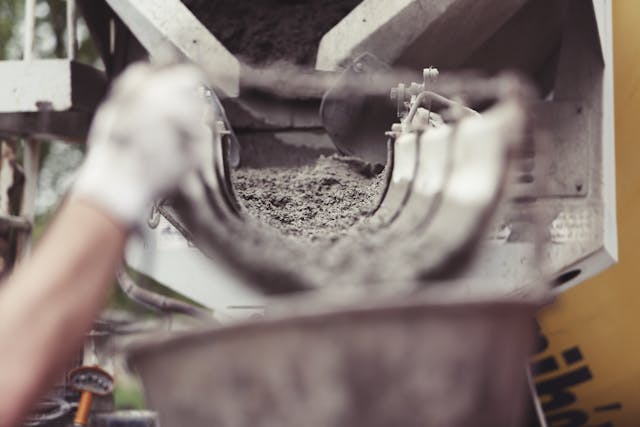
Concrete is a construction material with countless uses. It can be used for slabs, partitions, terraces, dikes, roads, posts, dams, beams, walls, pillars, and especially foundations. Compared to other materials, it demonstrates great strength, robustness, and ease of application.
To create quality concrete, it is important to master the cement-sand-gravel-water ratio. It should be noted that the calculation can sometimes seem complex. The balance between durability, workability, and strength represents a challenge requiring in-depth knowledge of both techniques and materials.
To avoid making common errors in cement dosage, sand volumes, gravel volumes, and water quantity, please consult this guide. We summarize practical advice for measuring the components of good concrete.

📋 The essentials at a glance: Personally, I consider the “1-2-3” rule (1 volume of cement, 2 of sand, 3 of gravel) as the indispensand base for versatile concrete dosed at 350 kg/m³. Precise dosing guarantees the structural strength of your slabs and foundations while preventing premature cracks. I recommend always measuring your components by bucket rather than by shovel to maintain a consistent mix throughout your batch.
How to calculate the concrete dosage for a 10 m² slab?
Whether it is the water volume cement dosage or the quantity of sand and gravel volumes, the proportions of each ingredient must be carefully studied. The concrete calculation varies from one project to another. If you plan to make a 10 m² slab, the concrete components will not be the same as those for a post or a foundation footing.
Whether you intend to use it for building a base or a terrace, the volume of the concrete slab is obtained by multiplying its surface area by its thickness. In the simplest cases, the surface area is calculated by multiplying the width by the length.
But the value can vary depending on the slab’s shape. Remember that there are square, trapezoidal, rectangular slabs, and more. In this situation, it is advisand to subdivide the slab shape into a series of rectangles to facilitate the calculation.
Regarding thickness, it can vary depending on the loads applied. In most cases, the thickness of a concrete slab ranges between 12 to 15 cm. When used for a pedestrian walkway or terrace, a thickness of 12 cm may suffice. However, you need a thickness of 25 cm for a drivable slab capable of supporting heavy vehicles.
It is therefore necessary to determine the use of your 10 m² slab to define its thickness. This allows you to calculate the volume of concrete. Note that the quantity of concrete is expressed in m³. For 1 m³ of concrete in common works, this includes 250 kg of cement, 1,200 kg of gravel, 800 kg of sand, and 125 l of water.
🗣️ My experience: In 2024, I poured a small garden shed slab in the middle of summer. Thinking to make spreading easier, I added too much water to the mixer to get a very fluid mix. Result: once dry, the concrete “powdered” on the surface and micro-cracks appeared. The lesson is clear: water is the most treacherous component of the dosage. For solid concrete, it must have the texture of a firm paste that does not flow off the trowel by itself.
What is the recommended concrete mix for an outdoor terrace?
| Type of work | Cement (kg) | Sand (L) | Gravel (L) | Water (L) |
|---|---|---|---|---|
| Blinding concrete | 250 kg | 500 L | 800 L | 125 L |
| Slab / Terrace | 350 kg | 400 L | 800 L | 175 L |
| Posts / Lintels | 400 kg | 400 L | 750 L | 200 L |
| Foundations | 350 kg | 450 L | 750 L | 175 L |
Just like mortar mixing, concrete mixing deserves careful consideration. If you plan to use it for building a terrace, you can choose between two different mixes, one with 300 kg per m3 and one with 350 kg per m3. Your choice affects the volume of water cement-sand-gravel mix to be used.

If you opt for the first mix, it is more suitable for a classic terrace which is relatively simple. It is thus unable to support heavy loads, but only a few chairs, a barbecue, and a table for sunbathing. To complete it, you need a cement mix of 300 kg, 820 kg of gravel water volume of 150 l and 880 kg of sand.
Regarding the 350 kg per m3 mix, it allows you to create a solid and resistant terrace capable of supporting a heavier load such as a steel or metal pergola, a cooking area, and even a veranda. To make it, you need to increase the gravel volume sand volume water volume as well as the cement mix. For this, gather 350 kg of cement, buckets of sand of 1100 kg, and 1125 kg of gravel water volume of 175 l.
Whether you choose the first or second mix, you can combine the concrete with welded wire mesh. This serves to reinforce the concrete’s resistance to compression and tension, making it stronger.
🌍 Did you know? Concrete does not really “dry” by evaporation, it “sets” by a chemical reaction called hydration. That’s why concrete can be poured underwater! In hot weather, fresh concrete must even be watered to prevent it from drying too quickly and cracking.
How does the concrete mix vary depending on the type of construction (walls, foundations, slabs)?
The concrete mix depends on the nature of the work. If you plan to build walls, the concrete calculation differs from that of the terrace slab and that of the foundations. Thus, the cement mix sand volumes gravel volumes water volume should not be standardized. It is essential to take into account the type of construction.
For those who want to build a cinder block wall, for example, they need a limited amount of cement mortar. This consists of one volume of cement to 3 volumes of sand and half a volume of water.
For most common works, concrete plays an essential role in ensuring the durability and strength of the structure. Thus, the concrete mix includes 1 volume of cement to 3 volumes of gravel, 2 volumes of sand, and half a volume of water.
Regarding the concrete mix for foundations, plan 1 volume of cement to 3.5 volumes of gravel, 2.5 volumes of sand, and of course half a volume of water.
In the most common cases, experts use concrete mixing at 350 kg per m3, as this corresponds to most masonry works. You can use it for columns, foundations, beams, driveable slabs, lintels, terraces, and many other reinforced concrete constructions. Some works, such as smoothed screeds, require very strong concrete. In this situation, it must be mixed at 400 kg per m3. For blinding concrete, it mainly applies to lean concrete with a lower cement dosage. You can thus choose the dosage of 250 kg per m3.
What tools are necessary to measure concrete dosage accurately?
More and more articles and guides explain the calculation of concrete dosage on the internet. Thanks to them, there is no need to be a building expert to determine the dosage-cement sand gravel volumes water volume. However, it must be said that no mistake is acceptable. Otherwise, the proportions of the concrete risk compromising the strength of the structure. It is therefore crucial to be precise in estimating the concrete volume to avoid making an error.
Several solutions can be distinguished that offer you exact, precise, and detailed results. The Dreux chart is one of them. It is a graph used to represent the results of tests carried out on samples.
To do this, simply modify each ingredient that makes up the concrete. For example, you can adjust the sand volumes, gravel volumes, the type of cement, or the water content. The test then provides you with the concrete mix precisely, considering its strength and fluidity. It is worth noting that the water quantity is very low to have fluid concrete. Water saturation reduces or limits the strength of the final material.
Apart from the Dreux chart, many online calculators help you define the concrete dosage accurately. These tools are generally simple to use. Yet, they demonstrate great efficiency, allowing you to measure the volumes of sand cement gravel water volume. Thanks to the results, you can purchase materials for your work exactly, avoiding any waste.
⚠️ Common mistake: Loading the mixer while it is stopped or pouring the cement first. This creates dry “clumps” at the bottom of the drum that will never mix. Always start the machine empty, pour some water and aggregates, then gradually add the cement for a fluid and homogeneous mix.
How does concrete dosage affect the strength and durability of the final material?
The concrete dosage should not be estimated lightly since it determines the quality, solidity, and durability of the structure. It is indeed essential to properly calculate the cement volume, sand volumes water volume, and aggregate dosage.
Recall that concrete consists of cement sand gravel water and, if necessary, additives. Its fluidity, strength, and durability depend on the proportions of its different ingredients. That is why the concrete dosage must adapt to the type of structure to be built.
Among its components, cement is one of the most essential elements. It helps guarantee the concrete’s resistance to tension, compression, and bending. When its dosage is high, the concrete’s strength is consequently significant. Many constructions require this to last over time. You can therefore increase the cement volume without overdoing it.
Similarly, gravel influences the structural properties of concrete. It also plays a role in the material’s strength. Two types of gravel can be distinguished, namely fine aggregates and coarse aggregates. While the former ensures the concrete’s tolerance to thermal cracking and shrinkage, the latter defines its compressive strength. In this sense, avoid neglecting sufficient gravel volume volume.
It therefore remains important to respect the dosage of each ingredient to ensure the quality of the final material. For example, if you add a lot of water, the concrete becomes porous and gradually loses its strength. Over time, excess water leads to the risk of cracks, which can seem dangerous especially for foundations.
💡 Practical tip: If you pour in cold weather (below 5°C), use an antifreeze admixture or warm water for your mix. The cold blocks the chemical setting reaction, which would make your concrete crumbly and without any mechanical strength once thawed.
Are there common mistakes to avoid when dosing concrete on a construction site?
Of course, several mistakes can be found during the mixing of concrete. The first applies to negligence in dosage calculation. Many do not realize they lack precision in determining the dosage-cement buckets sand volumes gravel volume water. However, this inattention causes imbalances in the making of concrete, which affects both its durability and its strength.
Another mistake people make is mixing in an inadequate manner. Yet, it must be both uniform and homogeneous. Do not hesitate to invest time in composing the concrete before pouring it. Likewise, consider using it within a suitable timeframe after preparation, otherwise it risks hardening. If this happens, you will have difficulty working it properly.
Except for the quality of cement sand gravel, the quality of water for concrete must be top-notch. Some people do not pay attention to it. However, the liquid can contain harmful substances such as acids, salts, oils, alkalis, and many other organic materials that alter the chemical reaction between cement and water. Consequently, this compromises the strength, durability, and robustness of the concrete. Make sure the water temperature is between 10 and 20 degrees Celsius. If the water is too cold, it undoubtedly slows down the setting of the cement. Conversely, water that is too hot accelerates the setting and limits the working time of the material.
What is the ideal concrete dosage for strong reinforced concrete?
Compared to other building materials such as wood or steel, reinforced concrete offers countless advantages. It has better durability against fire and corrosion. That’s not all; its tensile and compressive strength may seem unmatched. Flexible, this material can take multiple shapes offering you great architectural freedom.
It is also used in many applications such as buildings, foundations, civil engineering structures, and infrastructures. Whatever the use, reinforced concrete with a good dosage promises better longevity for the structure and unbeatable solidity.
The usual dosage of reinforced concrete includes 400 kg per m3. As an indication, 1 m3 of reinforced concrete consists of 400 kg of cement, 720 kg of sand, 975 kg of gravel, and 195 l of water. If you respect this dosage, it is suitable to reinforce the structures of your foundations, slabs, load-bearing walls, bridges, roads, and dams. Even better, it helps guarantee their stability.
🌟 Advantages (Concrete Mixer)
- Reduced cost for small volumes
- Control over pouring pace
- Accessibility (narrow areas)
🔍 Drawbacks (Truck Mixer)
- Expensive delivery flat rate
- Stress of rapid unloading
- Requires an available team
How to adapt concrete mix according to weather conditions?
To begin with, it should be emphasized that concrete is very sensitive to weather conditions. These affect both its strength and durability. It is therefore crucial to adapt the material mix to the conditions of the site where you pour the concrete. This relates both to the cement-sand ratio as well as the gravel volume water volume.
Rain is considered a scourge because it makes the concrete too liquid. This harms its strength and increases the risk of cracking. To address this issue, please reduce the mixing water content. Shelter the pouring with a waterproof cover to protect it from rain.
Outdoor temperature is also a major concern. If you expose concrete to freezing or very low temperatures, it can solidify gradually. To improve its strength, try to add more cement to the mix. And when it is hot, do not hesitate to increase the amount of water in the mix to prevent cracking of the material. Conversely, you can reduce the water volume.
Estimate the number of bags of 35 kg required pour your volume de concrete.
What are the current standards regarding concrete mix in construction?
To ensure user safety and the quality of the concrete structure, construction standards must be strictly followed. They cover all concrete construction work and come in the form of rules similar to urban planning standards.
There are many different standards. For those planning to carry out concrete works, they must, for example, follow the standards for design and sizing of the construction, as well as those for execution and implementation.
Similarly, the NF EN 13 670 standard brings together documents, plans, and drawings describing the execution specifications of the structure. For products and materials, they are defined by the NF EN 206/CN standard. These regulations concern the characteristics and requirements of the materials used in the concrete structure. Whether it is the nature of cement sand gravel water or their volumes, they must comply with the current rules ensuring the durability of the construction, as well as their quality.
Can additives be used to improve the concrete mix, and if so, which ones?
Besides water and cement sand gravel, it is quite possible to add additives to the concrete mix. They serve to improve or modify its properties. In most cases, they are in liquid form. You use only very small amounts during mixing. There are many types of additives, but silica dust is among the best-known products. It is notably used to strengthen the concrete’s resistance.
Apart from additives, more and more admixtures are available on the market. You can choose retarders for concrete, concrete setting accelerators, water repellents, air entrainers, anti-washout agents and more. Like the cement-sand-gravel-water volume ratio, their dosage must also be respected. They vary depending on the type of admixture or additive used. In all cases, please consider the manufacturer’s recommendations to avoid making a mistake.
FAQ: Successfully Mixing Your Concrete
How many buckets for a 35 kg bag of cement?
Can wet sand be used for the mix?
What is the drying time before walking on a slab?