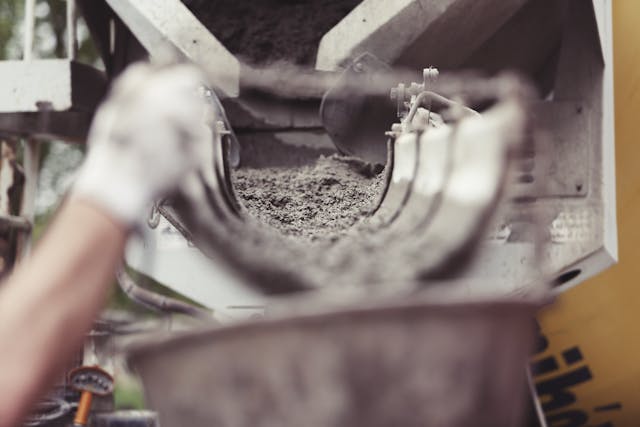
Concrete is one of the essential materials for civil engineering works. That’s not all, it is widely used in countless construction and renovation projects, including during the development of a garden path.
To save time in its production, nothing beats choosing ready-mix concrete (RMC). As its name suggests, it can be used directly on site. Like all concrete, it is made up of water, cement, sand, gravel, and admixtures that modify its characteristics.
To go further on the subject, it is appropriate to explain in the first paragraph the main advantages of ready-mix concrete (RMC).
📋 Key points: Personally, I consider ready-mix concrete the ultimate choice to ensure the durability of a structure, as its formulation at the plant guarantees a consistent strength of at least 25 MPa. It is a phenomenal time saver that allows pouring up to 8 m³ in just 30 minutes thanks to the concrete mixer truck. I recommend this solution as soon as your volume exceeds 2 m³ to avoid exhaustion with the concrete mixer.
What are the advantages of ready-mix concrete compared to on-site mixed concrete?
🍀 Advantages
- NF certified quality
- Speed of implementation
- Less physical fatigue
🔻 Limitations
- High delivery cost
- Strict time constraints
Taking into account the definition of ready-mix concrete (RMC), this type of concrete benefits from custom manufacturing to meet the client’s requirements. Unlike traditional concrete, its mixing is done in a plant before being delivered to the site.
As such, you can use it immediately. You do not need to wait, as this construction element is already delivered in a ready-to-use state. It thus offers you a considerable time saving and reduces the hardship of work on site. These types of ready-mix concrete (RMC) make pouring much faster and easier.
Moreover, the material produced at the plant is delivered directly to the site by means of a large vehicle called concrete dump trucks or concrete mixer trucks. Also called concrete mixer trucks, it handles the mixing of ingredients to produce concrete.
Thus, no one needs to collect the material. Its unloading is done via a concrete pump truck depending on the nature of the pour. All this greatly facilitates site organization. In addition, ready-mix applications require less equipment.
🗣️ My experience: In 2022, I wanted to pour a 15 m² garage slab alone with my small 160-liter concrete mixer. After 6 hours of effort, I realized that the first batches were starting to set before I had finished the last ones, creating unsightly cold joints. The lesson learned is clear: for 150 euros more, delivery by mixer truck would have given me a perfectly monolithic surface in a fraction of the time.
The mixing of cement, sand, gravel, and cement, water, admixtures in the truck prevents the risks of early hardening of the concrete or loss of its slump. Thus, it is no surprise that ready-mix concrete quality is top-notch.
Since the ready-mix types are composed according to the client’s requirements, the plant uses only the most precise measurements. Therefore, there is less waste of cement, sand, gravel and fewer expenses for the composition of the concrete.
🌍 Did you know? Concrete does not “dry,” it hardens through a chemical reaction called hydration. This process releases heat and continues for years, even though the contractual strength of 100% is officially reached after 28 days.
How is the quality of ready-mix concrete controlled during its production?
Before answering this question, it is important to remind you that there are different types of ready-mix BPE. Whether it is transit concrete, shrinkable concrete, or factory-mixed concrete, their common point is their professional quality.
Whether you use it to make a concrete access ramp, a park driveway, a pedestrian street, or other large-scale masonry work, ready-mix concretes deliver good results. However, it is always necessary to verify them after delivery of the concrete mixer trucks.
A visual inspection is required upon receipt of the material. This allows identification of any anomaly or appearance defect. Also try to analyze the measurement of air content. Along the same lines, assess the compliance of the consistency according to the required one.
The delivery note must likewise be complete. Many essential pieces of information must be included such as the name and contact details of the factory producing the ready-mix concretes BPE, the exact date and time of loading, the identification of the concrete mixer truck, the location of the site, the quantity of ready-mix concrete BPE in m3, the order number or references, and many others.
After the implementation or placement of the ready-mix concrete BPE, take the time to examine its strength by compressive testing of extracted samples.
If the material proves to be non-compliant with the client’s request and the applicable standards, it is possible to return it to the factory. You can also apply the terms provided in the contract with the producer.
What are the standards governing the manufacture of ready-mix concrete?
Just like cement dosing water aggregates, the different types of ready-mix BPE must comply with very specific manufacturing conditions. The composition of this material must conform to the standard NF EN 206+A2/CN.
Ready-mix concrete quality must guarantee that the manufacturing plant has already applied a quality assurance system. The constituents of its ready-mix concretes BPE are validated by tests and meet all standardized characteristics. Control and audits are carried out by a third party.
It is mandatory to control the constituent materials including admixtures and cement, sand, gravel. Likewise, the manufacturing equipment, properties, and ready-mix type BPE as well as the production process must be verified.
Pay close attention to the notifications of the CE marking. This requirement relates to the manufacturing plant of ready-mix concrete, the project manager, and the contractor.
According to the NF EN 206-1 decree, the structural work companies are directly responsible for the placement of ready-mix concrete during the execution of the work. These tasks must comply with the rules, namely NF DTU 13.3, NF DTU 21 and more.
If you follow them to the letter, it limits potential defects such as concrete cracking or premature degradation.
⚠️ Warning: Adding water to the mixer truck upon arrival at the site to make the concrete more fluid is a fatal mistake. This breaks the strength curve and radically increases the risk of cracking after drying. Instead, use a plasticizing admixture if necessary.
How is ready-mix concrete transported to the construction site?

The loading of this construction material can be done in two ways: either by using mixer trucks or by your own means. To ensure the safety of quality ready-mix concrete, the most effective solution is to prioritize the mixer truck. It is best suited for transporting the various types of ready-mix concrete BPE.
It is equipped with a rotating drum. Thanks to its unique design, it guarantees the maintenance of the ready-mix material homogeneity throughout the journey. Additionally, it prevents the risk of segregation.
| Delivery type | Recommended volume | Accessibility | Average extra cost |
|---|---|---|---|
| Standard mixer | > 3 m³ | Wide access | 0 € (Base) |
| Belt truck | 2 to 8 m³ | Obstacle < 12m | + 150 € |
| Pump truck | Any volume | Difficult access | + 400 € |
| Mix-pump | 3 to 5 m³ | Versatile | + 250 € |
Generally, concrete dump trucks have volumes ranging between 4 and 10 m3. Different types of trucks can be found, including the mixopump and the mixer truck equipped with a belt. The plant responsible for delivering the ready-mix BPE concrete makes its choice based on the site constraints.
If the material to be acquired does not reach the minimum volume, the client must take care of its transport from the concrete plant to the site. They only need to place their order with the plant and then come to the production site. After positioning their truck under the mixer, all that remains is to load the ready-mix concrete BPE.
If this solution interests you, it should be noted that your vehicle must be capable of supporting the ready-mix BPE material. Remember that 1m3 of concrete weighs up to 2400 kg. Attention must also be paid to the setting time, as the transport duration can accelerate or slow down the concrete setting.
What are the different strength classes of ready-mix concrete available on the market?
When studying the advantages of ready-mix concrete, its compressive strength is part of it. Four classes of ready-mix concrete can be defined according to the normal strength of the material reached at 28 days.
The category C16-20 concerns lean concrete. This type is generally used to level the ground. As for the C20-25 category, it is used for fences and other light foundations.
Regarding the classification C25-30, this refers to classic concrete which is practical for making traditional slabs or even foundations. The last type of resistance for ready-mix concrete is C30-37. This one stands out for its robustness and high resistance to heavy loads.
Even though the advantages of ready-mix are numerous, it remains important to understand their compressive strength.
Besides the resistance classes, there is also the slump class and the exposure class. The latter determines the approx.mental factors to which the material will be exposed during ready-mix applications, for example moisture, cold, or chemical attacks.
Thus, you must adapt the concrete production so that it can withstand these different conditions.
💡 Practical tip: Always plan a washing area for the truck chute. The driver will need to rinse their equipment before leaving. A simple hole in the ground or a recovery tarp will do to avoid soiling your land.
How does the cost of ready-mix concrete compare to that of traditionally mixed concrete on site?
Unlike concrete mixed on site, one can notice a number of ready-mix concrete advantages. This construction material is immediately usand after delivery at the production site. It is not surprising that it costs a bit more.
The ready-mix concrete price can vary according to multiple factors such as the type of ready-mix BPE, volume, handling, transport fees, and especially location. The ready-mix BPE price can be twice as much for the same material but in a different region. This increases the masonry work budget.
If you order a classic ready-mix concrete, plan a budget between €80 to €100 excluding delivery. The self-compacting concrete on the other hand costs
€40. And if you prefer waterproof concrete for your terrace, it is offered at €15. The fluid ready-mix type is the cheapest. It costs only €10.
Regarding transport fees, the mixer truck offers a trip between €100 to €200. If you choose a mixer truck with conveyor belt, a trip costs between €150 to €250. The price of a pump truck is higher, as it ranges between €250 up to €400.
What are the logistical challenges related to using ready-mix concrete for large construction projects?

Before proceeding with ready-mix concrete applications, it is important to know that it is a perishable material. During its transport or implementation, one can face countless challenges that must be overcome.
On a single order, it is possible that the manufacturing plant undergoes several last-minute changes, especially during transport.
When the delivery or loading of ready-mix concrete does not go as planned, it can increase transportation costs. In the worst case, this incident may alter the mix of cement, sand, gravel, and water. Thus, one should expect a modification of the quality ready-mix material.
Make sure that unforeseen events do not affect the cement-water-admixture ratio, the homogeneity of the concrete, the air content, and the slump. Note that the material can harden after two hours following the batching process. In that case, it becomes unusand, regardless of the ready-mix BPE price.
To avoid this, it is essential to anticipate any form of change. One must consider safety margins and plan for unexpected events. To ensure that delivery and ready-mix concrete applications are meticulously organized, try to plan for the unexpected using a digital solution.
With the advancement of technology, many efficient software programs ensure the logistics of mixer truck usage. Other tools are dedicated to managing possible complications during the pouring or placement of different types of ready-mix BPE.
Please prioritize those that offer multiple options and functionalities promising good planning and execution of the work.
Can the composition of ready-mix concrete be customized to meet specific construction needs?
Among the advantages of ready-mix BPE, the possibility of customization attracts many professionals as well as individuals. It is entirely feasible to adapt the composition of the material according to the expectations of each user.
To achieve this, it is enough to add specific products such as admixtures. They serve to modify the characteristics of ready-mix concrete. As such, it can be heavy, colored, delayed, fiber-reinforced, accelerated, lightweight, self-compacting, and more.
Regardless of the product used, it is important to ensure that the composition complies with the NF EN 206-1 standard. This decree specifies the different types of ready-mix concrete whose components are standardized. We distinguish concrete with specified properties, prescribed composition, and prescribed composition in a standard.
What is the average lifespan of ready-mix concrete once it is poured into structures?
Like all concrete, the type ready-mix BPE has a very long lifespan. This characteristic is explained by its high resistance. Thanks to its specific formula, it easily tolerates external aggressions such as pollution, corrosion, and weather conditions.
Just like concretes complying with the EN 206/CN standard, quality ready-mix concrete can last for 50 years or even 80 years.
Regarding its usage time, it must not exceed two hours. This period is between the moment of first contact between cement and water, i.e., the start of its composition, until the end of its implementation. It includes not only the manufacturing time but also the transport, unloading, and placement time on the construction site.
If this time is exceeded, there is a risk of loss of workability. The incident can cause the material to harden. The implementation of ready-mix concrete becomes more complex or even impossible.
Estimate the volume de concrete required pour your dalle.
How do weather conditions affect the transport and pouring of ready-mix concrete?
Weather conditions can impact both transportation and the pouring of the material. In any case, distribution companies continually offer better solutions for each problem.
To ensure the transport of ready-mix concrete from the plant to the construction site, the use of a concrete mixer truck is very common. This heavy vehicle is capable of maintaining its homogeneity throughout the journey. It is crucial that the delivery is quick, not exceeding 1 hour and 30 minutes at a temperature around 20 °C.
Whether in hot or cold weather, the workability of this type of ready-mix concrete (RMC) can decrease. To avoid this issue, it is necessary to incorporate plasticizers or set retarders into the material. The latter is especially helpful in very hot weather.
FAQ: Everything You Need to Know About Ready-Mix Concrete
How much time do we have to unload the concrete mixer truck?
What is the difference between concrete and mortar?
Can we order RMC for small volumes?