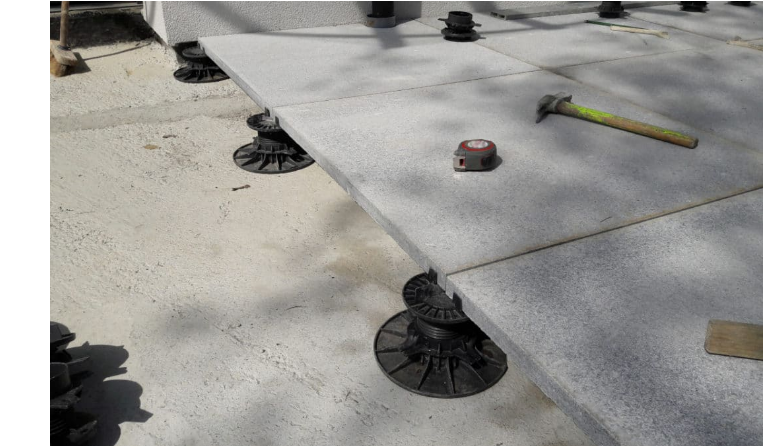

Despite the hectic pace of daily life, it is always necessary to spend good times with friends or family on the terrace. If you don’t have one, it’s high time to install one, if the budget is ready, of course.
Before you start, know that this project causes quite a bit of disorder in your outdoor space. Fortunately, there is a solution that facilitates earthworks. It is the installation of tiles on pedestals.
📋 📋 Key points: Personally, I consider that laying tiles on pedestals guarantees exceptional longevity for your terrace, reducing the risk of cracking by 90% compared to traditional glued installation. In my opinion, it is the smartest alternative for quick outdoor renovations. Its implementation requires no mortar, greatly facilitating the leveling work for DIYers.
Steps to lay tiles on pedestals
- Prepare the base: make sure the ground is stable, clean, and level (terrace, concrete slab, or compacted soil).
- Determine the placement of the pedestals: place them respecting the size of the tiles (generally at the 4 corners and in the middle for large tiles).
- Adjust the height of the pedestals: adjust to obtain a flat surface and a slight slope for water drainage (about 1 cm/m).
- Lay the first tile: check alignment with a spirit level.
- Continue laying: place the following tiles by slotting them onto the pedestals’ lugs to ensure regular spacing.
- Adjust if necessary: correct the height of the pedestals or the positioning of the tiles to maintain perfect alignment.
- Check the whole: make sure the final surface is flat and stable.
🎒 On site: During the renovation of my garden terrace last July, I chose self-leveling adjustable pedestals to compensate for a pronounced slope of my raw slab. I invested about 15 euros per square meter for these supports, which saved me valuable time when aligning the corners. The lesson learned is that you absolutely must check the level as you lay each tile to avoid cumulative offsets.
Principle and use of tile on pedestal
To better clarify the subject, it is appropriate to define what is meant by pedestal for tile. Simply put, it is an intermediate support with an adjustable height between 35 mm and 230 mm.
| Step | Objective | Materials used |
|---|---|---|
| Ground preparation | Have a stable base | Broom, level, possible geotextile |
| Placement of pedestals | Support the slabs | Adjustable PVC pedestals |
| Height adjustment | Obtain a flat and inclined surface | Bubble level, ruler |
| Slab installation | Create the terrace | Concrete, stone, ceramic slabs |
| Final adjustments | Ensure solidity and aesthetics | Adjustment keys, mallet |
🌍 Did you know? High-density polypropylene pedestals are designed to withstand extreme temperature variations ranging from -30 to +60 degrees Celsius, ensuring perfect stability of the covering in both winter and summer without risk of breakage.
This high-quality plastic support is installed between the ground and the paving. It not only serves to raise the slab but especially to stabilize it, simplifying the construction of the terrace.
The pedestal generally consists of a base or a footing, an adjustment nut, an adjustable head, fins, and a locknut.
It demonstrates remarkable robustness to withstand countless stresses such as temperature variations and load.
The principle of the slab on pedestal is ultra simple. It does not rest directly on the mortar layer. Instead, the slab rests on pedestals with adjustable height according to your requirements.
Installing a terrace slab on pedestals
| Type of support | Adjustment height | Maximum load | Ideal use |
|---|---|---|---|
| Fixed pedestal | 8 to 15 mm | 1000 kg | Low height, flat ground |
| Standard adjustable pedestal | 25 to 120 mm | 1200 kg | Classic terrace |
| Self-leveling pedestal | 40 to 260 mm | 1400 kg | Steeply sloped ground |
| XL self-leveling pedestal | 260 to 500 mm | 1500 kg | High elevation |
According to specialists, four pedestals are needed to support a slab, regardless of its shape, rectangular or square.
Before installation, these plastic supports must be pre-installed on the ground. Thanks to this technique, the covering of your terrace is not only waterproof and solid, but it will also last you many years.
In general, almost all traditional materials can be adapted to this pedestal installation method. However, it remains necessary to respect certain conditions such as selecting high-quality material.
Since the terrace is subjected to harsh conditions, the material must tolerate climatic variations. Although exposed to the elements, it must demonstrate great resistance.
Similarly, a material with consistent thickness is highly preferred. This allows for a surface without irregularities.
Stability problems are very common when working on an uneven surface. Moreover, this condition complicates the placement of the slab on pedestal. Nothing beats a solid and flat ground promising better results.
In any case, it is possible to carry out this installation on an old terrace, a concrete screed, or an indoor floor.
⚠️ Warning: Neglecting the peripheral stability of the terrace. Without installing a blocking edge, an edge clip, or a low wall on the border, the slabs located at the edges risk sliding outward under the weight of footsteps, causing the partial collapse of the structure.
How to install a terrace slab on pedestals?
With the intervention of a professional, this project seems relatively simple. However, it must be carried out with extreme care. For its success, it is preferable to have a slab that is sufficiently hard, such as concrete.
That said, the first step of the installation consists of defining the type of pedestal to install under the terrace slabs. Preferably, self-leveling pedestals with fins are among the specialist’s recommendations.
Plan for a slope between 1.5 to 2 cm per meter. If the surface already has one, you just have to follow it. Otherwise, you must make a screed on the slab. It is also possible to adjust the pedestals to create the slope.
Once this phase is finished, you need to proceed with the layout or diagram to help you define the structuring of the pedestals and slabs to be installed. Use a tape measure, a mason’s ruler, and marking chalk to draw a grid that facilitates their placement.
The next step is to prepare the pedestals. To do this, adjust each element by turning its head to obtain the correct height. Then secure the fin component located at the base of the support.
Now arrange all the pedestals on the ground. Remember to take into account the size of the slab at each location. Remove the fins now and lay the slabs starting from the top row.
Use a screwdriver to adjust the pedestals during the installation of the terrace covering. Use a spirit level to check the alignment and slope.
As for the finishing, do not hesitate to make some adjustments if necessary. A grinder equipped with a diamond blade can be useful for making cuts.
If the results do not satisfy you, you can correct the work by removing the slabs with a special lifting clamp. Likewise, the height of the pedestals can be adjusted according to your needs.

💡 Practical tip: Plan for a box of rubber shock-absorbing shims 1 or 2 millimeters thick. Placed on the head of the pedestal, this shim compensates for slight thickness variations of the slabs and completely eliminates clicking noises when walking.
Advantages and disadvantages of slabs on pedestals
🍀 Good sides
- Detachable structure allowing access to underlying pipes
- Instant water drainage through open joints
- Perfect compensation for original ground defects
🔻 Limits
- Initial purchase cost of 20 mm structural slabs
- Minimum threshold height of 4 or 5 cm required
If pedestal slabs are attracting more and more people, it is notably due to their proven robustness. They can support a load of up to one ton.
This type of flooring offers high resistance to seasonal weather conditions. Durable, it can be used long-term without deteriorating, even over many years.
That’s not all, it provides perfect waterproofing despite high humidity. With its finish using recyclable materials, it promises good impermeability. The pedestal terrace does not retain rainwater runoff. It shows no signs of moisture.
Thanks to the ventilated space between the ground and the slab, its installation promotes thermal dispersion of the sun’s rays. Once the flooring is installed, it generally requires no screws, no grouting, no glue, and no nails.
As for their drawbacks, it must be said that pedestal slabs do have limits. They must be installed on stable ground. Otherwise, it affects their durability and quality.
If you equip yourself with slabs or pedestals of poor quality, do not expect miraculous installation results. It remains essential to always have first-class components.
If you want to know how to install pedestal slabs, also discover the key steps to install tile on pedestals, compare possible materials with the interlocking paver guide, and get inspired by tips to build a garden shed.
FAQ – Pedestal Slabs
u003cstrongu003eIs a concrete slab needed under the pedestals?u003c/strongu003e
No, the pedestals can be placed directly on stabilized or compacted ground. However, a concrete slab ensures better durability.
u003cstrongu003eCan slabs be laid on pedestals without joints?u003c/strongu003e
Yes, because the spacing is ensured by the lugs of the pedestals. This also allows good water drainage.
u003cstrongu003eWhat weight can a slab on pedestals support?u003c/strongu003e
A properly installed system can support a significant load (up to several hundred kilos per m²), which is suitable for terraces and garden furniture.