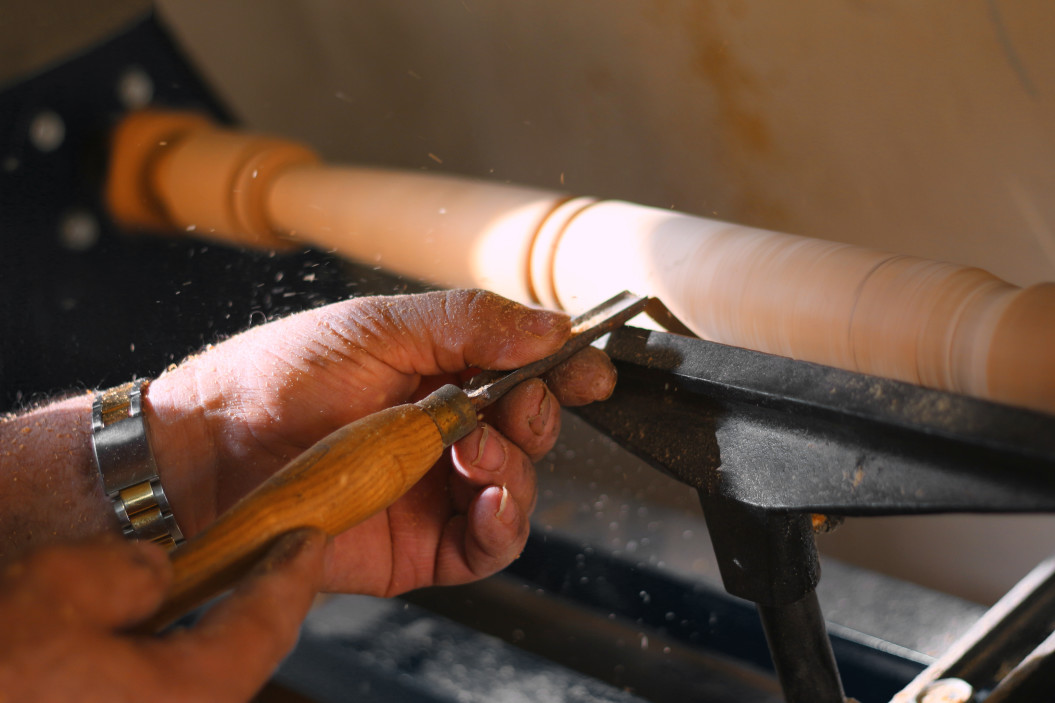
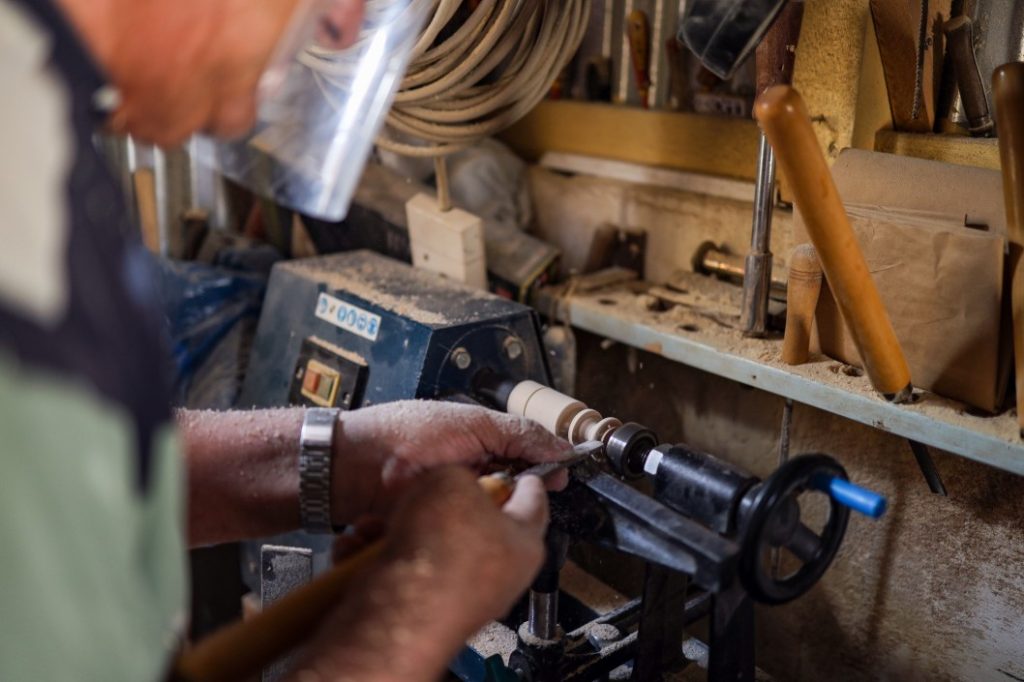
Woodturning is not only reserved for carpenters. This activity becomes a true passion for many individuals. It involves crafting wooden pieces or accessories with diverse structures.
To do this, the use of suitable equipment is essential. The wood lathe is specially designed for this operation. This device was once used by Egyptians and Romans.
Over time, it has continuously undergone technical progress. Today, the wood lathe is equipped with a powerful motor, a gearbox, digital controls, and multiple necessary accessories.
The machine benefits from new technologies that optimize its performance, making it more practical and faster. As a result, it significantly facilitates your tasks with each use.
📋 The essentials at a glance: Personally, I believe that making your own lathe can save up to 60% of the price of an entry-level model. My opinion is that the rigidity of the bed is the most critical element for safety. In 2026, using recovered motors such as those from washing machines remains the most cost-effective solution for beginners.
General presentation of the wood lathe
✅ Strengths
- Low manufacturing cost
- Customizable dimensions
- Ease of repair
🔻 Limitations
- Significant assembly time
- More frequent vibrations
Table of essential components
| Component | Main Role | Possible Alternatives |
|---|---|---|
| Electric motor | Provides rotational power | Recovered motor from an appliance |
| Chuck | Holds the wood piece | Suitable clamping grip |
| Tailstock | Stabilizes the other end of the wood | Homemade system with threaded rod |
| Solid frame | Supports the entire structure | Solid wood or recycled metal |
| Cutting tools | Shaping the wood | Wood chisels or DIY gouges |
To properly build your wood lathe, you need to plan for:
- a suitable motor,
- a stable base made of wood or metal,
- a solid fastening system to hold the pieces.
🗣️ My experience: During my first attempt in 2024, I used a 20-euro drill motor found at a flea market. I quickly realized that the lack of torque made turning oak pieces impossible. The lesson is clear: invest from the start in an asynchronous motor for smooth and safe work.
If you wish to use it, you first need to know the definition of a wood lathe. It refers to a mechanical device classified under parallel lathes.
As their name suggests, the wood lathe is used to create wooden objects. It is the best ally of carpenters and cabinetmakers who regularly work with this natural material.
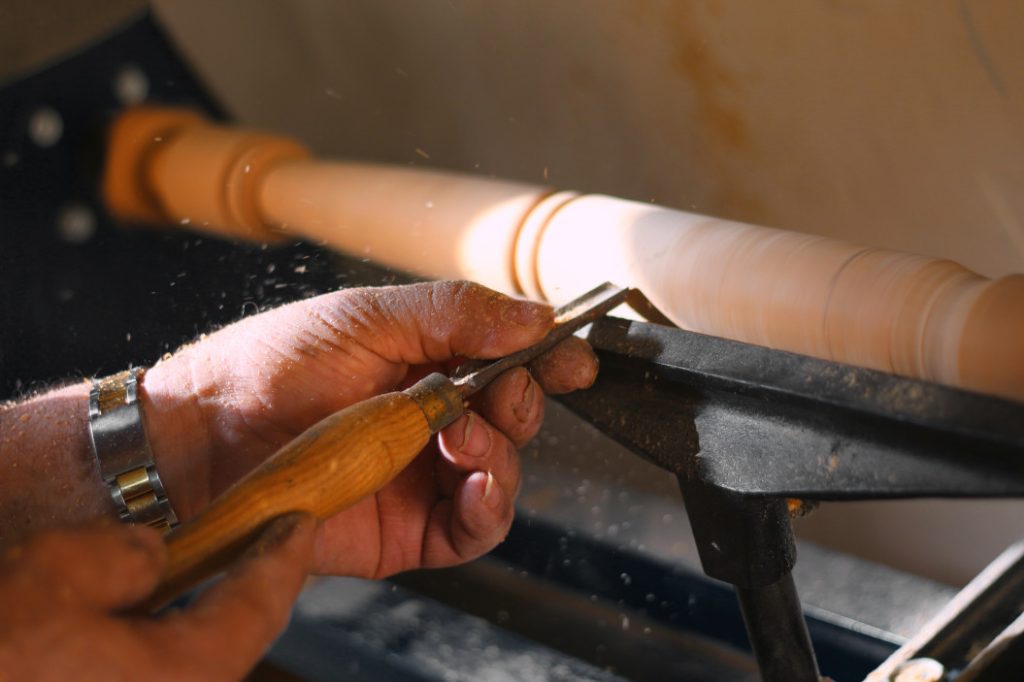
If you want to shape various forms, cylindrical, hollow or pointed, this machine tool is a great help. With its multiple integrated accessories, it allows you to develop your creativity and handyman skills by working with wood and its derivatives.
Easy to use, the tool is handled without difficulty. However, safety measures must be taken into consideration.
🌍 Did you know? The first wood lathes used a flexible pole on the ceiling as a spring. The turner operated a pedal, causing the piece to rotate alternately in one direction then the other.
Some precautions to remember
To protect yourself from chips projected outside the device, it is strongly recommended to wear safety glasses. Professionals accompany them with a face shield to enhance face protection.
With the noise in the workshop, using an appropriate headset helps you avoid potential hearing problems. A dust mask is similarly useful during sanding. If possible, wear waterproof boots to prevent injuries.
Once the safety devices are complete, now work in a well-lit area. Before starting the lathe, make sure the fittings are sturdy. Hold the device firmly with both hands against the tool holder. Secure the wood firmly between the centers or on the faceplate.
The different types of wood lathes
Two types of wood lathes can be distinguished: the workshop model and the bench model.
The first is more particularly intended for professionals due to its good stability and high precision. It is recognized by its large size and heavy weight.
With its length between centers up to 2 m, it helps you turn large wood pieces. The workshop wood lathe is sometimes equipped with an electronic or mechanical variable speed drive.
As for the second type, it is characterized by its small dimensions. It has a length between centers of 50 to 80 cm. To use it, you must install it on a workbench.
Other bench wood lathes are made of welded sheets. Due to its lightness, this model lacks stability. It is therefore not the right lathe for machining large diameter pieces.
Those made of cast iron seem more stable. Quality models feature an electronic variable speed drive. Most require moving the pulley belt to change speeds.
How the wood lathe works ?
To fully enjoy it, it is important to understand the mechanism of the wood lathe. It operates opposite to most devices.
While most often, power is supplied by the rotating equipment, the power of the wood lathe is generated by the rotating piece of wood.
The latter is firmly attached between the tailstock and the headstock. When driven by the motor, it spins on itself. The device then sculpts it using its gouges and other accessories.
It is equipped with multiple components, with its electric motor as the central element. It ensures the movement of the material via a belt. Depending on the models, its power ranges from 350 W to 2250 W.
The headstock is fixed to the bed. It holds the motor, the spindle equipped with a point or a chuck, the pulleys, and the shaft.
As for the tailstock or counterpoint, it can move along the length of the bed, unlike the headstock. It can adapt to the size of the wood to be shaped. It can be fitted with many different tips.
The bed is the part on which the tailstock slides. It has two parallel rails separated by a groove. Its length determines the size of the piece to be machined.
Now that you are informed about all the components of the wood lathe, you can start making it yourself. Check out the tips for building the device.
Steps to make a wood lathe yourself
If you plan to buy one, prepare a budget between 150 and 500 euros. If you want a professional model, the price rises above 1000 euros.
To save money, nothing beats making it yourself. With basic DIY knowledge, you can create your own wood lathe. To succeed, you first need to equip yourself well.
⚠️ Common misconception: Thinking that a light structure is enough because wood is not hard. In reality, a structure that is too light vibrates at high speed, which makes turning imprecise and can cause the piece to be ejected.
Necessary equipment
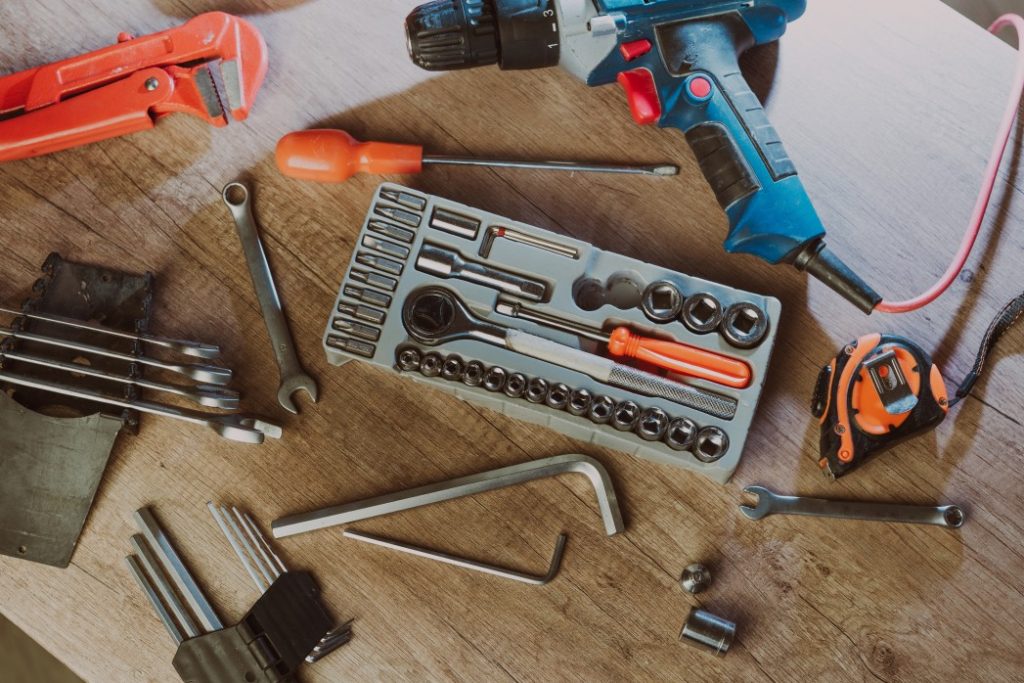
The first item to gather relates to the motor, preferably 24V and with 8000 rpm. As required tools, equip yourself with a hole saw and drill.
A hammer and screwdrivers are also essential. Likewise, you will probably need wood glue, carpenter’s clamps, large screws with nuts, nails, and wood screws.
As for materials, get many pieces of wood in various sizes. The composition of a wood lathe also requires clamping rings and a thin iron plate used to hold the motor in place.
The foundation
The first step concerns the assembly of the motor. Start by cutting the iron plate. Adjust it until it fits its shape.
Its size must be adapted to that of the motor. Allow an additional width of 2 cm to facilitate attachment at the motor base. That said, fix the motor with wood screws.
Now let’s move on to the rails, proceed to glue one of the two wooden bars with wood glue. Then, fix it on the bench with nails.
Once this step is done, glue and nail the other bar in a parallel manner. Make sure that the sliding wooden rectangle between the bars fits without obstruction.
The tailstock
As for the tailstock, place the first wooden rectangle then the second. You should have a tracing in the form of a circle at the height of the motor shaft.
To obtain the bearing circumference, draw another circle on the second rectangle. Then drill a hole using a hole saw to insert the bearing. That said, now slide the latter onto a screw and use a nut to lock it.
Glue and screw the two rectangles. Use two wooden cylinders for the tailstock. First cut the first cylinder. Drill it in the center and fix it with nails.
Cut the second and then drill. Use both and now install your tailstock. It is now functional and can slide on the bench.
Tips for choosing the wood lathe
If you are not skilled in DIY and doubt your ability to make your own lathe, consider purchasing one.
Know that there is a wide range of models available on the market. To help you find the ideal example, discover some useful tips:
The first point to examine before making a purchase decision applies to the power of the device. This criterion depends greatly on the type and hardness of the material to be processed. The more solid the wood appears to you, the higher the wattage value.
Also consider analyzing the rotation speed of the lathe. It must correspond to the level of precision sought and the diameter of the wood. You can find wood lathes on the market with speeds from 300 rpm up to 4,000 rpm for the most powerful models.
As for the motorization, you have the choice between single-phase asynchronous and three-phase asynchronous. For a small budget, favor the first. But if you care about durability and reliability, the second is a good option.
The weight of the wood lathe is also among the selection criteria to consider. Buyers often tend to prefer lightweight tools. However, these present a stability problem and lack precision.
On the other hand, heavy models combine solidity and better longevity. Despite their bulk, they are pleasant to use. Even if you opt for maximum speed, the machine does not vibrate.
In any case, using a wood lathe provides you with many advantages. It allows you to shape a range of wooden objects. To stimulate your creativity, equip yourself with a good lathe.
💡 Tip: To check your alignment, bring the tips of the fixed and movable centers together. If the gap exceeds 1 mm, your pieces will systematically be conical instead of cylindrical.
A project like creating a wood lathe fits perfectly into a DIY environment. To complement your interior arrangements, you can also design a headboard with storage, or learn how to make a door to give character to your spaces. If you like to repurpose materials, also get inspired by solutions to obtain free wooden pallets and start other creative projects.
FAQ
What type of motor should be used for a homemade wood lathe?
An electric motor between 300 and 500W is perfectly suitable for small amateur turning jobs.
How to ensure safety during use?
Always wear safety glasses, securely fasten the piece, and avoid loose clothing that could get caught.
Can a wood lathe be made without welding?
Yes, it is possible to assemble a wooden frame reinforced with metal brackets and adapt a mechanical system without welding.