Have you ever thought about connecting your ventilation system (VMC) to the bathroom or toilet light switch? It’s an idea that often comes up among DIY enthusiasts. Synchronizing the ventilation with the lighting may seem simple, but there are rules to follow, especially regarding the wiring diagram or electrical standard compliance (NF C 15-100). Between my Sunday tinkering and some memorable failures, I realized that a well-designed electrical connection changes everything, especially for electrical safety. Come on, grab the screwdriver, I’ll explain everything straightforwardly.
📋 The essentials at a glance: Personally, I believe that coupling your ventilation system to the lighting can halve the number of times the ventilation is forgotten in humid rooms. It’s an excellent economical solution to regulate bathroom humidity without installing an expensive sensor. You just need to make sure to comply with the NF C 15-100 standard when connecting to the lighting circuit.
Why connect a VMC to a light switch?
🍀 Pros
• Simple and economical automation.
• Reduction of electricity bills.
• Ideal for small bathrooms.
🔻 Cons
• Complex wiring if the neutral wire is missing.
• Risk of under-ventilation in winter.
• Motor noise related to switching on.
First, let’s ask the question of usefulness. A permanent VMC sometimes makes too much noise at night or runs when nobody is there. So, one might think it could run only when the light is on, to have more control over the activation of the ventilation.
🎒 On the ground: During the renovation of a studio last December, I installed this direct coupling for a material cost under 15 euros. The previous tenant left the ventilation running all day long simply out of forgetfulness. The lesson I draw is that a timer remains essential so that the ventilation continues to extract humid air at least 10 minutes after the light is turned off.
Pairing the VMC with the lighting circuit seems practical, but it requires understanding the different types of VMC and their reaction if they are regularly switched off. Before rushing in headfirst, it’s better to take stock of what you really have at home.
To go deeper, understanding how an electrical panel fuse works provides useful clues to secure your installation. And to go further in diagnosis, analyzing a noisy VMC offers interesting insight.
Differences between single-flow and double-flow VMC
In most homes, the single-flow VMC is the standard. It often offers one or two speeds (VMC speed 1 or 2 speeds), ideal for adjusting suction depending on presence in the room. The double-flow VMC, on the other hand, recovers heat from the extracted air and cannot be simply switched off via the lighting.
If you want to connect a VMC to a light switch, start by checking your model. Depending on the technology, the wiring diagram can be very different. An electrician friend told me he had to redo everything when switching from single to double flow… Keep in mind that each system has its own requirements!
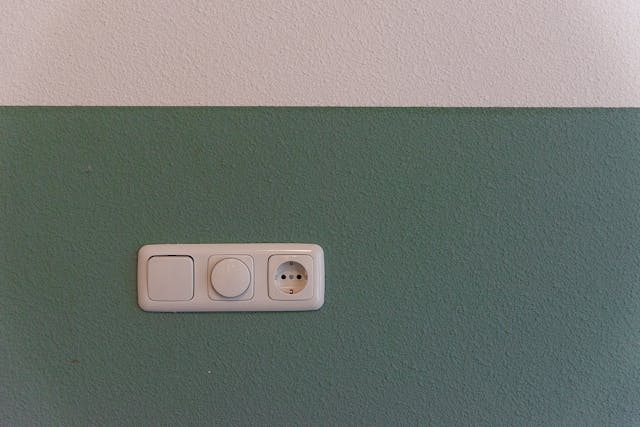
🌍 Did you know? A 10-minute shower produces about 1500 grams of water vapor into the atmosphere. Without immediate and prolonged extraction, this volume of water seeps into the partitions and promotes the appearance of mold in less than 48 hours.
Impacts on indoor air quality
Turning off your VMC too often can cause humidity buildup and promote mold growth. Manufacturers generally recommend continuous extraction to preserve the health of the home, avoid condensation after the shower, and ensure good indoor air quality.
By connecting your VMC to the light switch, you opt for occasional activation, thus intermittent air circulation. Weigh the pros and cons carefully, because from both a health and energy standpoint, every choice has its share of consequences.
💡 Practical tip: If you choose a timed model, set the potentiometer to 15 minutes. This is the ideal timing observed to completely renew the air in a 6-square-meter wet room after a shower.
What the electrical standard compliance (NF C 15-100) says ?
On the electrical connection side, it is impossible to ignore French legislation. The famous NF C 15-100 standard governs all domestic installations, including the VMC. It imposes strict rules to guarantee electrical safety and network reliability.
For example, this standard requires that a VMC can be disconnected without cutting the room’s lighting. It is therefore forbidden to connect the VMC and the light directly on the same circuit, under penalty of making the installation non-compliant.
- Provide a dedicated control device for ventilation (timer, dimmer…)
- Separate the VMC and lighting circuits at the electrical panel
- Install an appropriate protection (differential circuit breaker) for each line
Follow these requirements to ensure the electrical safety of your home. A compliance check after work happens more often than you think, so it’s best to anticipate!
⚠️ Common mistake: Connecting the device directly to the switch return without checking for the presence of the neutral wire in the flush-mounted box. Many simple switches only cut the phase. It is impossible to operate the motor without bringing a blue neutral wire from the junction box.
Wiring diagram to connect VMC to light switch
For those who like to visualize before acting, a good wiring diagram is worth all the speeches. Several solutions exist to control the VMC from the light switch, as long as the circuits remain independent at the electrical panel.
The most common method is to use a impulse relay or a time delay relay. The principle: as soon as the light is turned on, the VMC starts, then continues to run for a few minutes after turning off – ideal for finishing evacuating steam and odors.
Using a time delay relay
On my last project, I installed a time delay relay: the light switch activates both the lamp and the relay, which keeps the VMC running for 5 to 15 minutes after turning off. This setup prevents forgetting the VMC and respects the circuit decoupling required by the NF C 15-100 standard.
The advantage? Everything becomes automatic: you no longer have to think about ventilation, even during quick family visits to the bathroom…
Connection with separate circuit breakers
Always remember to isolate your lines! To connect the VMC while keeping an independent power supply from the lighting circuit, run two separate feeds from the panel: one for the VMC, one for the light. This way, you can work on one without affecting the other and stay compliant with electrical safety.
This approach requires a few extra meters of cable but really facilitates troubleshooting in case of failure or when equipment needs urgent replacement.
| Wiring type | Cable section | Fuse protection | Timing |
|---|---|---|---|
| Direct on switch | 1.5 mm² | 10 A or 16 A | Not available |
| With double switch | 1.5 mm² | 10 A | Manual |
| Timed on lighting | 1.5 mm² | 10 A | 2 to 30 minutes |
Practical advice and precautions to take
Before any work on the lighting circuit or ventilation, always check that the main power supply is turned off. Use a tester to confirm the absence of voltage on the wires, even after tripping the circuit breaker.
From experience, handling wet conductors near an air vent exposes you to the risk of electric shock. Wear insulating gloves and do not hesitate to ask a qualified electrician for advice if some points seem unclear.
Adapting to VMC speed and real needs
Many VMC models offer multiple speeds (low or high extraction). Take this option into account when wiring, to adjust the extraction power according to the room’s use. Some double switches even allow managing the light and the VMC speed separately.
A useful tip: install a small indicator light near the switch, to know if the VMC is still running after the lamp is turned off, especially with a time delay relay.
Maintain and regularly check the installation
A reliable electrical connection requires a minimum of maintenance. Regularly check that connections are tight and that no cable has blackened or melted, a sign of overheating. If the VMC loses efficiency, clean the ducts and replace the filters: many failures are due to neglected maintenance.
Don’t forget to take a look at the junction box and the electrical panel associated with the lighting circuit. These are often the weak links in an aging installation, and some regular checks can prevent many problems.
Answers to your questions about connecting ventilation
Is it legal to connect ventilation to the lighting circuit?
Yes, the NF C 15-100 standard allows the connection of an air extractor or ventilation to the room’s lighting circuit, provided that the total power does not exceed the breaker’s rating.
What happens if I turn off the light immediately?
If you do not use a timer module, the device will stop at the same time as the light. The humidity accumulated during the shower will not be completely evacuated.
Which circuit breaker protects this electrical setup?
Since the circuit is shared, the 10-amp breaker dedicated to the zone’s lighting ensures the protection of the entire installation.