
With the advancement of technology, manufacturers offer a large number of radiators on the market. The inertia model is among the most popular, due to its multiple advantages.
There are 2 types of electric inertia radiators. You can choose between the dry inertia product and the fluid inertia one. To learn more, this article explains their main difference.
But before addressing the main topic, it is appropriate to provide you with the definition of this heating system.
🗣️ My experience: Last October, I installed a fluid radiator costing 180 euros in my son’s room to replace an old energy-consuming convector. The air quality greatly improved and the heat became homogeneous without drying out the atmosphere during winter nights. The lesson I draw from this is that it is better to prioritize the fluid’s responsiveness in night spaces for optimal respiratory comfort.
Definition of an inertia radiator
If electric radiators have long been criticized for their lack of efficiency and high consumption, they now benefit from real technical and technological progress. Inertia radiators, also called soft heat radiators, now offer high thermal performance and optimal comfort.
Their principle is simple: heat is stored in a solid or liquid heating core, then gradually diffused into the room by radiation and convection. Unlike classic convectors, an inertia radiator ensures a homogeneous and pleasant heat that is maintained even after the device is turned off.
This technology also helps limit the electric consumption of an inertia radiator, making it an economical heating solution for the home. Depending on your needs, a dry or fluid inertia comparison will help you choose the model best suited to your living spaces, budget, and heating habits.

Advantages of an inertia radiator
✅ Strengths
- Very long thermal restitution after shutdown
- No maintenance or risk of liquid leakage
- Ideal for maintaining a stable temperature
🔻 Limitations
- Slower temperature rise at startup
- Very heavy weight of cast iron or stone blocks
- Higher purchase price than fluid models
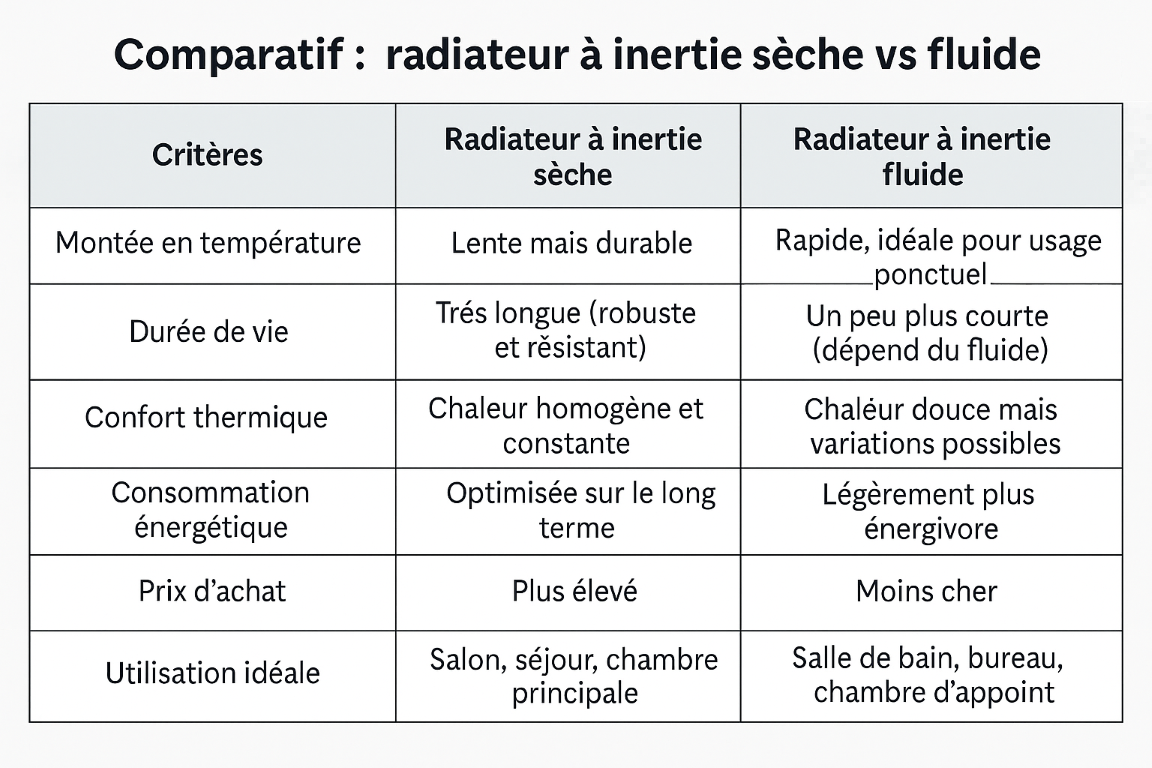
| Criteria | Dry inertia radiator | Fluid inertia radiator |
|---|---|---|
| Heating time | Slow but lasting | Fast, ideal for occasional use |
| Lifespan | Very long (robust and durable) | Slightly shorter (depends on the fluid) |
| Thermal comfort | Homogeneous and constant heat | Gentle heat but possible variations |
| Energy consumption | Optimized in the long term | Slightly more energy-consuming |
| Purchase price | Higher | Cheaper |
| Ideal use | Living room, lounge, master bedroom | Bathroom, office, guest bedroom |
💡 Practical advice: To achieve ideal thermal comfort, count on a base power of 100 watts per square meter for a standard ceiling height of 2.5 meters in a normally insulated home. Increase this value by 15% for rooms exposed to the north.

If you are looking for thermal comfort, bet on the electric inertia radiator. Whatever the model, it ensures the well-being of the occupants. It diffuses a gentle and homogeneous heat.
Between two heating cycles, temperature variations are relatively slow. This intensifies the feeling of comfort in the home.
⚠️ Common mistake: Installing a fluid-filled radiator in a living room with a high ceiling or poor thermal insulation. The fluid cools down too quickly as soon as the thermostat turns off, which forces the resistance to restart constantly and increases your electricity bill.
Aside from that, this type of radiator distributes heat by radiation. Compared to heat transfer by convection, this technology seems very pleasant.
It does not heat the ambient air, but rather objects, people, and walls. As a result, the device guarantees much better thermal comfort.
Many appreciate it for its balanced energy consumption. With the integrated smart programmer, the inertia radiator controls the accumulated heat optimizing its efficiency. It thus avoids any unnecessary operation once the temperature comfort is reached.
🌍 Did you know? A dry inertia radiator equipped with a natural stone heating core such as steatite continues to diffuse gentle heat in your room for nearly 45 minutes after it is completely turned off, without consuming a single watt of electricity during this phase.
Practical cases to insert
- A 1500W dry inertia radiator is perfect for heating a living room of 20 to 25 m² in a constant and economical way.
- A 1000W fluid inertia model is better suited for a bathroom used in the morning or a guest bedroom rarely occupied.
Difference between a dry inertia radiator and a fluid inertia radiator
These inertia radiator models share many identical advantages. Beyond their thermal performance, their thermal comfort is guaranteed.
Their mode of operation seems slightly different. Their goal is the same: to heat the house evenly while significantly reducing heat loss.
As for their difference, it is clearly visible in their heating core. While one appears dry, the other is fluid.
The dry inertia radiator has excellent inertia. It is capable of accumulating more calories. That’s not all; it combines durability, robustness, and resistance. This is why it has a longer lifespan compared to the fluid inertia radiator.
On the other hand, the latter is praised for its faster heating up. It is very practical in a bathroom where quick and occasional supplementary heating is desired.
Regarding price, this radiator requires a lighter investment compared to its counterpart. It suits buyers with a limited budget.
Handy, the device is not only lightweight but also compact. It is no surprise that it is intended for small-sized rooms and mobile needs.
To make the right choice, it is advisand to clearly define your objective. If you plan to heat living rooms, a dry inertia radiator will suit you perfectly.
Conversely, a fluid inertia model is perfect for a guest room, bathroom, or office. It can replace a supplementary heating device.
Finally, check if the programming and regulation options meet your expectations. They help you limit your energy consumption. Do not overlook the power, as this criterion guarantees the desired heating performance.
FAQ
Quelle puissance choisir pour un radiateur à inertie based on the taille de la pièce ?
On recommande approx. u003cstrongu003e100W per m²u003c/strongu003e. Par exemple, une chambre de 12 m² nécessitera un radiateur de 1200W.
u003cstrongu003eUn radiateur à inertie sèche ou fluide consomme-t-il moins qu’un convecteur ?u003c/strongu003e
Oui. Grâce à l’accumulation de chaleur et la diffusion douce, il consomme jusqu’à u003cstrongu003e30 % d’électricité en moinsu003c/strongu003e qu’un convecteur classique.
u003cstrongu003eQuel radiateur à inertie est le plus écologique ?u003c/strongu003e
Le radiateur à inertie sèche, plus durable et économe sur le long terme, est considéré comme le plus respectueux de l’approx.nement.