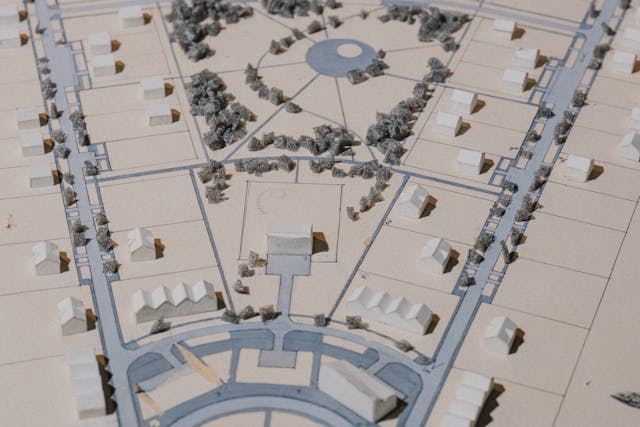
From July 2012, the as-built plan became a requirement according to the Urban Planning Code. It allows the detection and georeferencing of networks for all completed works. Additionally, it is the essential file for verifying the works carried out on a site.
That’s not all, the as-built plan document facilitates future work. It provides a detailed and clear representation of what has been built, mentioning any adaptations or modifications throughout the construction site.
To renovate a facade, expand the home, install a swimming pool, or convert your house into a BBC, it makes tasks much easier. If you want to get more information about this file, you have come to the right place. We invite you to read this article.
📋 What to remember: Personally, I consider the as-built plan to be the life insurance of your site because it guarantees network location accuracy within less than 10 cm. It is a mandatory document at the end of the project that prevents costly damages during future works. I recommend systematically requiring it to validate the compliance of your underground installations.
What is an as-built plan and why is it essential?
✅ Advantages
- Worksite safety
- Added value at resale
- Legal compliance DAACT
🔍 Drawbacks
- Expert intervention cost
- Final completion delay
You have probably already heard about it, but you do not know exactly what the as-built plan document means. As its name suggests, it is a plan that represents a detailed description of the completed works. It is prepared once the construction or rehabilitation works are finished.
The as-built plan realization plays a crucial role as it allows evaluating all objects classified in an inventory. It is therefore very useful for controlling the compliance of completed works with the specifications or contractual commitments.
It is no surprise that it is among the executed works file. This file is part of the documents presented to the client at the end of the works. The construction as-built plan certifies the site’s compliance with current standards.
Even better, it serves to indicate the actual state and location of each structure. It should be noted that these positions may differ from the sites planned before the project. As soon as the plan’s development faces site constraints, the location of the structures may change during the works.
🗣️ My experience: On a 2022 site, a client had lost their as-built plan during the installation of a swimming pool. Due to lack of precise data, the excavator cut a gas pipe that had been installed two years earlier. The lesson is simple: always keep a digital and physical copy of this plan, because an emergency intervention costs three times the price of the original document.
This as-built plan file is also necessary to simplify the execution of the upcoming construction site. In case the owner is considering a renovation or extension idea, it provides a solid and reliable base, avoiding the risk of errors during project planning.
For the maintenance of installations, this file serves as a reference tool helping the team of technicians to identify the location of underground networks, for example.
This is the case when planning to make a plumbing connection. One can very well consult the completed works as-built plan document. The latter also ensures the plumber’s safety during their intervention, limiting potential accident risks. Discover this section detailing the different precision classes of networks:
| Precision class | Maximum uncertainty | Type of network | Requirement |
|---|---|---|---|
| Class A | Less than 40 cm | Sensitive networks | Mandatory |
| Class B | Between 40 cm and 1.5 m | Non-sensitive networks | Recommended |
| Class C | Greater than 1.5 m | Old installations | To be updated |
| Geo As-built | Less than 10 cm | New connections | Current standard |
How to create an accurate as-built plan?

The as-built plan document is essential in the field of urban planning as well as construction. It attests to the professionalism and seriousness of the company responsible for the works. Moreover, it is the ideal tool to assess the compliance of completed works and to manage the future construction site.
Due to its importance, the creation of the as-built plan requires technical skills and great rigor. Regular and precise monitoring of the site is necessary. It is imperative to record scrupulously and accurately all the works carried out down to the smallest details.
During its development, the starting point is the initial project plan. You only need to compare it with the completed works. Please document any inconsistencies, modifications, and divergences throughout the works.
Remember to take into account every element of the site, namely the construction itself as well as all exterior fittings, network detection and georeferencing, and the adaptations made.
🌍 Did you know? Since the 2012 anti-damage reform, 100% of new sensitive networks must be mapped in Class A. This has helped reduce the number of accidents during excavations in France by more than 30%.
As a general rule, the creation of the as-built plan after works are completed is entrusted to a civil engineering or building professional. Besides their technical skills, the expert often uses specific software. This tool facilitates the graphical representation of the as-built works plan which must be both clear and precise.
What elements should appear on an as-built plan?
Regarding the structural work, the as-built plan document includes all the details of the completed works, including the foundation. It must be included among the as-built plan works since it is an essential element of a construction. It should be noted that it guarantees the strength and durability of the housing.
Similarly, the formwork will have its place in the construction works as-built plan. This temporary enclosure helps to hold the materials in place. It consists of numerous wooden boards. As for the reinforcement, it should not be forgotten in the completed works as-built plan, just like the framework. It helps ensure the consolidation of the structures.
💡 Practical tip: Keep your as-built plan in DWG format (source file) and PDF. The DWG format will allow a future architect or craftsman to integrate your networks directly into their design software without having to redo measurements.
Apart from the structural work, the content of the as-built works plan can vary depending on the nature of the project. In any case, certain elements such as the location of buried networks and the position of all structures must appear on the as-built plan.
Also, please include the dimensions and materials used. Data on electrical installations may seem essential, including wiring, valves, conduits, pipes, and more.
When the team makes changes during the site work, don’t forget to add them among the completed works as-built plan. The same applies to comments or notes that help clarify any additional information.
What is the difference between an as-built plan and an execution plan?
Unlike the execution plan, an as-built works plan only describes the works actually completed at the end of a project. It is developed based on an execution plan. Its difference lies in the fact that it includes all modifications made throughout the construction phase.
The execution plan, for its part, gathers all the plans necessary for carrying out the works. It thus consists of the foundation plan, section plan, level plan, cross-section and longitudinal profile, VRD plan, earthworks plan, sanitation plan, network plan, and of course the as-built plan document. This file is an essential tool in the realization of the works.
On the other hand, the construction as-built plan is a reference document simplifying future works as well as maintenance operations. It ensures both the verification of compliance of completed works with standard practices. Being part of the executed works file, this document allows the detection of networks by georeferencing and the location of buried networks.
⚠️ Common misconception: Thinking that the execution plan is sufficient for the as-built survey. The execution plan is what is planned to be done, whereas the as-built survey is what has actually been installed. It is not uncommon for a pipe to be shifted by 50 cm to bypass an unexpected rocky obstacle.
How to use an as-built plan in project management?

Professionals in dry networks, topography, and road sciences often embark on the creation of as-built plan documents to better assess the compliance of completed works with the initial plans.
Obviously, its preparation takes place at the end of the work. The objective is to define the actual location of the completed works. This precise description of the structures facilitates their traceability. Indeed, its usefulness is found not in the prior management of the project, but especially in its final execution.
It is important to emphasize that the list of completed works as-built plan is generally requested by the project manager or the client. It is a better tool to verify that each structure has been carried out in accordance with current standards and project requirements.
At some point, the competent authorities may require it during installation inspections. If the owner plans a house extension project, the as-built plan document is a valuable aid indicating all the strategic locations of the dwelling.
Which software is recommended for creating an as-built plan?
With technological advances, many construction software can guide you in the creation of as-built plan documents. Of course, it is still possible to establish it without using these tools.
However, these allow you to save a lot of time in constructing the as-built plan. Moreover, they take into account all the essential criteria for managing the development or construction project.
Among the most well-known, CAD software or Computer-Aided Design is both easy and practical to use. Other site monitoring software such as Alobees, Kaliti, Vertuoza, and Graneet are also very successful. More and more construction professionals use them due to their efficiency.
In any case, some preparations must be made before the creation of the as-built plan for completed works. It is necessary to clearly define the needs of your project.
Once this step is completed, conduct a preliminary study of the site identifying the elements to be included in the plan. Consider seeking advice from professionals for drafting the plan and especially for effectively listing the completed works as-built plan.
What are the best practices for updating an as-built plan?
In the building sector, the client is required to present a DOE or executed works file to their client. This includes many documents such as operating or maintenance manuals, the execution plan, and the as-built plan.
To prepare the latter, several steps must be carefully followed. The first is to record the completed works. To do this, collect key information such as materials, dimensions, or location of buried networks or equipment.
Then verify the compliance of completed works compared to what was specified in the execution plan. Ensure that each structure complies with current standards and project constraints.
The next phase is of vital importance as it allows detecting inconsistencies between the execution plan and the completed works through a comparison process. If necessary, it is crucial to update it to reflect the true state of the installations.
Once this step is completed, all that remains is to validate the as-built plan document by the competent authorities or the client.
How does the as-built plan impact the maintenance and operation of a building?
Thanks to the inventory of works as-built plan, it is easy for you to identify not only their condition but also their location. When you plan to carry out maintenance operations, you only need to refer to the document. This helps you effortlessly locate the position of the equipment.
Moreover, the as-built plan document provides you with precise and detailed information. This information is obviously useful for carrying out the maintenance of the installations.
This document proves to be particularly practical for the maintenance of development works and pipelines in a housing estate. Thanks to it, it is quick to locate the location of buried networks including wastewater, electricity, or drinking water.
If you want to know the size of the pipes in a network or data on the wiring, the as-built plan can help you. It gathers a number of details facilitating the maintenance and monitoring of the installations.
Who is responsible for creating and validating an as-built plan?
In most cases, the construction as-built plan is carried out by a surveyor or a geomatics engineer. You can also call on a cartographer. Given its importance in monitoring the construction or renovation project, its preparation requires thorough technical knowledge.
In the context of building a new home, it is recommended to entrust the creation of the as-built plan to an architect. If it is a multi-story building, it is safer to delegate this task to a design office specialized in residential construction.
Many people also prefer to turn to specialists who are mandated to carry out the construction of the as-built plan. Due to their experience and skills, they have no difficulty making surveys to establish the record of completed works.
As for the person responsible for validating an as-built plan, it is the project owner who takes care of it. They must present a complete file affirming the compliance of the completed works with the project requirements to their clients. And the as-built plan is part of it.
Where to find training or resources to learn how to create an as-built plan?
In the age of the internet, it becomes easy to gather information on the creation of the as-built plan document. There are several websites and pages that serve as guides to learn the techniques of composing this file.
Alternatively, many tutorials and videos summarize the steps of construction of the as-built plan. They explain precisely the procedures to follow to list the completed works as-built plan.
And as mentioned in the previous paragraph, many construction software help you establish this element of the record of completed works or ROE.
Although they provide you with great service, try first to learn the creation of the as-built plan using the tools mentioned above before fully benefiting from them.