💬 My experience: I renovated an old oak-beamed ceiling in my countryside cottage last spring for around 200 euros using white-washed pine cladding. The light reflection transformed our dim living space completely. Always treat exposed joists against wood-boring insects before installing new backing boards.
When you find yourself facing a ceiling adorned with beautiful exposed beams, the desire to make it a strong decorative element is undeniable. Sometimes, it’s an old attic being renovated, sometimes a living room open to rustic or contemporary style. The possibilities for covering are vast and deserve consideration depending on the desired outcome: wanting to hide, enhance, or highlight the wooden structure does not yield the same final result at all. Come on, I suggest a tour of the solutions and tips to transform this famous ceiling between beams, whether it’s a renovation project or a new interior design.
📋 Ceiling paneling options: Personally, I consider that updating inter-beam ceiling spaces brightens rooms by up to 40% while preserving rustic charm. Over 80% of homeowners choose white plasterboard or light wood tongue-and-groove paneling. Lightening these panels highlights exposed timber framework instantly.
Why enhance the space between the beams?
👍 Points forts
Enhances room brightness while retaining character.
Allows easy installation of acoustic insulation layers.
Hides wiring and electrical conduits seamlessly.
⚡ Points faibles
Cutting panels around irregular timber beams requires precise fitting work.
Slightly reduces visible beam depth if thick insulation is added.
The space between beams shapes the atmosphere of your room because it naturally draws the eye. In addition to bringing a strong architectural touch, properly treating these areas also improves sound or thermal insulation, depending on the ideas implemented. It will also be a space to express your favorite decor style without losing practicality.
During my work on an old house, I discovered that covering a ceiling between beams could radically change the atmosphere, ranging from a warm attic effect with wood paneling to the clear minimalism of a perfectly smooth stretched ceiling. So it all depends on your tastes and budget.
To plan your ceiling framing correctly, checking our ceiling cladding guide provides detailed structural advice. If you prefer plaster finishes, reviewing our Placostil system manual ensures smooth board integration. Additionally, balancing overall interior lighting using our room lighting selection tips highlights beam architecture beautifully.
What solutions are there to cover a ceiling between beams?
There are several classics, as well as some less common variants worth considering. Depending on the desired style, different materials or techniques will frame, underline, or mask the gap between each beam.
Whether you like the authenticity of a raw decorative finish or contemporary refinement, each solution offers different advantages in terms of aesthetics, maintenance, and cost. I will present two major approaches, each with its own practical options and implementation tips.
| Covering Material | Visual Style | Acoustic Insulation | Average Material Cost |
|---|---|---|---|
| Plasterboard (BA13) | Clean & Smooth | Medium | €6 – €12 / m² |
| Wood Paneling (Lambris) | Warm Rustic / Nordic | Low-Medium | €15 – €35 / m² |
| Stretched Canvas / Vinyl | Modern Minimalist | High (Acoustic) | €40 – €80 / m² |
| Exposed Brick Tiles | Industrial Loft | Low | €25 – €50 / m² |
💡 Did you know? Painting inter-beam ceiling spaces in bright satin white increases ambient light reflection inside rustic rooms by up to 50% without adding artificial lighting.
Traditional coverings: guaranteed authenticity
Wood paneling remains one of the key methods to immediately give character to a room with exposed beams. Fixed perpendicular to the beams, it brings warmth, insulation, and versatility, as it comes in many wood species. The charm works particularly well in interior design when you want to create a mountain or chic countryside atmosphere.
To install paneling, consider placing a light framework to ensure solidity. On a project, I liked mixing plank widths and different shades to enhance the lively aspect of the material. You can combine this with a decorative finish that is waxed or whitewashed depending on the desired effect.
Plasterboard and drywall: the practical solution
Installing plasterboard panels (often called drywall) creates a perfectly flat surface between the beams. This solution allows you to play with paint, wallpaper, or even the addition of recessed spotlights for a modern look. The trick is to cut precisely around the beams to get sharp angles.
Plasterboard offers a smooth finish compatible with all decoration styles. It also facilitates the installation of lighting fixtures and can help improve acoustic comfort. For an original look, why not mix matte white painted drywall with raw oiled beams?
Decorative options to personalize your ceiling
⏱️ Timing: Seal all border edges between new ceiling panels and rough wooden joists using flexible paintable acrylic caulk before applying the final paint coat.
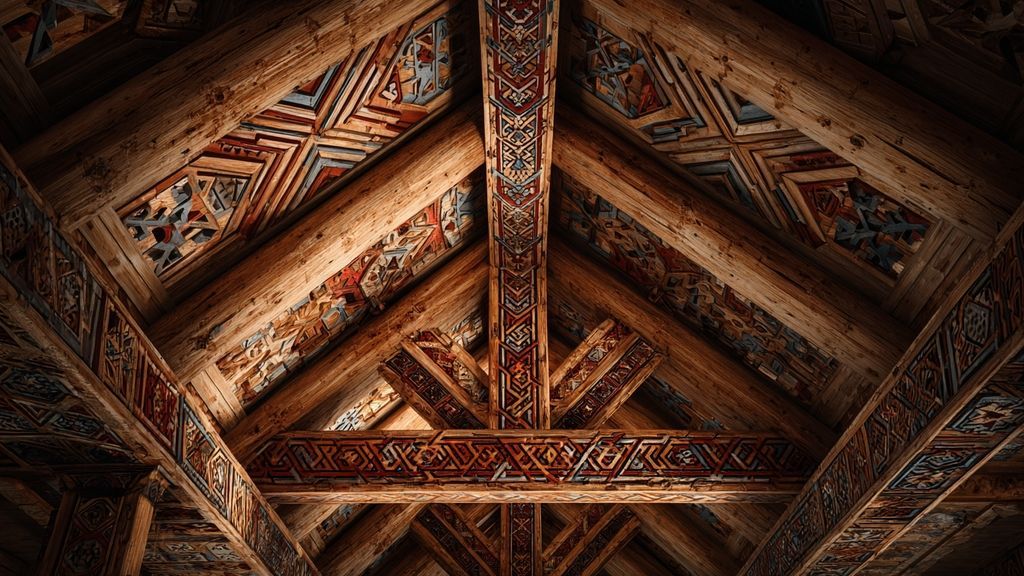
Once the base is installed, you are free to achieve a rustic style, a contemporary style, or even mix influences to break new ground. Some decorative finishes add a real extra soul to the ceiling between beams.
These choices offer the possibility to assert a decorative coherence throughout the room. A simple idea like a stretched canvas brings modernity, while the return of graphic patterns awakens the whole.
Stretched ceiling or stretched canvas: airy modernity
The stretch ceiling (or stretch fabric) is becoming increasingly popular in our modern interiors. It is a very thin membrane, heat-stretched between the beams, avoiding any tedious sanding or painting work. Its quick and clean installation appeals to those who want to change the atmosphere without a heavy commitment.
The great strength of this system lies in its customization: you choose the color, texture, and even the print of the fabric, from pure white to marble imitation. The resulting effect gives an impression of volume, much appreciated in a contemporary living room with exposed beams.
Decorative finishes and easy tips
A few accessories are sometimes enough to subtly dress the space between the beams, especially if you want to keep the charm of the old structure without completely hiding it. Plaster rosettes, closely joined friezes, or geometric wallpaper between the joists immediately give personality to a living room or an attic bedroom.
Don’t forget to adapt colors and textures to the ceiling height and natural light. In a small room, favor light tones, while a dark decorative finish works well in a large open living room.
Calculate required plasterboard or wood cladding material with cutting waste.
Estimated Standard BA13 Sheets (2.5m x 1.2m):
Practical tips and mistakes to avoid
Experience quickly shows that dressing a ceiling between beams always holds some surprises. I have faced the hassle of a poorly adjusted level, anchors torn out due to a too fragile support, or paneling warped by humidity. Here is a list of points to watch before you start.
- Check the dimensions and the spacing between the beams to anticipate difficult cuts
- Calculate the allowable load of the ceiling to avoid any risk of accident after installation
- Provide good ventilation and choose suitable materials in case of a low ceiling
- Opt for special screws or stainless steel anti-corrosion clips in a bathroom
- Take expansion into account and leave enough clearance between the panels and the beams
Always remember to ask a professional for advice if you hesitate: patience and good equipment remain your best allies to successfully complete your interior design without regrets. And remember, often the little detail changes everything in the perception of a space, especially with beautiful exposed beams in the spotlight.