
Wood has always been a highly valued construction material for both professionals and individuals. Given its solid reputation, it is not surprising that its price continues to rise.
Fortunately, plywood is an exception to this rule. It is affordable for all budgets. Despite its reasonable cost, it offers countless advantages.
For those hesitating to make a purchase, consult this article summarizing the essentials to know about the material. Reading it will help you make a good decision. You will also learn in our guide the price of plywood to help you prepare your budget.
Plywood is a versatile material used in carpentry, construction, and interior design. Its price varies depending on the wood species, thickness, and quality.
📋 Key points: Personally, I consider plywood to remain one of the most cost-effective and versatile materials for DIY, despite an average price increase of 15% in recent years. Buying whole sheets from a wholesaler allows for substantial savings compared to custom cutting. For your carpentry projects, be sure to carefully validate the chosen wood species to optimize your overall budget.
Comparative Table of Plywood Prices (Indicative)
| Type of Plywood | Common Thickness | Average Price per m² (€) | Main Use |
|---|---|---|---|
| Poplar | 5 to 18 mm | 8 – 15 € | Interior fitting, light layout |
| Pine / Fir | 10 to 22 mm | 12 – 25 € | Partitions, flooring, standard uses |
| Birch | 10 to 30 mm | 20 – 40 € | Furniture, decoration, intensive use |
| Marine (okoumé) | 8 to 25 mm | 30 – 60 € | Exterior, humid environments, boating |
| Film-faced plywood (CTBX) | 15 to 30 mm | 40 – 70 € | Concrete formwork, professional use |
🎒 On the ground: Last October, I bought three large sheets of 15-millimeter birch plywood to make an interior fitting, which cost me exactly 145 euros at a local timber merchant. I had initially compared prices at a typical big-box DIY store, but the prices there were much higher for a significantly lower wood grain quality. The lesson learned is that you should always consult professional wholesalers before finalizing your purchases.
Tips for Choosing the Right Plywood
Before buying, it is important to compare the wood species and possible uses. Here are the most common types to remember:
- Poplar: economical and lightweight, ideal for interior use.
- Pine/Fir: sturdy, common use.
- Birch: aesthetic and durable.
- Marine/Okoumé: moisture resistant.
- Film-faced CTBX: professional use, concrete formwork.
🌍 Did you know? Marine-grade plywood, used for boats or exposed exteriors, uses a specific phenolic glue. This composition allows it to withstand complete immersion in boiling water for more than 48 hours without undergoing mechanical delamination.
Definition of Plywood
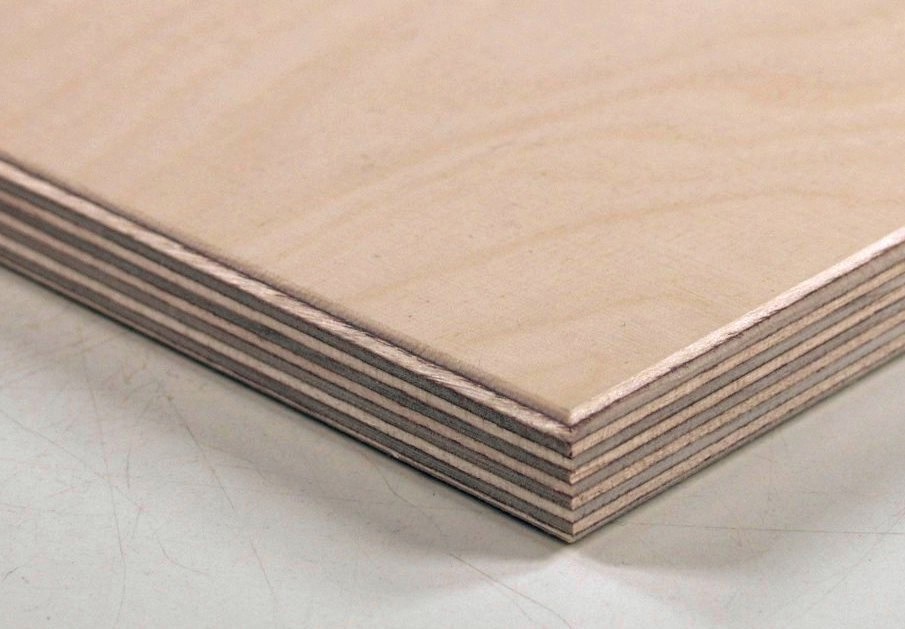
Plywood is a wood-based construction material. It consists of a panel made up of very thin sheets of wood.
Also called veneers or plies, these sheets measure between 0.8 to 4 mm thick. In an odd number, they come from the technique of slicing or peeling the wood. These plies are stacked and bonded together by hot pressing or gluing.
Plywood panels come in many versions. The wood species, the number of plies, panel manufacturing, and the quality of the glue remain the determining factors of their characteristics.
Poplar, beech, okoumé and maritime pine are among the most commonly used species in the industrial production of plywood.
It is worth recalling that its use dates back to Antiquity. It has continuously seen significant improvements over time.
Currently, these thin wood sheets are highly sought after, whether in construction or renovation.
⚠️ Common mistake: Buying cheap interior plywood thinking that a simple coat of varnish will protect it in a bathroom. Without the appropriate waterproof standard, moisture will seep through the edges, causing permanent swelling and the peeling of the wood plies.
Uses of Plywood
As we have just seen above, plywood can be identified by its various uses. Among the most well-known, it is classified as a structural element or reference material in building construction.
Many professionals use it as a facade panel. Others use it in the construction of floors, roofs, walls, exterior cladding, or siding.
Plywood is very essential in interior design. Its presence renovates your home. It offers a wide variety of uses to enhance rooms. For example, it allows you to create decorative partitions.
In carpentry, cabinetmakers choose it to make doors or various furniture. Since it has characteristics similar to solid wood, the finish is of exceptional quality.
The plywood wood panel also helps you to dress your walls or ceiling. It integrates seamlessly into many decors.

💡 Practical tip: Always store your plywood panels flat in the destination room for a minimum of 72 hours before working on them. This time allows the wood fibers to acclimate to the local humidity and prevents the cuts from warping afterwards.
Multifunctional, plywood finds its place in the transportation sector. The wood sheet contributes to the manufacture of bus walls, interior furnishings, floors, and decorations. It also allows for lining luggage compartments.
There are many other applications of plywood, such as in the production of crates or in boating. These are just some of the best examples among many others.
To complete your research on the price of plywood, also discover the advantages of steel tray tile imitation, compare with our advice on cement dosing, and explore our guide on concrete dosing.
The advantages and disadvantages of plywood
👍 Strengths
- Excellent mechanical resistance to deformation
- Lighter and easier to handle than solid wood
- Very good holding of screws and joints
🔍 Reservations
- Purchase price per square meter higher than derivatives
- Visible edges that require veneer strips
- Well-sharpened tools required to avoid splinters
Besides their multifunctionality, plywood boards offer countless strengths. Despite their closeness to solid wood, they are admired for their ease of use.
This material is not only lightweight but also more flexible. As such, it can be worked with ease, unlike solid wood.
Robust, plywood resists moisture, heat, and shocks. It does not deform despite the test of time. Thanks to its significant insulation capacity, it ensures the acoustic and thermal performance of a dwelling.
Despite its multiple advantages, it offers an attractive price. Available in several types, it is easy to find everywhere in the market.
It must be said, however, that manufacturers do not exploit it excessively. It is noted that plywood contains an irritating component called formaldehyde.
This is considered a substance posing health risks. Employees who handle it must be well equipped to limit the risks.
The different types of plywood
If there is a variety of plywoods, it is because this panel uses many types of wood in its composition.
Poplar is one of them and it is very suitable for peeling due to its rapid growth. Poplar plywood is among the highly favored raw materials in the fields of fitting, furniture, and packaging.
Okoumé can also be used to manufacture plywood panels. This tropical wood is grown in Gabon. It has the advantage of having a regular and homogeneous surface allowing it to be easily varnished or painted.
Okoumé plywood is reserved for both outdoor and indoor use. It is also found in decorative applications.
Finally, manufacturers use maritime pine to obtain panels, boards, or sheets of plywood. This wood makes them very efficient so that they can be used in construction.
That is why it is used in the design of essential elements such as beams or load-bearing floors. Thanks to its high resistance, maritime pine plywood can become an excellent exterior cladding for a house.
Aside from that, the performance and technical characteristics of the material allow differentiation among the plywoods on the market. These include CTBS plywood, CTBC plywood, and CTBX plywood.
What you need to know about the price of plywood
If you are considering buying an entry-level plywood, it is available for around €15 per m2. Due to its poor quality, it is only suitable for small corrective jobs.
For mid-range plywood, the price starts at around €30 per m2. With its thickness and strength, it can be used for most applications.
If you are looking for high-quality plywoods, opt for the premium product. Its price goes up to €70 per m2. This can promise durability, performance, and aesthetics.
With prices ranging from €15 to €70 per m2, the quality between panels varies greatly. The thickness of the material also affects its price. The same goes for its mechanical strength and fire resistance.
Note that plywood intended for outdoor use is more expensive than indoor plywood. Since it must withstand weather and humidity, it undergoes a specific treatment explaining the price increase.
That said, the design also makes a difference in cost among the various plywoods. They do not have the same appearance due to their finish and the wood chosen during their manufacture. Naturally, the most noble categories are the most expensive.
Maintenance of plywood
This material does not make life difficult for you. It requires no complex care. Daily cleaning is more than enough to keep it in its original condition.
Wiping with a sponge soaked in soapy water is necessary. After cleaning, it is important to dry it with a soft, clean cloth.
If your plywood shows grease stains, consider using a degreasing cleaner. If the stains are stubborn, do not hesitate to remove them with green abrasive paper. Be sure to act gently to avoid damaging the material.
After removing dirt and grease stains, rinse it with water. The final step is to let it dry.
If you want to restore the original shine of the material, linseed oil gives good results. This substance also nourishes and protects it from moisture.
When you follow these recommendations, you can enjoy your plywood for a very long time.
FAQ – Price of plywood
u003cstrongu003eWhat is the cheapest plywood? u003c/strongu003e
Poplar plywood is generally the most economical, with an average price of 8 to 15 € per m².
u003cstrongu003eWhy is marine plywood more expensive? u003c/strongu003e
Because it is designed to resist moisture and outdoor conditions, especially on boats or terraces, thanks to specific glues and wood species.
u003cstrongu003eWhere to buy plywood at the best price? u003c/strongu003e
Large DIY stores (Leroy Merlin, Castorama, Brico Dépôt) offer competitive prices, but specialized wood merchants often provide a wider selection.