A water leak in masonry does not show tangible signs at first. You can neither hear it nor see it clearly. However, the problem slowly and progressively worsens.
If not detected in time, it can cause significant damage to construction materials. Fortunately, it is possible to repair the wall. This article provides you with the best advice on the subject.
But before examining the details, let’s first look at the causes of water infiltration and the warning signs of the incident.
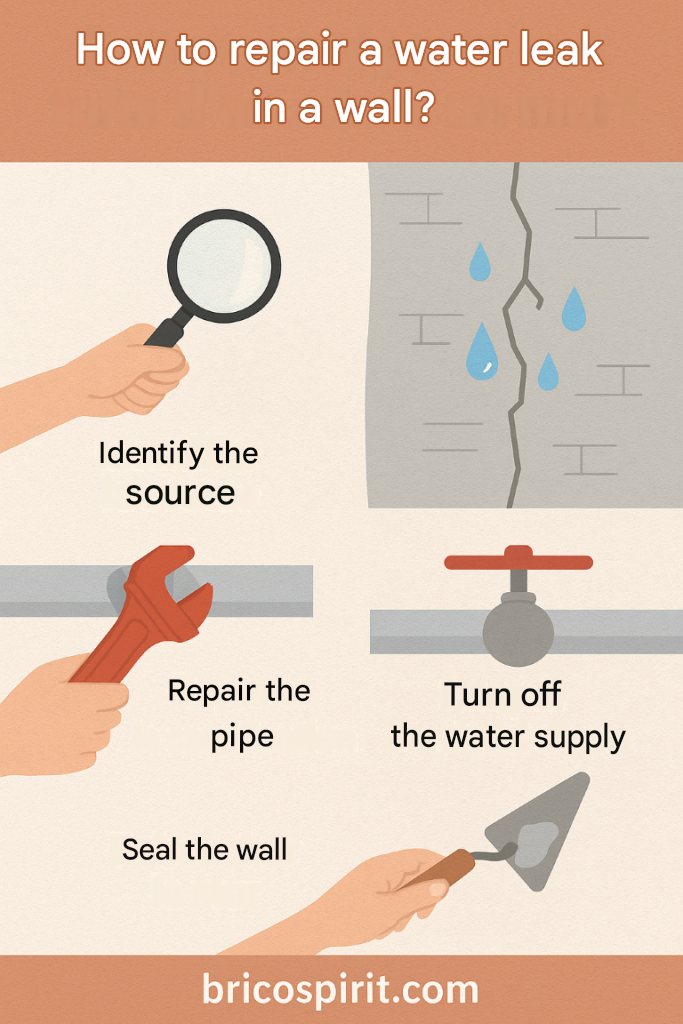
In brief — Turn off the water, secure the electricity, precisely locate the leak (meter test, moisture meter/camera), open cleanly, seal/replace the section, dry thoroughly, treat mold then close up. Quick recap: water & power off → diagnosis (where, why) → targeted opening → repair (fitting, sleeve, soldering) → drying + anti-mold → restoration (plaster/paint) → prevention (joints, pressure, purge).
Steps – Repairing a water leak in a wall
Turn off the water supply (main valve) and secure the electricity on the affected circuit.
Confirm the leak: meter test (all closed, if it runs → leak), signs of water stains/paint blistering/odors.
There are many reasons that encourage water infiltration into a wall or masonry. It comes from both inside and outside the house.
Generally, it results from a pipe break or a defective faucet. With stagnant water, slower water drainage, these elements form a revealing sign of an outdated installation.
If you do not resolve how to find a clog in a pipe, the leak may worsen. And in the worst case, it weakens the house structure.
Besides this, its main causes relate to a roofing problem. When it lacks maintenance, this situation leads to many humidity issues.
Why do I have mold stains on my windows? Where do unpleasant odors in the house come from? How do my paints crumble? Many questions require answers related to this problem.
If you notice damp areas on the lower part of the masonry, the water therefore comes from outside or more precisely at ground level.
Common causes involve a poor drainage system, broken garden hoses, clogged ducts with vegetation and many others.
🌍 Did you know?
An invisible micro-leak on a copper fitting located inside a partition can release more than 500 liters of drinking water in a single week, causing an invisible increase in your bill and the rotting of glass wool insulation.
The only time I wanted to "save time" with a simple sealant without opening, the stain came back two weeks later… Since then, I diagnose with the meter, I open squarely, I put a new sleeve and I dehumidify until the rate stabilizes: no more humidity recurrence.
Symptoms of water leak in a wall
Even if this problem is not apparent at first, you can identify it over time because of humidity stains on the affected wall.
It is generally accompanied by a proliferation of mold. These develop especially in the bathroom, kitchen, laundry rooms, or other damp areas. When they spread, they often emit a certain nauseating odor throughout the affected place. This also allows you to detect hidden leaks.
Water infiltration causes a large number of damages in the house. The drywall gradually deforms. Likewise, the wallpaper crumbles. As for the paint, it peels off the walls.
To determine the leak, also consider the audible clues. Even if it is inside the wall, you can hear a dripping sound after turning off the tap.
With PVC pipes, the sound intensifies, which makes detecting the problem easier. On the other hand, iron pipes complicate your task even if you listen closely to the clicking.
⚠️ Common mistake
Attacking a drywall partition with a sledgehammer or hammer to find a pipe is a common mistake. You risk crushing an embedded electrical conduit or accidentally piercing a second pipe located right next to it.
Tips for repairing a water leak behind a wall
To work precisely, it is necessary to accurately identify the location of the leak. To achieve this, use appropriate equipment such as a moisture meter, a thermal camera, and an electroacoustic detector.
Detection tool
Measurement accuracy
Type of targeted piping
Level of destruction
Thermal camera
Excellent (thermal difference)
Hot water pipes
None (non-contact)
Pin moisture meter
Medium (surface measurement)
All types of walls
None
Electroacoustic listening
Very high (vibrations)
Pressurized pipes
None
Endoscopic camera
Perfect (visual inspection)
Empty spaces and false ceilings
Very low (small hole)
Once done, remember to turn off the water supply to the affected pipe. All devices operating with water must be unplugged.
Once the fitting is repaired, wait at least 15 days before closing the partition or applying a filler. The structure must be perfectly dry at its core to prevent mold proliferation under the plaster.
For an internal leak, the repair proves to be more complex. It is more reasonable to entrust it to a professional plumber especially since the leak is located behind a brick or tile. Here is a summary of the choice between doing the work yourself or calling a professional:
🍀 Good sides
Surgical localization of the problem without destroying the entire room
Full coverage of costs by home insurance
Ten-year warranty covering new plumbing connections
🔻 Limits
Requires waiting for the expert's visit depending on the contracts
High intervention cost in case of a call on a public holiday
The technician first cuts the wall to facilitate his tasks. Then he proceeds to locate the damaged sections. Once this step is finished, he seals the masonry. The final phase aims to sand it down.
In the case where the leak comes from outside, it is necessary to start by identifying the source of the leak. If it concerns the irrigation system, the section of the pipe in the automatic water extinguisher can be replaced.
If the origin of the leak relates to poor waterproofing of the basement, this requires heavy work by optimizing or changing the waterproofing system.
When the water leak repair involves work at height, for example on the roof, there is nothing better than calling a professional. This project requires specific knowledge and experience in the field.
Even if their intervention can prove costly, it spares you from any risk of irreparable accident. Moreover, a specialist can promise you durable and effective results.
Estimateur d'infiltration invisible
Calculate the volume d'eau approximate libéré dans your mur chaque jour
u003cstrongu003eCan I seal without opening the wall?u003c/strongu003e
Only as a short-term fix (clamp, epoxy). For a lasting repair, u003cstrongu003eopening + replacementu003c/strongu003e of the section are essential.
u003cstrongu003eHow long to dry before closing up?u003c/strongu003e
Allow u003cstrongu003e48–72 hoursu003c/strongu003e with a dehumidifier/ventilation, and close up when the level returns close to normal (≈ 12–15% on BA13).
u003cstrongu003eWho to call if in doubt?u003c/strongu003e
A u003cstrongu003eplumberu003c/strongu003e for the repair, a u003cstrongu003edehumidifier specialistu003c/strongu003e if the damage is extensive. In an apartment building, notify the u003cstrongu003ebuilding manager/insuranceu003c/strongu003e.
u003cstrongu003eWhat does water damage insurance cover?u003c/strongu003e
Generally the u003cstrongu003ddamagesu003c/strongu003e (walls, paint), not the u003cstrongu003epipe repairu003c/strongu003e itself. Report quickly, make an official report.
u003cstrongu003eThermal camera or moisture meter: useful?u003c/strongu003e
Yes, ideal to u003cstrongu003elocateu003c/strongu003e without breaking everywhere and to check the u003cstrongu003edrying outu003c/strongu003e before restoration.