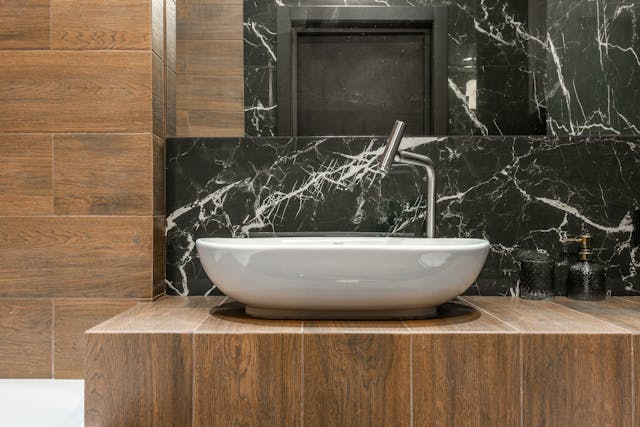
Just like the bathtub or shower, the sink is one of the essential elements that make up the bathroom. Besides its main role, it helps bring an aesthetic touch to the room.
Over the years, the basin loses its shine and possible impacts can break it. Faced with this situation, it is inevitable to replace it.
With some technical knowledge, it is still possible to take care of it yourself. If you are interested, we suggest you discover this article offering a complete guide on the subject.
But to better understand our ideas, it is appropriate to recap in the first part the important points to remember about the sink.

📋 Essential to remember: Personally, I consider shutting off the main water supply and draining excess pipe pressure the most critical starting step, as accidental valve slips can flood your bathroom in seconds. In my plumbing experience, applying fresh silicone sealant around base joints prevents costly subfloor water damage. Always verify hole alignments before securing new mounting bolts.
Presentation of the sink
🍀 Advantages
Saves $150 to $300 in professional plumbing labor fees.
Instantly modernizes bathroom aesthetic and property appeal.
Opportunity to inspect and replace aging pipe connections.
🔻 Weaknesses
Requires working in tight, uncomfortable under-vanity spaces.
Risk of minor leaks if silicone seals or threads are poorly aligned.
The sink is a sanitary appliance mainly used for washing your hands. Whether made of porcelain or ceramic, it consists of a basin, one or several taps, and a water drainage system.
To empty the bottom of the bowl more quickly, it intentionally has a rounded shape. This structure also helps to avoid any risk of water stagnation.
Besides that, the sink is equipped with a flat surface that holds soaps and some grooming accessories. Since the advent of hot sanitary water, traditional taps are gradually disappearing. They are now replaced by mixer taps.
This device can provide you with cold, hot, or lukewarm water according to your needs. It should be noted that its installation requires the intervention of a professional.
🛠️ My experience: Last April, I replaced an outdated pedestal basin with a modern vessel sink costing around $140 total. After failing to use plumber’s tape on the drain thread, I spent two hours fixing a slow drip under the basin, teaching me that wrapping every threaded connection three times prevents leak headaches.
Currently, the sink is not only a functional object but also an aesthetic one. Due to daily use, the basin may receive impacts. It can be broken or cracked.
Otherwise, it becomes clogged by soap residues or other debris. To avoid constantly asking yourself the question why are my pipes clogged, it is better to replace it.
If you are a good handyman and well equipped, here are the steps to follow to successfully complete this task.
To dive deeper, I recommend checking silicone joint smoothing techniques which ensures clean waterproof edges. Understanding clog detection methods helps keep new drainage lines clear. And to complete your renovation, exploring affordable bathroom work ideas offers great budget inspiration.
Prepare the site and plan the right tools
Like other DIY tasks, replacing a sink requires good preparation. To do this, it is necessary before any intervention to turn off the water supply. Remember to open the tap to drain the pipes.
If there is no valve, you can shut off the main water supply at the water meter. To prevent flooding and leaks, place a large container or basin under the sink.
| Sink type | Average material cost ($) | Installation difficulty | Typical install time |
|---|---|---|---|
| Pedestal Sink | $80 – $200 | Intermediate | 2 – 3 hours |
| Drop-In / Top-Mount | $50 – $150 | Beginner | 1 – 2 hours |
| Undermount Basin | $100 – $300 | Intermediate | 2 – 4 hours |
| Wall-Mounted Basin | $90 – $250 | Advanced | 3 – 5 hours |
With the aim of removing the old sink to properly install the new one, it is essential to have all the necessary tools. The tape measure is one of the very useful accessories for any DIY project.
It is not only used to calculate the distance between kitchen sink outlets. Here, it allows you to take measurements of your old basin to find an identical size.
Besides that, you need a spirit level, a pencil, a Phillips screwdriver, a flathead screwdriver, an open-end wrench, a socket wrench, a hammer and an electric drill.

Make sure to acquire a new sink of a category similar to the old model. Find a suitable fixing system, an under-sink cabinet, a drainage system, and matching taps.
💡 Do you know? Replacing an old bathroom basin with a water-efficient faucet setup can reduce household water consumption by over 30%, saving up to 700 gallons annually.
Dismantle the old bathroom basin
⚠️ Common mistake: Overtightening plastic P-trap nuts and flexible water supply lines using metal wrenches. Over-torquing cracks plastic threads and warps rubber washers, leading to persistent under-sink leaks. Hand-tighten plastic connections firmly, followed by a quarter-turn only.
In case of a defective sink, nothing beats replacing it forever. Instead of wondering : how to repair a resin sink, it is better to choose a new installation.
To dismantle the basin, it is first necessary to remove the drain then the trap. Once done, focus on the pipe ensuring the general water drainage, disconnect this element.
Unscrew the faucet connections using a suitable pliers. Now, the faucet and the sink are free, they can be removed without difficulty.
Use a cutter to peel off the sealing joint connecting the basin to the wall. Depending on the type of your installation, some screws must be removed to separate the sink. This is the case for a basin fixed on brackets and a pedestal sink.
As a reference, refer to the central drainage pipe. This facilitates the attachments of the new basin.
💡 Practical tip: Place a shallow basin and old towels directly beneath the trap before loosening pipe fittings to catch trapped residual water and debris cleanly.
Clean the area to prepare for the installation of the new sink
To act like a pro, there is nothing better than working in a clean space. With the dismantling of the old sink and fixing accessories, dust and debris of all kinds accumulate. Remember to get rid of them.
The mounting surface may be dirty, all debris that could clog it must be removed. Remove silicone residues using your flat screwdriver or a cutter. It is also possible to use fine sandpaper.
If necessary, place a protective tarp on the floor to protect the flooring from dirt and various stains. You certainly do not want to damage the surface during the work.
Reassembly of the sink and its mixer tap
Upon purchase, some sinks must be assembled before installation. To avoid mistakes, it is imperative to follow the manufacturer’s instructions in the user manual.
To start, screw in the drain to ensure its attachment to the sink. Beforehand, do not forget to put a gasket. The next step is to prepare the mixer tap.
Use a wrench to fix its hoses. Then proceed to screw the threaded rod and install the drain pull rod.
Since the sanitary appliance is now assembled, you can fix it. To do so, holes must be made to guarantee the placement of the basin on the wall. A drill is the ideal tool to accomplish this task. Make sure that your bathroom wall can bear the load.
Once the holes are made, place the anchors according to the required size. In most cases, sink manufacturers specify in the instructions the type of anchors to use.
The installation of the basin depends on its fixing method. Some models are placed on the pedestal, others on the cabinet or wall brackets. Before tightening it for good, still check the horizontality using a spirit level.
After the sink is properly secured, you can reinstall the faucet and connect it to the water supply lines. Generally, cold water comes in on the right and hot water on the left. Additionally, a colored indicator is located on the flexible hoses showing the position. You just need to refer to it.
Make the connection of the drainage circuit under the sink. You need to be careful to avoid any possible leaks. Attach the drain and install the trap. Add seals on all the joints.
If you have followed the steps mentioned above, everything should work correctly. Nothing prevents you from doing some checks on the flow of both cold and hot water. If you plan to place a cabinet under the basin, now is the time to install it.

Estimate total project cost comparing DIY installation versus hiring a plumber.
Pourquoi changer soi-même un lavabo de salle de bain ?
u003cbr/u003eDe nombreux bricoleurs préfèrent installer eux-mêmes leur u003cstrongu003enouveau lavabo u003c/strongu003epour faire des économies. À rappeler que cette tâche peut coûter entre u003cstrongu003e240 et 550 eurosu003c/strongu003e si on fait appel à un professionnel.u003cbr/u003e
Combien ça coute de changer soi-même un lavabo de salle de bain ?
u003cbr/u003eSi on a des notions techniques et si on s’équipe de matériels nécessaires dans sa u003cstrongu003etrousse à outils,u003c/strongu003e cette opération ne coûte pas grand-chose. La seule dépense importante est le prix d’acquisition du lavabo qui oscille entre u003cstrongu003e50 et 150 €u003c/strongu003e.u003cbr/u003eu003cbr/u003e
Quels sont les étapes pour changer soi-même un lavabo de salle de bain ?
u003cbr/u003eIl faut d’abord assembler tous les outils et démonter l’ancienne installation. Cela fait, il ne vous reste plus qu’à placer la nouvelle vasque et procéder à la vérification du système.u003cbr/u003e