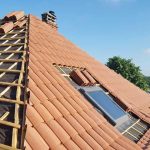
In our previous article, we already discussed roof waterproofing. This time, we will take a closer look at fiber cement roofing. It consists of corrugated panels made from a material combining cement, water, cellulose, and natural fibers. In most cases, this type of roofing takes the form of fiber cement sheets. Fiber cement tiles are less common in the market.
For several years, it has had a bad reputation because the old fiber cement sheets contain asbestos. As we all know, asbestos is a carcinogenic product. It can therefore cause serious health problems.
Fortunately, the new fiber cement roofs are completely safe since they are free of asbestos. In any case, there are some measures that apply to fiber cement roofs and that deserve to be known by the general public.
📋 Key takeaway: Personally, I consider that the 2026 regulatory update requires increased vigilance, as about 15% of fiber cement roofs installed before 1997 show signs of advanced degradation. My opinion is that diagnosis becomes the most critical step. This year, containment standards are tightening to ensure total safety during removal work.
What are the current regulations regarding fiber cement roofs?
🍀 Key advantages
• Excellent Class A fire resistance compliance for modern builds
• Significantly lighter load on roof trusses than traditional concrete tiles
• High resistance to rot, rust, and chemical weathering
🔻 Main limitations
• Stricter ventilation rules required during installation to avoid condensation
• High disposal fees if replacing legacy asbestos-containing structures
Before addressing this topic, it is worth reminding you that this roofing is an ecological material since it is made of natural fibers. It also stands out from its competitors due to its lightness, which facilitates installation and handling. Even better, fiber cement is particularly resistant to heat and cold. Reliable, it is also non-combustible. As it remains a waterproof material, it reduces condensation issues.
Despite their many advantages, do not forget that old fiber cement roofs made before 1997 contain asbestos. Their use therefore presents an imminent danger to the environment and especially to the health of the home’s inhabitants.
For owners, they thus bear their responsibility as they are consequently held accountable for all the side effects of asbestos on occupants as well as on external workers. It should be known that disorders caused by asbestos exposure represent the second leading cause of occupational diseases.
Currently, regulations on roofs containing asbestos prohibit any action likely to release asbestos products into the air. If you therefore plan to clean the fiber cement roof containing this dangerous product, be aware that you are violating the rules. Any form of high-pressure cleaning is strictly forbidden. Before starting a renovation or roof replacement project, it is mandatory to carry out an Asbestos Diagnosis before work or DAAT to detect the compound.
🗣️ My experience: While working on a barn in Brittany last March, I saw an owner spend 4,000 euros more than expected because he had not conducted prior sampling. The lesson is clear: never start a quote without a certified asbestos diagnosis, it is the only guarantee to avoid last-minute budget surprises.
Is it mandatory to remove a fiber cement roof containing asbestos?

Previously, asbestos was widely used in countless applications, especially in the construction sector. But at the beginning of the 20th century, its use raised many concerns, as the substance was scientifically proven to be the main cause of death among factory workers. People who use or handle it suffer from lung diseases such as mesothelioma, lung cancer, and more.
From January 1997, there is consequently, a decree banning its use in France. It is therefore required to refer to the construction date before handling a fibrocement roof to determine whether it contains asbestos or not.
Despite the legislation, the owner is not obliged to remove it as long as it is not deteriorated. However, the law prohibits high-pressure cleaning work that could release asbestos fibers into the air. Failure to comply with the rule results in a penalty requiring a fine.
In any case, even if replacing the asbestos roof is not mandatory, it is advised to remove it during a sale. The presence of this carcinogenic product can cause serious problems for potential buyers. Since they care about their health, they are unlikely to invest their money in a building that poses a danger.
If you therefore want to improve its safety and attract more buyers, do not hesitate to replace the fibrocement roof containing asbestos. This action also helps preserve the environment.
Regulations on asbestos in fibrocement roofs
Discover below a summary of the legislation on the asbestos roof as well as various possible solutions:
| Type of roof | Asbestos present | Legal obligations | Possible solutions |
|---|---|---|---|
| Old roof | Yes | Mandatory inspection, removal recommended | Removal under safety conditions |
| Recent roof | No | No restrictions | No particular risk |
What are the risks related to the presence of asbestos in a fibrocement roof?
As we highlighted in the previous sections, asbestos represents a health threat. Its dangers, however, only appear many years after exposure. Even though it is a natural substance, its widespread use certainly affects health.
When asbestos fibers are released into the air, they can be inhaled unknowingly. They then remain in the mucous membranes of your abdomen or lungs. Over time, this substance causes inflammation until a deadly disease such as lung cancer develops.
Besides that, asbestos causes multiple respiratory problems such as respiratory failure. Their severity depends on the amount of asbestos inhaled as well as the duration of exposure. Since these particles are ultrafine, they easily reach the natural barriers of the human body. Among the most well-known diseases are asbestosis, fibrosis, pleural lesions, mesothelioma, and many other cancers.
According to reliable sources, asbestos causes the death of 2,000 workers each year. Statistics confirm that 20 craftsmen lose their lives every week due to prior exposure. Because of these overwhelming figures, asbestos fibers remain a health hazard, not only for roofers or residents of a home with an asbestos roof but also for workers in the construction and public works sector.
What are the steps to follow to remove asbestos from a fiber cement roof?
Estimate your project cost including 2026 compliance standards.
It is crucial to remember that repairing a roof containing asbestos does not reduce health risks. It is better to find other solutions such as asbestos removal from the roof.
To achieve this, you must start by conducting a diagnosis to detect the presence of asbestos or not. If asbestos is present and its quantity exceeds 5 fibers per liter of air, asbestos removal is inevitable. If the asbestos quantity does not exceed 5 fibers per liter of air, you can avoid removal, but you must review the diagnosis after 3 years.
Before removing asbestos from the roof, be sure to wear all appropriate safety equipment, namely a protective mask, a suit with a hood, protective glasses, and waterproof gloves.
There are two types of roof asbestos removal: removal by roof removal and by containment. The first technique applies to fiber cement roofs that are not very watertight and already old. It involves removing the affected panels and replacing the roof.
The second technique is suitable for roofs that are not too damaged. For this, simply cover the fiber cement roof with a special product that traps the asbestos. You can then place panels on the roof to optimize asbestos neutralization.
| Action | 2026 Obligation | Average cost / m2 | Required professional |
|---|---|---|---|
| Asbestos diagnosis | Systematic (sale/works) | €15 – €25 | Certified diagnostician |
| Total asbestos removal | If degradation > 20% | €35 – €65 | Certified company 1552 |
| Encapsulation | Optional (if in good condition) | €25 – €40 | Specialized roofer |
| Disposal at waste center | Trackdéchets traceability | Variable | Authorized transporter |
🌍 Did you know? A single old fiber cement panel can contain up to 10% pure asbestos, which represents millions of potentially inhalable fibers if it is cut or drilled.
Procedures for asbestos removal from a fiber cement roof
For those with technical knowledge, it is still possible to remove asbestos from the roof yourself. But for greater safety and quality of work, it is better to entrust this task to a professional roofer. Below, we suggest a summary of the operation steps to facilitate your reading:
| Asbestos removal steps | Description | Legal obligations | Approved companies |
|---|---|---|---|
| Initial diagnosis | Identification of asbestos | Mandatory for old buildings | Diagnosis by certified professional |
| Removal work | Safe removal of asbestos | Performed by an approved company | Asbestos removal specialist |
| Waste management | Disposal of contaminated materials | Transport to approved treatment center | Authorized company |
How to know if my fiber cement roof contains asbestos?
Asbestos was widely used in the past in the construction of gutters, piping, floor covering sheets, and roofs. Since 1997, its handling has been prohibited due to its hazardous nature to health. This substance is responsible for countless infections and diseases affecting the lungs, digestive system, and heart. To limit risks, it is essential to identify corrugated sheets made of asbestos-containing fiber cement.
The first method is to look for the NT or new technology label when purchasing roofing. This information guarantees the absence of asbestos in the material. Generally, it is displayed on the inner side of the panel.
As for the second method, take the time to inquire about the manufacturing date of the roof. If it is after the year 1997, it is certain that the sheet does not contain asbestos. Otherwise, you should contact the manufacturer for more information on the subject.
It is also possible that the roof provides no indication, neither the production date nor the NT brand. In this situation, it is safer to take, for example, a sample of the roof to diagnose the presence of asbestos. Of course, this detection must be carried out by an expert.
What is the lifespan of an asbestos-free fiber cement roof?
🌟 The advantages
- Excellent fire resistance
- Durability over 40 years
- Historically low installation cost
🔻 Limitations
- Health risk (asbestos)
- Very high removal cost
- Prohibition of drilling/cutting
Despite common misconceptions, more and more people use fiber cement to cover industrial or agricultural buildings because it combines strength and great longevity. Almost all modern sheets benefit from professional-quality treatment ensuring safe handling. They therefore pose no danger to human health.
Depending on the brand and manufacturing quality, a fiber cement roof can last between 30 to 50 years. To enjoy it for a very long time, please maintain it properly. Unlike other roofs, fiber cement roofing does not require complex care.
Regular cleaning is necessary to keep it always clean. You can remove plant deposits as well as moss using a suitable product. Also remember to keep all rainwater drainage systems in good working order.
If you notice damaged sheets, do not hesitate to replace them. Know that some removed sheets can be recycled. Professionals use them for aggregate composition in concrete or insulation material.
⚠️ Common mistake: Using a high-pressure cleaner on asbestos-containing fiber cement. This is strictly prohibited by law because it sprays fibers into the air and permanently contaminates your garden and those of your neighbors.
Can I renovate or cover a fiber cement roof without removing it?
Like any roof, a fiber cement roof can deteriorate over time. That is why it is imperative to carry out frequent maintenance. If some panels are in poor condition, they can be removed and replaced without removing the entire roof.
Before carrying out this operation, certain cases require special attention, especially if you suspect the presence of asbestos in the fiber cement panels. If these date before 1997, the presence of this harmful product can be imagined. They are particularly dangerous when perforated, broken, or damaged. In this circumstance, you must go through a professional to decontaminate the roof from asbestos.
When the latter is manufactured from 1997 onwards and bears the NT marking, there is no risk to your health in this regard. You can therefore renovate it without worry. With professional cleaning, plan between 10 and 20 euros per square meter. These prices can, however, increase depending on the amount of waste to be removed, the surface area, and access to the site.
📦 Storage: If you handle panels (only in subsection 4 for individuals), they must be wrapped in a double airtight polyethylene film with the “Asbestos” logo visible before any transport.
Renovation solutions for a fiber cement roof
Before renovating your fiber cement roof, try to gather information on the regulations in force. If the material contains no asbestos, for example, there are no rules to follow.
| Renovation solution | Advantages | Disadvantages | Applicable regulation |
|---|---|---|---|
| Overlay with panels | Reduces replacement costs | Not suitable if asbestos is present | None if no asbestos |
| Complete replacement | Ensures a new and durable roof | High cost | Mandatory if asbestos is present |
What are the current alternatives to fiber cement for roofing?
Fiber cement generally consists of cellulose, cement, water, synthetic and natural fibers. These are mixed to provide a robust, lightweight, and thin material that can be molded into many textures and shapes.
Old fiber cement roofs contain asbestos. But since the 1990s, this mineral fiber substance has been banned in France in roofing production due to its toxicity.
Although the fiber cement roof is rarely used in individual housing, it can particularly be found in industrial or agricultural buildings.
The steel sheet roof is a better alternative to fiber cement. Also called dry roofing, it is made with profiles sometimes in lacquered steel. Its major asset lies in its initial waterproof treatment. Thus, it requires no waterproofing protection. While the steel sheet roof is mainly deployed to cover an industrial building, the fiber cement roof shows more versatility.
The slate roof and the classic tile also rank among other alternatives to fiber cement. If the first is prized for its aesthetic side, the second stands out for its better longevity. With frequent and proper maintenance, its lifespan can reach about 100 years.
Are fiber cement roofs still allowed in new constructions?
Today’s fiber cement roofs no longer contain asbestos. As a result, they can be handled safely. However, if you plan to use models dated before 1997, it is very likely that they still contain this toxic and hazardous substance for health.
It should be noted that fiber cement sheets come in different finishes, thicknesses, and sizes. They thus allow you to carry out many tasks, not only renovation but also new construction.
Besides its versatility, fiber cement roofing withstands bad weather. It remains intact despite the weight of snow and tolerates rain as well as strong winds. Since its structure is reinforced by fibers, this provides better dimensional stability, reducing the risks of deformation and cracking. That’s not all, fiber cement is among the non-combustible materials. It therefore offers good fire resistance, ensuring the safety of the dwelling.
What subsidies are available to replace a fiber cement roof containing asbestos?
Despite many restrictions on the use of asbestos in 1978, this substance has been strictly banned in the production of various materials since 1997. And from July 19, 2019, an asbestos diagnosis before work is mandatory for any type of construction prior to 1997. Professionals or individuals, everyone is required to carry out this survey to ensure the health and safety of occupants as well as construction personnel.
Fortunately, there are many funding options to help them remove asbestos from the roof. For example, you can benefit from the ANAH subsidy for the technical diagnosis and insulation work on elements containing asbestos. This is reserved for owner-occupiers and landlord owners.
For individuals, ANAH aid covers energy renovation work requiring the removal of asbestos roofs. This then generates an energy gain of at least 35%.
The landlord owner also has the opportunity to benefit from a tax deduction aimed at reducing the costs of asbestos removal. For houses used as residences for at least 2 years, there is a reduced VAT rate applicable to the removal of fiber cement roofing asbestos.
Finally, there are other local and regional aids for the rehabilitation of premises with asbestos roofs. To learn more, it is advisable to gather all necessary information on the subject.