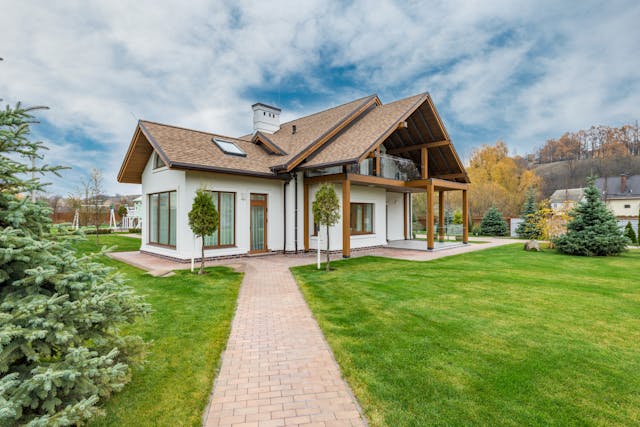
Instead of buying a new house, it is more economical to start building one yourself. Among the split-level house models, prefabricated houses, single-story house plans or traditional house with glass roof USB port, the first option has recently become increasingly popular.
Also known as semi-single-story house, this type of house construction is hugely successful. It appeals not only to individuals but also to professionals. Unlike other dwellings, it offers a unique identity to the home by playing with volumes as well as heights. Before going further on the subject, it is important to start this article with a definition of split-level houses.
📋 Key takeaway: Personally, I consider the split-level house the perfect architectural solution for sloping land, as it allows the terrain to be followed without massive earthworks. This concept naturally separates living and sleeping areas by just a few steps, offering a dynamic interior volume and cross-lighting. I recommend this layout to gain about 10% of usable living space by eliminating long traditional distribution corridors.
What is a split-level house?
Whether on the internet or on television, you have probably heard about it, but you do not know exactly what it is. Split-level house models are defined as a combination of a two-story house and a single-story house. You could say it is a true hybridization of construction styles. They feature an architectural design requiring much more ground occupation than any other.
The split-level house model is a better compromise between volume use and living space, and all for a reasonable price. Whether your land is hilly or sloping, it can adapt to any type of soil. It also allows combining light and space.
Its principle is based on the precise separation of the night zone from the day zone. The bedrooms and the bathroom are set apart from the living room, entrance, kitchen, and dining room. This greatly simplifies circulation in the common areas.
🌍 Did you know? Split-level architecture allows creating ceilings of different heights within the same structure. You can thus enjoy a majestic cathedral living room 4 meters high while keeping cozier and easier-to-heat bedrooms on the upper level.
Generally, the dependencies between these zones are located just below the sleeping area. This saves space for the laundry room, garage, or workshop, just like in a traditional house construction.
Although split-level house plans come in several variations, they are considered a basic single-story house. They obviously include living rooms, but also one or two floors reserved for the office, sleeping areas, and bathroom. This split-level house model features roofs with one or four slopes. Others stand out by the presence of a terrace.
🗣️ My experience: In 2024, I visited a split-level construction where the garage was located halfway between the living room and the bedrooms. The owner had arranged a laundry room directly accessible from this intermediate landing. The lesson is striking: the flow of movement is incomparable. You never really change floors; you simply move from one zone to another, which considerably reduces visual and physical fatigue compared to a straight staircase with 15 steps.
What are the advantages of a split-level house?
🌟 The pros
- Original interior aesthetics
- Optimization of difficult terrains
- Natural zoning of rooms
🔍 Drawbacks
- Unsuitable for disabilities (steps)
- Higher structural work cost
- Complex acoustic management
If you have difficulty deciding between a single-story house and a two-story house, we suggest opting for the split-level house as the ideal compromise. Thus, it combines the advantages of each type of construction.
Even better, it offers you more choices in designing house plan models. By letting your imagination run free, the construction of split-level houses can be original. For example, you can give them character by adding sharp angles, attic rooms, asymmetrical volumes, a suspended veranda, or a patio. Consequently, this model is one of the most customizable dwellings compared to the single-story house, two-story house, or traditional house with garage.
The advantages do not stop there. A split-level house construction combines practicality with comfort, thanks to the separation of spaces. They are often separated by short staircases. Due to this arrangement, it becomes easy to classify the different activities within the house. The goal is to assign a specific role to each part of the home and also to preserve the occupants’ privacy. The architectural style of split-level house models is therefore 100% functional.
| Level | Main function | Key advantage | Accessibility |
|---|---|---|---|
| Level 0 (Entrance) | Garage / Laundry | Thermal insulation | Direct from road |
| Split-level +0.5 | Living room / Kitchen / Lounge | Increased brightness | + 6 steps |
| Split-level +1 | Bedrooms / Bathroom | Total privacy | + 12 steps total |
| Split-level -0.5 | Cellar / Office / Home theater | Coolness / Quiet | Partial basement |
With an atypical structure, they also have the advantage of being adaptable to any type of terrain. Whatever the style, retro or modern, more and more split-level house plan models are available. You just have to entrust the construction project to a professional and they take care of everything.
How does the construction of a split-level house proceed?
Like the construction of a single-story house or two-story house, that of a split-level house always begins with the development of the plan. This step should not be taken lightly. Ideally, it is best to entrust it to an expert. You can find many professionals who are capable of offering you split-level house model plans. During their design, try to take into account the layout of all the bedrooms and other living spaces. Please carefully determine the arrangement of each room.
Before the work begins, take the time to inform yourself about the administrative procedures. It is required to obtain a building permit from the town hall. This authorization ensures that your construction project complies with local building regulations.
Once everything is in order, you can start the foundation and the construction of the floor. This obviously involves excavation as well as the raising of walls. The assembly of floors and roofs is the same.
Contrary to popular belief, finishing work and the fitting out of interior parts can take a lot of time. Also, interior installations such as electricity, plumbing, and insulation may inflate the budget. In any case, all these works must be carried out according to the rules of the art to guarantee the safety and comfort of the occupants.
What types of land are suitable for a split-level house?
Compared to Verdania traditional house, the Intimity traditional house, single-story house or two-story house, the split-level house has many interesting advantages. Its versatility is part of it. Unlike most house models, it can easily adapt to any type of terrain.
While most are suitable for flat ground, the split-level house model can be built on hilly land. But that’s not all, you can build it on sloping areas. This split-level house construction project gives you the opportunity to establish a creative and atypical habitat. The difference in levels gives it a personality. In case of selling the property, this unique architecture becomes its major asset.
Steep terrains are also a basis for building original landscaping. For example, you can install waterfalls, rock gardens, or terraced gardens. These undoubtedly contribute to the property’s value.
The construction of a split-level house, like that of a single-story house, often allows you to enjoy better panoramic views. This offers you a greater sense of space from all rooms and a feeling of privacy from the neighborhood. Thus, even if the placement of the house can be more complex, it also offers you many significant advantages.
How to optimize space in a split-level house?
In split-level house model plans, the goal is generally to maximize the living space. That is why this foundation requires a larger floor area than that of a two-story or single-story house. Despite this, it is still possible to arrange the interiors to save space.
To achieve this, you can multiply storage spaces to declutter the rooms. This helps you make use of every nook. If the walls have niches, do not hesitate to take advantage by integrating, for example, custom shelves.
Also reconsider the volumes. If possible, open up spaces by removing or breaking down partition walls. You only have to replace them with glass partitions or screens. With cubic structures, the attic area can be usable. With good lighting and better decoration ideas, you can create a cozy corner in every room of the split-level house.

What are the disadvantages of a split-level house?
Before answering this question, let’s recall that it turns out to be a compromise between a single-story house and a multi-story house. It thus combines the advantages of each type of construction. Even better, it differs by its practical and balanced layout making each area functional.
From an aesthetic point of view, a split-level house design is magnificent to look at. Moreover, it is customizable according to your taste. In general, it is characterized by the existence of two adjoining houses with different roof levels.
With their multiple advantages, it must be said that split-level houses do not have many disadvantages. However, it is important to specify that they receive criticism due to their exaggerated cost.
Compared to a single-story house, their construction requires a substantial budget. As a result, although most people intend to buy or create a split-level house model, it is often their wallet that prevents them. These people do not even need to have a house valuation done, because of their limited financial means.
For those who prefer to adopt an original style for their future split-level house, they must also plan a huge budget for their construction project. Its realization requires a certain expertise and know-how from a professional team. Yet, their intervention may be expensive. Added to this, remember that split-level houses are not practically suitable for elderly people.
Is a split-level house suitable for elderly people?
As we just mentioned above, one of the disadvantages of a split-level house construction lies in its unsuitability for elderly people. It is the same for occupants with reduced mobility. This kind of issue can also be found with multi-story houses.
Indeed, architects can make efforts to adapt split-level house plans to the needs of seniors. Nevertheless, finding solutions to access problems remains a challenge to overcome. The construction of the house makes their movement difficult.
Despite everything, it is always possible to resolve this issue by using devices such as the stairlift. This is specially designed to simplify the movement of elderly people or occupants with disabilities.
The equipment is generally installed along the existing railing. Flexible, it adapts to almost all architectural configurations. Its use is recommended in split-level house models allowing seniors to maintain their autonomy. Thanks to it, they can climb the stairs to use all the rooms without any problem.
⚠️ Common mistake: Multiplying small stairs of 2 or 3 steps without visual signaling. This is the number one fall trap. To secure your interior, use contrasting stair nosings or LED lighting integrated into the floor to clearly mark each level change.
Besides using a stairlift, you also have the option to adapt your split-level house so that it meets the needs of seniors. Although this project requires an additional expense, it helps you limit the potential risks of their falls. For example, you can arrange part of your ground floor to transform it into a living area for occupants with reduced mobility.
What are the differences between a split-level house and a two-story house?
When it comes time to build your own home, many model house plans come to mind. While the traditional house with a glass roof and USB port was previously popular, it is the split-level house and the single-story or two-story house that are increasingly attracting investors.
Many people tend to confuse a two-story house with a split-level house. Of course, they both have many strengths. However, each has its own specific features that distinguish it from traditional constructions.
At first glance, it should be noted that they differ somewhat in their overall appearance. Split-level house models are sometimes recognized by the presence of two adjoining pavilions that differ in their roof levels. A two-story house, on the other hand, often features a roof and configuration of a classic shape.
In general, it is complicated to build this type of home on a sloping plot. This is not the case with a split-level house construction. It can be easily founded on this type of terrain. Like the single-story house model, it is also suited to flat surfaces. As for the price, the construction of a split-level house is less expensive compared to a two-story pavilion. To clarify further, we invite you to read the following passage:
💡 Practical advice: The open spaces in a split-level can allow sound to travel. I recommend installing high-performance acoustic insulation under the screeds of the upper levels and favoring solid core doors for bedrooms to preserve the quiet of the night area.
What are the construction costs of a split-level house?
Estimate the additional investment compared to traditional construction.
€25,000
If you are looking for a compromise between a single-story house foundation and a two-story one, a split-level house will suit you perfectly. This applies to construction expenses. It is more expensive than a single-story house but more reasonable than a two-story house.
Split-level house models most often have a more contemporary style. However, this increases the construction price. A modern home indeed has particular features that directly affect costs. This includes the price of specific materials, quality interior and exterior finishes, flat roofing, spacious rooms, non-standard openings, and more.
As an indication, try to budget €200,000 to €300,000 for a 100 m² split-level house. You can save money if you choose to handle the construction yourself. However, if you hire a professional, you benefit from legal construction guarantees.
Hiring a builder is less expensive than hiring a craftsman or contractor. If you have a larger budget, nothing prevents you from using an architect’s services. They may charge you an average of €1700 per square meter.
How to arrange a split-level house to maximize natural light?

Daylight plays a crucial role inside a home. It provides you with comfort and warmth. Additionally, it has a positive effect on your mood. With clever arrangements, it is possible to optimize it in a split-level house.
To do this, consider playing with the color of the walls and decorative elements. Do not hesitate to favor white. Light shades brighten the room more. When choosing curtains, avoid patterns at all costs.
In order to let more natural light into the house, try to clear the space around each window. If furniture blocks the sun’s rays, it must be removed because it prevents the home from being illuminated. If you have dark furniture, consider painting it since it makes the interior darker.
And finally, you can multiply openings to let in more daylight. From the construction stage, many add several windows in their split-level house model plans. You can also install a skylight. Glass doors are a safe bet for optimizing natural brightness. To separate spaces, install a glass partition which is both functional and very decorative.
FAQ: Everything to Know About the Split-Level House SEO
Does a split-level house cost more than a single-story house?
Is this type of house suitable for people with reduced mobility?
How to efficiently heat a house with so many open volumes?