Ah, polyphane… If you have ever made a homemade lampshade or refurbished an old lamp found at a flea market, this name surely rings a bell. Used as a translucent and rigid support material, it often helps to shape our decorative desires, but not only that! The problem? Sometimes it’s quite hard to find at building material stores, not to mention the environmental concerns that encourage exploring other options. So if you’re wondering what to replace polyphane with for your future DIY projects, whether for health reasons, style, or simply because you want to make do with what you have, settle in: here’s a little homemade overview, mixing resourcefulness, tests, and informed advice.
Alternative: Polyphane is often used to make lampshades, but today there are several solutions to replace it depending on the desired finish, ease of installation, and budget. Some materials offer a more natural or ecological look, while others prioritize light diffusion or heat resistance. The right choice depends primarily on the type of lighting fixture and the desired ambiance.
Classic tips and easy-to-find materials
In the workshop, we never give up when faced with a lack of materials. Every good DIYer knows there are a thousand ways to repurpose everyday objects or try alternatives close to the look of polyphane. You just have to choose the right solution according to your project: making lampshades, restoring vintage lamps, building models… Each use has its requirements, whether it’s rigidity, transparency, or fire safety.
🗣️ My experience: In October 2025, while creating a nightlight for my craft workshop, I tried replacing the plastic support with thick tracing paper glued with spray adhesive. The tracing paper yellowed and shrank after only two weeks of use due to the proximity of the light source. The lesson I learned from this disappointment is that you must absolutely verify the thermal resistance of a material before pairing it with a heat source.
When I run out of polyphane to urgently remake a lampshade, I have sometimes rushed to the kitchen to raid the drawer of plasticized placemats. Some models, quite thick and matte, politely mimic the effect through a thin fabric glued on top. Of course, be sure to check their heat resistance to the bulb, as that’s the kind of detail that makes all the difference in the long run!
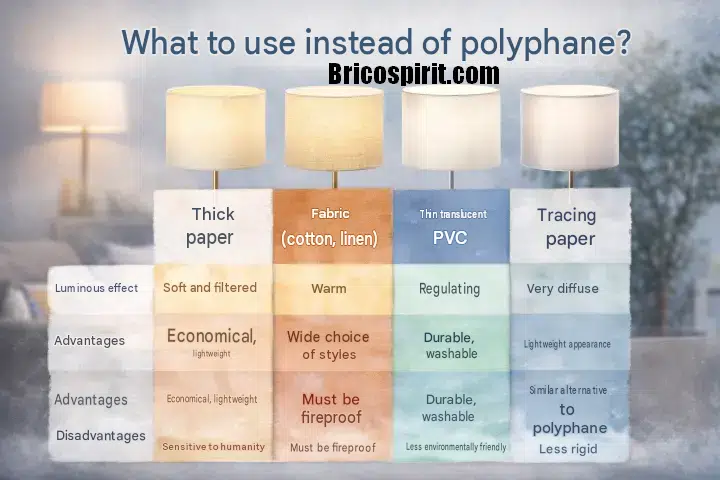
| Alternative material | Light effect | Ease of use | Main advantages | Disadvantages |
|---|---|---|---|---|
| Thick paper | Soft and muted | Easy | Economical, lightweight | Sensitive to moisture |
| Fabric (cotton, linen) | Warm | Medium | Wide range of styles | Must be flame-retardant |
| Thin translucent PVC | Even | Easy | Durable, washable | Less ecological |
| Tracing paper | Very diffused | Easy | Light appearance | Fragile |
| Polypropylene sheet | Neutral | Easy | Close alternative to polyphane | Less rigid |
🌍 Did you know? In Europe, the materials used for manufacturing lighting fixtures sold commercially must pass the incandescent wire test at 650 degrees. The M1 standard designates a non-flammable component, which is why treated papers and plastics are preferred to secure your creations.
PVC and transparent plastic
It’s impossible to talk about alternatives without mentioning PVC: this material offers excellent rigidity and holds up quite well over time. Some craft stores even carry transparent plastic sheets that can perfectly complement or even outperform polyphane for certain uses. For example, I have repurposed lids from large binders or food packaging to create small candle holders, and it works wonderfully!
One small downside: when it comes to cutting, these plastic materials are not always easy to work with. To avoid cracking, use a sharp cutter, steady hand, and a suitable cutting mat. The quality of a clean job really comes down to the method!
⚠️ Common misconception: The classic trap is to believe that the flexible plastic from bottles or recycled packaging will do the job. Under the heat of a bulb, even LED type, these low-quality plastics release toxic VOCs and eventually deform, ruining the shape of your lampshade.
Adhesive vinyl and laminated paper
Adhesive vinyl has become a staple in my workshop. You stick it everywhere, it serves as a semi-rigid support and works well for small structures, even for reusable stencils. I’ve also tried laminated paper, used in offices to laminate posters and documents: cut in large format after passing through the machine, it works perfectly to cover modern lampshade frames or create various decorative accessories.
The advantage of these materials is their ease of handling and the possibility to customize them with patterns or colors. Keep an eye on thermal resistance if you’re working near heat sources, to avoid unpleasant surprises later…
Making creativity rhyme with safety using new materials
For those who like to know they are crafting safely, the choice of material must include the notion of safety. Nobody wants to set the living room on fire during the first nighttime lighting! Safer and sometimes more environmentally friendly solutions are therefore gaining popularity.
At the top of the list, I particularly like to recommend fire-retardant paper. Even placed under a fabric lampshade, its fire resistance provides welcome peace of mind when combining creativity and family at home. There are several weights, different degrees of translucency, and once doubled, it offers a serious alternative to traditional polyphane.
💡 Practical tip: To ensure the safety of your assembly, always maintain a minimum space of 5 cm between the wall of the substitute support and the bulb. Systematically favor LED bulbs of 5 or 7 watts maximum, which heat up much less than older halogen models.
If you are working on a decoration or DIY project, you can also get inspired by these decoration ideas to harmonize an interior or consult a tutorial to make a headboard. For clean and durable finishes, knowing how to smooth a silicone joint can also prove useful.
Bioplastics made from corn starch
If you are looking to make an object using fewer fossil resources, turn to plant-based bioplastics. Sheets made from corn starch are surprisingly easy to handle. As a bonus, this will please those who want to limit the ecological impact of their handmade creations.
Little anecdote: I assembled a lightweight garland with bioplastic found in an organic store, with stunning results! Structurally, it is slightly less firm than polyphane but perfect for playing with light effects without sacrificing green consciousness.
Using polyester (mylar) or washi paper
The potential of polyester, especially in the form of mylar, is underestimated. This reflective and sturdy film is often used to insulate or protect surfaces, but it also adapts well to covering luminous decorative elements. Transparent or metallic, it plays with light in a unique way, a must-try for your most inventive projects!
Those seeking a handmade touch will fall for washi paper, the famous Japanese paper. It diffuses soft light, filters rays without dazzling, and gives the lamp a nearly zen appearance. Tip: position it doubled, or glue it onto a light weave to gain strength.
- Laminated placemat: economical, quickly repurposed, ideal for quick fixes.
- PVC or food-grade plastic: sturdy and easy to maintain, excellent for frequent use.
- Adhesive vinyl: customizable and flexible, helps structure original shapes.
- Fire-retardant paper: essential for safety on all work near heat.
- Bioplastics: ecological advantages, beautiful natural transparency.
- Polyester (mylar): strength, mirror effect, fantastic for innovative light plays.
- Washi paper: perfect for a subdued and noble atmosphere.
Consider ecological and practical alternatives
👍 Strengths
• Significant savings by using reclaimed materials.
• Possibility to create unprecedented and original transparencies.
• Materials often easier to cut with scissors.
🔍 Drawbacks
• Requires purchasing a separate spray adhesive.
• Longer preparation time to degrease the plastic.
• Sometimes less rigidity on large formats.
Just ten years ago, few solutions existed to properly replace polyphane. Today, several materials combine economy, customization, and a responsible approach. Between bioplastics, technical papers, and finds in the school supplies aisle, everyone finds something that suits them.
The idea, as always in DIY, is to test on a sample before launching a whole production. Ask yourself the right questions: what use will your finished object have? What exposure to heat? Do you need perfect transparency, or are you looking for a diffusing effect? Avoid settling on the first material you find without studying it, so you don’t end the evening trying to scrape melted plastic off your pretty base.
Advantages of adopting ecological alternatives
Turning to ecological alternatives can transform the creative process. Not only do you reduce your consumption of petrochemical products, but you also enhance the authentic appeal of the created object. Among my favorites: assembling a light frame with washi paper or incorporating bioplastic to reinforce lightness.
Moreover, more and more associations offer workshops and advice on how to promote domestic recycling in the field of decorative DIY. It’s often an opportunity to share tips, struggles, and great successes over a cup of coffee.
Tips for adapting each material according to the project
Some precautions to keep in mind: cut slowly, always test heat resistance, then cover with fabrics in a ventilated space (especially with plastics and adhesives). When choosing a material, think about the visible surface as much as the internal hold. And always enjoy experimenting: that’s how the best discoveries are made!
Don’t hesitate to mix several types of materials in the same project. Between robustness, aesthetics, and feasibility, blending genres sometimes yields truly beautiful effects, glue syringe or iron in hand. Nothing beats seeing your creation take shape with a homemade, resourceful solution.
What to replace polyphane with: solutions and advice
What materials can replace polyphane for a lampshade?
Thick paper, flame-retardant fabric, tracing paper, or translucent PVC are the most common alternatives depending on the desired lighting effect.
Is fabric safe to replace polyphane?
Yes, provided you use a low-heat LED bulb and treated or flame-retardant fabric to avoid any risk.
What is the closest alternative to polyphane?
Sheets of polypropylene or thin translucent PVC offer a very similar look and durability, while being easier to find.