In the construction field, many terms are commonly used, but they cause quite a bit of confusion. Waterproofing a terrace or a balcony? A veranda or a pergola? A shed or a garage?
Quick summary: attic = volume under the roof → loft = attic used as storage/light habitation.
Also, many people fail to distinguish between attics and the loft. If you are one of them, this article clarifies the issue and explains their difference with detailed explanations.
🗣️ My experience: In April 2026, I visited an old stone building whose listing mentioned a large convertible loft of 40 square meters on the floor. Upon going onto the site, I discovered a very bulky industrial W truss structure, leaving only a residual space that was unusable without a major modification of the framework. The real lesson I took from this visit is that a space under the roof only becomes a true functional loft if the floor is load-bearing and the access is secured by a fixed staircase.
List — Key differences
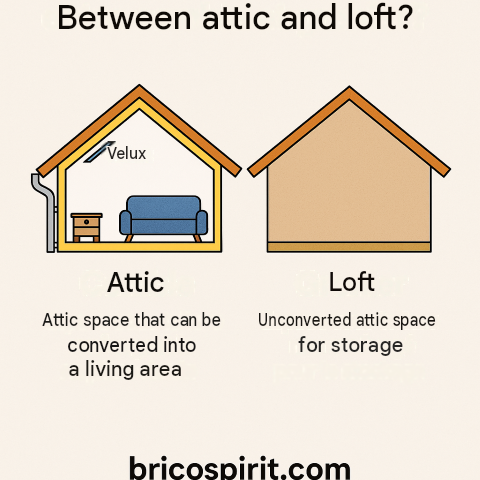
- Attics = volume: structural space under the framework, lost or convertible.
- Loft = function: storage area (or simple room) within the attic.
- Convertibility: convertible attics (height ≥ ~1.80 m, slope/span OK); loft = generally uninsulated, unheated.
- Insulation/Comfort: attics can be insulated/floored; loft often raw.
- Access: hatch/ladder (loft) vs standardized staircase (converted attic like a floor).
My anecdote (site)
I thought “I had a loft” until the day I wanted to insulate it: in reality, it was lost attic space (steep slope, low ties). After a isoplatelage + proper opening, I gained a real small loft for boxes… and halved the heat loss.
Comparison table
| Criterion | Attic space | Garret |
|---|---|---|
| Definition | Volume under the roof (structure) | Use of attic as storage room |
| Status | Technical space or potential living area | Non-habitable room by default (often) |
| Height/slope | Variable (lost vs. convertible) | Often low/irregular |
| Insulation | Possible (blowing, sarking, internal insulation) | Often nonexistent or minimal |
| Access | Hatch or stairs depending on project | Hatch/ladder most often |
| Real estate value | ↑ if convertible (living area after work) | Low impact (non-habitable area) |
| Uses | Technical, future development, air circulation | Storage, archives, seasonal |
What do you find in attic spaces that you don’t find in a garret?
To better understand our ideas, it is appropriate, to begin with, to provide the definitions of the garret and the attic spaces.
Etymologically, the first referred to agricultural warehouses used to store cereals and wheat. Since there is no need to accumulate grains nowadays, it becomes a simple storage place or a storeroom.
The garret is an uninhabited space located on the upper floor of a dwelling. It is situated in the attic space. The latter indicates a place between the ceiling and the roof of the top floor.
🌍 Did you know?
The word garret etymologically comes from the Latin granarium, which specifically designated the elevated place on the farm intended to keep grains safe from ground moisture and rodents.
It should be recalled that the top of a building is a source of heat loss. That is why roof waterproofing and attic insulation are among the works not to be neglected.
According to these definitions, the garret and the attic spaces refer to the same thing when talking about the space they describe. The particularity of the attic spaces lies in the possibility of their development.
The garret, on the other hand, designates a non-inhabited storage place. It can accommodate tools, belongings, or objects that are not used daily. However, they should not be thrown away, as they are needed at some point.
Their difference also lies at the fiscal level. The attic spaces are included in the calculation of property tax. This is not the case with an uninhabited garret.
⚠️ Common misconception
Storing heavy boxes or old furniture directly on the plasterboard of a suspended ceiling under the pretext that the attic space is empty is a frequent mistake. Without a real load-bearing floor fixed on the joists, you risk the immediate collapse of the ceiling of the room below.
Is the garret part of the living area?

As we have just explained above, it is the attic space that refers to a habitable place, because it can be developed. However, a garret is not designed for living in. Moreover, it is too small to provide you with comfortable living conditions.
On the other hand, this part of the house is used to store countless items such as off-season clothes, archives or souvenirs, travel bags, Christmas decorations, fishing gear, or skis. Also, many households use it to store provisions, freeing up space in the kitchen.
Whatever products are stored in the attic, this space must be well ventilated and well insulated. Otherwise, heat and humidity may damage your belongings. In the same context, the musty smell and mold odors can permeate your clothes and household linens.
It should be noted that the attic is not only difficult to access but also located at the top of the building. Therefore, you should not accumulate bulky furniture there. It is not designed to hold heavy objects. Worse still, this could weaken or damage the floor of the loft.
💡 Practical tip
If you use your attic space as a simple auxiliary storage, opt for an airtight retractable staircase. This will prevent the heat from your living rooms from continuously escaping into the cold roof area.
Is an attic taxable?
An unfinished attic will not be subject to property tax calculation. Conversely, the existence of convertible lofts is included.
Similarly, the attic is not among the surfaces to be declared for the residence tax, unlike converted lofts.
When you plan to declare taxes, calculate the size of the space under your roof. Know that an attic must measure a maximum height of 1.80 m. As for the roof slope, it must not exceed 30 °.
If not, the space is called a convertible loft, therefore taxable. Its height is thus greater than 1.80 m. It is fiscally counted as a habitable area.
What are the different types of lofts?
There are 2 types of lofts, namely lost lofts and convertible lofts. The first refers to a space that cannot be inhabited.
Not only does it not meet the height requirement, but also the size. However, it remains possible to convert it, but the work can be expensive and longer.
As for the second, it refers to rooms under the roof that are habitable and easily accessible. The roof slope must be greater than 35° and the height will be greater than 1.80 m.
If you plan to convert it, know that the work is generally more limited. It usually involves redoing the floor covering, insulating the roof, and installing electricity and partitions.
👍 Strengths
- Creation of a useful storage volume without increasing the footprint
- Obvious financial enhancement of the house’s value
- Easy access to check the condition of the roof covering and tiles
🔻 Limitations
- Requires costly structural floor joist reinforcement work
- Possible increase in development tax depending on the region
How to declare your attic space to the tax authorities?
When you plan to convert your attic, it allows you to create a living area within the house. It is important to inform yourself about the administrative procedures to avoid making a mistake.
When the new living space measures more than 20 m², you must submit a building permit application. Otherwise, a prior declaration of work may suffice.
If you intend to add a skylight or modify the framework, it is mandatory to submit a work declaration to the town hall.
Finally, do not forget to declare the new living area to your home insurance. In case of water damage, fire, or other types of incidents, the insurance can cover the costs.
Check if your attic space meets conversion requirements and estimate costs.