📋 In brief: Personally, I consider fiber-reinforced leveling to be the ideal solution for correcting an uneven floor while strengthening its resistance. In nearly 75% of renovations, it helps avoid a complete removal of the existing substrate. With careful preparation and proper dosing, you get a perfectly flat surface in a few hours. It’s an accessible technique, provided you follow the key steps.
Before laying the flooring, professionals often talk to you about floor leveling. More specifically, they recommend fiber-reinforced leveling.
Yet, you’re not quite sure you understand the technique. To help clarify things, let us provide you with more information.
🎒 On site: During a living room renovation, I tried a traditional leveling on a cracked floor. Result: microcracks reappeared after drying. I redid it with fiber-reinforced leveling, and the surface remained stable over time. Since then, I always favor this solution on fragile substrates. The lesson: it’s better to anticipate the floor’s constraints.
But to better clarify the subject, it is important to first explain what is meant by leveling.
What is leveling?
Leveling is a widely used process in construction. Whether it’s self-leveling screed or self-levelling screed, these terms refer to a layer of mortar designed to correct flatness defects and irregularities of a floor.
Indeed, the floor is supposed to receive the covering. However, it has imperfections. The leveling product is used to fix dips, bumps, or other level problems.
It is not only applied on a concrete slab. You can also apply it on ceramic stoneware or terracotta floor tiles, on a plastic slab, a cement screed, wood-based panels, a painted floor, and other coverings.
Conversely, floor leveling cannot be done on a floating floor or carpet. Likewise, it is not suitable for very damp floors.
To go deeper, I recommend precise concrete dosing which complements this topic well. tile laying also offers useful insights. And to go further, click-tile flooring provides interesting perspectives.
When should floor leveling be used?
To know if your floor needs it, take your mason’s ruler and assess the level differences. Leveling is only applied in thin layers.
If the floor imperfections seem minor to you, use a leveling coat. Otherwise, you need to choose another product.
There are different types, and each category is suited to a particular context. For example, we distinguish between indoor floor leveling and outdoor.
The first must be covered by a flooring. As for the second, this product is applied on balconies or terraces. It can be left bare.
Besides that, there are also leveling products for quick covering. Some are suitable only for underfloor heating, others for anhydrite screed.
Fibered floor leveling is among the most sought-after products by professionals. In renovation as well as in construction, it is especially reserved for sensitive and difficult substrates such as wood, derived panels, parquet, wooden floors, and many others.
🌍 Did you know?
A fibered leveling compound can compensate for irregularities up to 3 cm while greatly limiting the risk of cracking.
Why choose fibered leveling?
✅ Advantages
- High resistance
- Limits cracks
- Suitable for irregular floors
👎 Disadvantages
- Slightly higher cost
- Technique must be strictly followed
To better understand the advantages of fibered leveling, it is appropriate to provide a brief definition. Like any type of floor leveling, the product represents a layer of mortar made up of water, cement, and sand.
It is distinguished by its composition of metallic, mineral, or ceramic fibers. These elements spread in all directions to ensure the mortar’s robustness.
Due to its quality structure, the planifibre mortar leveling is capable of repairing major imperfections in the substrate.
As for the fibered leveling thickness, it can be substantial, unlike other varieties. The product can be applied in a thick layer to correct flatness defects or to conceal bumps.
It can be laid on a substrate with differences of 2 to 3 cm in depth. Note that there are two types of fibered leveling depending on the degree of irregularities.
Fibered self-leveling is perfect for imperfections up to 2 cm maximum. Fibered self-levelling, on the other hand, is intended for roughness of 2 to 3 cm in depth.
In this respect, fibered leveling is a better renovation solution for very damaged substrates. It demonstrates greater strength than classic leveling. It can fill holes up to 30 mm.
Other advantages of fibered leveling
Fibered leveling for renovation or construction is suitable for both indoor and outdoor floors. It is adapted to almost all substrates including tiles, concrete, synthetic slabs, or wooden floors. In short, it allows correcting the roughness of hard floors before applying a new covering.
It does not only attract professionals, due to its versatility or its high thickness. The fibered self-leveling coating is highly appreciated because it also offers rapid hardening and great durability.
Thanks to this technique, there is no need to create a screed. The fibers contained in the product perform the role of reinforcement. Fibered leveling provides high resistance to the floor.
It is not only used to level a hard substrate. It is also the ideal option to repair a weakened surface such as wood or cracked tiles.
The steps for carrying out fiber-reinforced leveling
With all the advantages mentioned above, fiber-reinforced floor leveling is unlikely to disappoint you. To achieve a better finish, it must be applied with extreme care. We invite you to discover some tips and steps for its execution.
⚠️ Common pitfall
Neglecting the bonding primer is a frequent mistake. Without it, the leveling compound may detach or adhere poorly to the substrate.
List of tools to assemble
| Material | Average price | Use | Frequency |
|---|---|---|---|
| Fiber-reinforced leveling compound | 20 to 40 €/bag | Leveling | Essential |
| Mixer | 50 to 150 € | Homogeneous mixing | Frequent |
| Mason’s rule | 20 to 60 € | Smoothing | Essential |
| Bonding primer | 15 to 30 € | Adhesion | Systematic |
To proceed with the application of self-leveling smoothing compound, it is necessary to equip yourself properly.
A sharp cutter is very useful during substrate preparation before work. This tool helps you remove glue marks or stubborn dirt from the floor.
Likewise, you need a vacuum cleaner and a soda solution to dust and clean the surface. Also equip yourself with a mason’s rule to take measurements.
When applying Planifibre mortar leveling compound, the product can spread everywhere. Protect the lower part of the wall with masking tape. In addition, add a trowel to your list to smooth the product on the substrate.
Professionals also sometimes use a measuring cup, a trowel, a tiler’s spatula, a mixing whisk, mixing buckets, and many other accessories.
Preparation of the substrate
Whether you are applying fiber-reinforced self-leveling compound or self-leveling compound, proper substrate preparation is essential. Start by inspecting its condition.
Like most work, the floor must be clean, dry, and sound. To achieve this, vacuum the surface to remove all dust. Take the opportunity to remove mold and traces of glue, paint, oils.
If the substrate appears very dirty, it will need to be washed with an appropriate product and then rinsed. Wait until the floor tiles are completely dry before moving on to the next phase.
If you are carrying out renovation work, it is advisable to remove the door threshold strips. Also remember to protect the base of the wall with masking tape to avoid staining the area.
Once this step is done, check the moisture level of the substrate. The solution depends on the severity of the situation. If necessary, do not hesitate to install a barrier against rising damp. Otherwise, your floor covering will detach too soon.
Now measure the height or depth of the imperfections to be corrected. This step helps you choose the product suitable for leveling defects. If the floor has holes or cracks, fill them with a repair mortar.
💡 Practical tip
Allow a drying time of 24 to 48 hours before laying a covering, and always mix the product according to the indicated dosages.
Application of the bonding primer
The next step is to determine the porosity level of the floor tiles. This helps you know whether or not to use a bonding primer. The latter ensures the adhesion of the coating.
With the infinite number of products on the market, make your choice according to the characteristics of the floor. Its application is clearly detailed on the packaging.
Whatever the manufacturer’s recommendations, it must always be applied on a clean surface.
Application of fiber-reinforced leveling compound
Before this operation, it is first imperative to prepare the fiber-reinforced floor leveling compound. In the bag packaging, the manufacturer explains how to mix the product.
You must take into account the amount of water and the dimensions of the surface to be covered. Professionals often use an electric mixer to make the coating homogeneous.
To simplify the work, it is preferable to opt for the self-leveling fiber-reinforced compound. This one is easier to apply. If your work consists of improving the interior of your home, prefer the special fiber-reinforced renovation leveling compound.
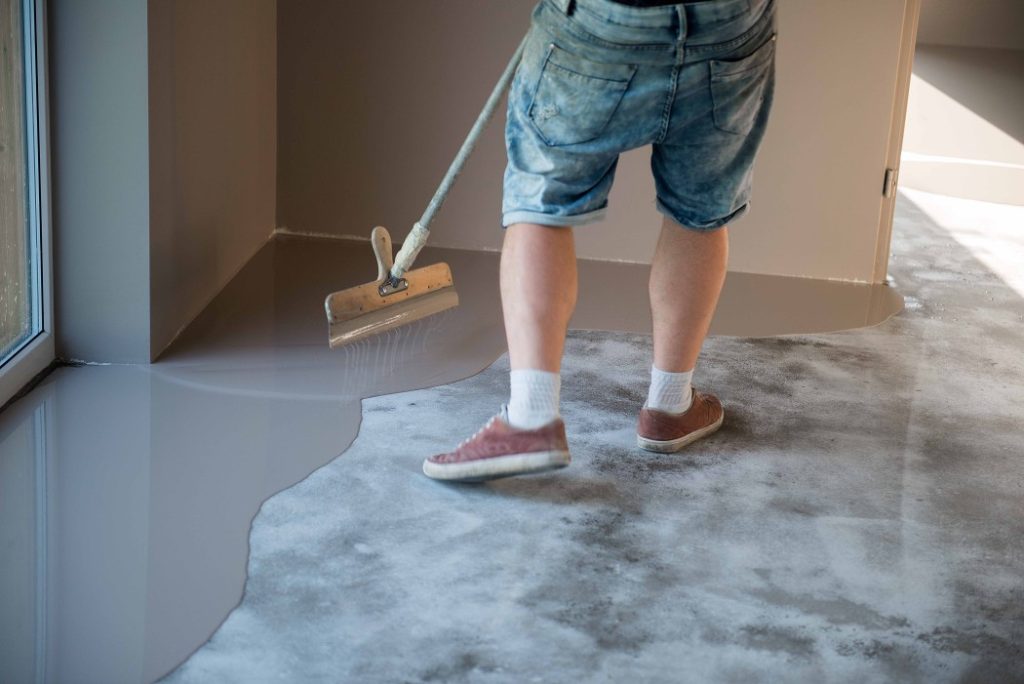
That said, now apply the fiber-reinforced leveling compound at a good thickness. Use a smoother or trowel to spread it evenly.
Respect the necessary drying time before walking on the surface or laying a covering.
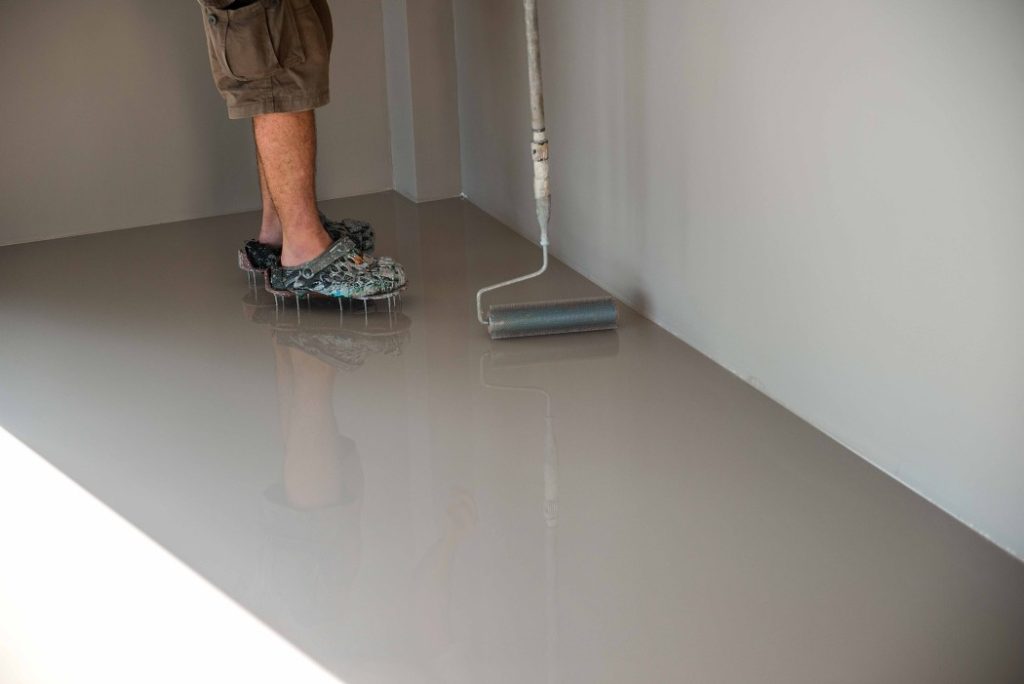
If you do not wish to cover it but leave it bare, it is recommended to use a de-bubbling roller. A few passes help solve bubble problems so that the floor is perfectly smooth.
If your surface is a wooden floor, doing the fiber-reinforced leveling must follow certain instructions to avoid material rot. The task requires, for example, a moisture diagnosis to help you check its condition.
The price of fiber-reinforced leveling compound
According to most people, the fiber-reinforced leveling compound price may seem quite high compared to other traditional mortars.
Since this product has an exceptional composition ensuring its resistance, it is normal that it is expensive.
Moreover, regardless of the fiber-reinforced leveling compound thickness, it must be admitted that its application remains a time-consuming activity. This increases labor costs when you hire a specialist.
The fiber-reinforced leveling compound is sold in 25 or 30 kg bags. Consider comparing prices to help reduce your expenses.
A 30 kg bag of fiber-reinforced leveling compound is on average available for about 30 €. You need about 1.5 kg of product to level one square meter. As for the price of fiber-reinforced leveling compound per m², the rate ranges between 8 and 14 €, excluding installation costs.
If you hire a professional, the price of self-leveling smoothing compound ranges between 10 and 30 € per square meter.
Prepare a budget of between 300 and 450 € to carry out the smoothing of the floor tiles in a 15 m² room. This cost includes all services such as floor and wall preparation, application of the smoothing compound, as well as finishing.
Choosing the right floor smoothing compound
To make your choice easier, the products on the market can be categorized into 3 main families.
There is the traditional type smoothing mortar which consists of 2 or 3 parts sand, one part cement, and one part water. Unlike fiber-reinforced renovation smoothing, this mortar is very fine.
The modern smoothing mortar is often available in powder form. It must be mixed with precise amounts of water to prepare it properly.
Generally, the fiber smoothing bag weighs between 25 kg and 30 kg. On the bag packaging, the manufacturer always specifies the recommended amount of water.
The third category is the special floor smoothing compound. As its name suggests, it is designed for a very specific substrate.
For example, there is a product intended only for porcelain stoneware slabs or terracotta tiles.
Not every self-leveling smoothing compound is necessarily suitable for wooden floors. This substrate requires a distinctive product that does not harm its characteristics.
When selecting self-leveling smoothing compound for floor or wall, think about defining your objective. If you plan to apply the smoothing compound outdoors, only favor products that meet this condition.
For an interior fiber-reinforced floor smoothing compound, it often serves a decorative function. Many products are already colored. You have a wide choice to match your interior decor style.
The white floor smoothing compound makes your living room bright, while the black one highlights your white furniture. For a contemporary theme, prefer the gray self-leveling smoothing compound. This option has recently become very trendy.
Why do a fiber-reinforced leveling?
u003cbr/u003eWhen your terracotta or porcelain stoneware tiles are damaged, you can fix them with fiber-reinforced self-leveling compound. Versatile, it treats delicate floors as well as hard floors.u003cbr/u003e
Who can do a fiber-reinforced leveling?
u003cbr/u003eEntrust this task to a qualified construction company. They work with a team of professionals capable of carrying it out according to the rules of the trade.u003cbr/u003e
How to do a fiber-reinforced leveling alone and cheaply?
u003cbr/u003eIf you master construction trades, hiring craftsmen becomes a waste. However, equip yourself with all the necessary tools and high-quality products to achieve better results.