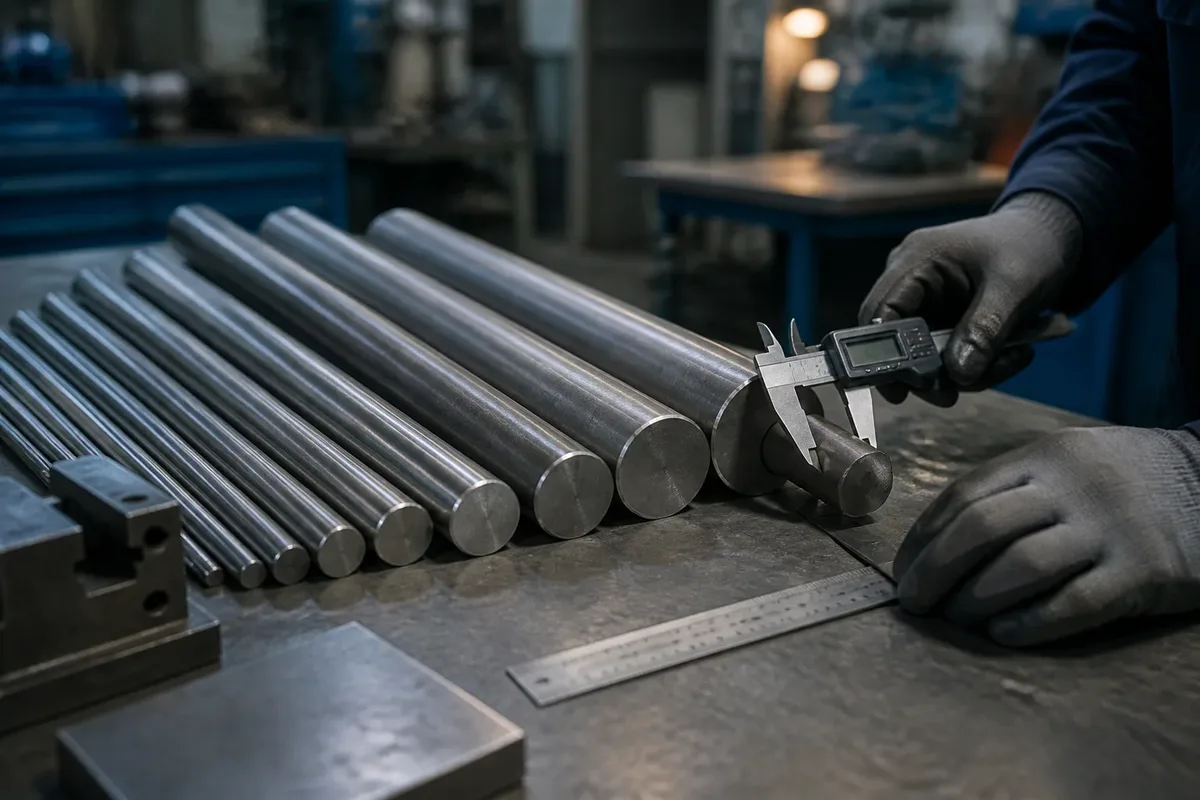
A custom solid round steel bar allows you to choose the necessary diameter and length, then order a cut adapted to the project. The commercial offers consulted mainly propose diameters between 6 and 40 mm for the solid round bar, while the round tube belongs to another product family.
The right purchase therefore begins with a simple distinction: solid piece or hollow profile. Then you must specify the grade, diameter, unit length, quantity, and the condition of the ends. A poorly requested cut sometimes costs less on the quote but more during machining or assembly.
| 🔩 | Product: solid round steel bar, not hollow round tube |
| 📏 | Dimensions: diameter, length per piece, and total quantity |
| 🧱 | Material: raw steel or grade specified by the supplier |
| ✂️ | Cut: straight cut, deburring, or machining rework |
| 💶 | Price: material, length, cut, packaging, and transport |
| 📦 | Order: a minimum piece announced, with cuts starting from 10 mm on one offer |
How to identify the round bar suitable for the project?
A solid round bar is suitable when a massive metal section is needed, machinable or weldable, with a defined diameter. The round tube is suitable when weight, internal passage, or making a frame matters more. For a piece that must receive a transverse drilling, threading, or lathe rework, go for the solid round bar.
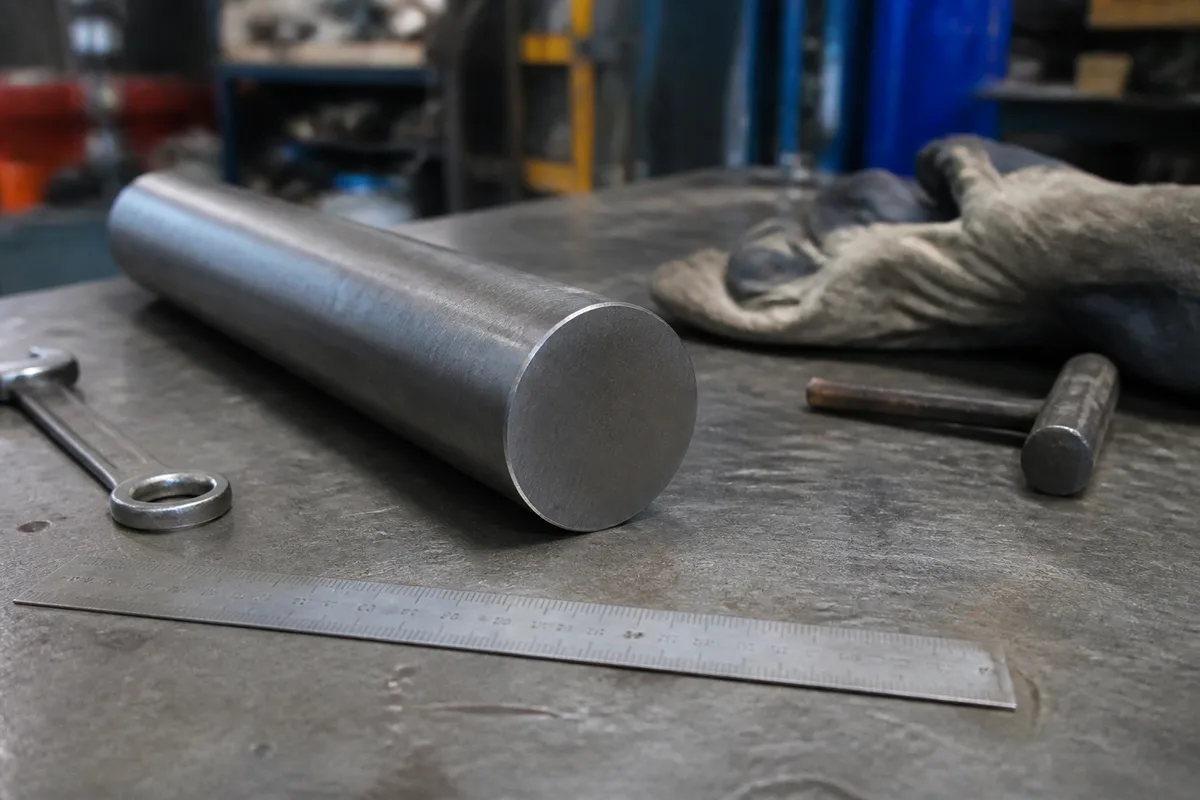
The first trap is the confusion between outer diameter and material diameter. For a solid round bar, the order indicates only the nominal diameter. For a tube, it must also specify the wall thickness. Ordering a 20 mm tube expecting to receive a massive 20 mm bar results in a much lighter and mechanically different piece.
But the profile alone is not enough to decide. A decorative piece, an unstressed shaft, or a spacer do not require the same preparation as an element welded into a metal structure. For industrial uses or repeated assemblies, the cut, straightness, and traceability take real importance. Broader applications are detailed in this article on custom steel bars.
- Choose the solid round bar for continuous material and machining rework.
- Choose the round tube for a hollow profile, especially in a frame or light structure.
- Refuse a reference that does not clearly specify diameter, length, and surface condition.
Diameter, grade, and surface condition: the characteristics that matter
The diameter is chosen based on the function of the piece, not based on the nearest availability. The cited commercial offers announce different ranges: 6 to 30 mm for one, 8 to 40 mm for another. These ranges describe particular catalogs, not a universal range of solid round bars.
To estimate the mass before ordering, use the indicative formula: m ≈ 0.006165 × d² × L, with d in millimeters and L in meters. Thus, a 12 mm solid round bar of 2 m represents about 1.77 kg of theoretical material. The calculation is based on a nominal steel density of 7.85 kg/dm³; tolerances and extra thicknesses can modify the delivered mass.
However, the diameter alone does not indicate the actual strength of an assembly. A commercial offer mentions the grades S235, S275, and S355 for hot-rolled round bars, but the grade must be linked to the datasheet of the ordered product. Mechanical strength, weldability, and machinability cannot be chosen with the sole word “steel”.
For a welded part, an easy-to-weld grade simplifies preparation and limits unpleasant surprises related to the heat-affected zone. For a part intended to be turned, drilled, or threaded, machinability becomes a priority. In the presence of moisture or corrosive agents, raw steel requires appropriate protection after manufacturing; paint applied on a greasy or poorly prepared surface does not hold by magic.
A hot-rolled bar may have a manufacturing skin and ends that are less clean than a calibrated or drawn bar. This is suitable for a part that will be reworked, welded, or painted after preparation. It becomes insufficient for an assembly where the diameter and surface condition must remain consistent along the entire length.
The order must therefore use the exact words: solid round, nominal diameter, cut length, announced grade, raw state or requested preparation. To deepen the difference between the available sections, consult this presentation of the custom steel profile, useful when the round bar is ultimately not the right geometry.
How to order a custom steel round bar without missing the dimensions?
To order properly, first gather the characteristics in a manufacturing line: grade, diameter, unit length, quantity, cut, and finish. An offer indicates a minimum quantity of one piece, a cut starting from 10 mm, and pricing per millimeter. These conditions belong to this offer and do not apply to all sellers.
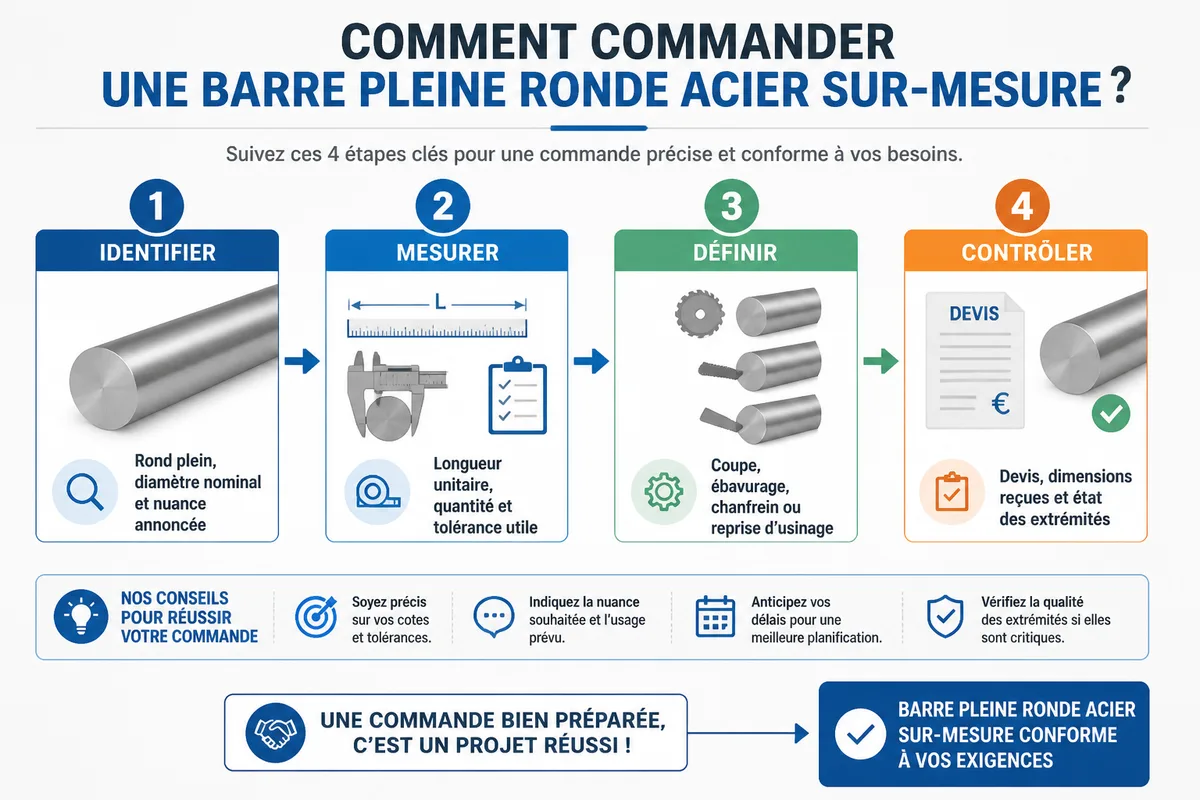
Yes, with the right dimensions.
Step 1: define the part
Write one reference per line, even for a small order. Example: “solid steel round, diameter 16 mm, length 420 mm, 4 pieces”. Add the grade if it is imposed by the plan or the manufacturing file. The expected result is a designation impossible to confuse with a tube or a flat bar.
Step 2: set the useful dimensions
Measure the finished length, then decide if an overlength is necessary for straightening, turning, or cutting to length in the workshop. An unnecessary overlength increases material and rework. A length that is too short condemns the part: the removed metal cannot be recovered.
Step 3: specify the cut and the ends
A standard straight cut is sufficient for a part that will be welded or reworked. Request special preparation only if the end goes directly into an assembly, receives threading, or must be handled without sharp edges. Deburring removes cutting burrs; it does not transform an end into a precision machined face.
Step 4: compare the total price
The final price adds the material, the billed length, the cut, additional operations, packaging, and transport. One commercial offer indicates as a guideline €1.66 including tax per meter and €1 including tax for cutting; another shows starting prices of €3.59 for a 6 mm solid round and €4.54 for an 8 mm diameter. These amounts are not comparable without knowing the length, quantity, and associated fees.
A custom manufacturing is announced between 2 and 12 working days in one offer. Another announces delivery between 3 and 10 days depending on stock. These deadlines do not necessarily cover the same period: manufacturing, preparation, shipping, and transport must be separated in the quote. To understand the formation of the amount, also see the criteria of the price of a custom steel bar.
Common Errors in Quotation and Reception
An order for solid round bar rarely fails because of the metal itself. It fails because a dimension is missing, a tube was chosen instead of a solid bar, or an assumed finish does not appear anywhere on the quote. The order document must exactly match the part that will be measured upon receipt.
For a professional request, a material certificate may be required. The 3.1 type document describes compliance issued by the manufacturer and must be linked to a specific batch, notably by a heat number. It must be requested with the order if traceability is necessary; a bar received without batch identification does not allow this proof to be reconstructed afterward.
- Confusing solid round bar and tube: the cross-section and weight change. Write “solid round bar” in the designation.
- Giving a length without tolerance: the cut obtained may be suitable for welding, but not for a fitted assembly. Specify the actually useful tolerance.
- Forgetting the end finish: a burr can hinder fitting or cause injury during handling. Request deburring if the part is handled as is.
- Comparing two initial prices: one may include cutting, the other charge it separately. Compare the total for the same length and quantity.
- Demanding a grade without a defined use: a stronger grade does not fix a poorly chosen diameter nor a poorly designed assembly.
To check the delivery, measure the diameter on a clean area, note the length of each piece, and observe the ends. A cut mark, a burr, or a slight difference in appearance does not automatically mean non-compliance; it becomes a problem if it contradicts the ordered finish or prevents the intended use.
Before validation, transfer the dimensions from the quote onto your drawing and check the end that will actually be assembled: it is this detail, more than the price displayed per millimeter, that decides if the custom steel round bar will properly do its job.