ol.mg-steps{list-style:none!important;counter-reset:mgstep;margin:1.6em 0;padding-left:0!important}ol.mg-steps>li.mg-steps__item{counter-increment:mgstep;list-style:none!important;padding-left:0!important;padding-bottom:1.4em}ol.mg-steps>li.mg-steps__item:last-child{padding-bottom:0}ol.mg-steps>li.mg-steps__item>:last-child{margin-bottom:0}ol.mg-steps>li.mg-steps__item>.mg-steps__title{margin:0 0 .25em;font-weight:600}ol.mg-steps>li.mg-steps__item>.mg-steps__title::before{content:counter(mgstep) “. “;opacity:.45;font-weight:500;font-variant-numeric:tabular-nums}ol.mg-steps>li.mg-steps__item:not(:has(.mg-steps__title))::before{content:counter(mgstep) “. “;opacity:.45;font-weight:500;font-variant-numeric:tabular-nums}.mg-kpis{display:grid;grid-template-columns:repeat(auto-fit,minmax(140px,1fr));gap:14px;margin:1.5em 0}.mg-kpi{padding:1em .9em;border:1px solid #e5e7eb;border-radius:12px;background:#f9fafb;text-align:center}.mg-kpi__value{display:block;font-size:1.7em;font-weight:800;line-height:1.15;color:#111827}.mg-kpi__label{display:block;margin-top:.35em;font-size:.85em;color:#6b7280;line-height:1.35}
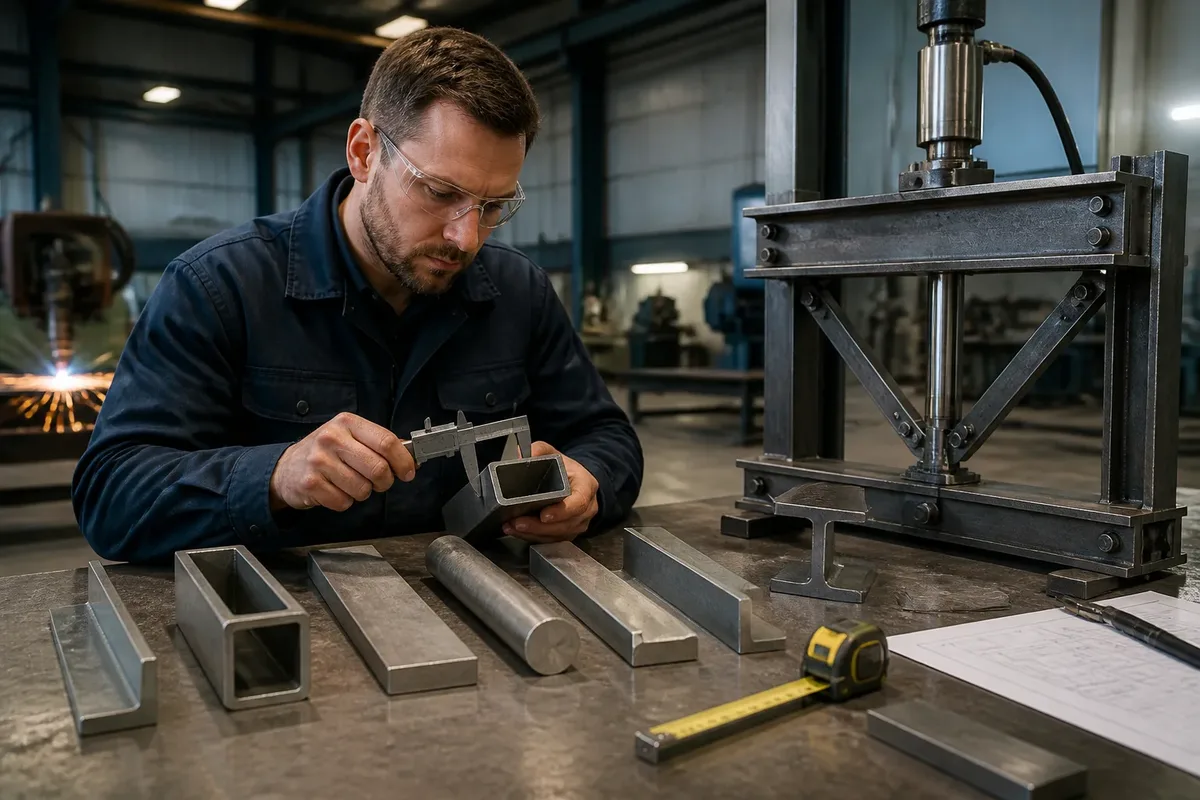
For a custom steel profile angle iron tube iron, the choice is not limited to the word “iron”: angle irons, tubes, flat irons, round or square irons, as well as U and T profiles, cut to the desired length, are ordered. The right shape depends on the geometry, dimensions, thickness, load, environment, and desired finish.
An angle iron is mainly used to create or reinforce a corner, a tube forms a closed structure, and a solid bar better withstands localized forces or machining. The commercial offers observed include square, rectangular, and round tubes, equal or unequal angle irons, as well as sections like 40 × 20 × 1.5, 2, or 3 mm; these references remain to be confirmed depending on stock and vendor.
| 📐 | Angle iron: L-shaped section for accessible corners, frames, and reinforcements. |
| ▣ | Tube: hollow square, rectangular, or round section to stiffen while limiting weight. |
| ▬ | Iron: imprecise term often referring to a flat, round, square, or solid bar. |
| 🧰 | Custom: length, quantity, drilling or additional operations to specify in the quote. |
| 🛡️ | Finish: raw steel, paint, galvanization, or treatment adapted to exposure. |
| ⚠️ | Load-bearing structure: a photo and a table do not replace calculation or verification by a professional. |
Which steel profiles can be ordered custom-made?
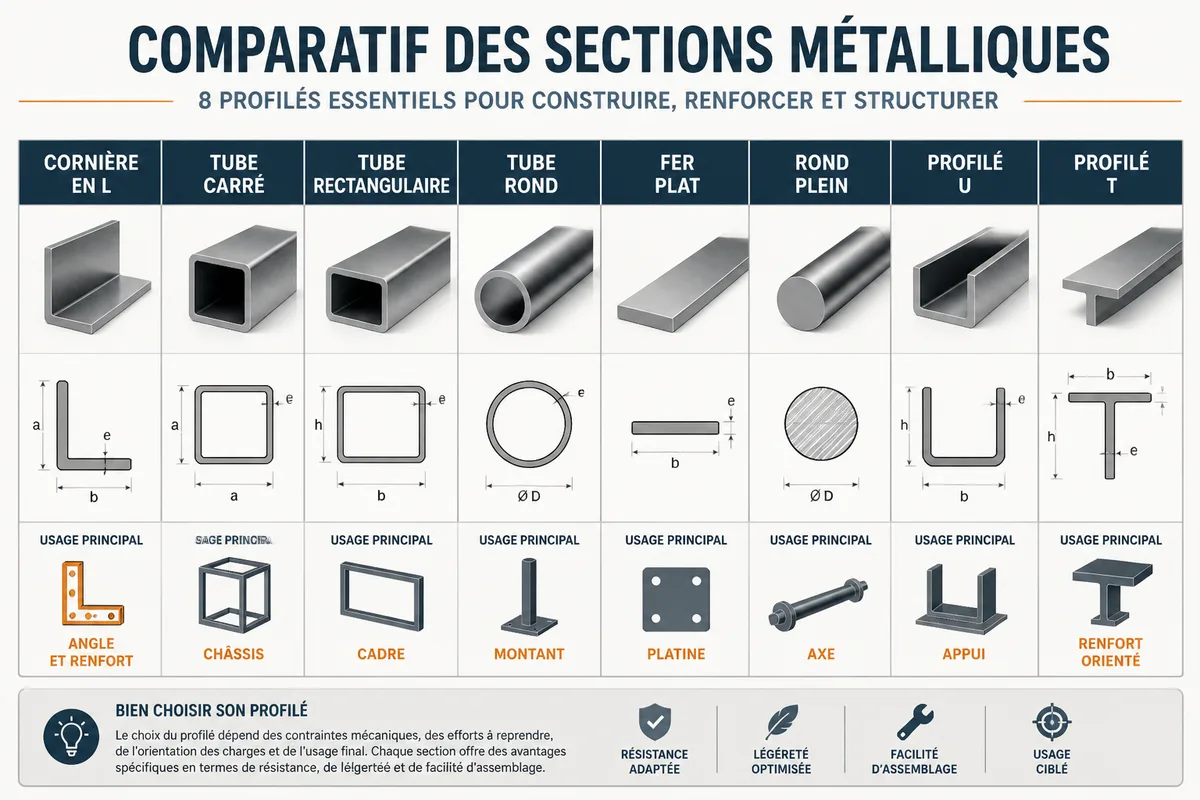
However, a custom steel profile is first chosen by its section, not by its commercial name. The angle iron offers two L-shaped flanges; the tube encloses its material around a void; the flat, round, or square iron generally remains solid. This difference dictates how to fix, weld, protect, and load the piece. A solid bar can then be compared according to section, length, and intended use.
Equal and unequal angle irons
The equal angle iron has two flanges of the same width, while the unequal angle iron favors one longer side. It is suitable for a frame, a reinforced bracket, a wall mount, or a connection between two perpendicular planes.
One flange can receive screws or bolts while the other rests on the support. This accessibility simplifies assembly, especially when the inside of a tube would be impossible to reach. A commercial offer consulted mentions sections ranging from 20 × 20 × 3 to 90 × 90 × 9 mm and also cites an example in 100 × 100 × 10 mm: these are not universal dimensions, they must be confirmed in the chosen catalog.
Square, rectangular, and round tubes
The square or rectangular tube provides regular faces for a chassis, a base, a gate frame, or a metal piece of furniture. The round tube fits better on a cylindrical post, a handrail, or a piece subjected to forces distributed around its axis.
The interior void saves material compared to a solid bar of comparable dimensions, but it requires checking the wall thickness and how the ends will be closed. A through hole, a poorly adjusted weld, or water left inside the tube can become the first weak point.
Flat, round, square, U and T bars
The term “bar” remains too vague to order properly. You need to ask for a flat bar, a solid round bar, a solid square bar, a U profile, or a T profile, then specify the cross-section and thickness when this concept applies.
The flat bar is used to make a bracket, a clamp, or a reinforcement; the solid round bar is more suited for an axle, a handle, or a spacer; the solid square bar provides a compact geometry. U and T profiles are useful when the shape must guide a support or distribute a connection over a web and flanges. To compare solid sections without mixing uses, also consult this guide on steel bar dimensions.
How to choose the right section for the load and assembly?
For a light frame, a square or rectangular tube is generally the most coherent choice; for connecting two planes, an angle iron is more straightforward; for a concentrated force at one end, a solid bar is more relevant. The span, direction of forces, supports, and fastening must be known before discussing dimensions.
The tube is suitable for the chassis.
The square or rectangular tube is better positioned when the part must keep flat faces and good rigidity in several directions. The angle iron is suitable here, the tube is not, when two flanges must be screwed separately onto two perpendicular supports. The solid bar wins when threading, handling a local force, or machining the entire material without cavity is required.
The largest visible section is not automatically the strongest in your assembly. A poorly oriented angle iron can deform, a thin tube can crush under clamping, and a solid bar can weigh unnecessarily heavy over a long length. The choice is made with the actual support points and assemblies, not by comparing dimensions taken from a catalog.
However, for a heavily loaded shelf, a beam, a guardrail, a mezzanine, or any part whose failure could injure someone, I cannot approve a section remotely. The S235 or S275 grade, sometimes offered in catalogs, is not enough to size a structure: you need to know the span, loads, supports, buckling, welds, and fastenings. Have the assembly checked by a competent person.
Shape, thickness, and grade
Wall thickness is decisive for a tube: it influences resistance to drilling, crushing, and welding. For an angle iron, the thickness of the flanges matters as much as their width. For a solid bar, the section and length influence mass and rigidity.
- Describe the load and its position, rather than just writing “solid structure”.
- Indicate the clear span between supports and how the part will be fixed.
- Request the grade, material datasheet, and certificate if traceability is necessary.
- Do not confuse a section available in the catalog with a section calculated for your use.
Machining and accessibility
The angle iron leaves its two faces accessible for drilling and bolting. The tube sometimes requires captive nuts, inserts, or end preparation; its interior is not easily recovered after closure.
The solid bar can be cut and drilled without internal voids, at the cost of higher material consumption and weight. For a round bar intended for an axle or a handle, also see this guide dedicated to custom round steel bars.
Custom steel cutting: which operations and what information to provide?
Thus, an actionable request does not just say “a two-meter angle iron”. It specifies the shape, section, thickness, grade, length, quantity, finish, and final use. Depending on the workshop, the service may include straight cutting, drilling, complex cutting, bending, or preparation for welding.
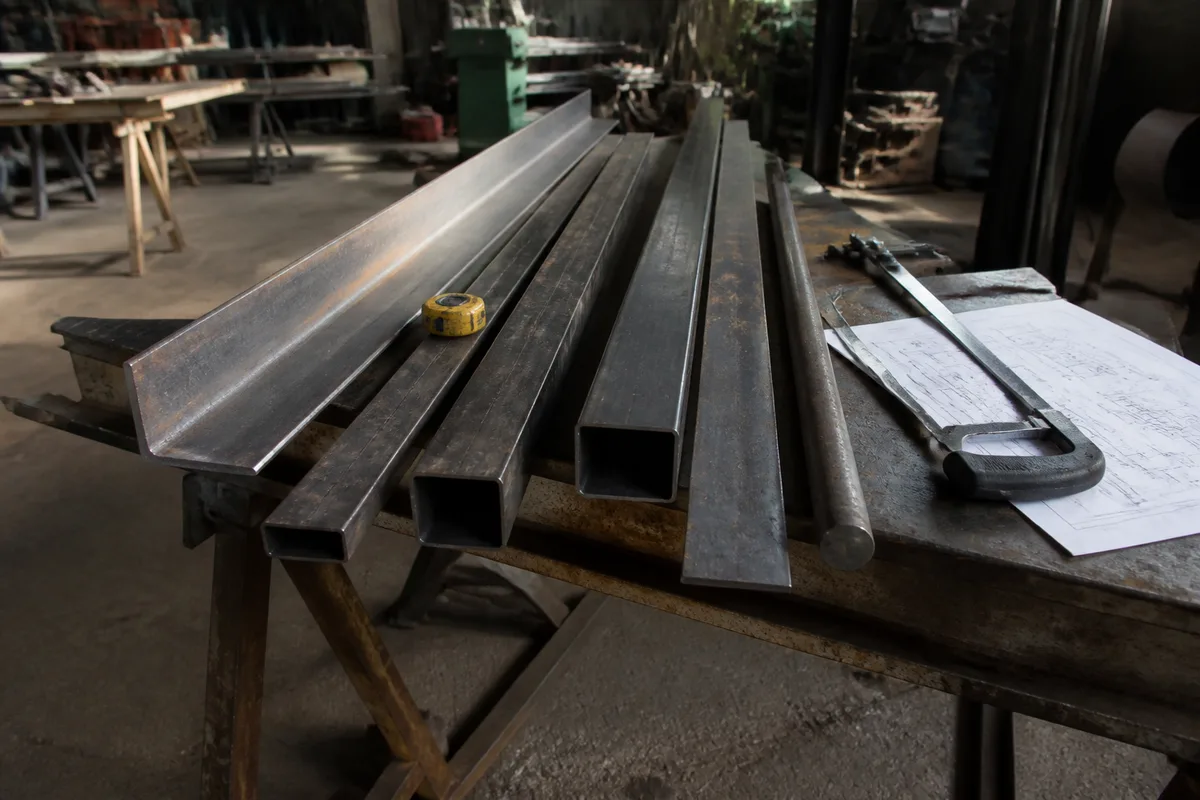
But an added operation changes the way of manufacturing and sometimes the tolerance obtained. A drilling must be positioned relative to an end and a face; a bending requires a radius and an orientation; a weld demands clearances and can cause deformation. Write these elements on a drawing, even a simple one, rather than leaving them in a phone exchange.
A CAD file can help for a repetitive part, while a dimensioned sketch is sometimes enough for a straight cut. In both cases, indicate the functional dimensions: those that must be respected for assembly. A cutting tolerance announced by a seller says nothing about the precision of a drilling or the deformation after welding.
And don’t forget accessibility. A perfectly cut part can become impossible to bolt if the nut is trapped behind a tube or if the wrench no longer fits after welding. Plan for assembly clearances, necessary chamfers, the order of assemblies, and the areas that will remain visible.
- Geometry: equal or unequal angle iron, square, rectangular or round tube, flat bar, solid round, square, U or T profile.
- Dimensions: cross-section, thickness, finished length, and quantity of parts.
- Transformation: cuts, drillings, bending, notches, chamfers, or welded parts.
- Finish: raw, painted, galvanized, or special treatment compatible with the use.
- Documents: dimensioned drawing, CAD file if necessary, tolerances, and intended use of the part.
Finish, price, and delivery: the details that change the order
Protection depends on the environment: raw steel may be suitable for a dry workshop and painted after preparation, while a part exposed to humidity requires protection planned before assembly. Galvanization also protects external areas, but cuts, drillings, and welds must be properly treated after intervention.
For an indoor part with little exposure, raw steel can remain rational if deburring, degreasing, and painting are planned. Outdoors, paint applied on a greasy or rusty surface will not last long. Hot-dip galvanizing can be relevant for truly exposed parts, provided the allowable dimensions, necessary vents for closed tubes, and compatibility with welds are checked.
The finish is decided before drilling and welding, not after rust. A galvanized angle iron cut on site loses its protection on the cut; a closed tube can retain water; an assembly of different metals can accelerate corrosion on contact. For aggressive use or high aesthetic requirements, ask for the exact treatment and included surface preparation.
Prices displayed online are introductory prices, not a universal rate. Commercial references have been shown between €3.47 and €8.36 for flat bars, round bars, tubes, or angle irons; an equal angle iron of 20 × 20 mm appeared from €5.85, and a 30 × 30 mm from €7.05. These amounts are linked to a specific offer and must be rechecked in 2026 with the length, quantity, cut, finish, delivery, and applicable tax.
Announced lead times are not decided with a promise of “fast delivery.” A commercial page mentions 3 to 10 days for an angle iron depending on stock, while others speak of a few days or express service. The actual lead time depends on the section, length, requested operations, and carrier: ask for a date for the exact reference.
Long profiles are not transported like small screws. Packaging can range from cardboard to pallet depending on weight and length; an observed offer distinguishes small parts under 30 kg and parts shorter than 1.2 m shipped on pallets. These are commercial conditions specific to the seller, not a general rule.
Angle iron, tube, or bar: which choice according to your project?
On the other hand, the right choice becomes quite clear when the use is described precisely: angle iron to connect two planes or reinforce a corner, tube for a closed and regular frame, solid bar for a compact part or a local force. The U or T profile takes the advantage when it offers a bearing surface or better-oriented rigidity than the three main families.
| Profile | Relevant Use | Main Advantage | Limitation to Watch |
|---|---|---|---|
| L-angle iron | Corner, frame, reinforcement, bracket | Two accessible flanges | Stiffness dependent on orientation |
| Square or rectangular tube | Chassis, legs, frame | Closed structure and regular faces | Interior difficult to reach |
| Round tube | Upright, handle, tubular element | Shape suited to forces around the axis | Less immediate flat attachment |
| Flat bar | Tab, clamp, reinforcement, plate | Flat face easy to fix | Less suited to a closed structure |
| Solid round or square | Axle, spacer, handle, machining | Compactness and continuous material | High mass over long length |
| U or T profile | Support, rail, oriented reinforcement | Specialized geometry | Assembly sometimes less accessible |
The tube is the preferred choice here, not the angle iron.
This decision applies to a closed frame whose four regular faces must remain clean. Conversely, an angle iron is essential to repair or reinforce an existing corner, as it can often be installed without enclosing the support. The flat bar becomes more logical for a plate, tab, or local reinforcement.
A common misconception often arises: “a tube is always stronger because it is closed.” This is false as soon as thickness, span, supports, and direction of force change. A thin tube can crush around a bolt; a thick angle iron can better handle a joint; a solid bar may be the only reasonable solution for deep threading. The section must serve the assembly, not the other way around.
Errors That Lead to a Second Purchase
- Ordering “iron” without specifying the shape: you may receive a flat bar when a round or square was needed. Write the full designation and dimensions.
- Choosing a section based solely on length: the span and supports determine stiffness. For a structural load, request professional sizing.
- Forgetting holes and access to nuts: a welded piece can make fastening impossible. Draw the assembly order before cutting.
- Painting without preparing the steel: oil, scale, and rust reduce adhesion. Clean, derust, and choose a system compatible with exposure.
- Comparing two base prices as if they were equivalent: length, cut, finish, transport, and quantity can differ. Compare the full quote.