ol.mg-steps{list-style:none!important;counter-reset:mgstep;margin:1.6em 0;padding-left:0!important}ol.mg-steps>li.mg-steps__item{counter-increment:mgstep;list-style:none!important;padding-left:0!important;padding-bottom:1.4em}ol.mg-steps>li.mg-steps__item:last-child{padding-bottom:0}ol.mg-steps>li.mg-steps__item>:last-child{margin-bottom:0}ol.mg-steps>li.mg-steps__item>.mg-steps__title{margin:0 0 .25em;font-weight:600}ol.mg-steps>li.mg-steps__item>.mg-steps__title::before{content:counter(mgstep) “. “;opacity:.45;font-weight:500;font-variant-numeric:tabular-nums}ol.mg-steps>li.mg-steps__item:not(:has(.mg-steps__title))::before{content:counter(mgstep) “. “;opacity:.45;font-weight:500;font-variant-numeric:tabular-nums}.mg-kpis{display:grid;grid-template-columns:repeat(auto-fit,minmax(140px,1fr));gap:14px;margin:1.5em 0}.mg-kpi{padding:1em .9em;border:1px solid #e5e7eb;border-radius:12px;background:#f9fafb;text-align:center}.mg-kpi__value{display:block;font-size:1.7em;font-weight:800;line-height:1.15;color:#111827}.mg-kpi__label{display:block;margin-top:.35em;font-size:.85em;color:#6b7280;line-height:1.35}
The price of a custom steel bar mainly varies according to the shape, dimensions, length, thickness, grade, and finish. The catalogs consulted show indicative prices ranging from about €1.63 excluding VAT per meter for some flat irons to several tens of euros per piece for crossbars or tubes of large dimensions, without a homogeneous comparison of cuts and delivery.
A price displayed per meter does not tell the whole story. A flat iron of 20 × 3 mm may appear at €1.96 including VAT per meter in a catalog, while another shows €3.47 per unit without specifying in the excerpt whether this unit corresponds to a bar, a cut, or another commercial condition. The material is only the beginning of the quote.
| 📌 | Shape | Flat iron, round, square, tube, angle iron or profile: each geometry consumes a different amount of material. |
|---|---|---|
| 📏 | Dimensions | The cross-section, diameter, thickness, and length directly influence the mass and price. |
| ⚙️ | Processing | Cutting, drilling, threading, chamfering, and deburring add operations to the simple price of the metal. |
| 🛡️ | Finish | Raw or black steel is not charged the same as a galvanized, painted, or prepared piece. |
| 🚚 | Logistics | Weight, package length, packaging, and distance modify the delivered cost. |
| 🧾 | Comparison | A price per meter, per kilogram, per millimeter, or per piece can only be compared on an identical perimeter basis. |
What does the price of a custom steel bar consist of?
The final price adds up the material, processing operations, any finishing, and delivery. For a small piece, fixed preparation costs can weigh more than the steel itself. Therefore, the proper comparison is not just the number displayed in the catalog, but the complete piece, ready to be used.
Metal is generally priced by weight, meter, millimeter, or piece. The seller then adds order preparation, saw adjustment, cutting, and sometimes packaging. A single short piece thus bears a significant share of fixed costs. A series of ten identical pieces spreads these costs over more units.
An initial price does not necessarily mean that the bar corresponds to your need. It may be a light section, a standard length, steel available in stock, or an amount to which cutting and transport are added separately.
Catalogs also mix several families under the term steel bar. A solid round, a square tube, and a beam do not have the same volume of steel nor the same use. The tube has a wall and an interior void; its price cannot therefore be deduced by looking only at its outer width.
For a price request, indicate at minimum:
- the exact shape of the profile;
- the steel grade when it is specified;
- the cross-section or diameter and thickness;
- the finished length of each piece;
- the quantity;
- the cut, finish, and delivery address.
A bar intended for a guardrail, furniture, or a decorative element is not ordered like a structural piece. For a load, a load-bearing weld, or a modification of an existing structure, verification by a competent person is essential: a photo and a price do not allow validating the assembly’s strength.
The steel grade, section, and weight of the bar
The section and grade influence the price because they determine both the amount of material, product availability, and its mechanical properties. The grades S235, S275, and S355 are not just commercial names: for a nominal thickness less than or equal to 16 mm, they correspond respectively to a minimum yield strength of 235, 275, and 355 MPa.
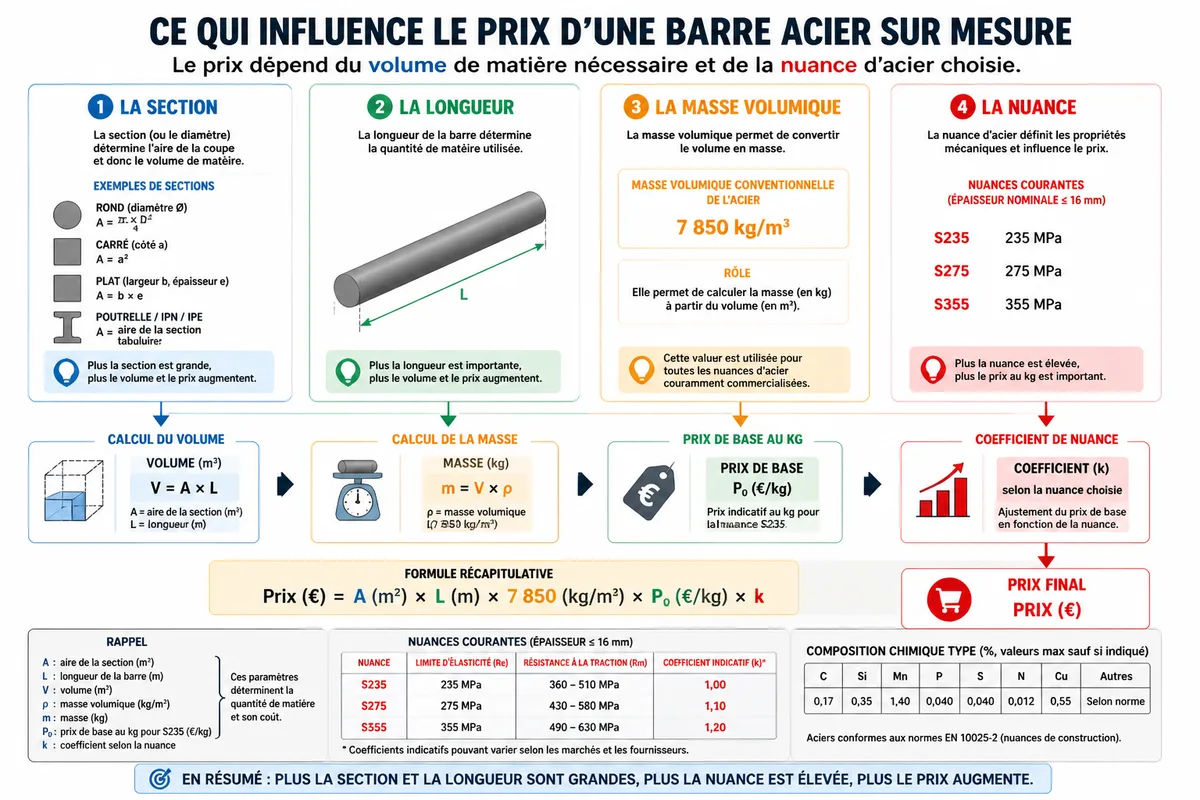
These yield strength values should not be mechanically extended to greater thicknesses: the standard values may be lowered depending on thickness and grade. For common DIY, the supplier may offer S235 in stock. For a precise mechanical requirement, the full designation and material certificate matter more than the price per meter alone.
A mass estimate starts from the volume of the bar and a conventional density of 7,850 kg/m³. For a solid bar, the volume is calculated by multiplying the section by the length. The actual mass may vary slightly depending on the grade and alloying elements; the weight indicated on the quote therefore remains the useful data for invoicing the order.
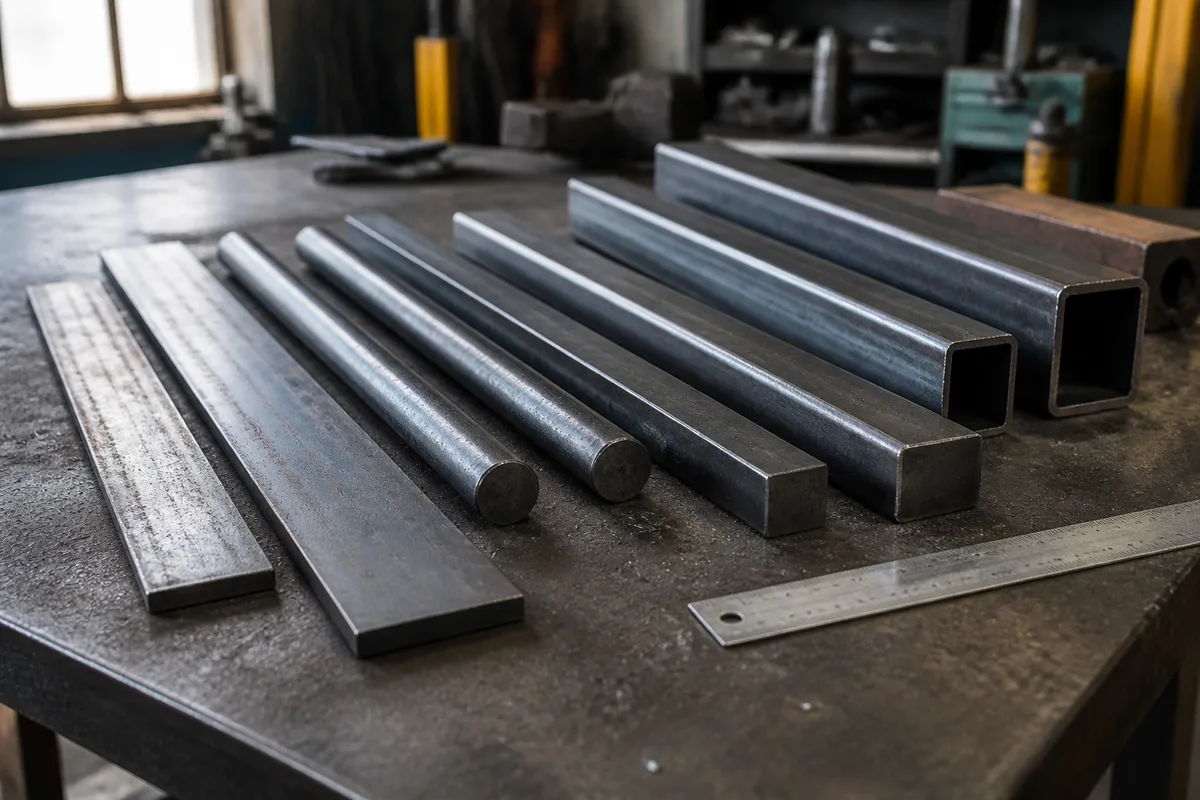
A consulted catalog offers custom round bars from 8 to 40 mm in diameter and square bars from 8 to 40 mm in section. A flat bar appears in a range from 16 × 6 to 100 × 10 mm. These dimensions describe a given commercial offer, not a general limit of all suppliers.
Availability also affects the invoice. A common reference can be cut from existing stock. A less common grade, a large section, or a particular length may require separate sourcing. Published estimates for S275 products indicate, for commercial comparison, €550/t for a UPE100 and €650/t for an IPE180; these amounts do not constitute a price per meter for a small bar intended for an individual.
The section is verified on three dimensions when the profile is hollow: width, height, and wall thickness. For a flat bar, width and thickness suffice to describe the geometry, while a solid round is defined by its diameter.
The choice of grade must remain consistent with the use. For interior decoration, paying for a specialized grade without mechanical need is an unnecessary expense. For a stressed part, choosing only the cheapest section is a poor decision: shape, assembly, and strength must be considered together.
The differences in range and designation are detailed in this guide dedicated to the raw cut steel iron bar, useful for distinguishing the raw product from an already prepared piece.
Which cutting and preparation operations increase the quote?
Custom cutting increases the cost when it involves a machine, a setup, handling, or inspection for each piece. The amount depends on the number of cuts, the required precision, the section to be cut, and the preparation of the end. A standard straight cut does not require the same work as a reworked or inspected piece.
A simple cut can be charged per unit, per millimeter, per batch, or in a preparation package. A catalog, for example, shows €1 including tax for cutting a range of round bars whose starting price is announced at €1.66 including tax per meter. The cut then represents a separate line from the material price, under the conditions of this offer.
The number of pieces changes the economic logic. Ten identical cuts can be grouped in the same series, whereas an order composed of ten different lengths requires more setups and handling. The required precision also plays a role: a tight tolerance or explicit dimensional control requires an additional operation.
The services to distinguish in the quote are as follows:
- cut to length;
- series cutting;
- deburring of ends;
- drilling or slotting;
- threading or tapping;
- chamfering;
- marking, inspection, or special packaging.
Light deburring does not produce the same piece as a finishing machining. A simply sawed end may retain a sharp edge and chips; a piece intended to be handled or assembled may require dedicated preparation. The quote must name the operation rather than just use the vague expression “custom cutting”.
For an individual, cutting with an angle grinder seems economical until the moment when it is necessary to hold a long bar, obtain identical lengths, and finish the edges. A bandsaw or a suitable metal-cutting saw produces a more consistent result, but the tool, consumables, and safety then factor into the true cost. Do not cut a heavy bar without a stable holding method.
Custom sizing is relevant when the finished dimension is certain and the absence of the tool would cost more than the cutting. It becomes a bad deal when the dimensions are not finalized: each mistake turns an already paid piece into scrap.
Finishing, surface treatment, and corrosion protection
Finishing changes the price because it adds preparation, a coating, or an inspection to the raw bar. Raw or black steel may be suitable for an interior part intended to be painted, while a humid environment requires appropriate protection. The choice therefore depends on the place of use, the desired appearance, and the expected duration of protection.
A raw surface often bears traces of rolling, scale, or superficial oxidation. Durable paint requires preparation compatible with the applied product: cleaning, degreasing, removal of friable parts, and suitable primer. Paying for decorative finishing on a piece that will then be welded and ground makes little sense; the area will have to be redone anyway.
Hot-dip galvanizing differs from a simple black finish. For steel thicknesses greater than 6 mm, the minimum coating requirements cited are 85 µm on average and 70 µm locally; for thicknesses greater than 3 mm and up to 6 mm, they are 70 µm on average. These values describe a hot-dip galvanizing coating according to the relevant thickness categories, not a paint thickness.
A galvanized bar is not simply a black bar with a different color. The treatment adds zinc, changes the appearance, and may require special preparation at the ends or welded areas. The quote must specify the type of treatment, the expected appearance, and any possible touch-ups.
Industrial painting, powder coating, polishing, and pickling belong to different services. A global price without a description of surface preparation does not allow knowing what is actually included. In outdoor use, protection of cuts and drillings deserves a separate line, as these areas can expose the steel after processing.
The finishing surcharge is not a reason to systematically choose the most expensive option. Unnecessary protection increases the bill and can complicate subsequent welding. Conversely, simply raw steel in an area exposed to water, salt, or condensation risks requiring quick rework.
Quantity, availability, and delivery: the costs that the catalog poorly shows
Quantity, stock, and delivery often determine the gap between the displayed price and the amount paid. A series allows spreading the setup costs, while a single order bears fixed costs on a single piece. Transport then depends on the total weight, length, packaging, and access constraints at the delivery location.
The standard lengths announced in some catalogs generally range between 2 and 3 meters. Buying a whole bar and then cutting it yourself may seem cheaper, but the calculation changes if the vehicle does not accept it, if storage is lacking, or if the tooling is not planned for this length.
A profile seller indicates a free delivery threshold starting from €200 of purchase. This condition belongs to their offer and does not allow concluding that transport will be free elsewhere. The package may also be subject to specific packaging: pieces under 1.2 meters are announced on pallets in one offer, while small pieces under 30 kg can be packed in cardboard under the same commercial conditions.
Minimum order quantities are even more variable. Published offers mention 1 ton for a 304 stainless steel U-bar, while the same datasheet also indicates a minimum of 100 kg in its description. Packaging or nameplate customization is announced with a minimum of 5 tons. Faced with a contradictory datasheet, none of these thresholds should be applied to an individual order.
Transporting a long bar poses problems that simple weight does not summarize. The package may exceed usual dimensions, require a pallet, or impose delivery with adapted access. A six-meter bar does not have the same logistical cost as an 80 cm piece, even if the total mass seems close.
For a small order, local pickup can reduce the bill if the seller offers it and if the transportation of the piece is safely possible. For a heavy or bulky order, compare the delivered amount rather than just the price of the material.
How to compare two prices for custom steel bars without making a mistake?
Two offers are comparable only if they describe the same shape, the same section, the same grade, the same length, the same quantity, and the same billing unit. Add finishing, cutting, VAT, and transport before concluding. A price per kilogram and a price per piece cannot be directly opposed.
| Product and displayed condition | Indicated price | Unit | Comparison limit |
|---|---|---|---|
| Custom round iron | From €1.66 VAT included | Per meter | Diameter, cut, and delivery to be linked to the offer |
| Flat iron 20 × 3 mm, black steel S235 | €1.96 VAT included | Per meter | Length and additional fees to be confirmed in the sheet |
| Flat iron 20 × 3 mm | €3.47 | Unit not specified | Impossible to compare directly with the price per meter |
| Flat iron 25 × 15 mm, black steel S235 | €12.80 VAT included | Per meter | Section different from 20 × 3 mm |
| Square crossbar 16 × 16 mm, length 2,000 mm | €24.59 VAT included | Per piece | The price includes a different commercial perimeter |
| Rectangular tube displayed in a profile range | €66 | Per piece | Dimensions and length not homogeneous in the excerpt |
The prices in the table are prices displayed in catalogs consulted on September 30, 2026. They serve to understand presentation discrepancies, not to announce a universal price. The value of €3.47 is particularly delicate to interpret since the unit is not specified in the excerpt; it should not be converted into a price per meter by assumption.
To bring an offer to a comparable cost, calculate the amount actually paid then divide it by the total length delivered or by the number of pieces, depending on usage. Do not add a flat delivery fee to a price already delivered; do not remove a discount conditioned on a threshold that your order does not reach either.
A clean quote request fits in a short sheet:
- “Flat steel iron S235, 25 × 15 mm”;
- “three pieces of 780 mm, straight cut”;
- “deburr ends or not, to specify”;
- “raw steel, black, painted or galvanized”;
- “price VAT included delivered to the indicated address.”
Add a tolerance only if necessary. A stricter precision can lead to an inspection or an additional operation; it should not be requested out of habit.
Which steel shape to choose according to use and budget?
Flat iron is suitable for plates, reinforcements, brackets, and decorative parts; solid round adapts to shafts, spacers, and ironwork elements; solid square provides a regular geometry for assemblies or visual details. The tube reduces the amount of material compared to a solid of the same bulk, but it requires a comparison with its wall dimensions.
The choice between shapes is not just about the lowest price. A flat iron is easy to drill and weld, but it does not replace a tube when a closed section is needed. A solid round resists torsion and buckling differently than a tube, and an angle iron offers two perpendicular flanges useful for a corner assembly.
The flat iron 20 × 3 mm displayed at €1.96 VAT included per meter is not a direct alternative to a square crossbar 16 × 16 mm displayed at €24.59 VAT included for 2 meters. The sections, volumes, units, and uses do not coincide. Comparing these two amounts as if they designated the same piece would be a reading error.
For a lightweight decorative piece, flat bar or small-section round bar is often easier to handle and finish. For a frame, a square or rectangular tube can offer practical assembly faces. For a load-bearing connection, an angle, a U, a T, or a beam requires verification of calculations and assemblies; the choice cannot be made remotely from a simple photo.
The custom round steel bar meets a different need than flat bar: its diameter, length, and the way it is held directly determine the cutting and finishing work. For flat applications, the dimensions and uses of custom flat bar allow for a more relevant comparison.
A hollow tube can reduce weight with the same external dimensions, but the wall thickness becomes the weak point if it is insufficient for drilling, welding, or expected stresses. Do not replace a solid bar with a tube just because the tube seems cheaper: usage, effective section, and assemblies must be compared.
For a beginner, flat or solid square bar is generally easier to measure and rework than a closed profile. For a series of identical parts, supplier cutting becomes relevant if it avoids multiple adjustments and guarantees repeated lengths. For a structural piece, call on a professional: the price of steel is secondary compared to a sizing error.
Common mistakes in a custom order
The decision depends on the actual use:
- DIY: final dimension, non-structural part, suitable cutting tool, and secure holding method.
- Supplier cutting: multiple identical parts, consistent tolerance, requested finish, or lack of appropriate tooling.
- Professional: load, guardrail, staircase, load-bearing element, structural welding, or uncertainty about the support.
For an industrial project or a more demanding series, the choice of a custom steel bar must include the plan, grade, tolerances, manufacturing operations, and logistics, not just the price shown on a product sheet.