Not long ago, we finished nicely decorating a kitchen, a living room, or a bedroom. Following the increase in the energy bill, it has become urgent to start energy renovation work.
It is important to specify that a poorly insulated home causes significant heat loss. When interior wall insulation is effective, you can keep the warmth inside the house longer. This makes it possible to save energy.
Between rock wool, glass wool, wood fiber, cellulose wadding, or hemp wool, there are many natural, synthetic, or mineral insulators for interior wall insulation. Before making your choice, it is important to first find out about the house insulation price to help you determine your budget.
📋 Key points: Personally, I consider interior insulation the most cost-effective project to reduce your heating bill by 25% with an average cost of 40 to 90 euros per m². It is a flexible solution that allows treating walls room by room without changing the exterior appearance of the house. I recommend coupling this work with MaPrimeRénov’ to halve your out-of-pocket expenses depending on your income.
What is the average price per m² for interior insulation with rock wool?
Some people criticize rock wool compared to glass wool because of its thinner thicknesses. However, this insulator has many interesting advantages. It combines economy, efficiency, and versatility. That’s not all; it has high fire resistance. Besides these multiple strengths, it guarantees good acoustic and thermal comfort in both summer and winter.
Regarding the price of interior wall insulation per m², it averages between 5 and 15 euros. From this range, we can deduce that the price of interior insulation with rock wool is affordable. The energy renovation work project is therefore accessible to everyone.
🗣️ My experience: In 2023, I insulated a 30 m² north-facing living room using rock wool under a metal frame. I had hesitated with a thin insulator to save space, but I ultimately sacrificed 10 cm of thickness for real performance. The lesson learned is clear: the acoustic comfort gained in addition to the warmth transformed the room, fully justifying the initial investment of 1,800 euros.
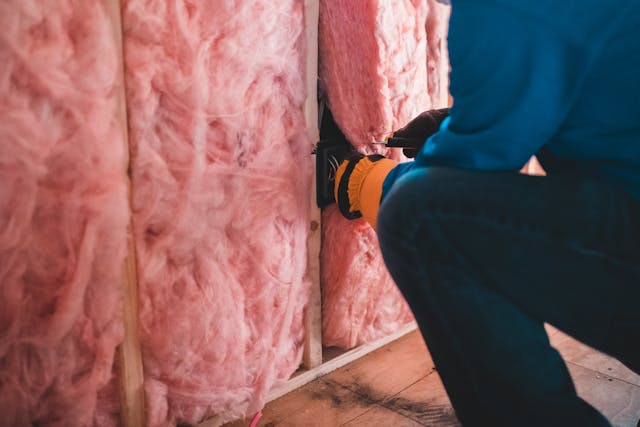
To insulate interior walls, it is advisand to favor rock wool in the form of semi-rigid panels. It guarantees better mechanical resistance, especially for vertical installation. Regarding its thickness, it can reach 20 to 22 cm for effective interior thermal insulation.
Besides interior wall insulation, rock wool is used for insulating convertible attics. You should budget between 15 and 25 euros including tax per m². And for lost attics, the price of interior insulation ranges between 10 and 15 euros including tax per m² depending on the expected performance level.
🌍 Did you know? A poorly insulated house loses 20% of its heat through the walls. By insulating from the inside, you can gain up to 3 or 4 degrees of perceived temperature in winter without even increasing the power of your radiators.
By the way, if you haven’t yet utilized the upper part of the house, but the project interests you, this article can help: What declaration to make for attic conversion.
How does the type of material affect the price of interior insulation of a house?
| Type of Insulation | Average Price per m² | Standard Thickness | Performance (R) |
|---|---|---|---|
| Glass wool | €15 – €30 | 120 mm | 3.15 |
| Rock wool | €20 – €35 | 120 mm | 3.30 |
| Wood fiber | €35 – €55 | 140 mm | 3.60 |
| Polyurethane | €45 – €70 | 80 mm | 3.50 |
We discover several factors that can influence the interior insulation price of a dwelling. The choice of materials is one of them. They are among the most important elements when calculating the house insulation price.
There are increasingly more options that can suit all budgets and all interior thermal insulation needs, both interior and exterior. Between hemp wool, rock wool, glass wool, cellulose wadding, polyurethane, or extruded polystyrene, each material stands out by its different levels of acoustic and thermal insulation.
It should be noted that their durability can also vary. Apart from that, each insulation material is suitable for a particular use. There is no truly best insulating material. It depends on the work you plan to do and the nature of the dwelling. All these parameters greatly influence the quality-price ratio of house insulation.
If you are looking for high thermal resistance, synthetic insulators are the better choice. There are several options such as expanded polystyrene, phenolic foam, polyurethane, and extruded polystyrene. The latter is particularly prized for its better longevity.
For an ecological solution, nothing beats opting for natural insulators. Of plant or animal origin, they offer optimal performance both in sound and thermal insulation. Moreover, they have no harmful effects on human health.
There is a wide choice of natural insulators such as hemp wool, sheep wool, duck feather, cellulose wadding, flax, wood wool, straw, cotton wool, and more.
And for those who focus on a good quality-price ratio for interior or exterior insulation, prioritize mineral insulators. Whether it is expanded clay, rock wool, glass wool, perlite, vermiculite, or cellular glass, they are inexpensive to purchase.
However, their effectiveness is impeccable for both interior thermal insulation and acoustic insulation of the house.
⚠️ Common mistake: Neglecting the treatment of thermal bridges at electrical outlets and floor/ceiling junctions. If the airtightness is not perfect, cold air rushes behind the insulation, canceling out much of its actual effectiveness.
What budget should be planned for the price of interior insulation of a 70 m² apartment?

Before asking yourself how to benefit from ANAH aid, first consider the budget to plan for interior thermal insulation. It is important to remind you that this energy renovation optimizes the thermal qualities of a home. On the other hand, exterior insulation is more specifically used to preserve the appearance of the exterior facade.
If you therefore want to balance your energy consumption, it is better to focus on interior wall insulation. It is estimated that this work can generate 400 to 750 euros per year on your heating bills. Even better, the project significantly improves the thermal and acoustic comfort of the home.
When talking about the cost of energy renovation work, people often think of the price of interior wall insulation. However, there is also attic insulation and floor insulation. Besides that, many factors come into consideration to obtain a fixed pricing.
On average, wall insulation ranges between 50 to 130 euros per m². For a 70m² apartment, a simple calculation is enough. Regarding floor insulation, plan a budget between 50 to 100 euros per m².
If you plan to use the services of a professional, make sure to include the fees for their intervention in the insulation quote. For those who want to save money on the house insulation price, favor mineral insulators. They seem inexpensive to purchase.
💡 Practical advice: Quality interior insulation has a lifespan of 25 to 30 years. Be sure to choose ACERMI-certified materials that guarantee the insulation will not compress over time, thus maintaining its initial thermal properties.
Are there government aids to reduce the cost of interior insulation?
To enjoy better thermal comfort at home, wall insulation work is essential. This project sometimes requires a large budget. Fortunately, you can benefit from aids to insulate your home.
MaPrimeRénov’ has been applicable for 15 years. This subsidy is accessible to condominiums as well as owners. It applies to homes as a primary residence. This public aid concerns several small works such as interior thermal insulation, the use of a heat pump, and more.
Regarding the zero-interest eco-loan, this interest-free loan is intended for an apartment or house completed more than 2 years ago based on the start date of the work. The dwelling must also be certified as a primary residence.
The energy check is also among the financial aids for energy renovation work. It replaced social energy tariffs in 2018. The principle is to help households pay their energy bills without difficulty.
To encourage them to replace coal, gas, and oil boilers, a scheme called heating boost has been established. It encourages individuals to use hybrid heat pumps, water/water or air/water.
It also concerns the installation of a combined solar system, an efficient biomass boiler, and many others. The grant strongly advises their use as they allow energy savings.
To subsidize your wall insulation work, floors or attics, you can similarly request other financial insulation aids such as the reduced VAT rates for the work, exemption from property tax, the Denormandie tax reduction and other local aids improving the energy performance of the home. In the meantime, take the time to consult this evaluation of ITI (Interior Thermal Insulation):
🌟 The advantages
- More affordable cost than EWI
- Can be implemented in all weather conditions
- Quick acoustic improvement
🔍 Drawbacks
- Reduction of living space
- Relocation of networks (sockets)
- Dust during the work
How does the price of interior insulation vary depending on the chosen thickness?
The thickness of an insulator is not chosen lightly. It is one of the essential points to remember that can vary the price of interior wall insulation and attic insulation. It depends on countless elements such as insulating materials, parts of the home to be insulated, living area, and more.
It should be noted that thickness plays a crucial role in the thermal performance of insulators, as it has a direct impact on the thermal resistance or R-value. Generally, the appropriate thickness ranges between 12 to 18 cm. When the thermal resistance is high, the insulator is thus efficient. Likewise, when the material is thick, the R-value is high.
The thickness of the material used to insulate interior walls also diversifies the price of interior insulation. When you choose a thick material, know that this increases the cost. Thus, the thicker the insulator appears, the more expensive it is and the more effective it is.
It should be known that some people also use thin insulators. They help optimize space in their home. They are also easier to install. However, this material is often a supplementary solution. It is preferable to opt for an insulator with a thickness of 12 to 18 cm.
What are the factors that most influence the price of interior insulation?
There are countless parameters that affect the price of interior insulation. They can lighten or inflate the thermal insulation quote for walls or acoustic insulation. The choice of materials helps define the cost of interior insulation price.
Some are inexpensive while others are sold at a high price. It is advisand to choose the one that fits your budget and especially that is suitable for the energy renovation work to be carried out.
Besides the insulators, the insulation technique counts among the elements that determine the house insulation price. Unlike exterior thermal insulation, interior thermal insulation can prove to be more affordable.
The first uses more advanced systems. Conversely, the second simply involves the use of roll or loose materials and the use of insulating panels.
Similarly, the type of housing has a significant impact on the average price for interior wall insulation as well as the price of attic insulation. It is noted that the price of interior insulation in a detached house is higher compared to the cost of wall insulation work in an apartment. The increase in costs is due to the extent of the surface area to be insulated.
It is also useful to take labor into account when considering the total cost of the insulation project. The cost depends on the complexity of the work, the hourly rate, the region, and the expertise and experience of the professional.
Estimate the cost de your travaux based on the surface de your murs.
*Hors aides financières déduites.
Can the price of interior insulation be estimated based on the type of building (house, apartment, office)?
In most cases, the price of wall insulation and attic insulation is calculated per square meter. Of course, it is essential to consider many parameters to obtain the overall cost of energy renovation work. One should also not forget to benefit from numerous financial aids for insulation that reduce expenses.
Whether you are equipping a house, an office, or an apartment, you can estimate the price of interior insulation per square meter. Even if you request several insulation quotes, the average insulation price is most often estimated per square meter.
On average, the price of wall insulation ranges between 20 and 50 euros per m². The price of attic insulation ranges between 25 and 45 euros per m². For the floor, please budget between 20 and 50 euros per m².
At all levels, the price for insulating a 100 m² house is approximately between 30,000 and 45,000 euros. And for a 65 m² apartment, plan a budget of 20,000 to 25,000 euros. We are talking here about interior wall insulation with window and frame replacement.
Is there a significant price difference between thermal and acoustic interior insulation?
Whether you plan to carry out thermal interior insulation of your house or soundproofing, know that these projects have roughly the same objective. It consists of enhancing the level of indoor comfort whether the insulation price is low or high.
While the first aims to enjoy thermal comfort in the home, the second serves to limit noise pollution to restore serenity at home.

For insulating interior walls, lost attics, or habitable attics, the price of acoustic insulation is determined by the type of insulation materials, the necessary equipment, and especially the labor. It is noted that the budget increases for larger rooms as well as for complex projects.
The price of house insulation is generally stable, whether it concerns acoustic insulation or thermal wall insulation. No significant price difference can be distinguished between these two insulation works. The total cost can vary mainly depending on the insulating material used.
How does the price of interior insulation affect the real estate value of a property?
When intending to sell your house, it is crucial to consider all the points that can enhance its value. Thermal interior insulation is among the essential elements impacting its sale price. Therefore, do not hesitate to invest your money in energy renovation work.
Even if the house insulation price seems expensive to you, the project allows for a better sale. It increases the value of your property to attract more buyers. Moreover, if your budget is limited, you can still access financial aid for thermal wall insulation.
It should be noted that good thermal insulation guarantees the quality of life and comfort of the occupants inside the house. It maintains a pleasant temperature, regardless of the season.
In summer, it prevents overheating, and in winter, it stops heat loss. An effective interior thermal insulation can reduce the energy bill by up to 30%. This represents a major advantage during the sale of a property.
What are the most economical options for the price of interior insulation without compromising quality?
If you are thinking of saving money on your energy renovation project, it is possible to handle it yourself without hiring a professional. It must be said that this decision carries a risk. But if you have knowledge related to wall insulation work, there is no problem in doing it yourself. This saves you the expensive labor costs.
If you have no knowledge, it is better to abandon the attempt. You can request many insulation quotes to find the best value for money. Otherwise, you have the option to choose less expensive insulators that still have interesting thermal performance.
With a price range between 10 and 20 euros per m², mineral-based insulators offer unbeatable prices. Otherwise, plant-based materials can cost between 10 and 30 euros per m². For those with a larger budget, they can opt for certain synthetic insulators available at a price between 50 and 60 euros per m².
FAQ: Budget and Price of Interior Insulation
What aid can be obtained for interior insulation?
Does interior insulation take up a lot of space?
Is it mandatory to install a vapor barrier?