The sunny days are back, and you notice that your faithful self-supporting pool looks gloomy because of an inflatable ring that no longer holds pressure? Rest assured, you are not alone. Between the cat jumping on it, the kids’ games, or a mishandling, a hole in the ring can quickly turn your swim into a distant memory. I have long searched for the perfect solution for pool ring repair, and some DIYers swear by expanding foam. But is it really suitable? And what alternatives exist? I’m sharing what I’ve learned on the ground, to help you avoid false good ideas and succeed in your ring renovation.
📋 Key takeaway: Personally, I consider the use of a cellular polymer to stiffen an inflatable structure an ingenious but temporary emergency solution. In 95% of cases, this method saves a swimming season when multiple punctures make air inflation impossible. It is an irreversible technical operation that permanently prevents deflating and folding the structure.
Understanding the problem: where is the air leak coming from?
Before pulling out the expanding foam gun or the patch, you need to pinpoint the source of the problem. In most cases, an inflatable ring leaks because it has been hit, rubbed against a sharp object, or worn out over time. Over time, the welds of the PVC fabric can also weaken. A short coffee break is needed to precisely locate the air leak: whistling sound, soft area… every clue counts.
💬 Personal anecdote: Last summer, my children’s self-supporting structure had an invisible porosity impossible to locate, deflating in less than 4 hours. Faced with the urgency of a heatwave weekend, I injected three cans of polyurethane through the inflation valve to fill the internal void. The lesson learned is that the product must be injected in very gradual steps, because the expansion force of the product can easily deform or tear the PVC welds if too much is applied at once.
A trick that always works for me is to gently pass a wet sponge over the still inflated ring. The bubbles will show you immediately, even for small holes in the ring. If the leak seems to come from a seam or a complex area, the diagnosis will be different from that of a simple central tear.
To go further, I recommend taking a look at our guide on the pallet pool which complements this topic well. Discovering the steps for how to arrange around an inground pool also provides useful ideas for your future garden layouts. And to go even further in the overall maintenance of your basin, our tutorial on leak detection for individuals to protect housing against damage offers interesting insights.
Expanding foam as a solution? Strengths and limits
🌟 The advantages
• Permanently eliminates the problem of air leaks.
• Allows extending the use of an old pool.
• Economical solution compared to buying a new liner.
⚡ Weak points
• Makes folding and deflating impossible.
• Risk of uneven aesthetics or waves.
• Increases the total weight of the empty structure.
The idea of using expanding foam to repair a pool ring may seem tempting. After all, it easily fills gaps, quickly expands, and solidifies. However, its effectiveness for repairing a pool ring deserves consideration. According to my experience and those shared poolside, the result depends greatly on the size of the hole, the flexibility required, and the type of material of the inflatable ring.
Expanding foam is designed to fill and insulate. On PVC fabric, especially if it needs to remain flexible and watertight, it will not always be able to follow the movements of the inflatable ring without cracking. Many DIYers have noticed that once dry, this foam becomes rigid and risks causing further cracks with use. Ending up with several air leaks around the initial patch is not uncommon.
🌍 Did you know? Polyurethane needs ambient air moisture to trigger its polymerization reaction and triple in volume. Inside a completely sealed and airtight liner, the product can take several days to fully harden at the core of the structure if a fine mist of water is not sprayed before injection.
When can expanding foam be a quick fix?
For a very large tear or when part of the ring has become unusable, expanding foam sometimes provides temporary relief. It then serves more to create a “plug” that maintains the shape of the inflatable ring, rather than restoring its primary function of holding air under pressure. It is also sometimes used to give a second life to a self-supporting pool intended for children’s play, where high pressure matters less.
One technique involves injecting the expanding foam into the cavity, then removing the excess once dry. This creates a sort of floating mattress, but you lose the ability to perfectly reinflate the ring. A significant side effect since comfort and pool stability often suffer.
Limitations to seriously consider
If you want to keep your self-supporting pool for several seasons, expanding foam rarely performs well over time. The main risk remains imperfect adhesion to the PVC fabric, water infiltration, and a total loss of the inflatable effect. Additionally, once the expanded foam is inserted, it is difficult or even impossible to reverse for a future ring renovation.
It should also be noted that some foams are not compatible with humid environments and may release questionable substances upon contact with water. So avoid them if durability, watertightness, and swimmer safety remain your priorities when repairing the pool ring.
- Permanent and hardly reversible effect: the foam blocks the inflatable function
- Problematic rigidity on winding or foldable joints
- Unpredictable sealing depending on cutting and installation
- Chemical risk depending on the quality of the foam used
⚠️ Common mistake: Filling the tube to 100% of its capacity at once. The internal expansion force is phenomenal and will cause the PVC liner heat seals to burst in less than 30 minutes. You must fill the structure to only 50% of its volume and let the product expand freely into the empty areas.
Traditional methods to repair an inflatable tube
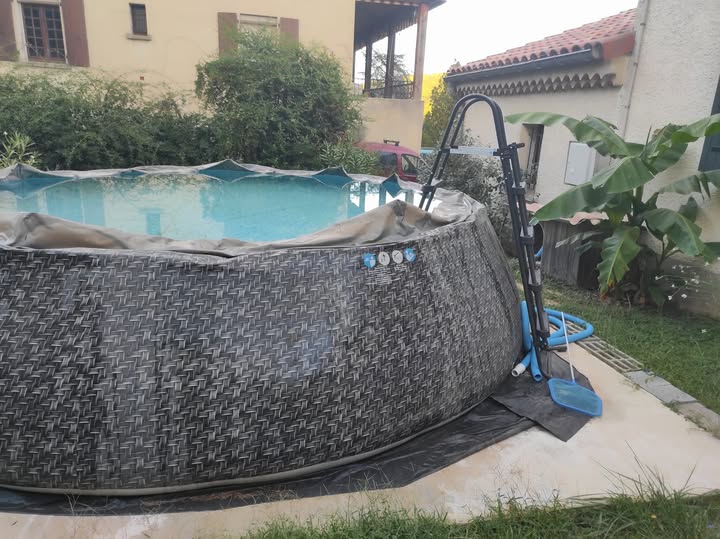
Faced with the limitations of expanding foam, I like to recall the solutions proven by professionals and experienced DIYers in the area. For a true pool tube repair, the combo of appropriate patch and PVC glue remains unbeatable, especially if you want to regain a clean, smooth, and reliable surface.
The repair kit for above-ground pools generally includes a small sheet of PVC fabric, a special glue, and instructions. The operation requires some patience and precision but offers the best results in terms of sealing and durability for the tube repair.
Necessary equipment for a durable repair
| Repair method | Average cost | Observed durability | Folding at season end |
|---|---|---|---|
| Classic PVC patch kit | €8 | Medium to high | Possible and easy |
| Special liquid neoprene glue | €12 | Excellent on cuts | Possible |
| Expanded polyurethane filling | €25 | 1 to 2 seasons max | Completely impossible |
Here is the list of tools and supplies I never part with when dealing with a hole in the tube:
- Custom-cut PVC fabric (specific patch)
- Quality PVC glue suitable for pools
- Marker to locate the air leak
- Alcohol or mild soap to degrease the area
- Clean, dry cloths to wipe before and after gluing
- Optionally, an extra strip to reinforce the inside
Essential step: let dry completely between each step and press the patch firmly during gluing to expel air and ensure better adhesion. My tip? Use two flat plates on each side to clamp the patch for at least a dozen hours to guarantee a solid pool tube repair.
What to do if the tear is too large?
When the hole in the tube exceeds a few centimeters or involves a seam, classic repair becomes complicated. Some combine repairs: they roughly fill with expanding foam to limit shape loss, then apply an XXL patch on top with plenty of PVC glue. It’s a way to extend the pool’s life a bit, but it remains a temporary fix.
In these extreme cases, an alternative to expanding foam is to fully double the damaged section with a piece of inner tube or reinforced fabric suitable for the pressure. The adjustment requires skill but allows you to gain a season or two without breaking the bank while ensuring an effective tire renovation.
⚠️ Warning: Let the expanded product catalyze and harden for at least 24 hours flat before starting to fill the pool with water. If you load the structure too early, the weight of the water will crush the still soft product and permanently deform the geometry of your installation.
Best practices and small mistakes to avoid
Among all the techniques tried, avoid giving in too quickly to the quick (and falsely miraculous) solution of expanding foam for your inflatable tire. It only works when you know for sure that the self-supporting pool will soon be replaced or will only be used by toddlers at low pressure.
Always take a few minutes to clean, dry, and prepare the damaged area. Even the best patch, without this prior care, will peel off in less than two swims! Also remember to regularly monitor the pressure level: overinflating speeds up the risk of new holes in the tire.
- Don’t wait to have a big hole in the tire to act
- Always store the self-supporting pool protected from frost in winter
- Plan ahead with a few meters of spare PVC fabric
- Discreetly test each new PVC glue before intensive use
You see, even if pool tire repair with expanding foam is attractive for its practicality, nothing beats a proven method. If you take the time to do it well, you will enjoy the joys of swimming longer, without (too many) unpleasant surprises during the next season.
Pool repair supply & cost calculator
Estimate required supplies based on pool diameter and repair technique chosen.
Estimated supplies needed:
Unit(s) / Can(s)
Estimated total repair expenditure:
$
Answers to your questions about reinforcing inflatable tires
Does polyurethane foam fear pool water?
No, once it has fully hardened, the cellular structure resists water and treatment products like chlorine or bromine without dissolving or crumbling.
How many cans of product should be planned for a large pool?
For a standard 3-meter diameter self-supporting model, you generally need between 3 and 5 large capacity aerosols to properly fill the entire internal volume.
Can the pool be stored in winter after this operation?
The whole becomes rigid and bulky. You will no longer be able to fold it into its original box. It will need to be stored as is in a garage or a large garden shed.