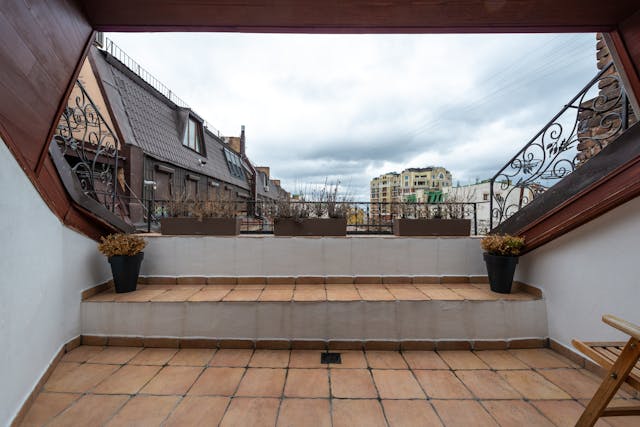
Looking for a new idea to cover the floor of your terrace? The pedestal tile will undoubtedly impress you. It offers countless interesting advantages. Among the most well-known are its resistance, elegance, durability, and reasonable cost, which attract more and more households.
Between reconstituted stone tiles, wooden planks, concrete, or composite, pedestal terrace tiling is gaining momentum. Trendy and aesthetic, it also offers ease of installation. If you want to get more information about this type of pedestal terrace tiles, we invite you to read this article.
📋 What to remember: Personally, I consider installation on pedestals the most accessible method for a DIYer, as it allows laying up to 25 m² of tiles per day without any heavy masonry knowledge. It is a self-draining system that eliminates 100% of the risks of water stagnation on your terrace. I recommend using 20 mm thick porcelain stoneware tiles to ensure optimal impact resistance.
What is pedestal tiling and what are its advantages?
👍 Strengths
- Installation without glue or joints
- Perfect water drainage
- Ultra-light structure
⚡ Weaknesses
- Cost of 20 mm tiles
- Thickness reservation

Between covering and waterproofing a terrace, you are struggling to choose your future outdoor project. Taking into account the many advantages of pedestal tiling, you decide to dress the floor of your terrace to modernize it.
Certainly, many are used to renovating bathroom tiling. But this material can also dress your courtyard using adjustable pedestals. Pedestal terrace tiling, as its name so aptly suggests, is nothing other than classic tiling, but installed on specific supports called pedestals.
🗣️ My experience: During a seaside project in 2024, I installed 40 m² of pedestal tiles in just two afternoons. The challenge was to correct a poorly placed rainwater drainage, which I managed by simply adjusting the pedestals to different heights, ranging from 40 to 65 mm. The lesson is clear: the pedestal forgives the defects of the substrate that glued tiling would have amplified.
In most cases, this support features a finish in synthetic material that is both solid and resistant. It is designed to support pedestal terrace tiles. Its use greatly simplifies the installation of pedestal terrace tiling, as the operation requires no major construction work. This is one of the advantages of pedestal tiling.
You can use it on any stable flat surface, including old tiles. If the slab is large, you need additional pedestals to ensure the durability of the flooring. Porcelain stoneware tiles are among the most commonly used materials for this type of deck slab pedestals.
Many people also choose pedestal tiles because they want to avoid pouring concrete. This becomes an interesting idea, as it becomes practical to install an irrigation or lighting system using the small space between the tile and the ground. Also consider using it to place cables or connections.
🌍 Did you know? Polypropylene pedestals are designed to support compressive loads of up to 1,000 kg per unit. They withstand extreme temperatures ranging from -30°C to +60°C without deforming or becoming brittle.
Besides that, ease of repair is among the advantages of pedestal tiles. Each slab is easy to remove and replace. After the deck pedestal installation, no drying time is needed. You can benefit from it immediately. This deck slab pedestal saves you from water stagnation problems. It ensures water drainage.
How to prepare the ground before laying tiles on pedestals?
Many are curious to know how to lay slabs on pedestals. Before addressing these details, it is important to emphasize that the ground needs to be well prepared before installing the deck slab pedestals. This prevents potential repairs while ensuring the longevity of the work.
To do this properly, you must first ensure the stability of the ground. If the terrain has many irregularities, it is necessary to compact the surface using equipment designed for this purpose. This serves to level the ground that has bumps or holes. Additionally, this operation simplifies the anchoring of the adjustable deck pedestal.
Professionals also recommend compacting to flatten the ground. Thanks to this solution, the tiles as well as the deck pedestals installed have excellent stability. This action also allows for more height for the deck pedestal installation.
If the household includes people with reduced mobility, it is imperative to excavate the ground. This involves removing the top layer of soil to bring the deck slab pedestals to the same level as the house. This way, everyone can easily cross door thresholds or small steps.
If you are lucky enough to have a stable flat surface, no preparation is needed before the deck pedestal installation. The same applies if you install it on an existing covering. You just have to remove vegetation or other debris on the surface.
⚠️ Common mistake: Forgetting to place noise-reducing pads (rubber) on top of the pedestals. Without these small rubber discs, your tiles will “clack” against the plastic with every step, creating unpleasant resonance and harmful micro-vibrations.
Which types of tiles are suitable for pedestal installation?
Unlike bathroom tiles or kitchen tiles, tiles for deck slab pedestals must be thick. It is recommended to choose tiles with a thickness of at least 20 mm.
Selecting a robust material involves the longevity of the installation over time. It is important to consider the weight that the deck tile pedestal can support. If you use thinner tiles, they are likely to break with minor impact.
Among the different models, porcelain stoneware tiles are the best choice for the deck slabs on pedestals. This material combines aesthetics, strength, and durability. That’s not all; its surface can be smoother. Indeed, it requires no anti-slip treatment. The trendy colors are light gray, off-white, and anthracite gray.
You can find a wide range of models on the market. While some imitate cement, others stand out with their wood parquet effect. Try to consider your decoration style so that your adjustable pedestal deck integrates perfectly with other elements of your outdoor space.
Regarding dimensions, the standard format, that is 60×60, is the most popular. But you can also use rectangular tiles or those measuring 50×50 or 40×40. It is not recommended to opt for smaller pieces. They require a certain number of adjustable pedestals, thus additional labor and material costs.
⏱️ Timing: An annual cleaning with a low-pressure water jet is sufficient. I recommend lifting a slab every 2 years to check that no plant debris is blocking the water drainage paths under your structure.
How to choose the right pedestals for outdoor tiling?
The adjustable deck pedestal plays an essential role in laying the slabs. Not only does it support the structure, but it also ensures the stability of the tiles. Even better, this support facilitates the installation of the deck tile pedestal, as its installation requires neither glue nor special joint.
To choose the deck pedestal properly, it is important to know all its components. It consists of fins, an adjustable nut, a base or foot, a locknut, and an adjustable head. The latter allows the height adjustment of the pedestal, on which the slab plate rests.
Several parameters must be considered to find the deck pedestals of your choice. Please analyze their height, the materials they are made of, their quantity, their compliance, and the accessories. Despite all these criteria, it is mainly the nature of the project that determines the model of deck pedestal to use.
Among the different types of products available on the market, the PVC pedestal is the support that offers many advantages. Its resistance to external stresses is remarkable.
Whether it concerns weight, heat, frost, and many other aggressions, nothing scares it. Durable, it can support your porcelain stoneware tiles for many years.
| Slab format (cm) | Number of pedestals / m² | Average weight (kg/m²) | Joint spacing |
|---|---|---|---|
| 40 x 40 | 7 to 8 | 45 kg | 3 mm |
| 60 x 60 | 4 to 5 | 48 kg | 3 mm |
| 40 x 120 | 6 to 7 | 52 kg | 4 mm |
| 60 x 120 | 5 to 6 | 55 kg | 4 mm |
No matter which deck pedestal you have chosen, make sure it complies with current standards, namely NF ISO EN 19069-1 and DTU 51.4. As for the height, it generally varies between 20 and 60 cm. The size of the slab pedestals mainly depends on the constraints of the terrain. It is preferable to favor the adjustable deck pedestal since it can be adjusted within a range of 20 to 25 cm.
What are the key steps to install tile on pedestals?
Just like the installation of other deck pedestal slabs, that of deck pedestal tiles begins with preparing the substrate. It is important to obtain a stable flat surface before proceeding with the slab assembly.
If the ground has unevenness, please first excavate the soil. If necessary, you can lay a geotextile film to prevent weed regrowth. If the surface is already stabilized, you do not need to prepare it. You can proceed directly to placing the adjustable deck pedestal.
Unlike work in the tiled bathroom, the deck pedestal construction may seem much easier. To arrange the supports, make sure to position them regularly and especially perfectly aligned according to the size of the deck pedestal slabs.
So that the surface of the deck tile pedestal is both stable and uniform, please carefully adjust the height of the adjustable deck pedestal. Try to place each slab plate on the deck pedestal with precision.
The tile angle must also be firmly fixed on the notches of the pedestals to ensure the stability of the deck. If necessary, do not hesitate to adjust the tile dimensions according to the perimeter of your deck. This helps you enjoy a better fit.
How to manage water drainage with tile on pedestals?
Among the advantages of pedestal tiles, this construction allows water to drain more easily, thanks to the free space between the covering and the ground. This prevents moisture stagnation, which is a major factor in the premature deterioration of the pedestal tile deck.
In any case, some measures must be taken to limit potential risks. It is advised to place the tiles on a slope of at least 1 cm per meter. At the passage with the garden, it is useful to install a drainage channel. To keep it perfectly stable, you can install a row of tiles.
Many drainage systems can be found on the market. It remains essential to consider the terrain constraints before making a choice. Most gutters are specially designed to collect rainwater. The device then guides it away from the surface of the pedestal slab deck.
What tools are necessary to install tile on pedestals?

To ensure the installation of the deck tile pedestal is successful, please follow the different steps explained in the previous section. Do not forget to take precise measurements and properly prepare the ground. Likewise, it is useful to have technical knowledge and to equip yourself with the necessary tools for the installation.
The spirit level is very useful for measuring inclinations, verticality as well as horizontality of a support. The mason’s rule also has its role in installing pedestal tiles. Similarly, you will need a chalk line, a wet saw, a laser, a tile lifter, a drill, a measuring tape, sandpaper, a cutter, and more.
As for materials, gather near you porcelain stoneware tiles, slab pedestals, cladding support, geotextile, noise-reducing shims, and much more. Do not hesitate to prioritize quality products to achieve good results.
How to adjust the height and level of pedestals for tiling?
The deck tile pedestal is a trendy idea to enhance the exterior of your home. It is not only pleasant to look at but also has a long lifespan. Additionally, it helps to hide floor imperfections while providing optimal thermal insulation.
However, to enjoy all these tile pedestal advantages, it is important to follow the installation steps. If you have an adjustable deck pedestal, you can adapt the height of the tiles to the floor leveling. This creates continuity that enhances the aesthetics of the deck tile pedestal.
To adjust the height of the deck pedestal, use the rotating ring. Properly position each support on the ground. Its installation does not require any joists or joints. The tiles are simply laid by interlocking.
During the installation of deck slabs on pedestals, regularly check the level of the deck. If necessary, use a wrench and turn the nut manually to adjust the height of the pedestal. No one is required to remove each support to achieve the desired level. The adjustment is simply done from above.
What is the durability of tiles laid on pedestals?
If deck slabs on pedestals interest you so much, know that there are several coverings to suit all tastes. Between concrete slabs, wooden planks, or natural stone, porcelain stoneware tiles are highly favored by both individuals and professionals.
Their main advantage lies in their superior longevity. They can adorn your deck for 50 years or more. The deck pedestals, for their part, are guaranteed for 10 years. To enjoy them for a very long time, tile pedestals require frequent maintenance which is not complicated at all.
Simply clean them regularly by removing leaves and all dirt that settles on the surface of the deck tile pedestal.
In case of stubborn stains, avoid using chemical or harsh cleaners. They may damage the tiles. Prefer natural solutions such as lukewarm water, white vinegar, or baking soda.
For damp or shaded areas, it is preferable to apply anti-moss products suitable for outdoor spaces. Algae or moss may form.
Where to find tutorials or guides for installing tiles on pedestals?
You can find many DIY courses online guiding you through the installation of a deck tile pedestal. Unlike traditional tile installation, this work is very simple. The adjustable deck pedestal can be installed without using screws or glue. The important thing is to ensure the stability of the deck slab pedestals.
YouTube is among the most widely used sites by internet users to learn how to install adjustable pedestal decks. Besides videos and tutorials, many articles provide clear and precise details about this work.
Many major retailers such as Leroy Merlin also offer excellent guides for installing tile pedestals. For beginners, it is recommended to be accompanied by a professional for the first deck pedestal installation.
Estimate rapidement le nombre de supports required pour your terrasse.
(Includes a margin de sécurité de 10%)
Practical guide for tile installation on pedestals FAQ
Should the pedestals be sealed to the ground?
Which tiles should be chosen for laying on pedestals?
How to make cuts along the wall edges?