Your lease forbids making holes, unless it’s the hollow brick partition that crumbles as soon as the drill touches it. In both cases, the drill stays in its case (and that’s just fine, because a picture can hang without drilling as long as you know two things that can be measured in five minutes: the weight of the picture and the condition of the wall).
On a sound paint surface, a light frame holds easily with self-adhesive strips. As soon as you exceed a few kilos or the wall powdery under your finger, there’s no point doubling the adhesive strips because you need to switch to another method.
Weigh the picture before buying any fixings
Almost no one does it, even though the bathroom scale is enough. First weigh yourself holding the picture, then without it. The difference gives you a fairly reliable value to choose the fixing.
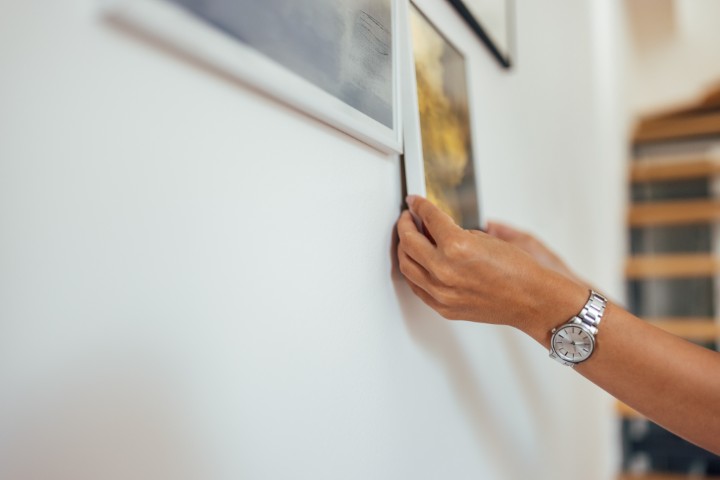
Does your frame have glass, even thin? If so, expect a surprise, because a poster under glass sometimes weighs more than a canvas of the same size stretched on a wooden frame, without glass or thick moulding.
And the canvas poses another problem with its hollow back, since nothing can be glued to it. Fixings are therefore placed on the frame’s stretcher bars, never on the canvas itself.
Which no-drill fixing for which picture?
This picture crosses the weight of the frame and the nature of the wall. The loads are those printed by manufacturers on the packaging, measured on a clean, dry, and flat wall (in other words, conditions your hallway doesn’t always offer).
| Fixing | Declared load | Suitable walls | To avoid |
| Fixing putty (Patafix type) | Very light objects | Smooth paint | Any framed glass |
| Simple adhesive hook | About 1 kg | Paint, wallpaper | Frames over one kilo |
| Command strips size S | 1.8 kg | Paint, tile | Damp or textured wall |
| Command strips size M | 5.4 kg | Paint, tile | Paint redone less than 7 days ago |
| Command strips size L | 7.2 kg | Paint, tile | Near a radiator |
| Mounting glue or strong double-sided tape | Varies by brand | Hard and sound surfaces | Rental (difficult removal) |
| Adhesive picture rail | Depends on model, see product sheet | Smooth and solid wall | Old plaster that flakes |
We first look at the load number, whereas it’s the wall that decides. Plasterboard, quite porous, absorbs part of some adhesives even before the frame is hung.
The plaster in old houses poses the opposite problem. It is hard and holds the strip well but cracks if you pull too quickly when removing it. And tile, often thought too slippery, is actually the best friend of the strips because it is smooth and doesn’t absorb anything.
With a textured plaster or a relief paint, there’s no point in insisting. Only the peaks of the texture touch the adhesive, the contact surface collapses, and nothing holds over time.
Your frame is heavy and you’re thinking about glue? It works, except you give up the clean removal that justified the whole interest of no-drill hanging. In rentals, I frankly advise against it, because it takes the paint off when you peel it off, and the wall repair will be charged to you at the inspection.
Applying the strips without missing the adhesion
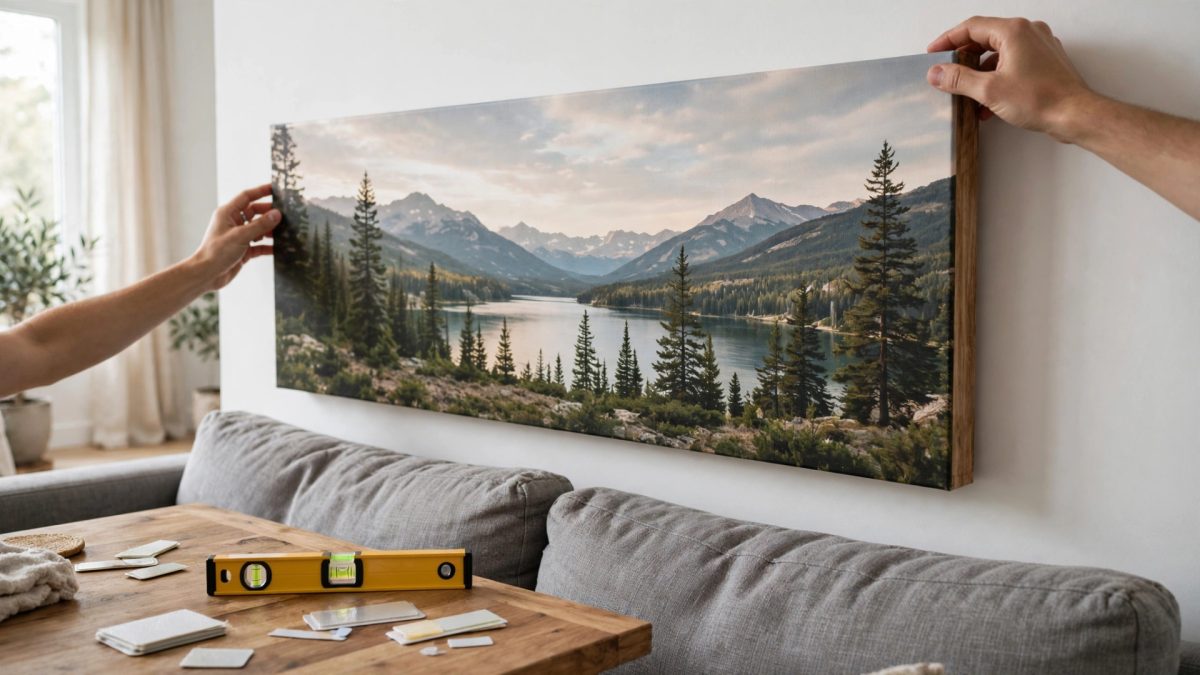
For a medium-sized painting, you almost always start with self-adhesive hook-and-loop strips. This is the method we follow here. Prepare a spirit level, a cloth, household alcohol, and a pencil or masking tape (the tape has the advantage of leaving no trace on the paint).
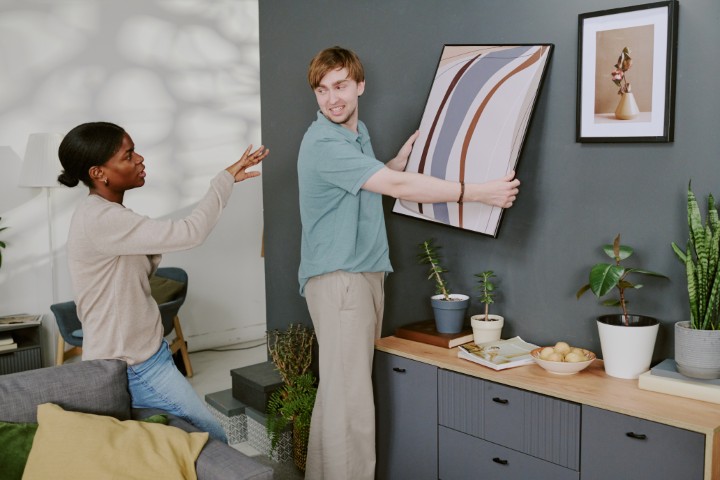
- Wipe the wall area with household alcohol and let it dry. If the paint has just been done, wait at least 7 days before sticking anything.
- Mark the location with masking tape starting from the center where the painting will hang.
- Assemble the strips in pairs and press until you hear the “click,” a sign that the Velcro sides are properly engaged with each other.
- On the back of the painting, stick a pair in each corner, on the frame molding or, for a canvas, on the wooden stretcher.
- Place the painting, adjust the level, then press each corner for 30 seconds.
- Remove the painting by pulling the bottom upward, press again for 30 seconds the strips left on the wall, and let rest for 1 hour.
- Put the painting back by pressing firmly until the click.
The resting hour is the step everyone skips because it seems unnecessary. Yet it’s the one that decides whether the frame will hold for years or end up slipping in the middle of the night.
And the day you want to take everything down, pull the strip gently downward while staying parallel to the wall, never towards you, otherwise you’ll take the paint off with it.
At what height and what size above a sofa?
Count about 150 cm between the floor and the center of the painting; this is the reference most decorators use. Above a sofa, where you look at the wall while seated, you can go down a few centimeters. In a hallway, however, stay at eye level of a standing person.
For width, apply the two-thirds rule if you want to avoid a small canvas floating above a three-seater. The painting (or group of paintings) occupies roughly two-thirds of the sofa’s width, which gives these measurements for common sizes.
| Sofa width | Target width (2/3) | Two-canvas variant |
| 150 cm | 100 cm | 2 canvases of 45 cm, 10 cm gap |
| 180 cm | 120 cm | 2 canvases of 55 cm, 10 cm gap |
| 210 cm | 140 cm | 2 canvases of 65 cm, 10 cm gap |
| 240 cm | 160 cm | 2 canvases of 75 cm, 10 cm gap |
The problem is obvious as soon as you browse the aisles. Standard sizes rarely match exactly 120 or 140 cm, and you end up with a canvas that is slightly too small, telling yourself it will work (it rarely does).
If it is one of your photos that should be displayed above the sofa, you can order a custom photo on canvas here to the exact centimeter between 20 and 200 cm. It arrives stretched on a wooden frame and hanging hooks are offered as an option. And since there is no glass, a canvas can be hung without drilling much more easily than a large framed glass picture.
For a very large size, refer back to the load chart. Weigh the canvas upon receipt and compare this weight to the capacity of the purchased strips, keeping a comfortable margin rather than aiming for the limit.
Mistakes that cause frames to fall
When a picture ends up on the floor, the product is rarely to blame. The culprit is almost always a dusty wall or a hasty installation. Before sticking, check these points one by one.
- The picture weighs less than the load indicated on the packaging.
- The wall is dry and flat, without plaster or peeling wallpaper.
- Nothing heats just below (radiator, convector, fireplace).
- The paint is more than 7 days old.
- The fixings are placed on wide edges or on the frame, never on the canvas.
Also beware of poorly ventilated bathrooms, where humidity softens the adhesive month after month. There, hang a small light canvas and keep the heavy frame for another room.
Frequently Asked Questions
<!– wp:rank-math/faq-block {"questions":[{"id":"faq-question-1792258634529","title":"How to hang a heavy object on the wall without drilling?","content":"Beyond about 7 kg, forget classic strips, they won't hold. On a hard surface, mounting glue or a strong double-sided tape does the job. The day you want to take everything down, the paint might come off with it.Your wall crumbles at the slightest impact? In that case, install a picture rail, it’s safer.
“,”visible”:true},{“id”:”faq-question-1792258640667″,”title”:”What is the 2/3 rule for hanging pictures?”,”content”:”Make sure that the picture (or the set of frames) covers about two-thirds of the width of the furniture below it (if there is no furniture, the width of the wall is the reference). With a 180 cm sofa, aim for about 120 cm wide.”,”visible”:true},{“id”:”faq-question-1792258646458″,”title”:”How to hang a canvas without drilling?”,”content”:”The stretched canvas gives you nothing to stick on, so everything depends on the wooden frame. Place the strips or adhesive hooks on its uprights, one at each corner.”,”visible”:true}]} –>
How to hang a heavy object on the wall without drilling?
Your wall crumbles at the slightest impact? In that case, install a picture rail, it’s safer.