Changing careers without cutting off income remains the main obstacle to retraining in the construction sector. In electricity, the issue arises with an additional constraint: the diploma is not just an asset on a CV, it determines the right to work independently.
We detail here what can actually be prepared remotely, what cannot be digitized, and how to finance the project while remaining employed.
How to train for the electrician CAP entirely online?
Let’s start with the point that advertisements keep silent about. The theoretical preparation is followed entirely online: courses, exercises, corrections, tutoring. The practical part, however, cannot be digitized, and the professional exams must be taken on a technical platform, in person.
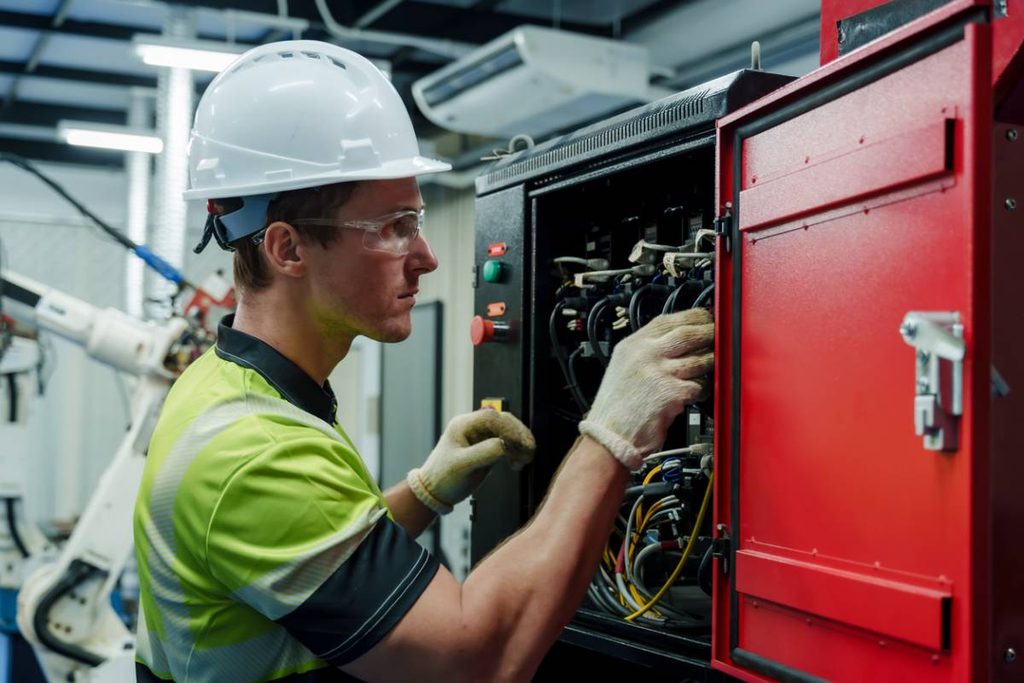
The exam consists of three professional tests. EP1, the installation task, lasts about eight hours and carries the heaviest coefficient. EP2 covers commissioning, EP3 maintenance, each lasting about two hours. Added to this are general subjects: French, history-geography, mathematics, and science.
The exemption many are unaware of: if you already hold a diploma of equivalent or higher level than the CAP, you are exempt from the general tests. Your preparation then focuses solely on the three professional tests, which radically changes the workload.
In this context, taking an electrician CAP for adults remotely means handling theory and methodology independently, then organizing the practical training yourself. Registration for the exam is done independently, with the rectorate, via the national Cyclades platform, usually between mid-October and mid-November for the following year’s session.
In all cases, plan a budget for materials. Practicing wiring requires having at home what is needed to assemble a panel: board, circuit breakers, wires, equipment, tools, and protective gear.
What financing solutions can be mobilized for your career change?
Several schemes combine, and it is often their stacking that makes the project viable.
The personal training account forms the basis. It is consulted and used on the official Mon Compte Formation platform, with rights accrued each year worked. Two points to know before starting: a flat-rate contribution from the holder is now mandatory for any training financed this way, and its amount was increased in 2026.
If your rights do not cover the total cost, top-ups exist. Your employer, your skills operator, the regional council, France Travail, or Agefiph can supplement the funding, each according to their own criteria.
The professional transition project deserves careful consideration if you are employed. Managed by the Transitions Pro associations, it finances a certified training with a view to career change and allows, under conditions, to keep a salary during the training.
The skills development plan of your company remains an underused option, especially if your employer is already involved in finishing work and welcomes skills upgrading.
Beware of solicitors: fraudulent solicitations around the CPF remain numerous. Access to your rights is exclusively through the official site, and your login details should not be shared with anyone, not even a training organization.
Organizing your revision and internships when you are already employed
The difficulty is not the volume of lessons. It is the consistency.
An organization that lasts twelve to eighteen months is based on three simple principles. Block fixed time slots during the week rather than waiting for available time, which never comes. Alternate theory during the week and practice on weekends, as hands-on work anchors concepts much faster than reading. And tackle diagrams and standards first, because the EP1 exam assesses both the method and the action.
Regarding internships, a clarification is necessary. The exam regulations do not require a professional training period for individual candidates. This does not mean you should skip it: without real wiring hours, the practical tests remain very difficult to pass.
Several solutions exist for an employee. A training agreement during leave, a few observation days with a craftsman in your network, or supervised practice as part of real work. The goal is not to tick an administrative box, but to arrive at the exam with automated actions.
Finally, consider electrical authorization. The CAP certifies a diploma, the authorization is issued by the employer after specific training and conditions intervention on live installations. Both are complementary; neither replaces the other.
And after: the diploma as the key to installation
This is why this CAP carries more weight than a simple certificate. Electrical installation work is among the building activities reserved for qualified persons: one must hold a professional diploma in the trade or justify three years of experience acquired as an employee or manager.
In other words, without a diploma or validated experience, creating an electrical business is not possible. The CAP opens this door, just like field experience.
Once the business is created, other obligations take over, starting with ten-year insurance, mandatory before opening the first site, a topic we detailed in our article dedicated to the ten-year insurance for micro-entrepreneurs in construction.
A diploma is prepared in the evening. An installation, however, is done in broad daylight.
FAQ: the electrician CAP for career changers
Peut-on vraiment passer le CAP électricien entièrement à distance ?
La préparation théorique se suit en ligne, mais les épreuves professionnelles EP1, EP2 et EP3 se déroulent en présentiel sur un plateau technique. Une formation à distance couvre donc les cours et la méthodologie, jamais la pratique du câblage, qui doit être travaillée par ailleurs.
Est-on dispensé des matières générales en reconversion ?
Oui si vous détenez déjà un diplôme de niveau équivalent ou supérieur au CAP. Vous ne présentez alors que les épreuves professionnelles, ce qui réduit fortement la charge de révision et la durée de préparation.
Le stage est-il obligatoire pour un candidat individuel ?
Le règlement d’examen ne l’impose pas aux candidats individuels, contrairement à la voie scolaire. Il reste fortement recommandé : les épreuves pratiques évaluent des gestes professionnels qui ne s’acquièrent pas sur le papier.
Faut-il le CAP pour créer son entreprise d’électricité ?
Les travaux d’installation électrique relèvent des activités réservées aux personnes qualifiées. Il faut donc détenir un diplôme professionnel du métier, comme le CAP, ou justifier de trois années d’expérience professionnelle dans le domaine, pour exercer à son compte.
Sources
To go further: Personal training account of a private sector employee (Service-Public.fr) and Can I benefit from the personal training account? (Mon Compte Formation).