.en-bref { max-width: 640px; margin: 2em auto; padding: 1.5em 1.8em; color: #78350f; font-family: “Inter”, “Segoe UI”, sans-serif; text-align: left; position: relative; box-sizing: border-box; background: #fffaf0; border: 1px solid #b45309; border-left: 6px solid #b45309; border-radius: 8px; box-shadow: 0 8px 24px rgba(251, 191, 36, 0.15); }
.en-bref h2, .en-bref .en-bref-header { font-size: 1.15em; font-weight: 700; margin-bottom: 0.6em; color: #b45309; }
.en-bref p, .en-bref li { font-size: 1em; line-height: 1.65; margin: 10px; }
.en-bref strong { color: #451a03; }
.key-takeaways { max-width: 640px; margin: 2em auto; padding: 1.5em 1.8em; color: #78350f; font-family: “Inter”, “Segoe UI”, sans-serif; text-align: left; position: relative; box-sizing: border-box; background: #fffaf0; border: 1px solid #b45309; border-left: 6px solid #b45309; border-radius: 8px; box-shadow: 0 8px 24px rgba(251, 191, 36, 0.15); }
.key-takeaways h2, .key-takeaways .key-takeaways-header { font-size: 1.15em; font-weight: 700; margin-bottom: 0.6em; color: #b45309; }
.key-takeaways p, .key-takeaways li { font-size: 1em; line-height: 1.65; margin: 10px; }
.key-takeaways strong { color: #451a03; }
.key-takeaways ul { list-style: none; padding-left: 0; }
.key-takeaways li { margin: 0.45em 0; padding-left: 0.2em; }
.mg-callout{margin:1.5em 0;padding:.9em 1.1em;border:1px solid;border-left-width:4px;border-radius:10px;font-size:.97em;line-height:1.65}.mg-callout>:first-child{margin-top:0}.mg-callout>:last-child{margin-bottom:0}.mg-callout__label{display:block;margin:0 0 .35em;font-weight:700;font-size:.82em;letter-spacing:.03em;text-transform:uppercase}.mg-callout__label::before{margin-right:.45em;font-size:1.05em;vertical-align:-.06em}.mg-callout–info{background:#eff6ff;border-color:#bfdbfe;color:#1e3a5f}.mg-callout–info .mg-callout__label{color:#2563eb}.mg-callout–info .mg-callout__label::before{content:”2139FE0F”}.mg-callout–tip{background:#f0fdf4;border-color:#bbf7d0;color:#14532d}.mg-callout–tip .mg-callout__label{color:#15803d}.mg-callout–tip .mg-callout__label::before{content:”1F4A1″}.mg-callout–warning{background:#fffbeb;border-color:#fde68a;color:#7a4a10}.mg-callout–warning .mg-callout__label{color:#b45309}.mg-callout–warning .mg-callout__label::before{content:”26A0FE0F”}.mg-callout–danger{background:#fef2f2;border-color:#fecaca;color:#7f1d1d}.mg-callout–danger .mg-callout__label{color:#dc2626}.mg-callout–danger .mg-callout__label::before{content:”1F6D1″}.mg-proscons{display:grid;grid-template-columns:1fr 1fr;gap:16px;margin:1.5em 0}@media(max-width:560px){.mg-proscons{grid-template-columns:1fr}}.mg-proscons__col{padding:.9em 1.1em;border:1px solid;border-radius:10px}.mg-proscons__title{display:flex;align-items:center;gap:.4em;margin:0 0 .5em;font-weight:700;font-size:.9em;letter-spacing:.02em}.mg-proscons__col ul{margin:.3em 0 0;padding-left:1.15em}.mg-proscons__col li{margin:.3em 0;line-height:1.55}.mg-proscons__col–pro{background:#f0fdf4;border-color:#bbf7d0;color:#14532d}.mg-proscons__col–pro .mg-proscons__title{color:#15803d}.mg-proscons__col–pro .mg-proscons__title::before{content:”2705″}.mg-proscons__col–con{background:#fef2f2;border-color:#fecaca;color:#7f1d1d}.mg-proscons__col–con .mg-proscons__title{color:#dc2626}.mg-proscons__col–con .mg-proscons__title::before{content:”274C”}.mg-steps{list-style:none;counter-reset:mgstep;margin:1.5em 0;padding:0}.mg-steps__item{counter-increment:mgstep;position:relative;padding:0 0 1.1em 3.2em;min-height:2.4em}.mg-steps__item:last-child{padding-bottom:0}.mg-steps__item::before{content:counter(mgstep);position:absolute;left:0;top:0;width:2.2em;height:2.2em;line-height:2.2em;text-align:center;border-radius:50%;background:#2563eb;color:#fff;font-weight:700;font-size:.95em}.mg-steps__title{margin:.15em 0 .3em;font-weight:700}.mg-steps__item>:last-child{margin-bottom:0}.mg-kpis{display:grid;grid-template-columns:repeat(auto-fit,minmax(140px,1fr));gap:14px;margin:1.5em 0}.mg-kpi{padding:1em .9em;border:1px solid #e5e7eb;border-radius:12px;background:#f9fafb;text-align:center}.mg-kpi__value{display:block;font-size:1.7em;font-weight:800;line-height:1.15;color:#111827}.mg-kpi__label{display:block;margin-top:.35em;font-size:.85em;color:#6b7280;line-height:1.35}
.wp-block-image,.ai-image{margin-bottom:1.75em}.wp-block-image>figcaption,.ai-image>figcaption{margin-top:.5em}
Humidity in a Room: Common Causes and Solutions According to the Wall Concerned
Humidity in a room can come from condensation, water infiltration, a leak, rising damp, or insufficient ventilation. The affected area often gives a first clue: bottom of the wall, cold corner, window frame, ceiling, or wall directly exposed to rain.
This guide helps distinguish symptoms, perform some careful checks, and choose a response consistent with the probable cause. The goal is not to hide a damp wall with paint, but to prevent damage from reappearing after repairs.
In Brief
- 💧 An isolated stain after rain rather suggests infiltration than a simple indoor air problem.
- 🌬️ Condensation often affects corners, windows, and cold walls, especially in a bathroom or kitchen.
- 🏠 Humidity at the bottom of a wall can be related to rising damp, but a leak or waterproofing defect should also be checked.
- 🛠️ Paint, bleach, and dehumidifiers alone do not solve infiltration or rising water issues.
How to Quickly Identify the Type of Humidity in a Room?
The location, appearance of the marks, and their evolution help guide the diagnosis, without replacing expert assessment when the problem is significant. Humidity that appears after rain, rises from the floor, or concentrates on a cold surface is not treated the same way.
Signs to Observe
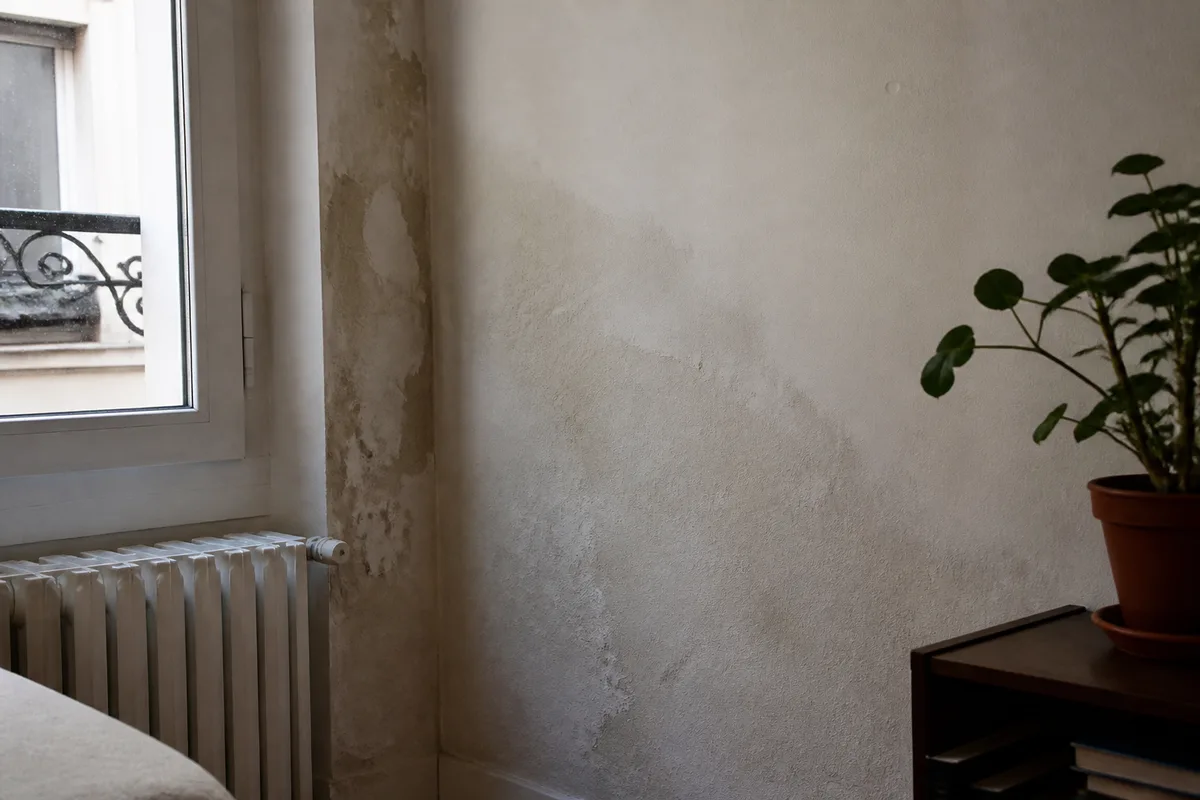
A damp wall may show halos, dark stains, blisters, peeling paint or wallpaper, saltpeter, a persistent odor, and mold. Crumbling plaster or friable plaster are also signals to take seriously.
The shape of the damage matters as much as its color. A mark located near a pipe does not point to the same cause as a continuous damp band at the base of an old wall.
| Observed Area or Aspect | Possible Cause | First Check |
|---|---|---|
| Wall corner or window frame | Condensation, thermal bridge, or insufficient ventilation | Observe fogging, ventilate, and check air renewal |
| Bottom of the wall, with progressive height | Rising damp or leak at floor level | Look for saltpeter, peeling, and contact with a buried wall |
| Exterior wall, mark after rain | Facade crack, roof, or waterproofing defect | Check the facade, gutters, and downspouts |
| Ceiling or top of a wall | Roof leak, pipe, or apartment above | Compare the stain’s evolution with rain episodes or water use |
The Four Most Common Causes
- Condensation: water vapor deposits on a cold surface.
- Insufficient ventilation: humid air remains in the room, especially after a shower or cooking.
- Water infiltration: water enters through a crack, facade, roof, or buried wall.
- Rising damp: ground water progresses into a wall in direct contact with the earth, especially without a waterproof barrier.
“The right solution depends first on the origin of the water: reducing vapor does not repair a cracked facade, and repainting does not stop rising damp.”
Why Does Humidity Appear on an Exterior Wall?
A damp exterior wall is often exposed to water entry from the facade or roof. A crack, degraded plaster, overflowing gutter, or poorly protected joint can let water penetrate the masonry. The mark may worsen after a rainy episode, but water can take time to reach the interior face.
Possible Causes
Infiltrations can come from a crack in the facade, degraded joints, a roof leak, or a defect around a window. In a basement, a buried wall can also be subjected to water pressure accumulated in the soil, called hydrostatic pressure.
Insufficient insulation or a thermal bridge can, however, create surface moisture without direct infiltration. The wall becomes colder, which increases the risk of condensation when the indoor air is laden with water vapor.
Suitable solutions
The first step is to stop the water entry: roof repair, fixing a crack, restoring a joint, or improving rainwater drainage. For facade work, the method must take into account the substrate, its condition, and its exposure; the guide dedicated to facade waterproofing can help frame the different interventions.
On a buried wall, a professional can assess the usefulness of drainage, external waterproofing, or an internal tanking coating. Tanking forms a barrier on the wall, but it should not be presented as an automatic solution: if water continues to exert pressure or if the structure is cracked, the cause must be treated as a priority.
How to treat moisture on an interior wall?
A damp interior wall can be affected by condensation, a nearby leak, or through infiltration. To fix the problem, you must first check adjacent rooms, pipes, exterior walls, and ventilation. The treatment can then combine repair, air renewal, drying, and restoration of the substrate.
Condensation in a room
Condensation frequently appears in bathrooms, kitchens, and poorly ventilated bedrooms. It concentrates on cold walls, corners, and areas behind furniture placed too close to the wall. Poor thermal insulation and thermal bridges reinforce this phenomenon.
Functional ventilation removes the vapor produced by occupants and domestic uses. This may involve improving air inlets and outlets, cleaning vents, or installing an appropriate system, such as a single-flow or double-flow mechanical ventilation system after studying the dwelling.
Leak or infiltration through the wall
An interior stain located near a bathroom, kitchen, or pipe may indicate a leak. If it corresponds to an exterior wall and worsens after rain, the facade, roof, or joinery must be checked.
In this case, the water entry must be repaired before redoing the plaster. A dehumidifier can speed up drying comfort, but it does not replace leak repair and alone does not prove that the wall is dried out.
How to know if the moisture comes from condensation or the wall?
A directional test consists of sealing an aluminum foil sheet tightly on a clean, dry area for a limited time. If fog forms mainly on the side exposed to the room, condensation is plausible; if moisture appears between the foil and the wall, the water may come from the wall. This test remains indicative.
The aluminum foil test
- Clean and dry a small representative area, without aggressively scraping mold.
- Fix the edges of an aluminum foil sheet with adhesive tape to limit air exchange.
- Observe separately the side facing the room and the side against the wall.
- Compare the result with the stain location, weather, and ventilation habits.
A moisture meter can complement this observation by giving an indication of the moisture in a material. Measurements vary depending on the type of wall, coating, depth, and device used; therefore, they should not be interpreted as a universal severity threshold.
Why does moisture appear at the bottom of a wall?
Moisture at the bottom of the wall is consistent with rising damp when the wall is in contact with a damp ground and does not have an effective waterproof barrier. Water then progresses through the materials, sometimes to a significant height. A buried leak, a waterproofing defect, or splashes must also be ruled out.
Recognizing rising damp
The indicative signs are a relatively continuous damp band, saltpeter, peeling plasters, and more marked deterioration near the floor. In old walls, the absence of a waterproof course can promote this phenomenon. However, the presence of the mark on an interior partition is not sufficient to confirm the diagnosis.
A professional can investigate the source of the water, check the materials, and determine if an injection into the lower part of the wall is appropriate. The injection of waterproof resin aims to create a barrier against the progression of water, but its implementation depends on the masonry and the general condition of the building.
Work to consider
- Identify and eliminate any possible leak at the floor level or from a pipe.
- Check rainwater, the ground, and buried walls.
- Have an injection of resin studied if capillary rise is confirmed.
- Remove degraded coatings only after treating the cause.
- Choose a coating compatible with the substrate and its moisture behavior.
“A damp wall must be treated before any renovation: otherwise, the coating can peel off and the paint blister again after a few weeks or months.”
What to do immediately when facing a damp wall?
Start by protecting the occupants and belongings, then check if water continues to enter. Ventilate without blocking the vents, move furniture away from the wall, and document the evolution of the stains. In case of an active leak, shut off the relevant water supply if it can be done safely and quickly contact the responsible party or a professional.
Good practices
- Photograph the stains and note their location, date of appearance, and progression.
- Move furniture and textiles away to allow air circulation around the wall.
- Ventilate the room and maintain a regular temperature without heating a soaked wall abruptly.
- Look for a visible leak, an overflowing gutter, or a recent trace after rain.
- Request a diagnosis if the stain spreads, if the substrate crumbles, or if the origin remains uncertain.
Furniture placed against a cold wall can prevent drying and create a confined area favorable to mold. In a kitchen, cooking steam should be captured at the source; in a bathroom, the extractor should continue to operate after the shower.
Common mistakes to avoid
- Painting immediately: the finish masks the stain but can blister when the wall remains waterlogged.
- Sealing ventilation: this reduces vapor evacuation and can increase condensation.
- Using only bleach: it does not repair a leak, infiltration, or ventilation defect.
- Installing a waterproof lining too quickly: moisture can remain trapped behind the new wall.
- Relying on a single measurement: a moisture meter or a photograph is not always enough to identify the source.
How to treat mold without worsening the problem?
Mold must be approached with caution, especially when it covers a large area, returns quickly, or is accompanied by a strong odor. Exposure should be limited, ventilate, and find the cause of the moisture before redoing the finish. Sensitive individuals can seek medical advice if symptoms persist.
Take precautions
Avoid dry brushing a large moldy area, as this can release particles into the air. Wear appropriate protection for small maintenance tasks and never mix multiple household products, especially those containing bleach and acidic products.
Repair before restoring
After eliminating the cause, the wall must dry according to its thickness, material, temperature, ventilation, and the amount of water present. There is no single timeframe applicable to all buildings. Too early a renovation can trap moisture and cause new peeling.
To redo a floor or a finish in a renovated room, the choice of materials must remain compatible with the substrate. Installing linoleum, for example, is prepared on a clean, dry, and sufficiently stable floor; it should not be used to conceal persistent moisture.
Which solutions to compare according to the cause of the humidity?
Ventilation, repairing an infiltration, and resin injection do not address the same problem. The best option is the one that acts on the identified origin, while a surface product only serves as a finish. The following table helps to compare the responses without turning a hypothesis into a diagnosis.
| Solution | Targeted cause | Benefit | Limit |
|---|---|---|---|
| Improved ventilation | Condensation and humid air | Removes the vapor produced in the room | Does not repair infiltration or rising damp |
| Facade or roof repair | Water infiltration | Eliminates water entry from outside | Masonry can remain damp during drying |
| Resin injection | Confirmed rising damp | Creates a barrier in the lower part of the wall | Must be adapted to the substrate and diagnosis |
| Tank coating plaster | Basement wall exposed to humidity | Limits water passage on the interior face | Does not always replace external or structural treatment |
| So-called anti-humidity paint | Finish of an already renovated surface | Can complement the restoration | Does not treat the cause of the humidity |
When should you call a professional?
A professional diagnosis is preferable when the humidity spreads, returns despite ventilation, affects a buried wall, follows a crack, or seems to come from an inaccessible pipe. It is also recommended before insulation, cladding, or waterproofing work. Interventions on the structure, gas, electricity, or height should not be improvised.
Situations that require a diagnosis
- The cause remains unknown after visual checks.
- The wall is very degraded, crumbly, or covered with saltpeter.
- The stain appears on the ceiling or near an electrical installation.
- The water returns after each rain or after using equipment.
- The dwelling has a strong musty smell or extensive mold.
Which specialist to contact?
The professional depends on the probable origin: roofer for a roof leak, facade specialist for a crack or plaster defect, plumber for a pipe, humidity specialist for a global diagnosis, or qualified company for injection and waterproofing work. Request a written description of the suspected causes, proposed work, and their limits.
General health regulations and housing-related procedures can be checked on Service-Public.fr. For energy renovation work, evolving information and conditions must be verified with France Rénov’ before any commitment.
How to prevent the return of humidity in a room?
Prevention is based on regular air renewal, reducing vapor sources, and monitoring sensitive areas. It does not exempt repairing building defects. A room can remain humid despite correct habits if the facade, roof, or foundations allow water entry.
- Ventilate after showering, cooking, and drying laundry.
- Do not block extraction vents or air inlets.
- Leave space between bulky furniture and cold walls.
- Monitor window seals, gutters, and traces after rain.
- Treat cracks and waterproofing defects before repainting.
Proper insulation can reduce cold walls and thermal bridges, but it must be designed with the behavior of the existing wall in mind. On old masonry, trapping moisture behind an unsuitable material can shift the problem rather than solve it.
Useful sources to consult
| Source | Useful Data | Practical Use | Precautions |
|---|---|---|---|
| France Rénov’ | Energy renovation and available schemes | Check the aids and applicable conditions | Rules and amounts may change |
| Service-Public.fr | Official information on housing | Identify procedures and responsibilities according to the situation | A technical diagnosis remains necessary for the cause of the disorder |
| Anah | Information on certain home renovations | Search for schemes matching the project | Check eligibility before signing a quote |
Key Points
- 🔎 Locate the stain and observe its evolution before choosing a treatment.
- 🌬️ Ventilation acts on condensation, not on infiltration or rising damp.
- 🧱 Treat the cause before plastering, painting, or applying a covering.
- 🛠️ Have buried walls, persistent leaks, and significant damage diagnosed.
Frequently Asked Questions
Can you paint on a damp wall?
It is better to wait until the cause is eliminated and the surface is sufficiently dry. Paint applied too early can blister, peel off, or trap moisture inside the wall.
Why does humidity mainly appear in winter?
In winter, walls and windows are often colder while indoor activities produce vapor. When ventilation poorly evacuates this humid air, condensation forms more easily on cold surfaces.
Is a dehumidifier enough to solve the problem?
It can temporarily reduce air humidity and improve comfort. However, it does not fix leaks, infiltration, or rising damp, and its use should not replace finding the cause.
How to know if humidity comes from infiltration?
A stain that worsens after rain, is located near a crack, or appears on the ceiling may indicate infiltration. This observation should be complemented by checking the roof, facade, gutters, or pipes.
How long does it take to dry a wall?
The time depends on the wall thickness, material, temperature, ventilation, and amount of water present. There is no reliable duration without knowing these parameters; follow-up measurement can be useful before renovation.
.magic-lb-overlay{position:fixed;inset:0;background:rgba(15,23,42,.92);display:none;align-items:center;justify-content:center;z-index:99999;cursor:zoom-out;padding:20px}
.magic-lb-overlay.open{display:flex}
.magic-lb-overlay img{max-width:95vw;max-height:95vh;object-fit:contain;border-radius:8px;box-shadow:0 8px 32px rgba(0,0,0,.5)}
.magic-lb-close{position:absolute;top:16px;right:20px;color:#fff;background:rgba(0,0,0,.5);border:none;width:40px;height:40px;border-radius:50%;font-size:24px;cursor:pointer;display:flex;align-items:center;justify-content:center}
.magic-lb-close:hover{background:rgba(0,0,0,.8)}
.wp-block-image img{cursor:zoom-in;transition:transform .15s ease}
.wp-block-image img:hover{transform:scale(1.01)}
.magic-img-link{display:inline-block;text-decoration:none}
(function(){
var ov=document.getElementById(‘magic-lb’);if(!ov)return;
var img=ov.querySelector(‘img’),btn=ov.querySelector(‘.magic-lb-close’);
function open(src){img.src=src;ov.classList.add(‘open’);document.body.style.overflow=’hidden’}
function close(){ov.classList.remove(‘open’);img.src=”;document.body.style.overflow=”}
document.addEventListener(‘click’,function(e){
var a=e.target.closest(‘a.magic-img-link’);
if(a){e.preventDefault();open(a.getAttribute(‘href’));return}
var i=e.target.closest(‘.wp-block-image img’);
if(i&&!e.target.closest(‘a’)){e.preventDefault();open(i.currentSrc||i.src)}
});
ov.addEventListener(‘click’,function(e){if(e.target===ov||e.target===btn)close()});
document.addEventListener(‘keydown’,function(e){if(e.key===’Escape’)close()});
})();