.en-bref { max-width: 640px; margin: 2em auto; padding: 1.5em 1.8em; color: #78350f; font-family: “Inter”, “Segoe UI”, sans-serif; text-align: left; position: relative; box-sizing: border-box; background: #fffaf0; border: 1px solid #b45309; border-left: 6px solid #b45309; border-radius: 8px; box-shadow: 0 8px 24px rgba(251, 191, 36, 0.15); }
.en-bref h2, .en-bref .en-bref-header { font-size: 1.15em; font-weight: 700; margin-bottom: 0.6em; color: #b45309; }
.en-bref p, .en-bref li { font-size: 1em; line-height: 1.65; margin: 10px; }
.en-bref strong { color: #451a03; }
.key-takeaways { max-width: 640px; margin: 2em auto; padding: 1.5em 1.8em; color: #78350f; font-family: “Inter”, “Segoe UI”, sans-serif; text-align: left; position: relative; box-sizing: border-box; background: #fffaf0; border: 1px solid #b45309; border-left: 6px solid #b45309; border-radius: 8px; box-shadow: 0 8px 24px rgba(251, 191, 36, 0.15); }
.key-takeaways h2, .key-takeaways .key-takeaways-header { font-size: 1.15em; font-weight: 700; margin-bottom: 0.6em; color: #b45309; }
.key-takeaways p, .key-takeaways li { font-size: 1em; line-height: 1.65; margin: 10px; }
.key-takeaways strong { color: #451a03; }
.key-takeaways ul { list-style: none; padding-left: 0; }
.key-takeaways li { margin: 0.45em 0; padding-left: 0.2em; }
.mg-callout{margin:1.5em 0;padding:.9em 1.1em;border:1px solid;border-left-width:4px;border-radius:10px;font-size:.97em;line-height:1.65}.mg-callout>:first-child{margin-top:0}.mg-callout>:last-child{margin-bottom:0}.mg-callout__label{display:block;margin:0 0 .35em;font-weight:700;font-size:.82em;letter-spacing:.03em;text-transform:uppercase}.mg-callout__label::before{margin-right:.45em;font-size:1.05em;vertical-align:-.06em}.mg-callout–info{background:#eff6ff;border-color:#bfdbfe;color:#1e3a5f}.mg-callout–info .mg-callout__label{color:#2563eb}.mg-callout–info .mg-callout__label::before{content:”2139FE0F”}.mg-callout–tip{background:#f0fdf4;border-color:#bbf7d0;color:#14532d}.mg-callout–tip .mg-callout__label{color:#15803d}.mg-callout–tip .mg-callout__label::before{content:”1F4A1″}.mg-callout–warning{background:#fffbeb;border-color:#fde68a;color:#7a4a10}.mg-callout–warning .mg-callout__label{color:#b45309}.mg-callout–warning .mg-callout__label::before{content:”26A0FE0F”}.mg-callout–danger{background:#fef2f2;border-color:#fecaca;color:#7f1d1d}.mg-callout–danger .mg-callout__label{color:#dc2626}.mg-callout–danger .mg-callout__label::before{content:”1F6D1″}.mg-proscons{display:grid;grid-template-columns:1fr 1fr;gap:16px;margin:1.5em 0}@media(max-width:560px){.mg-proscons{grid-template-columns:1fr}}.mg-proscons__col{padding:.9em 1.1em;border:1px solid;border-radius:10px}.mg-proscons__title{display:flex;align-items:center;gap:.4em;margin:0 0 .5em;font-weight:700;font-size:.9em;letter-spacing:.02em}.mg-proscons__col ul{margin:.3em 0 0;padding-left:1.15em}.mg-proscons__col li{margin:.3em 0;line-height:1.55}.mg-proscons__col–pro{background:#f0fdf4;border-color:#bbf7d0;color:#14532d}.mg-proscons__col–pro .mg-proscons__title{color:#15803d}.mg-proscons__col–pro .mg-proscons__title::before{content:”2705″}.mg-proscons__col–con{background:#fef2f2;border-color:#fecaca;color:#7f1d1d}.mg-proscons__col–con .mg-proscons__title{color:#dc2626}.mg-proscons__col–con .mg-proscons__title::before{content:”274C”}.mg-steps{list-style:none;counter-reset:mgstep;margin:1.5em 0;padding:0}.mg-steps__item{counter-increment:mgstep;position:relative;padding:0 0 1.1em 3.2em;min-height:2.4em}.mg-steps__item:last-child{padding-bottom:0}.mg-steps__item::before{content:counter(mgstep);position:absolute;left:0;top:0;width:2.2em;height:2.2em;line-height:2.2em;text-align:center;border-radius:50%;background:#2563eb;color:#fff;font-weight:700;font-size:.95em}.mg-steps__title{margin:.15em 0 .3em;font-weight:700}.mg-steps__item>:last-child{margin-bottom:0}.mg-kpis{display:grid;grid-template-columns:repeat(auto-fit,minmax(140px,1fr));gap:14px;margin:1.5em 0}.mg-kpi{padding:1em .9em;border:1px solid #e5e7eb;border-radius:12px;background:#f9fafb;text-align:center}.mg-kpi__value{display:block;font-size:1.7em;font-weight:800;line-height:1.15;color:#111827}.mg-kpi__label{display:block;margin-top:.35em;font-size:.85em;color:#6b7280;line-height:1.35}
.wp-block-image,.ai-image{margin-bottom:1.75em}.wp-block-image>figcaption,.ai-image>figcaption{margin-top:.5em}
Which drill should you choose for assembling furniture, screwing regularly, and making a few holes at home? For most domestic uses, a cordless drill-driver is the most versatile starting point. It allows you to drill wood or metal with the appropriate accessories, while facilitating furniture assembly thanks to the torque adjustment.
This guide compares the available solutions based on the material, frequency of use, autonomy, weight, budget, and accessories. It is a documentary comparison established from manufacturer or merchant datasheets and published tests; not all models have been directly tested by the editorial team.
In brief
- 🔧 For flat-pack furniture and small jobs, generally choose a cordless drill-driver.
- 🧱 To occasionally drill a brick or cinder block wall, the hammer function can be useful.
- ⚡ A 12-volt battery favors compactness; an 18-volt platform is more suitable for demanding tasks.
- 🪛 The adjustable torque, the chuck, and the tool’s balance often matter more than a power rating given alone.
- 🛡️ A hammer drill does not replace a rotary hammer for heavy-duty concrete work.
Which drill is really suitable for furniture assembly?
For assembling furniture, the cordless drill-driver is generally the most balanced solution: it combines drilling and screwing in one tool, without a cable to move around. A compact screwdriver may suffice for simple assemblies, while a hammer drill becomes interesting if the tool also needs to fix objects into relatively hard walls.
The cordless drill-driver, the most versatile choice
A drill-driver has a chuck, that is the part that holds the bit or drill, as well as a torque adjustment ring. In screwing mode, this ring limits the applied force to reduce the risk of driving a screw too deep or damaging a wood panel.
For a home, this tool covers most common tasks: flat-pack furniture, shelves, small repairs, and drilling in wood. Its appeal increases when the batteries are removable and compatible with other tools of the same range.
The compact screwdriver for small assemblies
A compact screwdriver is lighter and easier to handle in tight spaces. It is suitable for furniture with many screws, especially when working speed and hand comfort take precedence over the ability to drill various materials.
Its limitation is functional: a dedicated screwdriver is not necessarily designed to accept drill bits or to drill a wall. If you want a single tool for multiple tasks, a drill-driver will be more versatile.
The hammer drill for walls
The hammer function adds small impacts to the rotation of the drill bit. This function helps to occasionally drill hard materials like brick or cinder block, provided you use a suitable drill bit and check the nature of the material.
The hammer function expands the possibilities of a drill, but it does not turn the tool into a rotary hammer intended for heavy-duty work.
For occasional wall fixing, this function can avoid buying a second device. However, repeated drilling of concrete, making many holes, or using large diameters rather justify a rotary hammer, designed to transmit more impact energy.
The corded drill: continuous power and usage constraints
A corded drill runs on mains power and does not depend on a battery. It can be suitable for a workshop or long jobs, when autonomy and battery changes are significant constraints.
However, the cable reduces freedom of movement and requires a nearby outlet. To assemble furniture in the middle of a room, a cordless drill is generally more practical. The corded drill becomes especially relevant when continuous power supply matters more than mobility.
How to choose the features of a cordless drill?
Technical specifications help link the tool to a specific task. For a beginner, it is best to first look at the voltage, torque, chuck, weight, and available batteries, then check the accessories. A high value is only useful if it truly corresponds to the material and frequency of work.
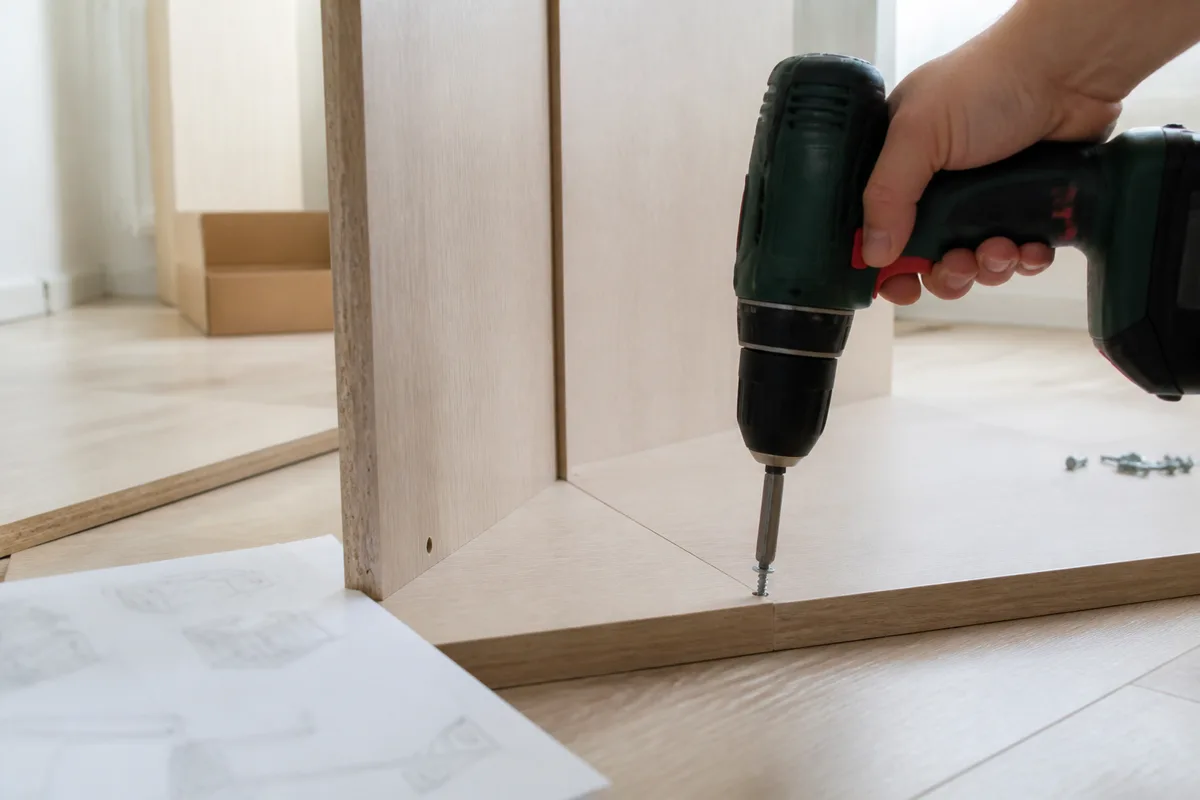
Battery voltage: 12 or 18 volts?
A 12-volt drill favors compactness, reduced weight, and maneuverability. It is well suited for assembling furniture, general screwing, and small drilling in wood or less resistant materials.
An 18-volt drill generally has a larger reserve for demanding tasks. This voltage is recommended for more sustained use, especially when drilling regularly or using percussion. However, it can be bulkier and heavier.
| Intended use | Preferred solution | Why | Limit to accept |
|---|---|---|---|
| Flat-pack furniture | 12 V drill-driver | Compact and maneuverable for screwing | Less suitable for demanding tasks |
| Versatile DIY | 18 V drill-driver | More reserve for drilling and screwing | Potentially higher weight and bulk |
| Occasional fixings in brick | Cordless hammer drill | The hammering complements the rotation | Insufficient for heavy masonry |
| Long workshop tasks | Wired drill | Continuous power supply | Cable and reduced mobility |
Torque and its settings
Torque, expressed in newton-meters, or Nm, corresponds to the force exerted by the tool on the screw in screwing mode. The graduated ring allows selecting a tightening limit: a low setting suits fragile panels, while a higher setting may be necessary for a strong screw.
An adjustable torque mainly helps preserve screw heads, threads, and furniture panels. The maximum torque should not be confused with the overall efficiency of the drill: the bit, the screw, the material, and the skill of the user also influence the result.
Variable speed and two mechanical gears
The variable speed trigger allows starting slowly, positioning the bit correctly, and limiting jerks. The two mechanical gears complement this setting: the first favors force at low speed, while the second prioritizes speed for certain drillings.
To assemble furniture, a slow start speed is easier to control. For metal, an appropriate speed and a specific drill bit limit the risk of overheating. The setting should therefore follow the material rather than just seeking speed.
The chuck and accessory compatibility
The chuck holds drill bits and some screwing accessories. A keyless chuck is convenient at home because it allows changing tools without a dedicated key. Before purchase, check the accepted diameters and compatibility with the bits you plan to use.
The choice of accessories is as important as the drill itself to obtain a clean hole. A wood bit, a metal bit, and a masonry bit do not meet the same needs and should not be interchanged.
Weight, balance, and handling
A lightweight tool causes less wrist fatigue when assembling furniture, especially when there are many screws or they are placed high up. The balance between the battery, motor, and handle also influences precision: a compact drill can be more comfortable in a narrow cabinet.
If several people use the tool, observe the shape of the handle, access to the trigger, and ease of reversing the rotation direction. There is no model reserved for one gender: maneuverability depends on morphology, available strength, and working posture.
Battery life and battery system
A removable battery allows work to continue with a second pack while the first is charging. For occasional use, a single set may suffice if sessions are short. For many pieces of furniture or regular work, two batteries reduce interruptions.
Compatibility with a tool platform deserves special attention. An interchangeable battery with a screwdriver, sander, or lighting can reduce future purchases, but you need to compare the actual range available before choosing.
Functions and equipment that are truly useful
- LED lighting can help in a dark corner or inside a piece of furniture.
- A charge indicator makes it easier to anticipate a recharge.
- A speed controller improves control at startup.
- A disconnectable hammer function prevents unnecessary strain on the mechanism in screwing mode.
- A case with bits and drill bits can be practical, provided the accessories match the materials worked on.
What power to choose according to your home projects?
To determine which drill power to choose, start with the material and the duration of the work. Watts mainly concern corded devices, while cordless models are compared more by voltage, torque, speed, and battery capacity. High power alone therefore does not guarantee a better result.
For assembling flat-pack furniture
A compact cordless drill-driver is sufficient in most cases. Torque adjustment, the appropriate bit, and moderate speed are more important than high hammer capacity. To avoid damaging particleboard, start with low torque and increase it only if the screw does not sink in enough.
For occasional DIY
To install a shelf, repair a door, assemble furniture, and make a few holes, a versatile drill-driver is a coherent compromise. An 18-volt version becomes interesting if the tool will also be used for wall fixings or more frequent work.
For drilling wood and metal
Wood is drilled with suitable bits, choosing the necessary diameter and depth. Metal requires specific drill bits and controlled speed to limit overheating. A drill with variable speed offers more control than a model operating only at high speed.
For finishing operations on a metal piece, a drill is not always the appropriate tool. A guide dedicated to metal sanding and tool choice addresses this different need.
For fixing objects into a wall
First identify the material: plasterboard, brick, cinder block, or concrete. A hammer drill may be suitable for occasional holes in brick or cinder block, but a rotary hammer is better suited for repeated work in concrete.
Before drilling a wall, the most important question is not the announced power: it is the nature of the support and the possible presence of networks.
For a plasterboard partition, the choice of fixing also matters. The method of choosing a Molly plug for BA13 must be adapted to the weight of the object and the thickness of the board.
What accessories should you buy with a drill?
A very comprehensive kit is not necessarily more useful. To start, select a few good quality bits and drill bits corresponding to the materials in your home. This approach avoids paying for unusable accessories or mistakenly choosing a masonry bit for metal.
Screwdriver Bits
- Phillips bits for common furniture and hardware screws.
- Hex or Torx bits when the furniture screws require it.
- Magnetic bit holder for quick bit changes.
- Bits sturdy enough to prevent wear on the screw recess.
Drill Bits Suitable for Materials
Plan for a set of wood bits for panels and battens, metal bits for steel or aluminum, and masonry bits for brick or cinder block. The diameter should match the anchor, the screw, or the intended cable passage.
Additional Accessories
A depth stop can help reproduce consistent drilling depths. A level, a tape measure, a pencil, and a network detector usefully complete the equipment. For furniture, clamps can hold two pieces aligned during screwing and prevent forcing on the panels.
What Mistakes to Avoid When Assembling Furniture?
Problems often come less from the drill than from incorrect settings or too rapid a movement. Three precautions significantly reduce risks: use the correct bit, start slowly, and control the torque. The instructions must also be followed, as some panels cannot withstand repeated tightening.
- Choose the bit matching the screw. A poorly fitting recess slips and can make the screw impossible to remove.
- Start with low torque. Too high a setting can go through a panel or strip the thread.
- Hold the pieces properly. A misaligned panel creates stress that deforms the assembly.
- Pre-drill when the material or screw requires it. Pre-drilling reduces the risk of wood splitting, especially near an edge.
- Avoid forcing when the bit slips. Stop the tool, check the recess, and replace the bit if it is worn.
For furniture, the correct setting is one that tightens the screw sufficiently without compressing or damaging the panel.
Which Models to Compare for Domestic Use?
The models below are cited as options for documentary comparison, not as a universal ranking. The available information does not allow comparison of each feature at the same level of detail; when data is not provided, it is indicated as not communicated rather than inferred.
| Model | Type | Documented Distinctive Feature | Profile It Seems Suitable For | Price |
|---|---|---|---|---|
| DeWalt DCD795D2-QW | Cordless Hammer Drill Driver | Very high performance according to the consulted source | Demanding work and performance seeking | See current price |
| Black+Decker BL188 | Cordless Hammer Drill Driver | Solid performance for screwing and drilling | Looking for a quality-price compromise | See current price |
| Metabo SB 18 L Set | Cordless Hammer Drill Driver | Versatility | Various uses at home | See current price |
| Skil 3070 HA | Cordless Hammer Drill Driver | Compactness and performance | Handling in small spaces | See current price |
| Bosch UniversalImpact 18V | Cordless Hammer Drill Driver | Suitable for small holes | Small drilling jobs | See current price |
DeWalt DCD795D2-QW: for prioritizing performance
The DeWalt DCD795D2-QW is described as a very high-performance cordless hammer drill-driver. Based on this documentation, it seems intended for DIY enthusiasts who want a tool capable of handling more demanding tasks than just simple furniture assembly.
The available source does not provide all the necessary specifications to compare its weight, torque, battery life, or equipment with those of other models. Therefore, it should not be chosen solely based on an impression of power, but after verifying the exact specifications of the offered variant.
Black+Decker BL188: a compromise for screwing and drilling
The BL188 model is presented with solid performance for screwing and drilling. It may interest a private user who assembles furniture, installs a few items, and wishes to keep a hammer function without moving to a professional tool.
Detailed data on the battery, kit contents, and torque are not provided in the available information. It is therefore necessary to check the version sold, as the included equipment may vary depending on the offer.
Metabo SB 18 L Set: for seeking versatility
The Metabo SB 18 L Set is identified as a versatile cordless hammer drill-driver. This orientation corresponds to a user who regularly uses a drill for different tasks, not limited to furniture assembly.
The mention “Set” suggests a commercial package, but the exact contents are not provided here. Check the list of accessories, the number of batteries, and the charger before purchase instead of assuming they are identical from one offer to another.
Skil 3070 HA: for spaces where compactness matters
The Skil 3070 HA is described as compact and efficient. This profile may suit someone working in cabinets, closets, or hard-to-reach areas where the bulkiness of the drill quickly becomes inconvenient.
Torque, battery life, and weight values are not provided in the available facts. The announced compactness alone does not allow conclusions about endurance or drilling capabilities.
Bosch UniversalImpact 18V: for small holes
The Bosch UniversalImpact 18V is presented as suitable for small holes. It can therefore be considered by a beginner whose needs are limited to a few drillings and domestic screwing, provided the exact pack configuration is verified.
For intensive use in concrete or masonry, this description is not enough to position it as a substitute for a rotary hammer. The choice must remain consistent with the frequency and difficulty of the work.
Which drill to choose according to your profile?
The right choice depends on the dominant scenario, not on a general ranking. For flat-pack furniture, maneuverability and adjustable torque take precedence over hammer function. For home maintenance, an 18-volt platform and compatible batteries may be more relevant. For frequent concrete work, one must move beyond the category of hammer drills.
| Profile | Generally coherent choice | Priority criterion | What to avoid |
|---|---|---|---|
| Furniture assembly only | Compact drill-driver | Adjustable torque and low fatigue | Heavy tool bought for a hammer function rarely used |
| Versatile beginner | Cordless drill-driver | Ease of handling and suitable accessories | Kit filled with incompatible accessories |
| Regular DIYer | 18 V model | Battery life, torque, and battery platform | Relying solely on the number of volts |
| Occasional wall fixings | Hammer drill | Compatibility with the material | Considering it as a rotary hammer |
| Frequent concrete drilling | Rotary hammer | Impact energy | Forcing a hammer drill on long series |
How to buy a drill without making a mistake: the steps
A simple method avoids paying for an unnecessary function or choosing a tool that is too limited. First, note the actual planned tasks, then check the compatibility between the material, accessories, and the machine. This approach is more reliable than a selection based on a brand or an isolated value.
- List the tasks for the next twelve months: furniture, shelves, wood, metal, walls, or heavier work.
- Identify the surfaces: furniture panel, solid wood, metal, plasterboard, brick, cinder block, or concrete.
- Choose the type of tool: drill-driver, hammer drill model, corded device, or rotary hammer.
- Compare voltage and weight: 12 volts for compactness, 18 volts for a larger reserve, without forgetting balance.
- Check the torque, chuck, and speed: these elements determine screw-driving control and drill bit compatibility.
- Check the contents of the case: batteries, charger, bits, drill bits, and warranty must be clearly indicated.
- Check the price and availability on the day of purchase: offers vary depending on the retailer and the variant.
What precautions should be taken before drilling at home?
Drilling exposes you to several risks: electrical cables, pipes, material projection, dust, and loss of tool control. Safety begins with identifying the surface and area, then wearing appropriate protection. Never drill blindly into a wall or near an installation.
- Turn off or move energy sources when the situation requires it and check for the absence of cables or pipes.
- Wear protective glasses against projections and use respiratory protection when dust justifies it.
- Hold the piece to be drilled firmly; do not hold a small element directly in your hand.
- Remove the battery or unplug the device before changing a drill bit or bit.
- Do not use percussion on a surface that may crack without verifying its nature.
For more complex renovation work, such as a shower or a worktop, a drill represents only part of the process. The guides on installing an Italian-style shower and on replacing a worktop help distinguish the tooling from the overall project.
To remember
- 🔧 For assembling furniture, a cordless drill-driver is generally sufficient.
- ⚖️ A 12 V version favors lightness; an 18 V version offers more reserve for varied work.
- 🧱 Percussion is suitable for occasional drilling in certain walls, but a rotary hammer remains preferable for frequent concrete work.
- 🪛 Adjustable torque, variable speed, compatible chuck, and good grip are the priority criteria.
- 🔍 Always check the variant, case contents, price, and availability with the retailer.
Frequently Asked Questions
Which drill to choose for assembling furniture?
A compact cordless drill-driver is generally suitable for assembling furniture. Favor adjustable torque, variable speed, an appropriate bit, and a good grip. Percussion is only useful if the tool also needs to drill certain walls.
Is a hammer drill indispensable?
No. It is not necessary for screwing or drilling furniture panels. It becomes useful for occasional holes in brick or cinder block, but it does not replace a rotary hammer for repeated work in concrete.
Which voltage to choose between 12 volts and 18 volts?
12 volts favors compactness and comfort for assemblies and small jobs. 18 volts is more suitable for versatile or demanding use. Weight, torque, and autonomy should also be considered along with voltage.
Can the same drill be used for wood, metal, and masonry?
A versatile drill can work these materials if it has the appropriate drill bits and necessary settings. Wood, metal, and masonry require different accessories and speeds. For frequent concrete, a rotary hammer is more suitable.
Should I buy a second battery?
A second battery is convenient when work sessions are long or close together. For a few screws and small holes, one battery may suffice. Above all, check the battery system compatibility with other tools you plan to use.
How We Compared
This comparison is based on the announced uses, tool categories, technical criteria, and published information for the mentioned models. Since detailed data is not identical for each variant, characteristics not provided are indicated as not communicated rather than inferred.
The comparison is established as of August 14, 2026. Prices, stock, kit contents, and sales conditions may change, so please check the latest information with the retailer before ordering.
Useful Sources to Consult
- Bricozor Guide on Choosing a Drill: types of tools, accessories, and uses according to materials.
- Les Numériques: documentary comparison of several cordless hammer drills.
- Domomat: selection criteria such as chuck, hammer function, and motor type.
.magic-lb-overlay{position:fixed;inset:0;background:rgba(15,23,42,.92);display:none;align-items:center;justify-content:center;z-index:99999;cursor:zoom-out;padding:20px}
.magic-lb-overlay.open{display:flex}
.magic-lb-overlay img{max-width:95vw;max-height:95vh;object-fit:contain;border-radius:8px;box-shadow:0 8px 32px rgba(0,0,0,.5)}
.magic-lb-close{position:absolute;top:16px;right:20px;color:#fff;background:rgba(0,0,0,.5);border:none;width:40px;height:40px;border-radius:50%;font-size:24px;cursor:pointer;display:flex;align-items:center;justify-content:center}
.magic-lb-close:hover{background:rgba(0,0,0,.8)}
.wp-block-image img{cursor:zoom-in;transition:transform .15s ease}
.wp-block-image img:hover{transform:scale(1.01)}
.magic-img-link{display:inline-block;text-decoration:none}
(function(){
var ov=document.getElementById(‘magic-lb’);if(!ov)return;
var img=ov.querySelector(‘img’),btn=ov.querySelector(‘.magic-lb-close’);
function open(src){img.src=src;ov.classList.add(‘open’);document.body.style.overflow=’hidden’}
function close(){ov.classList.remove(‘open’);img.src=”;document.body.style.overflow=”}
document.addEventListener(‘click’,function(e){
var a=e.target.closest(‘a.magic-img-link’);
if(a){e.preventDefault();open(a.getAttribute(‘href’));return}
var i=e.target.closest(‘.wp-block-image img’);
if(i&&!e.target.closest(‘a’)){e.preventDefault();open(i.currentSrc||i.src)}
});
ov.addEventListener(‘click’,function(e){if(e.target===ov||e.target===btn)close()});
document.addEventListener(‘keydown’,function(e){if(e.key===’Escape’)close()});
})();