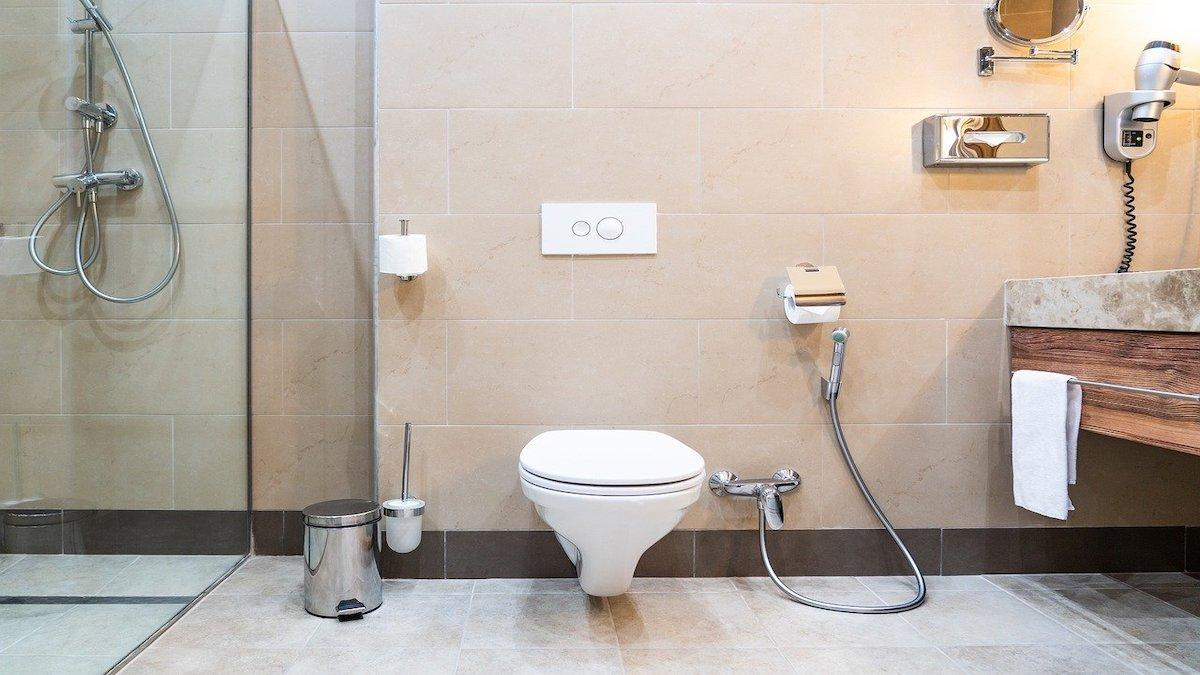
You are planning to renovate your toilet and are considering replacing your sanitary fixtures with wall-hung toilets? In this article, we will give you some advice, especially on how to choose the right model.
📋 Key takeaway: Personally, I consider the wall-hung toilet to be the aesthetic and hygienic choice par excellence, as it frees up 100% of the floor surface for easier cleaning. Its installation relies on a support frame capable of bearing a load of up to 400 kg without faltering. I recommend thoroughly checking the accessibility of the waste pipe before closing the casing, as 15% of post-installation leaks are due to poor initial fitting.
Which choice for wall-hung toilets?
Several models of wall-hung toilets are available on the sanitary market. It is therefore important to consider several criteria to select your wall-hung toilets. 
🗣️ My experience: In 2023, I installed my first wall-hung toilet pack in a cramped bathroom. I had forgotten to plan an access hatch for the shut-off valve located inside the casing. When a slight joint leaked three months later, I had to break part of my tiling to intervene. Lesson learned: never seal a casing without a discreet but functional technical access.
Choosing the wall-hung toilet
To begin with, you must choose a model whose dimensions allow you to install it. If you have limited space, you can opt for a space-saving bowl. Only then can you indulge yourself with aesthetic criteria. Of course, the more options you add, the higher the price will be. You must therefore define your budget, not forgetting installation if you call on a professional.
Regarding the design of the wall-hung toilet, manufacturers offer models in different colors. You are therefore not obliged to settle for white. For example, you can choose black. The choice is also available in the shape of the bowl. While the classic oval is available, you also have rounded toilets, even truly round, or conversely rectangular.
Finally, you should also consider the available options. For example, you can select a rimless bowl if you want to limit limescale. Moreover, the seat can be Japanese for your intimate hygiene or detachable to easily clean the back of the bowl.
To go further, I recommend our guide on click-lock tiles which also provides useful tips for your floors. And to go even further, our file on affordable plumbers offers interesting insights on labor costs.
Choosing the support frame
Choosing wall-hung toilets is not limited to buying a bowl and a seat. You also need to consider the mounting support.
Specifically, regarding its mounting, the self-supporting frame can be fixed
- to the wall (if it is load-bearing);
- on the floor (except for the wooden floor);
- on the wall and on the floor.
The control panel should also catch your attention. It can be single or double if you want to have two flush capacities. The control can also be contactless, if hygiene is an essential criterion for you. Finally, you must consider the material. The panel can be made of thermoplastic, stainless steel, brass…
🌍 Did you know? Modern concealed cisterns allow precise adjustment of the flush volume. By switching from a standard 9-liter flush to a dual flush 3/6 liters, a family of four saves on average 35,000 liters of water per year.
The choice is also present at the level of the frame cladding, used to hide the fastening and drainage system of the toilet. It’s up to you to decide whether you opt for a ready-to-install, paintable, or tileable casing.
Finally, as with the bowl, pay attention to the options. For example, you can choose to integrate a hand wash basin.
| Technical element | Standard height | PMR height | Maximum load |
|---|---|---|---|
| Top of the bowl | 40 cm | 45 to 50 cm | 400 kg |
| Drain axis | 18 cm | 18 cm | N/A |
| Frame support | 112 cm | 112 cm | Wall/floor fixing |
| Casing depth | 15 to 20 cm | 15 to 20 cm | Steel structure |
⚠️ Common mistake: Not lubricating the lip seals of the drain pipe and the supply sleeve. Without silicone grease, the seal can pinch or twist during the insertion of the bowl, causing an invisible leak behind the casing that will only appear several weeks later.
Why install wall-hung toilets at home?
🌟 Advantages
- Modern and sleek design
- Impeccable hygiene on the floor
- Reduced noise nuisance
🔍 Drawbacks
- More technical and longer installation
- Higher overall price
- Maintenance limited by the casing
Although it costs more than a floor-mounted toilet bowl, the wall-hung toilet also offers several advantages, which may lead you to choose it when renovating toilets.
First of all, it cannot be denied that it is more aesthetic than traditional toilets. Wall-hung toilets bring modernity to the room, making it easier to integrate into a bathroom.
The comfort criterion is also important to highlight, as you can choose the height at which the bowl is fixed, thanks to the support frame. This is an undeniable advantage for seniors and people with disabilities.
Furthermore, the fact that the bowl does not rest on the floor makes this choice more hygienic. You will be able to clean the floor more easily.
Finally, there are many options in the models, which is much less the case with a traditional toilet. For example, you can select a seat with a soft-close hinge, which is ideal if you have children at home. The seat can be unclipped and again, this makes cleaning easier, just like the rimless bowl which reduces limescale deposits.
🔧 Tip: For the casing, favor moisture-resistant plasterboard (green) type BA13 doubled, or rigid foam construction panels ready to tile. This prevents any deformation caused by natural condensation around the cold water tank.
How to successfully install your wall-hung toilet?
To successfully install your new toilet, taking measurements is a crucial step. Be meticulous, especially if the space is unusual. You must also pay attention to the nature of the floor and wall for fixing the support. Furthermore, it is strongly recommended to consult online tutorials before considering doing the work yourself.
It is also important to respect a number of basic rules, some of which are common regardless of the DIY project you undertake. For example, avoid starting work late in the day. If an unexpected event occurs, it is easier to buy additional materials or call a professional during the day and on weekdays. Along the same lines, it is necessary to work with quality tools. Not only will the work be neater, but you will also save time. Another basic tip: do not forget to turn off the water before starting and plan an access hatch for possible future repairs.
Estimate the cost of your installation (excluding labor).
€430
FAQ: Successfully installing your wall-hung toilet
Can a wall-hung toilet be installed on a plasterboard partition?
How do you adjust the height of the bowl?
What to do in case of a leak in the built-in tank?