.en-bref { max-width: 640px; margin: 2em auto; padding: 1.5em 1.8em; color: #78350f; font-family: “Inter”, “Segoe UI”, sans-serif; text-align: left; position: relative; box-sizing: border-box; background: #fffaf0; border: 1px solid #b45309; border-left: 6px solid #b45309; border-radius: 8px; box-shadow: 0 8px 24px rgba(251, 191, 36, 0.15); }
.en-bref h2, .en-bref .en-bref-header { font-size: 1.15em; font-weight: 700; margin-bottom: 0.6em; color: #b45309; }
.en-bref p, .en-bref li { font-size: 1em; line-height: 1.65; margin: 10px; }
.en-bref strong { color: #451a03; }
.key-takeaways { max-width: 640px; margin: 2em auto; padding: 1.5em 1.8em; color: #78350f; font-family: “Inter”, “Segoe UI”, sans-serif; text-align: left; position: relative; box-sizing: border-box; background: #fffaf0; border: 1px solid #b45309; border-left: 6px solid #b45309; border-radius: 8px; box-shadow: 0 8px 24px rgba(251, 191, 36, 0.15); }
.key-takeaways h2, .key-takeaways .key-takeaways-header { font-size: 1.15em; font-weight: 700; margin-bottom: 0.6em; color: #b45309; }
.key-takeaways p, .key-takeaways li { font-size: 1em; line-height: 1.65; margin: 10px; }
.key-takeaways strong { color: #451a03; }
.key-takeaways ul { list-style: none; padding-left: 0; }
.key-takeaways li { margin: 0.45em 0; padding-left: 0.2em; }
.mg-callout{margin:1.5em 0;padding:.9em 1.1em;border:1px solid;border-left-width:4px;border-radius:10px;font-size:.97em;line-height:1.65}.mg-callout>:first-child{margin-top:0}.mg-callout>:last-child{margin-bottom:0}.mg-callout__label{display:block;margin:0 0 .35em;font-weight:700;font-size:.82em;letter-spacing:.03em;text-transform:uppercase}.mg-callout__label::before{margin-right:.45em;font-size:1.05em;vertical-align:-.06em}.mg-callout–info{background:#eff6ff;border-color:#bfdbfe;color:#1e3a5f}.mg-callout–info .mg-callout__label{color:#2563eb}.mg-callout–info .mg-callout__label::before{content:”2139FE0F”}.mg-callout–tip{background:#f0fdf4;border-color:#bbf7d0;color:#14532d}.mg-callout–tip .mg-callout__label{color:#15803d}.mg-callout–tip .mg-callout__label::before{content:”1F4A1″}.mg-callout–warning{background:#fffbeb;border-color:#fde68a;color:#7a4a10}.mg-callout–warning .mg-callout__label{color:#b45309}.mg-callout–warning .mg-callout__label::before{content:”26A0FE0F”}.mg-callout–danger{background:#fef2f2;border-color:#fecaca;color:#7f1d1d}.mg-callout–danger .mg-callout__label{color:#dc2626}.mg-callout–danger .mg-callout__label::before{content:”1F6D1″}.mg-proscons{display:grid;grid-template-columns:1fr 1fr;gap:16px;margin:1.5em 0}@media(max-width:560px){.mg-proscons{grid-template-columns:1fr}}.mg-proscons__col{padding:.9em 1.1em;border:1px solid;border-radius:10px}.mg-proscons__title{display:flex;align-items:center;gap:.4em;margin:0 0 .5em;font-weight:700;font-size:.9em;letter-spacing:.02em}.mg-proscons__col ul{margin:.3em 0 0;padding-left:1.15em}.mg-proscons__col li{margin:.3em 0;line-height:1.55}.mg-proscons__col–pro{background:#f0fdf4;border-color:#bbf7d0;color:#14532d}.mg-proscons__col–pro .mg-proscons__title{color:#15803d}.mg-proscons__col–pro .mg-proscons__title::before{content:”2705″}.mg-proscons__col–con{background:#fef2f2;border-color:#fecaca;color:#7f1d1d}.mg-proscons__col–con .mg-proscons__title{color:#dc2626}.mg-proscons__col–con .mg-proscons__title::before{content:”274C”}.mg-steps{list-style:none;counter-reset:mgstep;margin:1.5em 0;padding:0}.mg-steps__item{counter-increment:mgstep;position:relative;padding:0 0 1.1em 3.2em;min-height:2.4em}.mg-steps__item:last-child{padding-bottom:0}.mg-steps__item::before{content:counter(mgstep);position:absolute;left:0;top:0;width:2.2em;height:2.2em;line-height:2.2em;text-align:center;border-radius:50%;background:#2563eb;color:#fff;font-weight:700;font-size:.95em}.mg-steps__title{margin:.15em 0 .3em;font-weight:700}.mg-steps__item>:last-child{margin-bottom:0}.mg-kpis{display:grid;grid-template-columns:repeat(auto-fit,minmax(140px,1fr));gap:14px;margin:1.5em 0}.mg-kpi{padding:1em .9em;border:1px solid #e5e7eb;border-radius:12px;background:#f9fafb;text-align:center}.mg-kpi__value{display:block;font-size:1.7em;font-weight:800;line-height:1.15;color:#111827}.mg-kpi__label{display:block;margin-top:.35em;font-size:.85em;color:#6b7280;line-height:1.35}
.wp-block-image,.ai-image{margin-bottom:1.75em}.wp-block-image>figcaption,.ai-image>figcaption{margin-top:.5em}
A successful Maisons du Monde decoration is not about gathering furniture and accessories from the same brand. Harmony comes rather from a common thread shared between colors, materials, volumes, and the flow within the home.
This guide offers a concrete method to define a style, organize purchases, and arrange each space without creating a catalog effect. You will be able to progress from the main furniture to the details, adapt your choices to a small space, and check the overall coherence before any new purchase.
In brief
- 🎨 Choose a guiding style, a short palette, and a few recurring materials before filling your cart.
- 📏 Take measurements of the rooms, openings, and passages before buying a piece of furniture or a light fixture.
- 🛋️ Start with the structural elements, then add textiles, lighting, and decorative objects.
- 🌿 Mix collections with personal pieces to avoid a decoration that is too uniform.
How to define the decorative identity of your home?
To achieve a harmonious interior decoration, start by selecting a dominant ambiance rather than a complete collection. The palette, shapes, and materials will then serve as sorting criteria in the different rooms.
Choose a guiding style without making everything uniform
The styles associated with Maisons du Monde can evoke very different universes: contemporary, industrial, bohemian, Scandinavian, natural, or more colorful. These labels are useful for orientation, but they should not lock you into a decor reproduced identically.
The right guiding style is one that connects the rooms without removing their function or personality. For example, you can keep a natural base in the living room, add some industrial elements in the entrance, and maintain a softer bedroom, provided you reuse at least one common color or material.
Build a coherent color palette
Limit the main palette to a background color, a secondary shade, and one or two accent colors. Off-white, beige, soft gray, or wood tones can serve as a base, while a green, blue, terracotta, or stronger yellow adds relief in small touches.
Also observe the natural light. A dark or very warm color can strongly alter the perception of a poorly exposed room, whereas a light and matte textile will help lighten it. Samples, photos taken at home, and temporary trials are more reliable than a selection made solely on screen.
Select recurring materials and shapes
To combine materials in decoration, choose a maximum of three families for the entire home: wood and natural fibers, metal and glass, or thick textiles and ceramics, for example. The discreet repetition of a material creates continuity even when the furniture does not come from the same collection.
Shapes play the same role. If the room already features several straight lines, a rounded mirror, a soft pendant light, or a coffee table with softened edges can balance the composition. Conversely, multiplying original shapes in a small space quickly makes the whole harder to read.
A coherent decoration relies less on buying an entire collection than on the controlled repetition of a few visual markers.
How to organize your purchases before decorating?
Organize your purchases in three steps: measure and plan, choose the structural elements, then complete with accessories. This progression reduces scattered purchases and avoids adapting the whole room to an object chosen too early.
Step 1: measure each room
Note the length and width of the walls, ceiling height, the position of doors, windows, radiators, and outlets. Also note the width of stairs, hallways, and elevators if a bulky piece of furniture must be delivered.
Transfer these measurements onto a simple sketch. Then draw the intended location of the sofa, bed, table, or storage furniture, leaving a realistic passage around each element. The expected result is a layout plan, even a rough one, that immediately excludes incompatible dimensions.
Step 2: Choose the Structuring Elements
Start with the piece of furniture that determines the use of the room: sofa in the living room, bed in the bedroom, table in the dining room, or closed furniture in the entrance. Check its depth, door or drawer openings, and the space needed for daily use.
Do not choose cushions, vases, or frames yet. They will depend on the color and volume of the main furniture. A photograph of the room, the scaled plan, and the exact dimensions of the furniture constitute your decision sheet.
Step 3: Complete with Textiles and Accessories
Add curtains, rugs, cushions, lighting fixtures, and decorative objects after validating the furniture. Distribute color accents across several rooms rather than concentrating the entire strong hue in a single space.
The expected result is a short list, ranked by priority: essential, useful, decorative. This hierarchy helps you postpone purchases that neither meet a need nor address a specific visual imbalance.
Step 4: Check Practical Constraints
Before ordering, check the instructions, materials, maintenance, weight, and delivery or return conditions indicated by the seller. Availability, dimensions, finishes, and prices may change: always verify the official product sheet at the time of purchase.
- Room and passage measurements;
- Exact function of the furniture;
- Color observed in real light;
- Maintenance compatible with your use;
- Budget remaining after purchasing the main elements.
How to Harmonize the Entrance and Passage Spaces?
The entrance must announce the atmosphere of the home while accommodating daily uses. A shallow piece of furniture, a mirror, and a well-placed light source are often enough to create a coherent first impression without cluttering the passage.
Create a Coherent First Impression
Bring into the entrance a shade or material already present in the living room. A similar wood, a metallic handle, or a related textile is enough to establish continuity. However, avoid installing all the decorative codes of the house there: the space must remain readable from the threshold.
Combine Aesthetics and Storage
Favor closed furniture for shoes, bags, and accessories that quickly give an impression of disorder. Open hooks can remain visible, but their number must correspond to the volume actually used daily.
In a narrow hallway, measure the available depth before choosing a console. A vertical mirror can accentuate height, while lighting directed toward the wall avoids visually reducing the width.
How to Compose a Warm and Balanced Living Room?
In the living room, build the composition around a central point: the sofa, a coffee table, a rug, or a decorated wall. Other elements should support this ensemble without competing through their colors, dimensions, or patterns.
Build the Central Point of the Room
First place the sofa and determine the orientation of the seats. The rug must be large enough to visually connect the furniture rather than remain isolated in the center of the room. A coffee table that is too small or too far breaks this relationship.
If the living room is long, create several zones: conversation, reading, dining, or storage. An armchair, a lamp, and a small table can form an autonomous corner, provided direct circulation to other spaces is preserved.
Mix Furniture and Textiles
Combine a dominant material with a contrasting material. A fabric sofa can be accompanied by wood, woven fibers, or metal, while a highly textured piece of furniture will benefit from being surrounded by calmer surfaces.
To avoid overload, alternate patterns and solid surfaces. A printed cushion can be echoed by a small object or a poster, but it is not necessary to repeat the same pattern on all textiles.
Install Multi-Level Lighting
Combine general lighting, functional light near an armchair or desk, and ambient light. This arrangement allows adapting the living room for reading, meals, or a quiet evening without relying on a single pendant light.
The choice of lighting fixtures must take into account ceiling height, table size, and door openings. A visually imposing pendant may suit a large room but unbalance a small living room.
How to unify the dining room and kitchen?
Connect the dining room and kitchen with measured echoes: a wood finish, a shade of metal, or a seat color. The priority remains the circulation around the table, chairs, cabinets, and preparation areas.
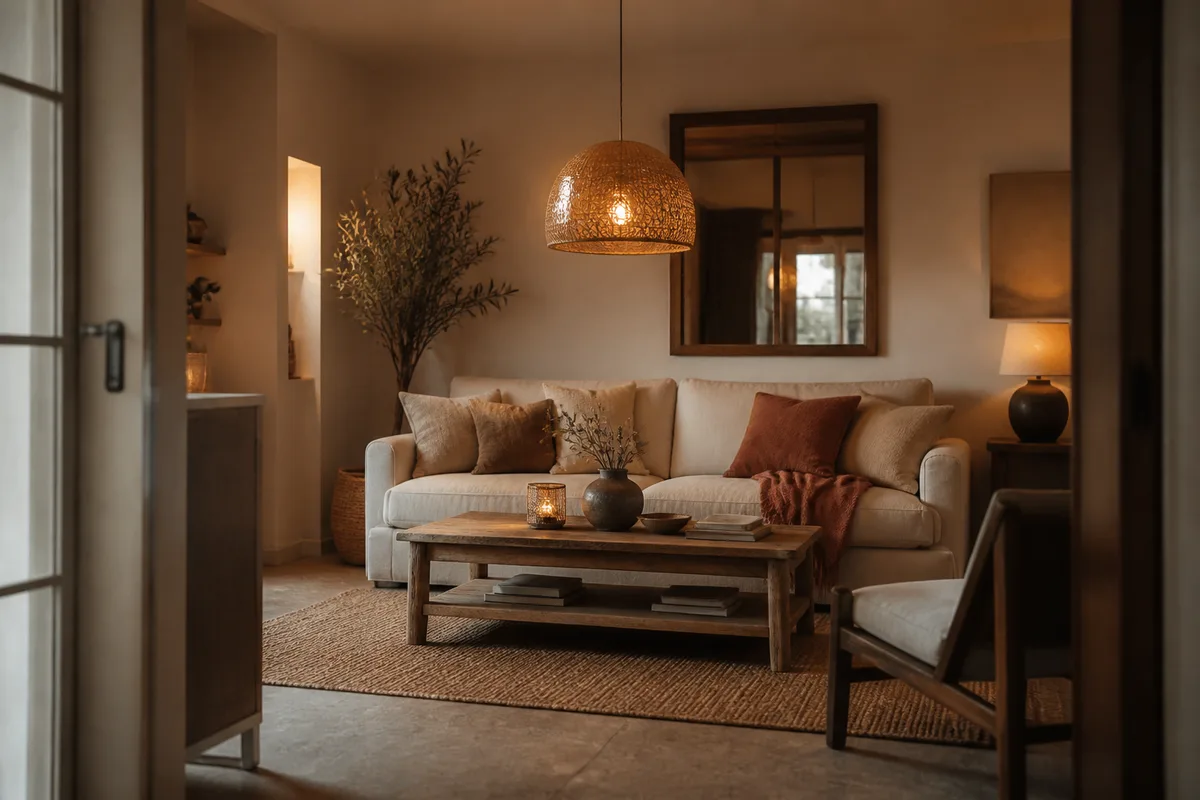
Choose a table suited to the uses
Determine the usual number of guests and the frequency of meals before choosing the shape of the table. An extendable table can meet a compact daily use, while a fixed table is better if it remains constantly open.
Look at the whole from the living room. The table, chairs, and lighting fixture should form a clear composition, without exactly replicating the same materials. A colored seat can become the accent point if the other surfaces remain sober.
Decorate without hindering circulation
Leave the opening areas of cabinets and the refrigerator fully accessible. Rugs must be stable and compatible with chair movement, while objects placed on the table should not interfere with meals.
If you are also renovating the work wall, compare solutions in this guide on kitchen backsplashes by material. The backsplash can become a visual link between kitchen and dining room, but its shade must be tested with the fronts and the countertop.
Create continuity with the living room
Use a single accent color or a common finish. Continuity does not mean that the two spaces must have the same furniture: it consists of circulating a few visual signs while maintaining a distinct function for each.
How to arrange a calming bedroom?
A balanced bedroom favors calm volumes, low-contrast colors, and adjustable lighting. Choose the bed and storage before accessories, as they determine circulation and the amount of visible surfaces.
Choose the bed and bedside tables
Measure the space around the bed and check that doors, drawers, and windows remain accessible. Bedside tables do not need to be perfectly identical, but they must have a height compatible with the mattress and offer a truly useful surface.
Work on textiles and colors
Use bedding to introduce shades from the palette. A solid base can be enriched by a textured throw, cushions of different sizes, or a headboard that adds relief without multiplying patterns.
In a bedroom, coherence is more about restraint in contrasts than accumulation of objects. Keep the brightest colors for a detail that can be easily replaced, such as a poster, a cover, or a small lamp.
Care for lighting and storage
Plan for general lighting and two sources near the bed if the layout allows. For storage, combine closed volumes with a niche or a lightly loaded shelf to keep some objects visible without exposing the entire bedroom to clutter.
How to decorate a small apartment without overloading it?
In a small space, Maisons du Monde decoration should support use before seeking visual effect. Select proportionate furniture, keep a light palette, and use walls or available heights when the floor is already very occupied.
Bet on multifunctional furniture
A bench can serve as seating and storage, a console as a side table, and a closed piece of furniture as a light partition. However, check that the dual function does not make the object difficult to use: a chest hard to open will not replace accessible daily storage.
Using mirrors, colors, and light
A mirror placed opposite a light source can enhance the feeling of space without actually enlarging the room. Curtains installed near the ceiling and visually light furniture also help to clear sight lines.
Avoid multiplying small pieces of furniture to fill every corner. A few more coherent elements often give a greater impression of space than a succession of independent objects.
What alternatives to combine with Maisons du Monde?
The best decoration does not depend on a single brand. To personalize your interior, you can complement Maisons du Monde furniture with existing objects, second-hand items, or elements from other specialists, while maintaining the same criteria of color, scale, and material.
| Option | Interest | Point of caution | Recommended use |
|---|---|---|---|
| Personal pieces | Bring a story and avoid the catalog effect | Control colors and proportions | Frames, souvenirs, books, and textiles |
| Second hand | Allows variation in shapes and finishes | Check condition, sturdiness, and dimensions | Small furniture and unique pieces |
| Other decor brands | Expands the choice of materials or uses | Compare actual shades and scales | Lamps, textiles, or targeted accessories |
For an online supplement, do not rely solely on a staged photograph. Analyze the dimensions, materials, return conditions, and consistency with elements already present. You can also consult this review on an interior decoration site to broaden your comparison method, without confusing inspiration with automatic recommendation.
Combining several sources works when each new object follows an already defined rule: color, material, function, or proportion.
What common mistakes should be avoided?
The most costly mistakes appear even before delivery: incorrect measurement taking, too broad a palette, or purchases made without hierarchy. Identifying them allows you to correct the project before the decoration becomes difficult to modify.
- Buying an entire collection: the whole may seem coherent in the catalog but become uniform at your place. Keep a few strong elements and mix them with personal pieces.
- Choosing colors on screen: the lighting in your home can alter the perception of a finish. Test the shades in the room and at different times of the day.
- Neglecting proportions: a rug that is too small, a pendant light too low, or a sofa too deep unbalances the space. Always compare dimensions with your plan.
- Decorating before solving storage: objects accumulate when daily uses have no dedicated place. First plan the necessary closed volumes.
- Forgetting circulation: a piece of furniture may be aesthetic but obstruct a door, window, or passage. Draw its footprint on the floor before purchase.
How to check the final coherence of each room?
A room-by-room check allows you to distinguish a real lack from a simple desire to buy. Observe each space from the entrance, then from the areas where you settle most often.
Using a checklist
- Does the room have a clearly identifiable main element?
- Does the palette contain repeated colors without being omnipresent?
- Do materials and shapes create echoes between the furniture?
- Does the storage meet daily usage needs?
- Are passages, doors, and windows kept clear?
- Is the lighting suitable for different times of the day?
Gradually Adjust the Decoration
Live for a few days with the main layout before completing the walls or shelves. This period reveals the truly empty areas, the obstructive objects, and the lighting needs that the plan did not always allow to anticipate.
Also remove an element when the room seems too cluttered. A coherent decoration is built by addition, but also by subtraction: each object must retain a function, an emotional value, or an identifiable visual role.
Key Takeaways
- 🎯 Define a guiding style before selecting products.
- 📐 Measure furniture, walls, and walkways before any purchase.
- 🧩 Repeat a few colors and materials to harmonize the rooms.
- 🪴 Mix collections with personal and second-hand items.
- 🔎 Adjust gradually after observing the actual uses of the home.
Frequently Asked Questions
Should all the furniture be purchased from the same collection?
No. A collection can provide a base, but buying all matching elements risks producing a decor that is too uniform. Mix pieces while keeping two or three common references, such as a shade, a material, or a shape.
How to mix several styles without creating disorder?
Choose a dominant style and use the others as accents. Limit the number of strong colors, repeat a material in several rooms, and avoid associating several very bulky pieces of furniture in the same space.
Which element should be chosen first to decorate a room?
Start with the element that structures the use: sofa, bed, table, or storage furniture. Its dimensions and color will serve as a base to select textiles, lighting, and accessories.
How to decorate a small apartment with the brand?
Favor multifunctional furniture, closed storage, and compact proportions. Keep a tight palette, clear walkways, and use walls to free up the floor.
How to avoid the catalog effect with a Maisons du Monde decoration?
Do not reproduce a complete scene presented in-store or online. Keep some furniture, but add personal objects, second-hand pieces, and textiles chosen according to your own palette.
.magic-lb-overlay{position:fixed;inset:0;background:rgba(15,23,42,.92);display:none;align-items:center;justify-content:center;z-index:99999;cursor:zoom-out;padding:20px}
.magic-lb-overlay.open{display:flex}
.magic-lb-overlay img{max-width:95vw;max-height:95vh;object-fit:contain;border-radius:8px;box-shadow:0 8px 32px rgba(0,0,0,.5)}
.magic-lb-close{position:absolute;top:16px;right:20px;color:#fff;background:rgba(0,0,0,.5);border:none;width:40px;height:40px;border-radius:50%;font-size:24px;cursor:pointer;display:flex;align-items:center;justify-content:center}
.magic-lb-close:hover{background:rgba(0,0,0,.8)}
.wp-block-image img{cursor:zoom-in;transition:transform .15s ease}
.wp-block-image img:hover{transform:scale(1.01)}
.magic-img-link{display:inline-block;text-decoration:none}
(function(){
var ov=document.getElementById(‘magic-lb’);if(!ov)return;
var img=ov.querySelector(‘img’),btn=ov.querySelector(‘.magic-lb-close’);
function open(src){img.src=src;ov.classList.add(‘open’);document.body.style.overflow=’hidden’}
function close(){ov.classList.remove(‘open’);img.src=”;document.body.style.overflow=”}
document.addEventListener(‘click’,function(e){
var a=e.target.closest(‘a.magic-img-link’);
if(a){e.preventDefault();open(a.getAttribute(‘href’));return}
var i=e.target.closest(‘.wp-block-image img’);
if(i&&!e.target.closest(‘a’)){e.preventDefault();open(i.currentSrc||i.src)}
});
ov.addEventListener(‘click’,function(e){if(e.target===ov||e.target===btn)close()});
document.addEventListener(‘keydown’,function(e){if(e.key===’Escape’)close()});
})();