During a renovation project, many ideas come to mind. On the one hand, you want to do the roof repair. On the other hand, you prefer to change the bathroom sink. With the success of the self-supporting ceiling, you are also tempted by this structure.
In the end, it is the latter that convinces you and you consider installing it in your interiors. Also known as a false ceiling, the 5 m version is gaining popularity.
If you want to learn more about the subject, this article offers important details to consider. First, it is appropriate to provide you with a definition of a 5m self-supporting ceiling.
📋 Essential to remember: Personally, I consider installing a 5-meter self-supporting drop ceiling using double-stud structural frames (M90 or M100 studs back-to-back) to be the cleanest way to span large rooms without attaching hangers to the existing slab. In my experience on site, opting for rigid doubled studs prevents central sag completely over long distances. Building a self-supporting ceiling across a 5m span typically costs $35 to $60 per square meter in structural hardware and plasterboards.
What is a 5-meter self-supporting ceiling and how does it work?
🍀 Key advantages
• No drilling required into upper ceiling slabs or floor joists
• Superior acoustic isolation due to complete structural decoupling
• Ideal for hiding HVAC ducts, electrical cables, and mineral wool insulation
🔻 Main limitations
• Requires wide M90 or M100 structural profiles, reducing ceiling height
• Demands strong load-bearing side walls for perimeter track attachment
The 5 m self-supporting ceiling is nothing other than an additional ceiling integrated below the main ceiling. Due to its delicate position, it is generally made from lightweight materials such as plasterboard sheets.
This 5 m framework is an ideal option to hide deterioration of the original ceiling. It is a quick solution for home renovation.
To dive deeper, I recommend reading soundproof plasterboard selection and benefits which complements false ceiling projects well. Exploring how to use smoothing plaster gives practical joint finishing advice. For further reading, discovering fill hole in wall techniques brings interesting drywall preparation tips.
It is particularly suitable for interiors with a ceiling height that can be lowered. This option is also intended for installations equipped with a medium-sized plenum.
More and more people confuse it with the suspended ceiling. Although these two structures provide the same appearance, each has its particularities that distinguish it from the other. Their difference mainly lies in their installation.
With the self-supporting system, its installation does not require hangers that attach to the ceiling. Instead, rails fixed to the existing walls hold the false ceiling.
The latter is installed from wall to wall without using beams accompanied by hangers to support it. Its installation offers many considerable advantages. Discover in the following sections the benefits of choosing the 5 m self-supporting ceiling.
My experience: During a living room renovation in late 2025, we spanned a 5-meter room using back-to-back M90 metal studs spaced at 40 cm intervals. At $48 per square meter, the frame held standard BA13 plasterboards without any central flex. The crucial takeaway is to crimp or screw back-to-back studs every 30 cm along their full length to achieve maximum rigidity.
What are the advantages and disadvantages of 5-meter self-supporting ceilings compared to other types of ceilings?
Compared to the suspended ceiling and the stretched ceiling, the 5 m self-supporting ceiling is highly praised for its ease of installation.
Of course, its installation requires the intervention of a professional if you do not have technical knowledge. In any case, the operation can prove simple and quick to carry out. It allows you to save a lot of time.
The 5 m self-supporting ceiling has also continued to attract homeowners, thanks to its better acoustic and thermal insulation. This construction is highly favored when renovating the insulation of a home.
| Stud Size & Layout | Maximum Span (Single Stud) | Maximum Span (Doubled Back-to-Back) | Stud Center Distance |
|---|---|---|---|
| M48 (48 mm) | 2.10 m | 2.50 m | 60 cm |
| M70 (70 mm) | 2.90 m | 3.40 m | 40 cm / 60 cm |
| M90 (90 mm) | 3.70 m | 4.30 m | 40 cm |
| M100 (100 mm) | 4.20 m | 5.00 m | 40 cm |
It is notably the absence of hangers fixed below the floor that helps reduce noise. This not only improves the thermal comfort of the house but also the acoustic insulation.
In renovations, the self-supporting system is a better solution when it remains difficult to fix hangers due to damaged, deformed, or weak structure. As mentioned above, it does not require the use of beams with hangers to support it.
If your main ceiling is damaged or aged, installing a 5 m self-supporting ceiling helps hide its imperfections. Due to its design, it adds a touch of modernity to a room.
As for its disadvantage, this structure can conceal more or less significant damage. For example, it covers mold stains. Its installation thus constitutes a temporary solution since the moisture remains present.
💡 Did you know: Self-supporting ceilings eliminate physical contact with the upper floor slab, cutting impact noise transmission by up to 15 decibels compared to suspended hanger systems.
How to choose the right type of 5-meter self-supporting ceiling based on desired properties and technical constraints?
The first point to determine is the room where you will install the false ceiling. If you plan to install it in highly visible rooms such as the living room, adult bedroom, or dining room, pay particular attention to its aesthetic aspect.
If the structure is installed in humid rooms such as the bathroom or kitchen, its manufacturing materials must be water-resistant. In any case, prioritize a 5 m self-supporting ceiling with a robust finish.
Interview question, this installation generally does not require complicated care. However, some materials can prove to be more demanding than others. To make your life easier, prefer those that can be maintained without difficulty.
What materials are used for 5-meter self-supporting ceilings and how to install them?
There are several elements that can be used to build a 5 m self-supporting ceiling. However, it is crucial to favor those that demonstrate strength and durability to enjoy them for a long time.
This construction is made from plasterboards that are mounted from wall to wall. Unlike other ceilings, it does not require hangers fixed to the beams.
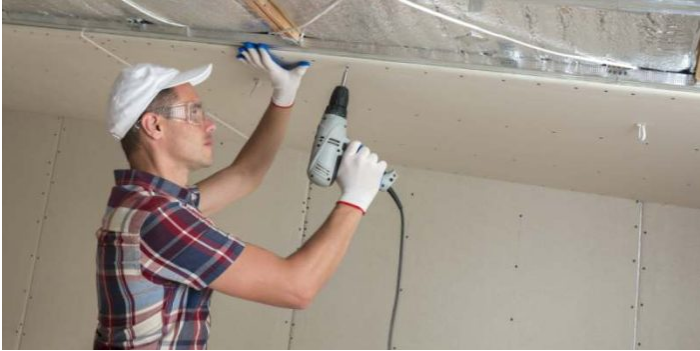
On the other hand, it must be screwed onto a metal framework composed of studs and rails installed between the load-bearing walls.
⚠️ Common mistake: Using single M48 or M70 studs for a 5-meter span. Undersized metal studs bend under the weight of plasterboards, causing central sagging, cracked plaster joints, and potential frame failure.
There are several types of pre-galvanized metal studs that can be used, namely M48-35, M70-35, M100-50, and M90-35. You can choose the one that corresponds to the desired structure. Also, you have the option to choose between a double span and a single span. To facilitate the assembly of multiple studs, using the splicing technique is an excellent idea.
All the materials and equipment for installing a 5 m self-supporting ceiling are not difficult to find. They are available online or in DIY stores. For a 20m2 room, for example, their price ranges between 1000 to 2000 euros.
Compared to some false ceiling materials on the market, this figure allows you to make significant savings.
How to maintain and repair a 5-meter self-supporting ceiling in case of damage?

When your self-supporting ceiling ages, its dismantling may seem unavoidable. Fortunately, this operation is a real child’s play.
Since it is not supported by hangers, you can remove it very easily. The same applies when it is attacked by humidity.
To preserve it for a long time, it is advisable to take care of it regularly. Like any structure made of plasterboards, the self-supporting ceiling does not require any complex maintenance.
For dusting, for example, a brush stroke may suffice. If the surface is not painted, you can clean it with a sponge soaked in soapy water. Remember to dry it quickly to avoid soaking it with water.
It is recommended to use non-aggressive products to maintain the structure. Also, try to check the hardness of the water.
Be aware that very hard water creates whitish stains on the surface. To avoid this kind of situation, it is recommended to rub it with a dry cloth after washing.
How to install a 5-meter self-supporting ceiling safely and in compliance with current standards?
⏱️ Practical tip: Stagger plasterboard end joints perpendicularly across doubled studs. Use a drywall jack during installation and allow 24 hours between joint compound coats for optimal seam strength.
The installation of a 5 m self-supporting frame is carried out in three distinct phases. It remains essential to follow each recommendation to ensure the success of the work.
The first step concerns the selection of pregymetal studs. In doing so, two options are available to you. You can choose between a single span and an adjacent one.
For the latter, it is imperative to join the studs in number by means of a butt joint system.
Once done, fix the rails now. It is important to use equipment suitable for the studs. Make sure to maintain a gap of 60 cm between the walls and the rails.
The last phase consists of installing the self-supporting ceiling. For this, you just have to firmly screw the ends of the studs using a screw.
Make sure that each panel is distributed so as to form a right angle of 90 ° with respect to the support. To keep the ceiling structure more resistant, use a new screw to fix it rigidly.
What precautions should be taken before installing a 5-meter self-supporting ceiling and how to check the solidity of the structure?
Before assembling the frame, a few elements must be taken into consideration. The first point to highlight concerns the quality of the equipment to be used.
It is strongly recommended to favor only top-quality materials guaranteeing the durability of the self-supporting structure.
That said, taking measurements should not be done lightly. This step contributes greatly to the success of the ceiling installation.
The size of the room determines the type of studs and rails used. You must also measure precisely the height at which the frame will be installed. Try to leave at least 1 cm between the top of the rail and the main ceiling.
The surface that will receive the self-supporting structure must be well prepared. To do this, simply dust and clean it, making the location healthy and clean.
Equip yourself with suitable tools and devices to facilitate your tasks. It is preferable to be assisted by another person in order to save time. The use of a ladder is unavoidable to easily access the support.
To ensure the quality of the work, nothing is better than entrusting the task to a professional. Moreover, their intervention does not cost a fortune. You can always compare prices with other providers.
Estimate total material cost for M90/M100 doubled stud ceiling frameworks.