ol.mg-steps{list-style:none!important;counter-reset:mgstep;margin:1.6em 0;padding-left:0!important}ol.mg-steps>li.mg-steps__item{counter-increment:mgstep;list-style:none!important;padding-left:0!important;padding-bottom:1.4em}ol.mg-steps>li.mg-steps__item:last-child{padding-bottom:0}ol.mg-steps>li.mg-steps__item>:last-child{margin-bottom:0}ol.mg-steps>li.mg-steps__item>.mg-steps__title{margin:0 0 .25em;font-weight:600}ol.mg-steps>li.mg-steps__item>.mg-steps__title::before{content:counter(mgstep) “. “;opacity:.45;font-weight:500;font-variant-numeric:tabular-nums}ol.mg-steps>li.mg-steps__item:not(:has(.mg-steps__title))::before{content:counter(mgstep) “. “;opacity:.45;font-weight:500;font-variant-numeric:tabular-nums}.mg-kpis{display:grid;grid-template-columns:repeat(auto-fit,minmax(140px,1fr));gap:14px;margin:1.5em 0}.mg-kpi{padding:1em .9em;border:1px solid #e5e7eb;border-radius:12px;background:#f9fafb;text-align:center}.mg-kpi__value{display:block;font-size:1.7em;font-weight:800;line-height:1.15;color:#111827}.mg-kpi__label{display:block;margin-top:.35em;font-size:.85em;color:#6b7280;line-height:1.35}
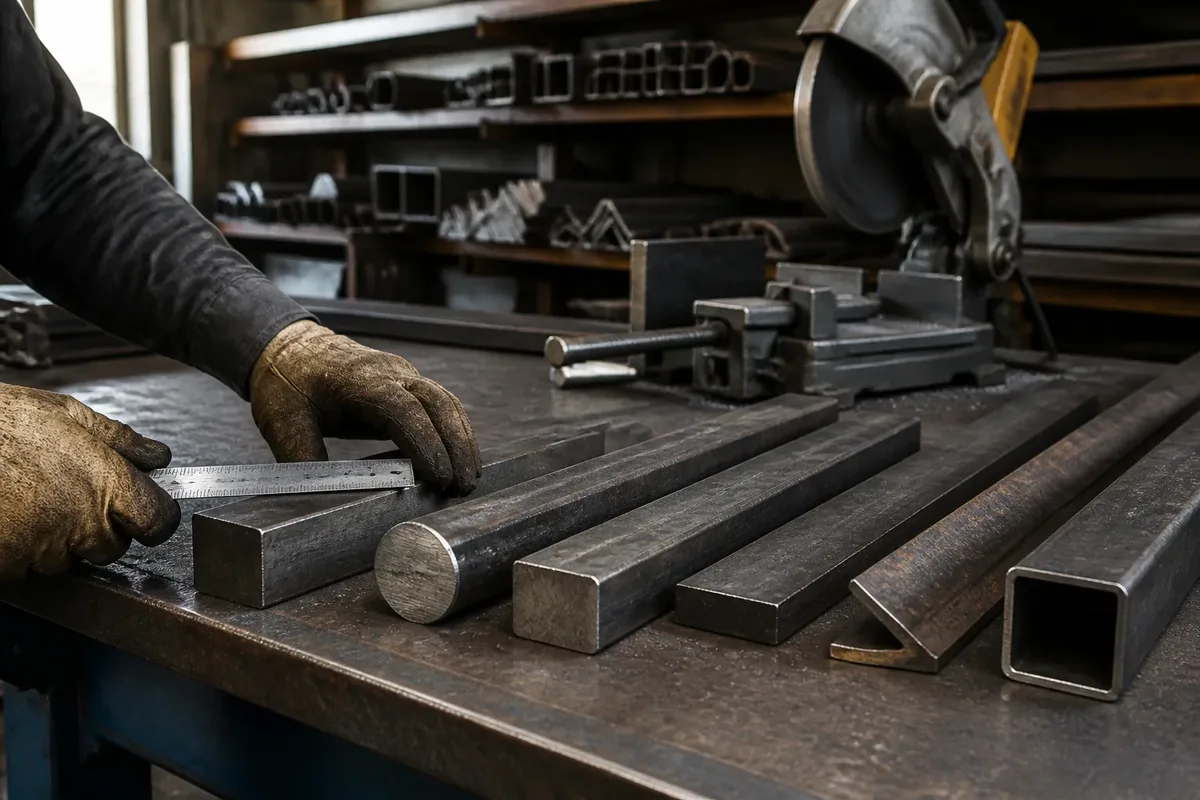
Are you looking for a raw steel iron bar cut to size? Raw steel bars and profiles can be ordered to the desired length, including solid round, solid square, flat, angle, round tube, square or rectangular tube. The price depends on the shape, cross-section, grade, length, and cutting conditions: without these exact dimensions, no serious quote can be pulled out of a hat.
The term “iron” here, in most catalogs, refers to an uncoated steel piece rather than pure iron. The material may come with mill scale, a saw mark, or slight oxidation; it is therefore not ready to be left outside without protection. For a frame, a support, or a repair, custom cutting saves time, provided the correct profile is ordered and adjusted length is not confused with structural sizing.
| 🔩 | Material: uncoated steel, generally sold under the commercial name of iron or raw steel bar. |
| 📐 | Shapes: solid round, solid square, flat, tube, angle, T iron, and some load-bearing profiles. |
| ✂️ | Cutting: length prepared on request, with precision and edge condition to be confirmed. |
| ⚙️ | Grades: S235, S275, and sometimes S355 depending on the reference and supplier. |
| 🎨 | Finish: raw surface to be painted, treated, or galvanized if the environment requires it. |
| 🚚 | Order: shape, section, length, quantity, grade, tolerance, and delivery address must be specified. |
What is a raw steel iron bar cut to size?
A raw steel iron bar cut to size is an uncoated steel piece cut to the requested length. It can be solid or hollow, straight or profiled, depending on the chosen reference. The cut adapts the length to the project; it does not choose the grade or section for you.
In common language, “iron” is often used to refer to construction steel. It is generally not a piece of pure iron, a material that would not correspond to common locksmithing or metalworking uses. The product sheet must therefore specify the shape, dimensions, and, when the application requires it, the steel grade.
Raw finish means the surface does not automatically receive paint, galvanization, or stainless treatment. A bar may retain a dark mill scale from rolling, handling marks, and a lighter mark at the cut location. For a visible piece, cleaning and preparation before painting must be planned.
However, a solid round bar of 20 mm and a round tube with a 20 mm outer diameter do not play in the same league: the first is solid, the second contains a hollow and its rigidity also depends on the wall thickness. This difference changes the weight, drilling, welding, and behavior under stress. The technical sheet, not the word “iron,” decides.
What types of bars and profiles to choose for your project?
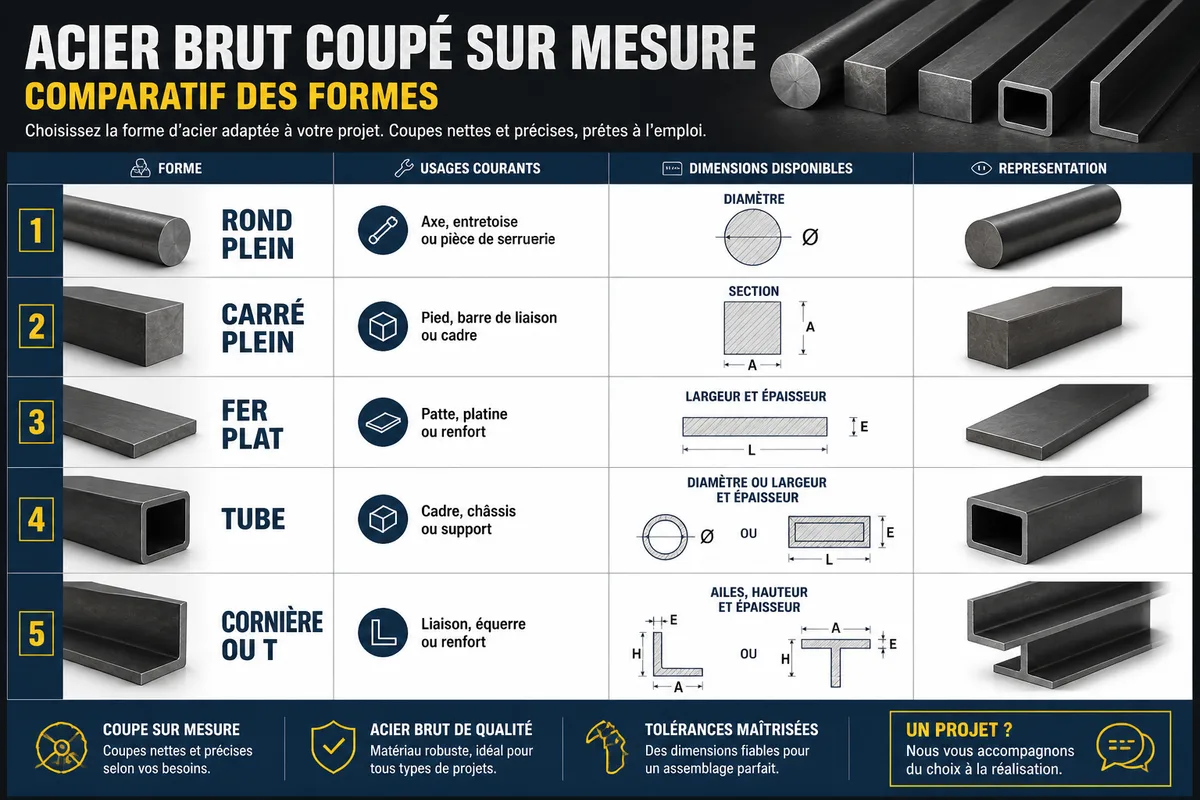
The right profile depends on the load, how the piece will be assembled, and the available space. A solid round is well suited for an axle or a locksmith piece, while a flat bar facilitates a plate or a bracket. A tube saves material in the center, but its wall requires more care in drilling and welding.
Solid round and square
Solid round is practical for making an axle, a spacer, a metal handle, or a turned part. Solid square offers flat faces useful for assembly and positioning. In a specialized catalog, solid round diameters ranging from 8 to 40 mm are offered on some references; this range is not a general availability.
To delve deeper into the most sought-after case, consult this round steel bar guide: it helps distinguish the diameter, length, and actual function of the piece.
Flat iron, tubes, angles, and beams
Flat iron is used for fixing brackets, plates, stops, and reinforcements when a wide face is needed. A catalog offer, for example, presents flat sections ranging from 16 × 6 to 100 × 10 mm; these dimensions belong to this specific commercial range, not to a universal availability rule.
Round, square, and rectangular tubes are suitable for frames and chassis when a hollow section suffices. Angles combine two perpendicular wings to form a joint or reinforcement. T-iron and beams correspond to more specific geometries: their choice is not limited to measuring the visible length.
To compare the families before ordering, this file on steel bar dimensions usefully complements the choice of section.
Sections, grades, and cutting: which characteristics to check?
The section describes the geometry of the piece; the grade describes the steel class. For common references, catalogs notably offer S235, S275, and sometimes S355, with a subclass like JR, J0, or J2 to specify when the datasheet provides it. Length alone therefore does not allow evaluating strength or suitability for use.
The S235 grade corresponds to a minimum yield strength of 235 MPa up to 16 mm nominal thickness, then 225 MPa beyond 16 to 40 mm. For S275, the corresponding values are 275 MPa then 265 MPa. For S355, they are 355 MPa then 345 MPa. These values concern the indicated thickness ranges and do not replace the calculation of a structure.
| Grade | Minimum yield strength up to 16 mm | Beyond 16 to 40 mm | To remember |
|---|---|---|---|
| S235 | 235 MPa | 225 MPa | Common construction steel, generally favorable weldability |
| S275 | 275 MPa | 265 MPa | Higher strength than S235 for the considered range |
| S355 | 355 MPa | 345 MPa | Reserved for design justified by need |
The suffixes JR, J0, and J2 indicate a Charpy impact energy requirement of 27 J respectively at +20 °C, 0 °C, and −20 °C. A designation “S235” alone therefore remains incomplete when a certificate or an impact energy requirement is necessary.
But do not choose S355 as you would choose a slightly longer screw. A stronger grade does not correct a section that is too weak, a poorly designed weld, or an assembly that leaks. For a guardrail, a beam, a loaded chassis, or a load-bearing element, the sizing must be verified by a competent person; no photo of the piece is sufficient.
Does cutting modify the piece?
Yes, cutting leaves an edge whose quality depends on the process, thickness, and announced tolerance. A cut by saw, thermal, or another process does not produce exactly the same surface condition. The term “to the millimeter” must therefore be read with the associated tolerance, not as a magic promise.
A thermal cut can create a heat-affected zone and a rougher or inclined edge. A saw cut often leaves a different mark, with geometry depending on the machine and setting. Thermal cutting quality classes range from 1 to 5; the requested class must be known before concluding that the piece is directly ready to assemble.
For a piece that must fit together, ask for the length tolerance and the condition of the ends. If the edge is intended to be welded, clean contaminants and remove obstructive burrs. If the cut must remain visible, plan for edge finishing: raw steel does not necessarily come out with a fine locksmith finish.
What uses for a raw steel bar cut to measure?
A raw steel bar cut to the right length is suitable for frames, supports, reinforcements, chassis, and metalwork pieces when the section and grade have been chosen for the required load. It reduces workshop waste and facilitates preparation before welding, drilling, machining, or bolting, without dispensing with checking the final assembly.
Manufacturing and Metalworking
In a workshop, the prepared lengths limit cutting operations and waste. A flat bar can become a bracket or a plate, an angle iron a corner reinforcement, a tube a frame element, and a solid round bar a part intended for turning. The profile must be matched to the function; taking the available stock because it is cheaper is a false economy.
The bar can be drilled, welded, or machined when the grade and thickness allow it. S235 is generally appreciated for its weldability, but the setting, edge preparation, and welding process remain decisive. A bead laid on a dirty or oxidized surface yields a poor result, even with good material.
For structural use, request the full designation and traceability. A 3.1 material certificate links the results to a batch and a heat number; it allows matching the chemical composition and mechanical characteristics of the ordered grade. This document makes sense for a truly tracked part, not as decoration attached to a quote.
Fitting, Repair, and DIY
At home, applications are more modest: metal feet, frames, stops, brackets, grilles, or protective elements. Cutting to length avoids transporting and then cutting a bar several meters long. To make a door or a frame, the accuracy of the diagonals and holding during welding will matter more than a commercial pitch about perfect cutting.
However, a raw steel bar is not a finished exterior material. In a dry room, protection can be aesthetic; outside or in a humid room, it becomes a precaution against corrosion. The choice between paint, anti-corrosion primer, and galvanization depends on exposure, surface preparation, and compatibility between products.
Price, Order, and Delivery: What Information to Provide?
The price of a custom-cut steel bar is built from the material, shape, section, grade, length, quantity, cutting, and transport. Sellers sometimes display a price per millimeter, per linear meter, or per piece; these units are only comparable after harmonizing the exact reference.
Commercially, an offer shows a custom round bar starting at €1.66 including tax per linear meter, with €1 including tax for cutting announced separately. This amount is not a general rate: it depends on the reference, length, quantity, and delivery conditions displayed at the time of the order. A flat bar of 20 × 3 mm is also shown from €3.47 on another offer, without this value allowing comparison between a round bar or another section.
A starting price is never equivalent to a complete quote. It may exclude cutting, packaging, delivery, a minimum quantity, or a finish. To compare two offers, put each element on the same line: material, cutting, number of pieces, treatment, and transport.
The theoretical weight helps spot a gross error in a quote. For steel, a conventional density of 7.85 kg per cubic decimeter is commonly used. For a solid round bar, the theoretical weight in kilograms per meter is approximately equal to 0.006165 × diameter², with the diameter in millimeters. This formula does not replace the actual weight nor the manufacturer’s tolerance.
- Exact shape: solid round, square, flat, tube, angle iron, T or other profile.
- Dimensions: diameter, width, height, thickness and, for a tube, outer diameter and wall thickness.
- Unit length and quantity of pieces.
- Complete grade, for example S235JR, if required.
- Desired finish: raw, painted, primed, or galvanized.
- Cutting tolerance and possible deburring request.
- Address, delivery access, and unloading method.
To better read the lines of a quote, also compare the criteria for the price of a steel bar: an apparently small difference may come from transport or cutting rather than the material.
Weight and length directly influence handling. A long bar can be difficult to unload, store, or move in a staircase, even if its total weight seems reasonable on paper. The packaging announced by some sellers distinguishes small pieces shipped in boxes from longer or heavier pieces prepared on pallets; the exact rule must be read on the relevant offer.
Raw steel after cutting: finishing, corrosion, and purchase decision
Raw steel must receive appropriate protection as soon as it is exposed to moisture, water splashes, or outdoor air. A raw surface can be cleaned and then covered with a compatible paint system, while galvanization protects with a zinc coating. Keeping the raw appearance is only reasonable in an environment where oxidation is controlled and accepted.
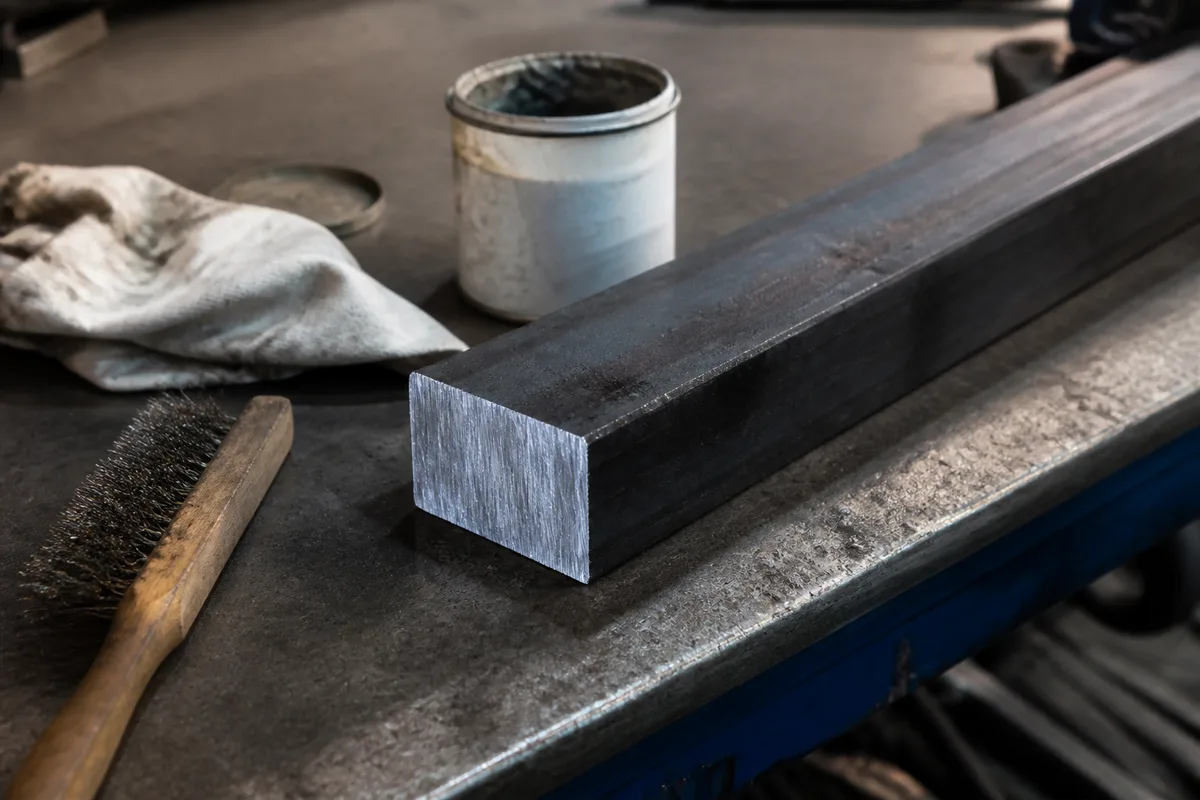
Paint adheres to a surface free of dirt, grease, and friable parts. Mill scale may require mechanical preparation depending on the chosen system. The cut ends deserve special attention: they concentrate cutting defects and become a practical starting point for rust if left bare.
Hot-dip galvanization is not a simple gray paint. For a compliant coating, the minimum thickness depends on the steel thickness; from 6 mm, the indicated values are 85 µm on average and 70 µm locally, while between 3 and less than 6 mm they are 70 µm on average and 55 µm locally. These values concern hot-dip galvanization, not electrolytic galvanization nor a paint film.
For an unstrained indoor part, the painted raw bar may suffice. For a durable outdoor part, do not leave the steel bare under the pretext that rust will give “a nice look.” This choice is only suitable if oxidation is part of the desired appearance and if material loss remains acceptable; for a support, protection planned from the design stage is the serious choice.
Before confirming the order, check the cutting sheet, the complete grade, and the delivery conditions. The announced lead times for custom items can range from 2 to 12 working days depending on a commercial offer, but this timeframe is not transferable to all suppliers or all shapes.
- Define the function of the part before choosing the shape.
- Note the dimensions in the correct order, with units.
- Choose the grade only after identifying the load and environment.
- Request the cutting tolerance and edge condition.
- Add the planned anti-corrosion protection, or order the raw part knowingly.
- Check the quantity, estimated weight, and delivery access.
The raw steel iron bar cut to size is a DIY item for a frame, a bracket, or a well-defined repair, with the right profile and suitable tooling. It becomes a false good idea as soon as it replaces a structural calculation, a certified grade, or external protection. For a load-bearing element, choose the right support, have the sizing checked, and never confuse a clean cut with a safe part.