
📋 What to remember: Personally, I consider bleeding a heated floor essential to maintain its performance, especially when air accumulates in the circuit. In nearly 70% of cases, poor water circulation causes a noticeable drop in heating. With a simple method and some checks, you can restore even heat distribution in less than an hour. Regular bleeding also helps avoid costly breakdowns.
As technology advances, many technologies serve to distribute heat in a home. During the initial heating installation, wall radiators are among the most chosen options by the general public.
However, the heated floor also constitutes an interesting alternative. This underfloor heating system demonstrates enormous efficiency. That is why it is very present in modern homes.
To optimize its performance, it requires periodic maintenance, like any other heating circuit on the market. If you are not familiar with cleaning a heated floor, this article provides you with more information.
But before diving into the topic, let’s first look at some key elements to help you see more clearly.
What is meant by heated floor?
Also called underfloor heating, the heated floor is nothing other than a heating system for homes, but integrated into the floor.
This technique stands out for its remarkable discretion. Despite its ingenious location, it allows you to heat your home efficiently with better temperature distribution.
It is not new; it was already used since Antiquity by the Romans. But as time passed, this underfloor heating circuit has greatly improved.
Since 1960, the heated floor has begun to establish itself. At that time, this heating installation still operated as traditional radiators. Currently, it continues to attract more and more people due to its performance and multiple advantages.
There are 2 types of heated floors. You can choose between the water heated floor or hydraulic heated floor and the electric heated floor.
Whatever your system, it remains essential to bleed underfloor heating. Its maintenance is of vital importance, extending its lifespan and preserving its efficiency.
📍 My experience: At a client’s home in winter, some rooms remained cold despite a high thermostat setting. After inspection, I discovered air in the loops of the heated floor. A complete bleed was enough to restore uniform heat in less than 45 minutes. Since then, I always check this point first. The lesson is clear: air in the circuit is often the real culprit.
How does the heated floor work?
Its mode of operation can be simple. Whether it is an electric heated floor or hydraulic heated floor, no installation is visible on the outside.
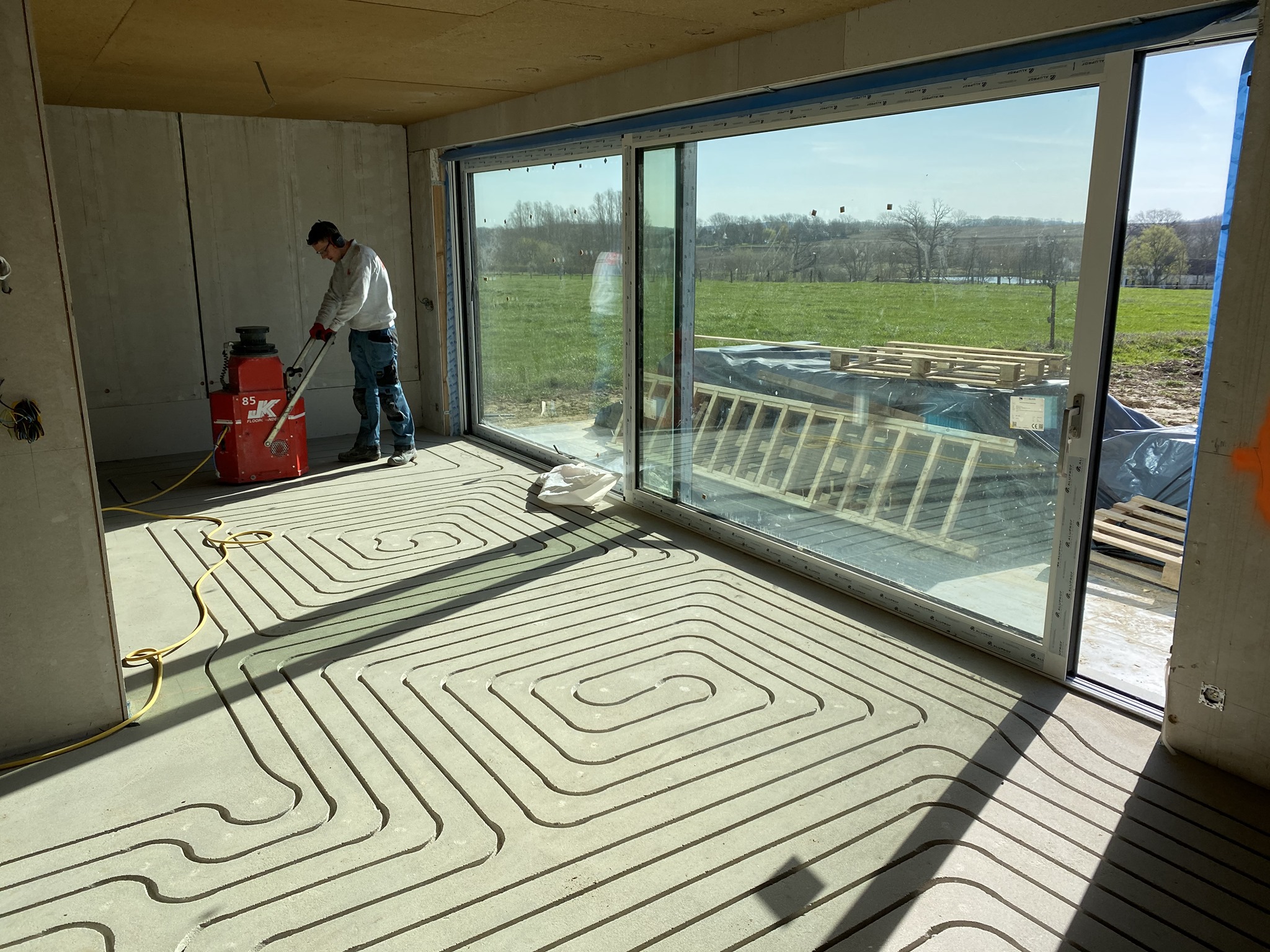
Heat is diffused and transmitted through a hot water circuit or a network of cables under the floor. A screed is used to cover these elements, ensuring the uniform and regular emission of heat. The pipes are laid under a concrete slab. The system benefits from better insulation.
Due to its delicate location, it is necessary to check it from time to time. Consider performing the underfloor heating purge or the underfloor heating sludge removal at fixed intervals. Otherwise, the underfloor heating circuit will lose performance. It takes a long time to heat up.
According to specialists, the underfloor heating cleaning should be done at least every 5 years. Whether it concerns the first loop sludge removal or the collector drain valve, it is preferable to always go through a professional.
🌍 Did you know?
A simple air bubble in an underfloor heating circuit can reduce thermal efficiency by up to 30% in certain areas of the house.
To go deeper, I recommend purging underfloor heating which complements this topic well. checking plumbing also provides useful insights. And to go further, efficient heating offers interesting information.
Advantages of underfloor heating
If many households choose this heating solution, it is notably because of its countless advantages. Underfloor heating is part of the installation that provides better thermal comfort.
If you like walking barefoot in your room, you will surely be charmed. It is capable of continuously emitting gentle heat all year round. Unlike electric radiators, it distributes a homogeneous temperature throughout the house, including in the hallways.
In summer, you have the option to circulate cold water in this underfloor heating installation. Thanks to this solution, it can very well replace your air conditioning. It is capable of reducing the indoor temperature by a few degrees, which is already pleasant.
From an aesthetic point of view, underfloor heating is completely invisible. Unlike bulky radiators, it is simply placed under the floor.
You do not have to drill your cupboards to install the water outlet pipe or buffer tank. The hydraulic underfloor heating or electric underfloor heating is not visible.
To benefit from all these advantages, prioritize the underfloor heating purge.
Good reasons to purge an underfloor heating system
🌟 The pros
- Improves heat distribution
- Reduces energy consumption
- Prevents breakdowns
⚡ Weak points
- Technical handling
- May require a professional
Before answering this question, it should be noted that underfloor heating can be connected to a gas boiler or a wood pellet boiler.
No matter the heating device connected to the system, bleeding underfloor heating is a crucial step not to be overlooked. Although its presence is barely noticeable, it must undergo periodic bleeding.
Just like underfloor sludge removal or collector drain valve, this maintenance method helps preserve its performance over time.
That’s not all, the operation prevents potential breakdowns or leaks. It should be noted that overheating is one of the risks with electric underfloor heating. During underfloor heating cleaning, you will have the opportunity to check all the cables.
By the way, this heating system requires delicate maintenance. The work generally involves breaking the floor to access the water pipe or buffer tank underfloor heating.
Given the constraints encountered, it is normal for the work estimate to rise. If you plan to bleed underfloor heating, you need to budget significantly.
That said, this underfloor heating cleaning prevents the accumulation of oxygen in the water pipe. It is important to recall that this situation blocks the water from circulating, causing damage to the circuit.
As a result, the pressure inside the pipes becomes very high. This leads to excessive energy consumption. It is therefore urgent to proceed with underfloor heating bleeding. This work allows the air contained in the circuit to be expelled.
As a rule, underfloor heating bleeding is done automatically via the heating system’s manifold. You only intervene at the end of the underfloor sludge removal.
⚠️ Warning
Bleeding all loops at the same time is a common mistake. It prevents effective air evacuation and can unbalance the circuit.
Contact a professional to bleed an underfloor heating system
For quality work, there is nothing better than turning to a professional. Underfloor heating cleaning or underfloor heating bleeding, system maintenance requires the know-how and experience of a heating engineer.
Whether you have an electric underfloor heating or hydraulic underfloor heating, the work demands significant technical knowledge.
Moreover, the operation can be delicate since the installation is located under concrete, linoleum, or tiles. Only a plumber-heating engineer has the skill to access the circuit without causing damage.
⏱️ Timing
Perform the bleeding at the start of the heating season and check the pressure between 1 and 1.5 bar to ensure optimal operation.
| Equipment | Average Price | Use | Frequency |
|---|---|---|---|
| Bleed key | 5 to 15 € | Open bleeder | Occasional |
| Bucket | 5 € | Collect water | Each bleeding |
| Flexible hose | 10 to 25 € | Direct water | Frequent |
| Pressure gauge | 20 to 50 € | Check pressure | Regular |
Steps to bleed an underfloor heating system

Here are the steps to follow to ensure the underfloor heating purge:
Learn the essentials about the manifold
Before starting the work, it is important to familiarize yourself with the system. The underfloor heating consists of loops ensuring the circulation of water in the rooms to be heated.
As for the manifold, this component manages the regulation of the water supply and its return to the production equipment. To control it, it has a boiler supply valve and return taps that ensure the system can be stopped.
Usually, the manifold handles the automatic underfloor heating purge. However, you can also perform the manifold drain valve yourself at the end of the underfloor heating flushing or when there is a drop in water pressure. This latter case is generally caused by a malfunction of the expansion vessel at the boiler.
Make the necessary connections
The first step is to shut off the main water supply. Take a garden hose and connect one end to a water supply. The other end must be connected to the drain valve port.
Use a second garden hose. Connect one end to the water outlet and the other to the lower drain valve.
Once done, you can open the valve cap while securing the hose. Now connect the water drainage hose to the wastewater outlet.
Use a third hose and connect it to the upper drain valve of the manifold. Its other end ensures waste evacuation.
)()Perform the flushing of the first loop
To do this, first close the valves of each loop except the first one. Use a screwdriver to open the drain ports. Now open the water supply feeding the flushing equipment and turn it on.
Once this step is completed, the flushing begins and the water coming out appears muddy. The flushing of the first loop is finished when the water runs clear. You can then perform the same operation with the other loops.
Restart the circuit
When the flushing of all loops is indeed finished, proceed to start the heating circuit. Before this phase, first shut off the main water supply.
Remove all hose fittings, whether at the manifold or the flushing device. Then replace the caps on the drain ports.
Then remember to open the loop valves and fill the underfloor heating water. To ensure air purge, unscrew the screw. Once the air escapes, screw the screw back in.
To purge underfloor heating easily, equip yourself with a flat wrench, an adjustable wrench, a flat screwdriver, a Phillips screwdriver, and a garden hose.
FAQ
Why bleed a heated floor?
u003cbr/u003eMaintenance optimizes the system’s performance. Even better, it helps you reduce potential breakdowns.
Who to call to bleed a heated floor?
u003cbr/u003eIt is strongly recommended to use a heating engineer to ensure the maintenance of the circuit. With their technical knowledge, they promise you high-quality work.
How to bleed a heated floor alone?
u003cbr/u003eTo start, don’t forget to disconnect the main water supply. Once done, make all the connections. Proceed with flushing the first loop, then the others. All that remains is to restart the system.