Monitoring your home from your phone, across the country, is no longer a luxury feature. Connected cameras now cost about the price of a small household appliance and can be installed in an afternoon.
Everything then depends on the choice of equipment and your ability to distinguish a real detection from a false alarm. The legal framework, meanwhile, is much stricter than most buyers imagine. Let’s take things in order.
How to choose a remote surveillance camera suited to your needs?
The first sorting is based on location. An outdoor camera must have a protection rating of IP66 or IP67, guaranteeing it can withstand heavy rain and dust. Indoors, this criterion disappears and you can prioritize discretion or motorization.
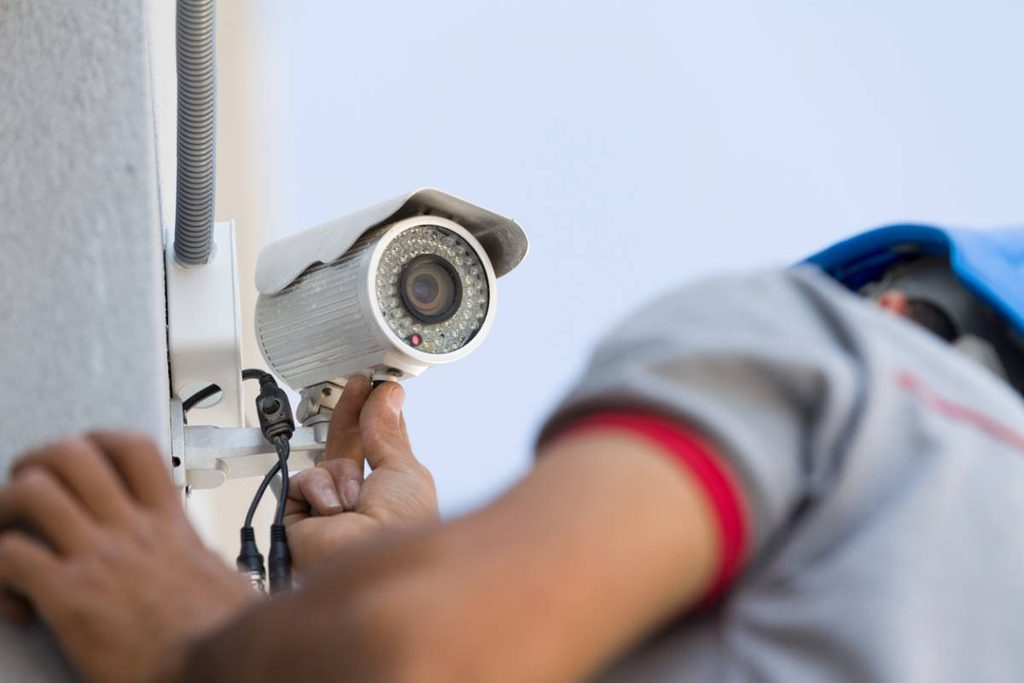
Next comes resolution. 4 megapixels is enough to monitor an entrance or garden, 8 megapixels, often called 4K, becomes useful when you want to zoom in on a license plate or a face from a distance. Beyond that, you mainly pay for extra storage.
The power supply method then determines the whole setup. PoE carries power and data through a single network cable, the most stable solution for a fixed installation. Wi-Fi avoids running cables but depends on signal quality at the back of the garden. Battery solves the problem of areas without electrical supply, at the cost of regular recharging.
Finally, count the number of points to cover: front door, service access, driveway, garage.
Think in terms of a system rather than isolated cameras. Specialized video surveillance retailers like Europ Camera offer complete kits combining several cameras and a recorder, a more coherent approach than buying mismatched units. Professional ranges, like Hikvision models, are found both among demanding private users and small businesses.
The legal framework, to read before buying: a private individual can install cameras at home without authorization or declaration, provided they only film their own property, interior of the home, garden, private access path.
Filming public roads is prohibited, including to monitor your car parked in front of your house, and filming at the neighbor’s is equally forbidden. Invasion of privacy is punishable by a €45,000 fine and one year imprisonment.
Adjust the field of view down to the millimeter after installation.
Essential features to secure your home in real time
The difference between a useful system and a gadget lies in the quality of alerts. A basic motion detection triggers on a cat, a branch, or a change in light: after a week, you turn off notifications, and the system becomes useless.
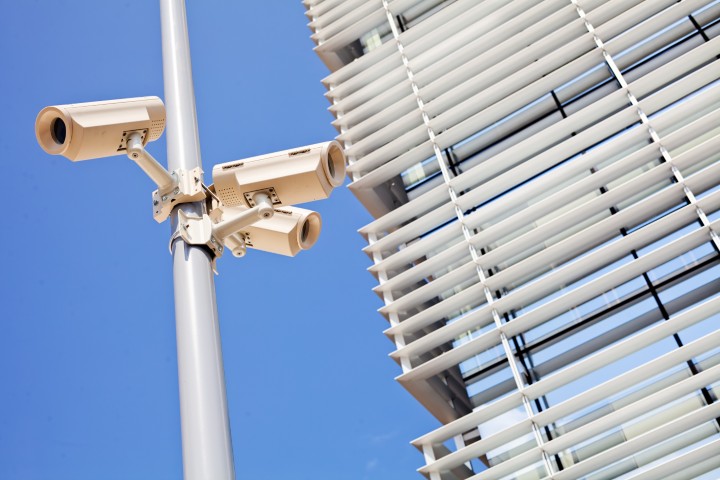
So look for intelligent detection capable of distinguishing a human or a vehicle from the rest. Embedded technologies like AcuSense from Hikvision are based on this logic and reduce the number of false alerts.
Second point, night vision. Classic infrared provides a decent black and white image, but a face remains difficult to identify. So-called color night vision cameras, like the ColorVu range, rely on a more sensitive sensor and discreet lighting to preserve colors, which makes all the difference during identification.
Our advice: check the announced night vision range in meters and compare it to the actual distance between the camera and the area to be covered. A 30-meter range on paper is useless if your gate is 40 meters away.
Complete the equipment with three features that will save you time daily. Two-way audio lets you talk to the delivery person without leaving your desk. The siren or spotlight, triggered at the slightest detection, scare off the prowler before any intrusion. As for configurable detection zones, they ignore the street or the hedge stirred by the wind.
Then there is storage. The microSD card is sufficient for a standalone camera, the NVR recorder becomes necessary from three or four cameras, and the cloud offers an off-site copy in case of equipment theft, usually by subscription.
Even if the equipment is stolen, the footage remains.
Connect your IP cameras and access footage from anywhere
An IP camera is simply a camera that communicates via the computer network rather than through a dedicated video cable. This is what makes remote viewing possible: the footage passes through your box, then through the manufacturer’s app on your phone.
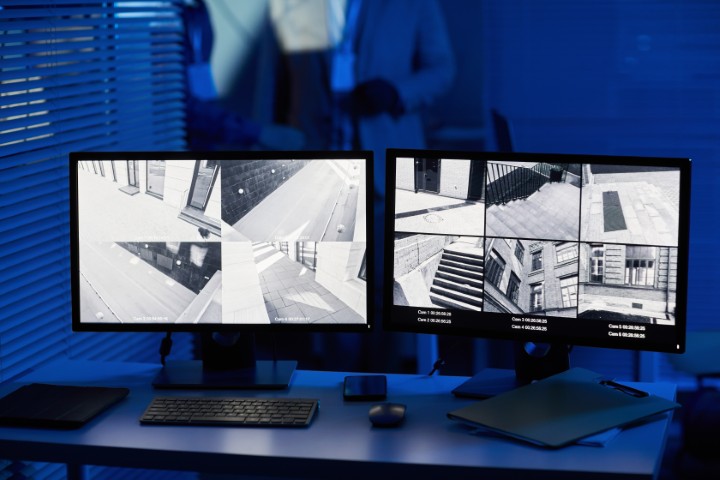
The typical installation boils down to three steps. Connect the camera to a PoE switch or to the recorder, which powers it and connects it to the network. Add it in the mobile app by scanning the code on the device. Finally, adjust the detection zones and notifications, taking the time to test at different times of the day.
One technical point matters more than you might think: the upload speed of your internet connection, the one used to send footage outward. Several high-resolution cameras viewed simultaneously require a good upload speed, and it is often this that explains choppy images remotely, not the camera.
Remember that a surveillance camera remains a connected device, capable of opening a breach in your network. Change the default password at first setup, then keep the firmware updated. For remote access, prefer the manufacturer’s secure connection service over manually opening ports on your box.
A poorly secured camera watches your home. And watches you too.
FAQ: Home Video Surveillance
A-t-on le droit d’installer une caméra de surveillance chez soi ?
Oui, sans autorisation ni déclaration préalable, à condition de ne filmer que votre propriété : intérieur du logement, jardin, chemin d’accès privé. La voie publique et les propriétés voisines ne doivent jamais entrer dans le champ, même pour surveiller un véhicule stationné devant chez vous.
Quelle différence entre une caméra IP et une caméra classique ?
Une caméra IP transmet ses images avec le réseau informatique, ce qui permet de les consulter à distance depuis une application mobile et de les enregistrer sur un NVR ou dans le cloud. Une caméra analogique classique reste dépendante d’un câble vidéo relié à un enregistreur local, sans accès distant natif.
Faut-il informer les personnes qui viennent chez soi ?
Oui pour les personnes employées à domicile, garde d’enfants, aide à domicile ou femme de ménage, qui doivent être informées de la présence des caméras, celles-ci ne pouvant pas servir à les surveiller en continu. Un panneau visible à l’entrée informe utilement les autres visiteurs et les intervenants ponctuels.
Quelle résolution choisir pour une caméra de surveillance ?
Le 4 mégapixels convient à la plupart des usages domestiques, entrée, jardin ou garage. Le 8 mégapixels devient pertinent si vous devez identifier un visage ou une plaque d’immatriculation à distance, en gardant à l’esprit que la résolution supérieure consomme davantage de stockage et de bande passante.
Sources
For further information: Video surveillance and video protection at home (CNIL).