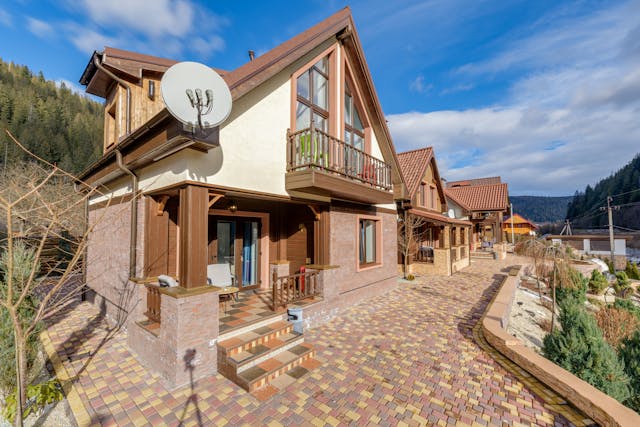
For making an access ramp, a terrace floor covering or garden borders, concrete is the ideal building material combining durability, aesthetics, and strength. Many also use it for paving their yards, driveways, or verandas.
Thanks to their multiple advantages, interlocking pavers continue to enjoy great success. They are not new; they have been used since antiquity. But they remain to this day the best option for exterior paving materials.
You can find different types of interlocking pavers. Apart from the concrete model and the natural stone one, the reconstituted stone paver is also gaining popularity.
If you have trouble making your choice, this article can serve as a guide to help you choose the material that best meets your expectations.
📋 Key points: Personally, I consider the interlocking paver to be the top solution for a driveway because it can support up to 60 tons per m² depending on the chosen thickness. It is a profitable investment that combines a lifespan of more than 30 years with great ease of installation without mortar. I recommend opting for a minimum thickness of 6 cm if you plan to have vehicles circulate on it.
What is an interlocking paver?
🍀 Advantages
- Very limited maintenance
- Easy replacement of a paver
- Excellent permeability
🔻 Limitations
- Sensitive to roots
- Long manual installation
Of course, you are eager to know the price of interlocking pavers or the maintenance of interlocking pavers. But before going into details, it is appropriate to provide you with their definition to better clarify the subject.
The interlocking paver is nothing other than a concrete or stone paver suitable for all situations and configurations. It is widely used in garden landscaping projects to rehabilitate or modernize a garden path, a yard, a terrace, a veranda, or the edge of a mini-pool.
According to masonry professionals, it is considered the equivalent of the stone paver, but in a more efficient and especially more refined version. Regardless of the types of interlocking pavers, they stand out by their distinctive shape.
Usually, they are I-shaped, but nowadays you can find interlocking pavers in S, T, X, Z, and H shapes. Thanks to these different shapes, they can adapt to many installations.
📍 My experience: During my first driveway installation in 2018, I neglected to compact the sand bed to save time. Result: after the first autumn rains, stagnant puddles appeared due to slight settling. The lesson is clear, never skip the vibrating plate step, it is what guarantees the final stability of your work.
In general, interlocking pavers are made of gravel, sand, water, and of course cement in various thicknesses and dimensions. Since it is a decorative floor covering, a wide range of interlocking pavers is available in many colors such as red, dark gray, white, ochre, light gray, beige, or even green.
Thanks to this variety of shades, it is easy to personalize your terrace or driveway while creating original patterns. The goal is to break the monotonous style of outdoor stone pavers.

What are the advantages of interlocking pavers compared to other flooring materials?
Reconstituted stone pavers, interlocking pavers concrete or natural stone pavers, whatever the types of interlocking pavers, this floor covering is prized for its easier installation. Thanks to its more specific shapes, each piece fits together just like puzzle pieces. It is easy and quick to lay on mortar or on a sand bed.
Unlike other materials, interlocking paver maintenance is child’s play. Despite the simplicity of the operation, they have a long lifespan. If you manage to take care of them regularly and properly, they can dress your yard for up to 50 years.
No matter your choice of interlocking pavers, this covering also stands out for its unbeatable robustness. Especially since these are types of interlocking concrete pavers, the material shows remarkable resistance. It withstands heavy traffic, notably driveable interlocking pavers. These allow vehicles to pass over them without any problem.
Besides that, many professionals favor them for their tolerance to weather conditions. You can use them regardless of the climate. The interlocking paver can be adjusted on site right after compaction.
Permeable, it prevents the formation of puddles. With its smooth surface, snow removal can seem easy and quick. It is also possible to use de-icing products with it, for example calcium chloride or salt.
Regarding the repair of interlocking paver prices, this operation does not cost much. You just have to remove the broken or stained paver by lifting the affected part. The choice of dark-colored interlocking pavers helps to hide stains or imperfections.
As for the price of interlocking pavers, you can expect from 10 euros per paved meter or per square meter. Their cost depends on thickness, type of interlocking, model, and especially the manufacturer’s reputation.
How to choose the right type of interlocking paver for a specific project?
There are different types of interlocking pavers available on the market. This floor covering comes in many shapes, colors, and various sizes. To make things easier, they can be divided into 3 main categories.
First, there are the interlocking natural stone pavers, which are generally made of granite. This model is resistant to scratches as well as corrosion. Aesthetic, it comes in several configurations and shades, including pink, orange, ochre, and more. Some are made of limestone. They stand out due to their neutral color. The price of interlocking pavers may seem high.
Regarding reconstituted stone pavers, they offer a wide choice of shapes and tones. Their specialty is their ability to imitate wood, natural stone, or even marble. This floor covering can be square or rectangular. Its thickness is at least 6 cm. Although it is suitable for all terrains, it is not suitable for water points such as ponds or pools.
The concrete paver model is among the most used types of interlocking pavers in garden landscaping. It can take many different configurations. For example, there are geometric shapes, stars, or letters. It is the perfect interlocking paver for creating decorative pavements.
In most cases, it differs from other types of interlocking pavers by its attractive neutral color. Some models are molded versions combining aesthetics and lightness. They are intended for pedestrian paths. Others stand out for their robustness. These driveable interlocking pavers allow cars to pass over them without any problem.
Besides the different types of interlocking pavers, it is important to consider the quality of the material when purchasing the covering. Choose a paver resistant to external aggressions such as UV rays, stains, or weather conditions.
🌍 Did you know? Contrary to popular belief, interlocking pavers shaped like “S” or “I” offer 25% greater mechanical resistance than classic rectangular pavers thanks to their physical interlocking which better distributes horizontal loads during vehicle braking.
The choice of interlocking pavers also depends on the fields of application. While some are designed to create a pedestrian walkway, others are for driveable roads. Be sure to consider your budget before making a decision. Usually, concrete interlocking pavers are cheaper, while natural stone models seem more expensive.
What are the installation steps for interlocking pavers?
Interlocking paver installation can be done by simple individuals. But for better results, there is nothing like entrusting it to a professional.
To achieve this, start the work by preparing the ground. It must be both dry, clean, and leveled. Ideally, fill the hollows with gravel or sand.
Before laying the foundations, mark the outlines of the laying surface using a strip of paint or a simple rope. Thanks to this marker, it is easy for you to lay the foundation sand on a perfectly leveled ground.
The next step is the application of the sub-base of crushed stone. To protect it, use geotextile over the entire surface. It prevents grass from growing on the surface and reinforces the soil’s stability.
Once done, you can spread the sand for the bedding layer. Be sure to smooth and compact it well while respecting the slope. Once you are satisfied with the result, lay the interlocking paver. Press it slightly into the sand and make sure to adjust it so that each element is well aligned.
If necessary, cut the interlocking pavers using a diamond disc grinder or a paver cutter to improve the aesthetic aspect. For the finishing, it involves filling the joints between the pavers with gravel or polymeric sand. All that remains is to compact the ground and then the pavers using a plate compactor or a hand tamper to ensure an excellent fit.
⚠️ Common mistake: Using mortar to joint pavers laid on sand. The pavers must be able to “move” very slightly with temperature variations and loads. A rigid joint will eventually crack and the pavers may chip under pressure.
What maintenance is required for interlocking pavers?
To preserve their condition over time, interlocking paver maintenance can be essential. Unlike other coverings, their care does not require any complex procedure. You can perform it at least once a year.
To do this, simply clean the interlocking pavers made of concrete or reconstituted stone pavers using a garden hose. If dust accumulates, it is better to use a high-pressure cleaner.
In case of stubborn stains, a soft brush helps you remove them more easily. The same applies to excess plant moss.
It is important to avoid using chemical products as they may damage the surface of the interlocking pavers. Also, refrain from using abrasive detergents and aggressive substances.
To keep the shine of the interlocking paver, it is important to protect it from splashes as well as scratches. Do not let liquids such as coolant or oil seep between the interlocking paver surfaces, as this could stain them.
Do not slide any heavy object over the pavers to avoid scratching them. Even if you use models of driveable interlocking pavers, you should not park heavy cars on them.
Some people are accustomed to using natural solutions for interlocking paver maintenance. If the idea appeals to you, know that baking soda offers miraculous results. Otherwise, you can use Marseille soap, hydrogen peroxide, black soap, coarse salt, and more.
How to manage water drainage with interlocking pavers?
No matter the choice of interlocking paver materials used, this floor covering generally has no problem with water drainage, thanks to its smooth surface. Nevertheless, it is imperative to take measures to avoid such problems.
During interlocking paver installation, it is essential to lay them on a sand bed to ensure water drainage underneath. This type of installation can be crucial in facilitating the evacuation of rainwater below the structure.
Please make sure to compact the gravel or the sand bed well so that the ground remains stable. Likewise, do not forget to properly joint the interlocking pavers using polymer or sand during finishing.
When making foundations for their installation, you must provide a slope of about 2% towards the outside to ensure water drainage.
Whatever the interlocking paver price, prioritize those made with quality materials. Some permeable concrete interlocking pavers have a significant infiltration capacity.
Can interlocking pavers be installed over an old surface?
Unlike other pavers, installing interlocking pavers on any surface does not require mortar or special glue. You only need to lay a layer of sand to cushion shocks and level the ground.
Before this step, the ground must be prepared and all dirt removed. Once done, draw a guideline to serve as a laying guide for the interlocking paver. Then apply a layer of sand over the old surface and start installing the stone paver blocks or concrete interlocking pavers.
If they are not well aligned, use a chisel and hammer to adjust them. Once in place, the final phase is filling the joints with sand. Besides securing them, this gives them a uniform appearance.
Estimate the number of m² à commander
What is the average cost of installing interlocking pavers?
Compared to other flooring materials, concrete interlocking pavers are sometimes less expensive. It is a better garden landscaping solution at a low cost.
| Intended Use | Recommended Thickness | Type of Installation | Resistance |
|---|---|---|---|
| Pedestrian walkway | 4 cm | Draining sand | Low |
| Garage access | 6 cm | Sand or stabilized | Medium |
| Driveway | 8 cm | Stabilized sand | High |
| Heavy vehicles | 10 cm + | Concrete slab | Maximum |
Regarding interlocking paver installation price, it is defined by the ease of the work. You simply have to fit the blocks together without needing to bind them with concrete, cement, or specific glue.
Generally, the installation fees for interlocking pavers can range from 40 to 100 euros per square meter. However, it should be noted that many factors can influence the interlocking paver installation price.
As mentioned above, there are different types of interlocking pavers. The price depends on the model of paver to be laid.
If you want to save money, concrete interlocking pavers are cheaper to install. On the other hand, the most expensive are natural stone examples. One can also favor reconstituted stone pavers which remain a better compromise in terms of price.
Besides the types of interlocking pavers, the price for their installation depends on the surface area to cover, the installation technique, the size, shapes, and materials of the pavers.
How to repair or replace damaged interlocking pavers?
Despite their high resistance and better longevity, interlocking pavers can be affected by the test of time. After many years of intensive use, this floor covering is put to the test. It is not surprising that it gets damaged or sinks.
Fortunately, it is quicker and easier to remove the damaged types of interlocking pavers and replace them. For this, there is no need to call a professional. You just need to have the right tools and you’re good to go.
The first step is to remove the damaged paver. It is advisand to proceed carefully to avoid breaking the surrounding blocks. Drill holes around the paver and break it into pieces with a hammer and chisel. Once done, you can lift the debris.
Now prepare the base. To do this, use a sufficient amount of stabilized material. This is a mixture of cement and sand. Apply a thin layer in the hole left by the damaged block using a trowel.
As soon as this layer is perfectly leveled, install a new interlocking paver to replace the broken one. Make sure it is firmly pressed in with a rubber mallet. The repair work is completed by adding joints all around the paver using fine white sand.
What are the current trends in design and color for interlocking pavers?
Even though this flooring has been around for a long time, it continues to attract many households to this day. With a variety of colors, patterns, and shapes, the range of interlocking pavers offers you the opportunity to unleash your creativity to personalize your garden layout.
You can use different types of interlocking pavers to define the courtyard, garden path, or intersections while enhancing the visual appeal of your property. Feel free to use a wide pallet of shades, ranging from cream, red, or even brown tones.
Recently, the interlocking paver in silver white tone has been very popular. It brings a touch of modernity to your outdoor layout. The gray and beige colors are also trendy. If you lack inspiration, please seek advice from professionals.
Frequently Asked Questions about Installing Interlocking Pavers
How to prevent grass from growing between the pavers?
Can interlocking pavers be installed on an existing concrete slab?
What is the average price per m² for this type of flooring?