The American refrigerator has long been an exceptional product. It has become a common family purchase, with price differences ranging from one to four times for comparable volumes.
We take stock of what justifies these differences, the criteria that really matter, and the times of the year when the same appliance costs several hundred euros less.
What is an American fridge and what prices should you expect?
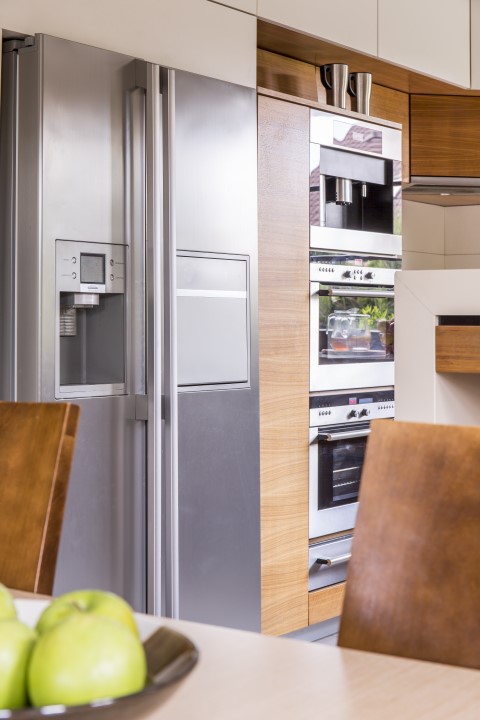
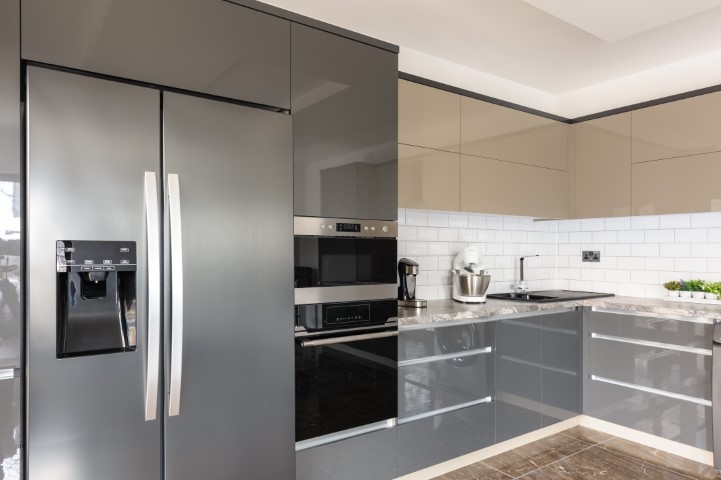
The format is recognized by its two vertical doors, freezer on one side, refrigeration on the other, hence its other name side by side. The multi-door versions, called French door, place the freezer in a drawer under a larger cold section.
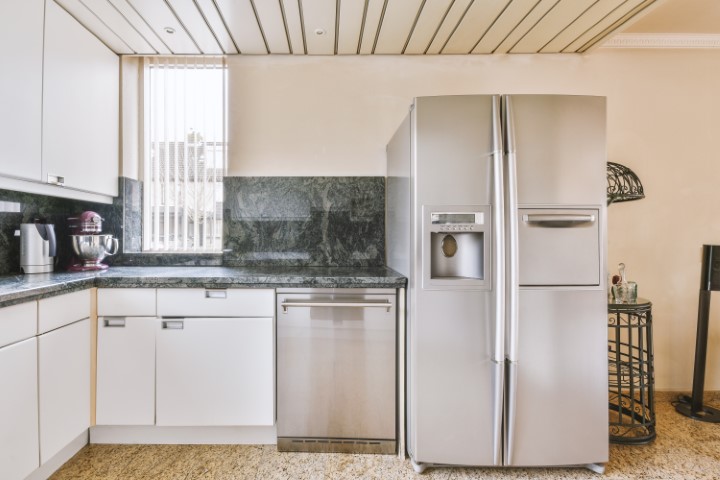
In terms of volume, count on 450 to 750 liters depending on the models, the most sold range being between 500 and 700 liters for a family of four to six people. The width is around 90 centimeters, with so-called slim versions reduced to about 83 centimeters for European kitchens.
| Segment | Indicative budget | What you get |
|---|---|---|
| Entry level | Less than €700 | 460 to 560 liters, ventilated cooling, often an inverter technology compressor, challenger brands |
| Mid-range | €700 to €1,200 | 550 to 620 liters, water dispenser, better sound insulation, anti-fingerprint finishes |
| High-end | €1,200 to €2,500 | Major brands, ice maker, convertible zone, connectivity, better rated energy classes |
A point that product sheets rarely highlight: beyond 600 liters, the volume gain is expensive, both in purchase and consumption. Size according to your actual shopping needs, not according to the available space.
How to compare offers to pay the right price?
The first reflex is to read the energy label correctly. Since March 2021, the scale has returned from A to G and the mentions A+, A++ and A+++ have disappeared: a device formerly rated A+++ can now appear as C without having changed an iota. So never compare an old label with a new one.
For this type of appliance that runs continuously, the letter alone is not enough, and we recommend a simple calculation. Identify the annual consumption in kilowatt-hours indicated on the label and multiply it by the kilowatt-hour price of your contract. You get the real cost over the year, and the difference between two models can finally be compared in euros.
The QR code on the label gives access to the official product sheet in the European database, useful for verifying a feature announced by a seller.
Then come four concrete criteria:
- The water dispenser: connected to the network, it requires a nearby water supply. With a reservoir, it is filled by hand, five to eight liters depending on the models, without plumbing constraints.
- The noise level in decibels, crucial if the kitchen is open to the living room.
- The actual dimensions: width, but also clearance of five to ten centimeters for ventilation, door opening space, and passage through your hallway on delivery day.
- Delivery conditions: carrying upstairs, commissioning, and removal of the old appliance, which the seller is required to provide when delivering an equivalent piece of equipment.
A price displayed without these items is not a comparable price.
Find a cheap American fridge on a major platform
Generalist platforms drive prices down on this type of product because they bring together established brands and challenger brands on the same results page. At Cdiscount, as with its competitors, the large appliance catalog thus mixes references sold directly by the retailer and offers proposed by third-party sellers.
This distinction deserves your attention before confirming the cart. Check who sells and who ships, the announced delivery time, the delivery conditions for a device weighing more than one hundred kilos, and the return conditions. For a purchase of this size, a three-week delay or delivery at the foot of the building completely changes the experience.
Then use filters rather than sorting by price alone: maximum width, minimum capacity, energy class, presence of a dispenser. You instantly eliminate models that will not fit in your home, and the price ranking finally becomes relevant.
Finally, remember that the two-year legal warranty of conformity applies regardless of the purchase channel, including platforms.
Good deals and ideal periods to buy cheaper
The calendar counts as much as the seller. The winter and summer sales, four weeks in January and June, remain the most reliable windows for large appliances, with real discounts on end-of-series items.
Black Friday, at the end of November, produces the most spectacular drops on connected models and major brands. We recommend noting the usual price of the targeted model several weeks in advance, the only way to measure the real discount on the day. The French Days play the same role in spring and autumn.
Three avenues complete the picture. Manufacturer cashback offers, which add to the seller’s discount and are claimed after purchase. End-of-series, when a model is replaced by its new version, often in spring. And products from returns or refurbished, to be examined on a case-by-case basis depending on the warranty offered.
The right purchase is the right model at the right time. Rarely both on the same day.
FAQ – Cheap American fridge in 2026
Quel budget prévoir pour un réfrigérateur américain ?
À partir de 600 à 700 € pour un modèle d’entrée de gamme de 460 à 560 litres, entre 700 et 1 200 € pour le milieu de gamme avec distributeur d’eau, et de 1 200 à 2 500 € pour les grandes marques équipées d’une machine à glaçons ou d’une zone convertible.
Quelle classe énergétique viser sur ce type d’appareil ?
Les réfrigérateurs américains se situent le plus souvent entre les classes D et F, les classes A à C restant rares sur ces grands volumes. Plutôt que la seule lettre, comparez la consommation annuelle en kilowattheures multipliée par le prix du kilowattheure de votre contrat : c’est le seul calcul qui traduit l’écart en euros.
Faut-il une arrivée d’eau pour un frigo américain ?
Uniquement pour les modèles à distributeur raccordé au réseau. Les versions à réservoir amovible, de cinq à huit litres, se remplissent manuellement et s’installent partout, et les modèles sans distributeur offrent une porte lisse et un rangement intérieur plus exploitable.
Quelle largeur prévoir dans la cuisine ?
Environ 90 centimètres pour un modèle standard, 83 centimètres pour les versions slim, auxquels s’ajoutent cinq à dix centimètres de dégagement pour la ventilation et l’espace nécessaire à l’ouverture complète des portes. Mesurez également le passage entre la porte d’entrée et la cuisine avant de commander.
Sources
For further information: Choosing your appliances well thanks to the energy label (economie.gouv.fr) and The energy labeling change of March 1, 2021 (DGCCRF).