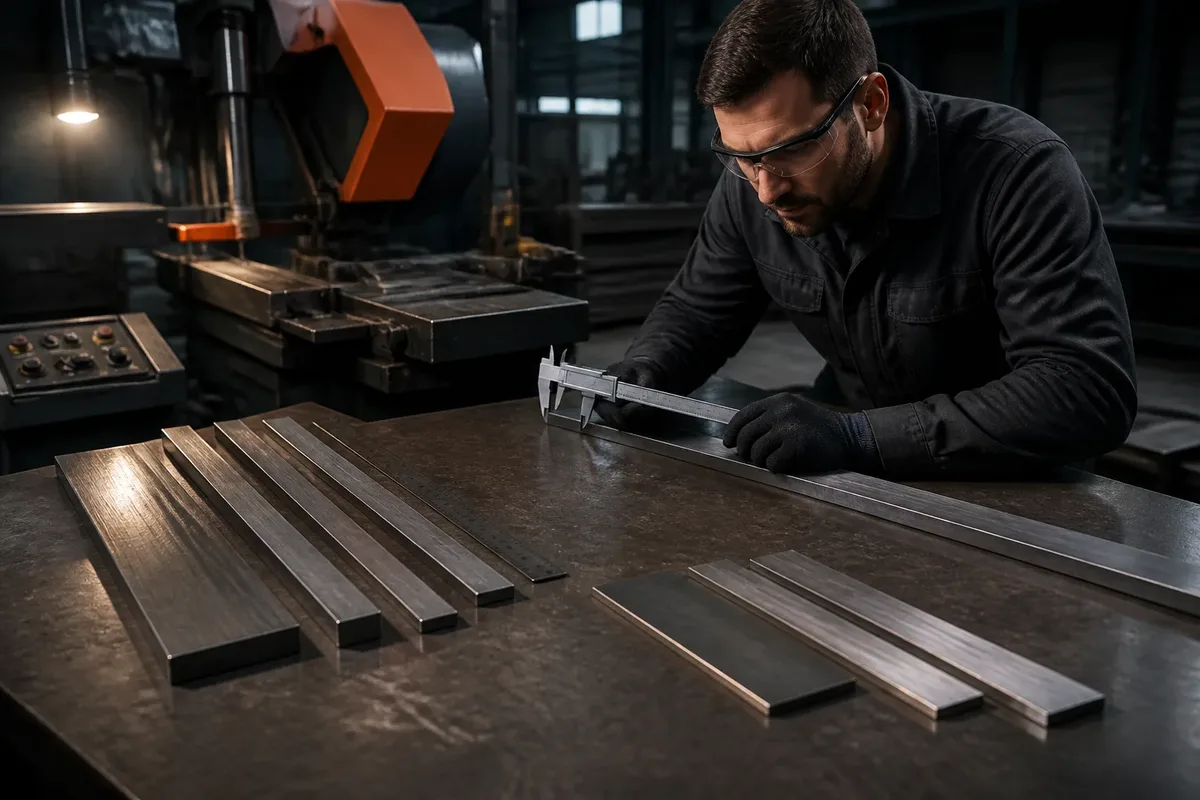
A custom flat bar is a flat bar, mainly made of steel, cut to a defined width, thickness, and length. To order, you must specify the dimensions, steel grade, quantity, any finishing, and delivery method; the price and availability must be confirmed at the time of the request.
The trap is to choose a dimension because it looks sturdy on a screen. A 40 × 3 mm section, for example, does not behave the same as a 40 × 10 mm flat bar, and raw steel intended to remain outdoors will not age like a protected piece. The right order therefore starts with the actual use, not the price displayed per meter.
| 📐 | Shape: solid bar with a rectangular section, intended to be cut or transformed. |
| 📏 | Dimensions to provide: width, thickness, and finished length, in millimeters. |
| 🔩 | Uses: plates, supports, frames, reinforcements, grilles, and locksmith parts. |
| 🧱 | Common grades: S235JR, S275JR, and S355J2 appear in an observed industrial catalog. |
| 🛠️ | Options: cutting, drilling, chamfering, surface treatment, or special packaging. |
| ⚠️ | Warning point: a catalog dimension alone is not enough to validate a load-bearing part. |
Custom flat bar: definition and section characteristics
But the flat bar remains a simple piece to describe: it is a solid steel bar with a rectangular section, whose width, thickness, and length determine the delivered geometry. Its wide face facilitates drilling, welding, and assembly, while its grade and surface condition determine its use.
It is called a rectangular section because the piece has two transverse dimensions, then a length. The width corresponds to the large visible face; the thickness measures the distance between the two parallel faces. The observed industrial catalog distinguishes the flat bar from the wide flat starting at a width of 150 mm. This commercial classification does not change the customer’s action: all three dimensions must always be provided.
A flat bar can be hot rolled or offered with a smoother finish from another manufacturing process. Hot rolling generally leaves a less fine surface, with scale that must be removed before painting or bonding. A machined or dressed piece requires a more precise description of edges, flatness, and straightness.
The shape seems elementary, yet it poorly supports vague descriptions. “Flat 40” is not enough: 40 mm can refer to the width, while the thickness remains unknown. For drilling or a plate, this omission rarely results in a good assembly; the drill bit breaks through too close to the edge, the screw does not bear properly, or the piece warps.
What are the uses for a steel flat bar?
A custom flat bar is especially suitable for assembly parts and locksmith elements whose geometry remains clear: plates, brackets, frames, reinforcements, grilles, or supports. Small sections are used for finishing and connections; thicker sections meet rigidity needs, provided that forces and supports have been studied.
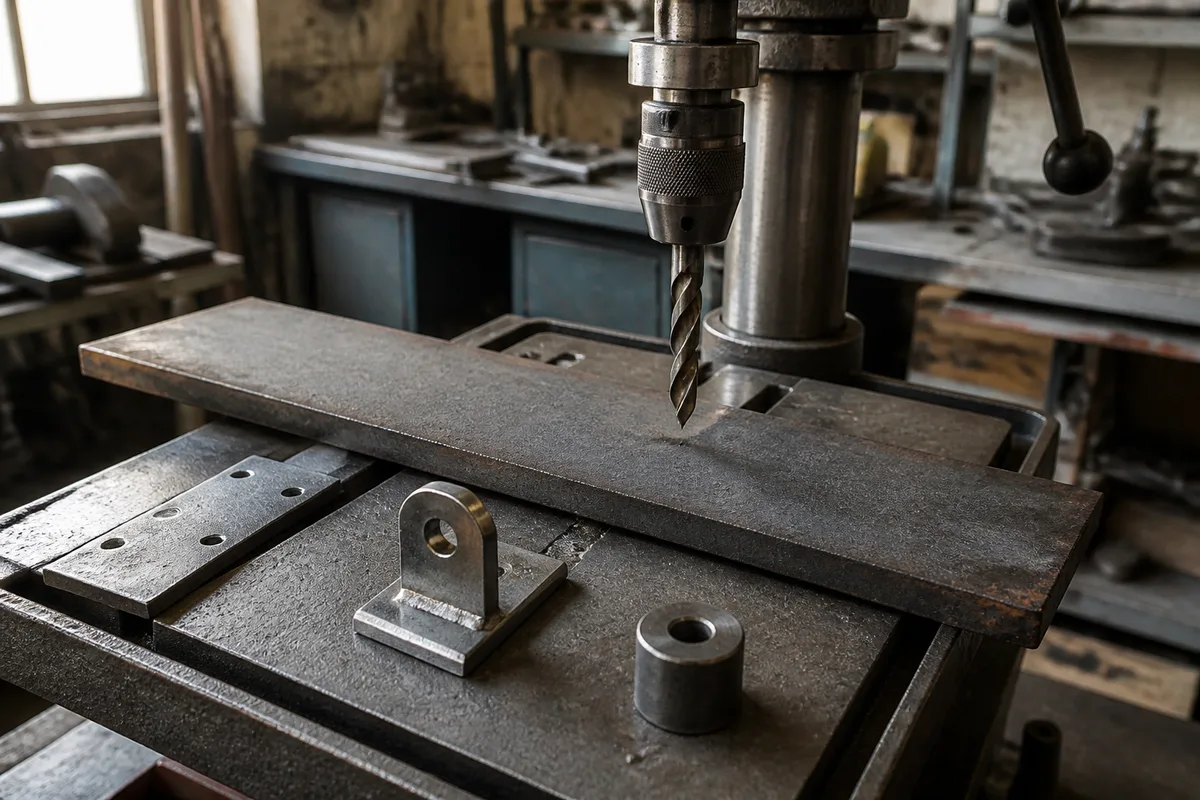
In locksmithing and ironwork, it can form a gate border, a grille crossbar, a fixing bracket, or a connecting piece. In metal carpentry, it is used to make an anchor plate, a support under a tabletop, or a clamp. In a DIY workshop, it also becomes a stop, a mechanical shim, or a screwed reinforcement.
Comparison with other profiles prevents the flat bar from being stressed in an unfavorable direction. An angle iron offers two wings at a right angle, a tube encloses a hollow section, and a flat bar provides a single wide face. To choose between these shapes, the article on custom steel profiles helps distinguish the function of a flat bar, a tube, and an angle iron.
A flat bar can be part of a guardrail, a staircase, or a structure, but this possibility does not automatically mean approval. A piece exposed to a load, impact, or bending stress must be sized considering its span, supports, assemblies, and the actual load applied. For a load-bearing piece, have the assembly checked by a competent person: no photo can validate its safety.
How to choose width, thickness, and length?
Thus, the choice of a section is made based on the function of the piece, then the assembly and manufacturing constraints. The width must allow space for holes, screws, or weld beads; the thickness influences resistance to bending and shearing; the length must correspond to the finished dimension, including any planned cuts or adjustments.
Yes, for a non-load-bearing piece, you can start from the space requirements and the fixing method.
For a tab or a plate, start by drawing the piece to scale with the holes, edges, and weld zones. A 20 × 3 mm section may be suitable for a small lightly stressed connecting piece; a 40 × 10 mm flat bar provides more material but also increases weight, cutting cost, and drilling difficulty. These examples describe geometry choices, not allowable loads.
The flat bar is often compared to a miniature beam, which misleads beginners. A wide and thin strip can deform quickly if stressed along its thin thickness. The orientation of the piece, the free span, the fixing points, and the direction of the force matter as much as the material. In a structure, calculation cannot be replaced by reading a table.
- Connecting or finishing piece: prioritize space, drilling, and appearance first.
- Plate or support: check the space around holes, available thickness, and how the force enters the piece.
- Element subjected to bending: do not choose the section without knowing the span, supports, and load.
- Element exposed outdoors: incorporate corrosion, welds, and water drainage from the design stage.
The installation direction must therefore be drawn before ordering. A flat bar laid flat offers low height in one direction; placed on edge, it provides greater height against bending in that same direction, at the cost of a different assembly. This detail changes the behavior of the piece and cannot be corrected with a coat of paint.
What dimensions and grades are available?
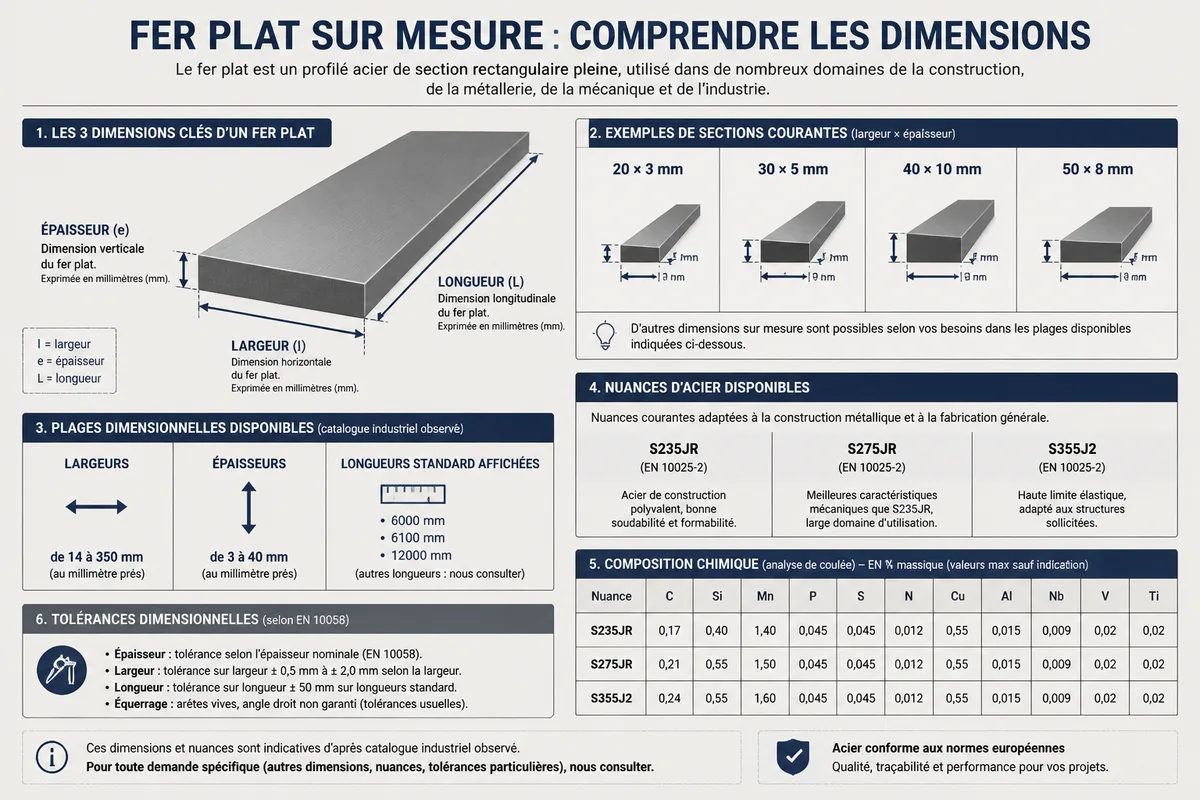
When ordering, always write the section as width × thickness, then add length and quantity. Dimensions such as 20 × 3, 30 × 5, 40 × 10, or 50 × 8 mm are common examples of commercial presentation; an observed industrial catalog shows widths from 14 to 350 mm, thicknesses from 3 to 40 mm, and selectable lengths of 6000, 6100, or 12000 mm.
The values of 40 mm width and 3 mm thickness appear in several commercial offers consulted. However, not all datasheets are consistent: the same reference presented as 40 × 3 mm includes a different thickness value elsewhere. A contradictory datasheet should be discarded until clarified; ordering based on a title alone is a bad habit.
The grades S235JR, S275JR, and S355J2 appear in the selector of an observed industrial catalog. The number associated with the letter S corresponds to a nominal class of minimum yield strength of 235, 275, or 355 MPa within the thickness range covered by the applicable table. This value alone is not sufficient to choose a part: the grade, thickness, assembly, and calculation must remain consistent.
| Choice | What it provides | Practical limit |
|---|---|---|
| S235JR | Common construction steel, often chosen for general parts. | Does not alone validate a load-bearing part or a welded assembly. |
| S275JR | Nominal class higher than S235 in the relevant thickness range. | Availability and assembly requirements remain to be confirmed. |
| S355J2 | Higher nominal class, intended for defined strength needs. | Useless as an automatic choice without sizing and technical documentation. |
| Raw steel | Surface suitable for preparation, painting, or subsequent protection. | Mill scale and rust must be treated before finishing. |
| Protected steel | Better environmental resistance when the treatment is appropriate. | Cut, drilled, or welded areas may lose this protection. |
The simple choice is as follows: for a non-load-bearing DIY plate, S235JR is generally a reasonable starting point; for a structure, choosing an S355J2 without verification is a false good idea. A higher grade neither compensates for a section that is too thin, nor a poorly prepared weld, nor a poorly designed support.
Price, cutting, and weight: what really changes the quote
But the price of a custom flat bar cannot be correctly read from an isolated amount per meter. The section, grade, length, number of cuts, drilling, packaging, and transport all factor into the total. A commercial page displayed €1.45 including tax per meter for 16 × 3 mm and €28.06 including tax per meter for 100 × 12 mm; these amounts have no provided date and do not constitute a 2026 price list.
Another commercial display announced €3.37 including tax per meter for a 40 × 3 mm section, while a product page indicated €6.08 for a reference presented with the same section. These two amounts cannot be compared without knowing the billed length, the cut, fixed fees, applied taxes, and delivery. The useful figure is that of a detailed quote, not the headline price copied into a cart.
To read the price at the correct level, it is necessary to separate the cost of the material, that of the cut, and that of transport. A long bar may have an attractive price per meter, then become less advantageous once packaged and delivered. Conversely, a short cut may cost more per unit because it involves an operation and packaging despite a small amount of steel.
Weight helps anticipate handling. For carbon steel, the conventional estimate uses 7.85 kg/dm³: approximate mass in kilograms = length in meters × width in millimeters × thickness in millimeters × 0.00785. A 40 × 3 mm flat bar thus weighs about 0.942 kg per meter; 100 × 12 mm reaches about 9.42 kg per meter. This calculation remains an estimate, as the actual mass depends on the material and tolerances.
The standard lengths displayed in an industrial catalog include 6000, 6100, and 12000 mm. Other sellers announce custom cuts, sometimes with very different ranges. A tolerance of ±1 mm is announced for a 40 × 3 mm product, but this value belongs to this specific offer. It should not be extended to every supplier nor every cutting operation.
To deepen the calculation of the total cost, the article on the price of a custom steel bar usefully distinguishes the price of the material, the processing, and the delivery fees.
Manufacturing, finishing, and implementation criteria
And the part that arrives is not always the part that the drawing suggested: the cut may leave a burr, the drilling may deform a thin edge, and the welding may pull the metal. For a clean result, indicate the expected operations before the quote and specify if the edges, flatness, or visible appearance have functional importance.
Drilling is prepared with the hole diameter, its position relative to the edges, and the fastening method. A hole close to an edge that is too thin weakens the area or leaves little material around the screw. After cutting, deburr the edges before assembly: a sharp edge can injure, hinder the support of a washer, and sometimes trap water under a finish.
Welding requires a clean preparation, free of paint or scale on the area to be joined. Heat can cause deformation, especially on a long, thin piece or one welded on only one side. Appropriate clamping, a controlled welding sequence, and normal cooling limit surprises; heating at random to straighten a bar is a troubleshooting method, not a manufacturing specification.
Bending is decided before cutting, because the section, grade, radius, and bending direction determine the necessary effort. A flat bar bent on edge does not behave like the same flat bar bent flat. For a small decorative piece, a well-equipped workshop can offer the operation; for a piece that must maintain precise geometry or strength, entrust it to a professional.
- Raw interior steel: degrease, remove friable parts, apply compatible primer then the finish.
- Steel exposed to weather: protect edges, holes, and weld beads, where water often starts its work.
- Galvanized or treated piece: anticipate areas removed by cutting, drilling, or welding.
- Visible piece: request a clear requirement on the appearance of faces and edges before manufacturing.
A finish does not turn a poor substrate into a durable piece. Paint will blister on a greasy surface, rust will return through a forgotten edge, and water will remain trapped in a closed assembly without drainage. Therefore, treatment must follow steel preparation, not serve as a cover-up for a poorly defined order.
How to request and check a custom flat bar?
Finally, an effective quote request fits on a short sheet: section, unit length, quantity, grade, surface condition, additional operations, and delivery address. The seller must then separately show the cut piece, machining, packaging, and transport; otherwise, the final price will remain impossible to compare.
Here is the information to gather before sending the request:
- width × thickness, in millimeters;
- finished length of each piece and expected tolerance;
- number of pieces, with any need for full bars;
- desired steel grade or use justifying this grade;
- drillings, openings, bevel cuts, chamfers, or bends;
- finish: raw, painted, galvanized, or other requested treatment;
- packaging, address, and unloading constraints.
An example of a correct request would be: “12 pieces in S235JR steel, section 40 × 5 mm, finished length 620 mm, two holes of defined diameter on the plan, deburred edges, raw finish, separate packaging.” The dimensioned plan must specify distances between holes and edges; a simple annotated photograph is not enough if the dimension is important.
The quote must confirm the dimensions after cutting, the announced tolerance, the grade, the surface condition, and included operations. It must also distinguish the price per meter from the price per piece: this difference explains part of the comparisons that seem inconsistent. A product sheet showing a contradictory section must be corrected before payment, not interpreted in favor of the doubt.
Upon receipt, measure one piece before unpacking the entire lot and compare it to the plan. Check the width, thickness, length, number of pieces, holes, and angles; also look for deformations that would prevent assembly. Photograph the label, the package, and the piece if an anomaly appears, then file the claim with the order number and measured dimensions.
To compare other sections or shapes without mixing units, the file on steel bar dimensions complements this method. If the project uses several profiles, the page dedicated to custom steel bars for your industrial applications broadens the choice beyond just flat bars.
Frequently Asked Questions about Custom Flat Bar
How to store a flat bar before use?
Store the flat bar in a dry and ventilated place, on supports that isolate it from the ground. Avoid prolonged contact with water, soil, and damp materials, then quickly remove any condensation or rust marks before painting.
Can you cut a steel flat bar yourself?
Yes, an angle grinder equipped with a disc suitable for steel or a hacksaw allows you to make a cut on a small section. The bar must be immobilized, protective equipment worn, and the edges deburred after cutting to remove burrs and sharp angles.