How to reduce the electricity consumption of a water heater without changing the installation
Reducing the consumption of a water heater starts with accessible adjustments, without disassembly or wiring modification. The temperature of the tank, operating hours, heat losses, and the amount of hot water used directly influence the electricity bill.
This guide proposes a progressive method: first act on the thermostat and habits, then check off-peak hours and insulation, and finally identify interventions that require a plumber or a qualified electrician. You will also learn how to measure the result without confusing energy savings with simple tariff variations.
In brief
- 🌡️ A setting around 50 to 55 °C can limit losses but should not lead to insufficiently hot water.
- ⏱️ The Auto mode and off-peak hours are useful only if the contract and schedules actually correspond to your usage.
- 🧤 Insulating the tank and accessible pipes reduces losses, especially when the tank is located in a cold room.
- 🔧 Descaling, the safety group, and the electrical panel should not be handled without the necessary skills.
Understanding the main causes of consumption
An electric water heater consumes electricity to heat water, but also to compensate for heat losses from the tank and pipes. According to the orders of magnitude relayed by ADEME and EDF, domestic hot water can represent up to 20% of a household’s energy consumption, while an electric tank is sometimes estimated at about 800 kWh per person per year.
This average does not constitute a personalized forecast. The volume of the tank, the number of occupants, the inlet water temperature, the length of the pipes, and shower habits can strongly modify the result. A tank that is too large heats and maintains an unnecessary amount of water, while a device that is too small can cause frequent restarts or a lack of comfort.
| Possible cause | Observable sign | Action without changing the installation |
|---|---|---|
| Too high temperature | Very hot water, frequent mixing with cold water | Check then carefully adjust the thermostat |
| Unnecessary heating during the day | Contactor in forced position | Check the Auto mode and contract schedules |
| Thermal losses | Tank or pipes hot to the touch | Insulate accessible and authorized parts |
| Scaling or defect | Noise, less hot water, leak or unusual heating time | Have the device checked by a professional |
The primary goal is not to heat less at all costs, but to heat only the amount of water necessary, at a temperature compatible with safety and comfort.
How to adjust the water heater temperature safely?
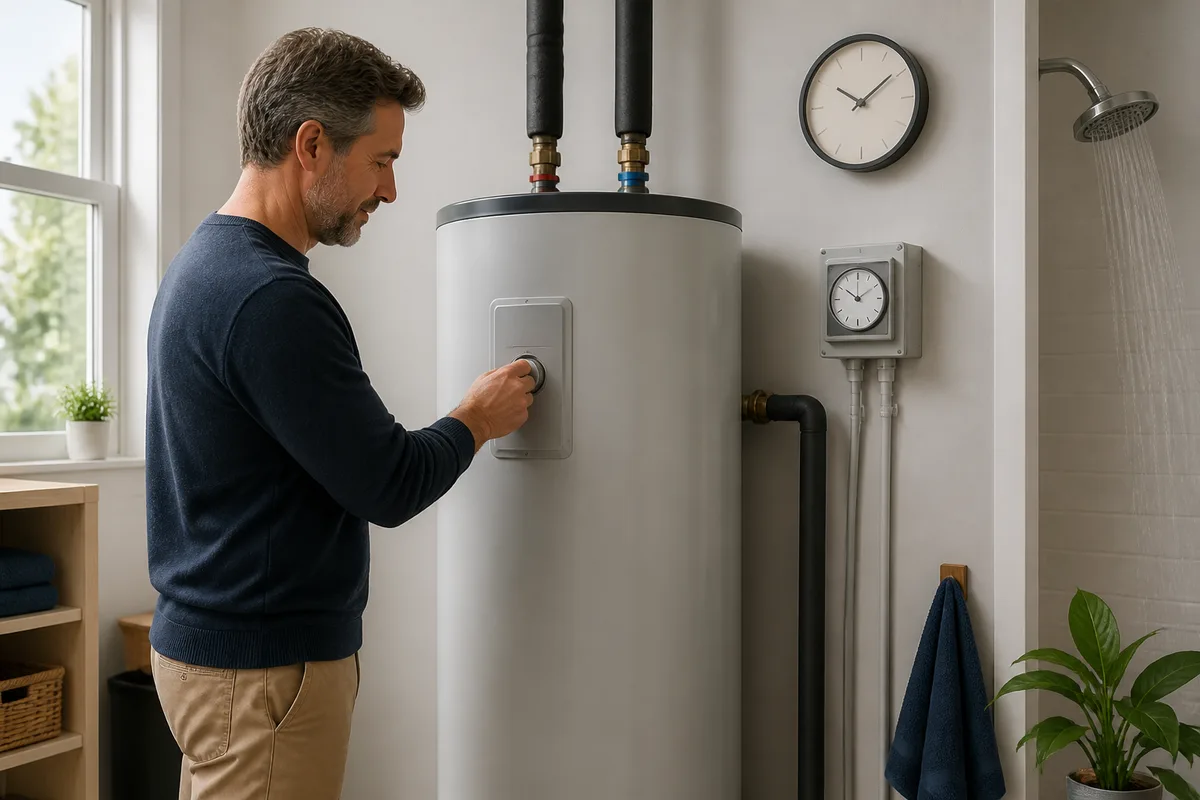
To reduce the water heater’s consumption, first check the existing setting, then generally aim for a range of 50 to 55 °C when the manual and installation configuration allow it. This decrease limits losses due to temperature maintenance, but it should not be done randomly nor lead to using insufficiently hot water.
Recommendations may vary depending on installations, manufacturers, and applicable health guidelines. In case of doubt, consult the tank’s manual or seek professional advice; the National Agency for Food Safety and competent public bodies remain the references for questions related to water sanitary quality.
Step 1: locate the thermostat
Turn off the power only if the manual indicates this precaution to access the adjustment area, then identify the thermostat without removing any electrical cover. On some models, a graduated dial is accessible under a cover; on others, the setting is digital. Never touch wires, terminals, or electrical protections to modify the temperature.
Step 2: Choose a moderate setting
Gradually adjust the temperature within the range recommended by the manufacturer, rather than switching directly from a high level to the minimum. Then wait for a full heating cycle and check the comfort at the tap, without taking measurements with a device not intended for this use.
Step 3: Check the result
Observe for a few days the availability of hot water, the recovery time, and any occurrence of water that is too hot or too cold. A decrease in comfort, significant variations, or unusual operation should lead you to revert to the previous setting and request an inspection.
Available estimates mention indicative savings of about 31 euros per year for an appropriate temperature setting. This amount depends on the price per kilowatt-hour, the volume of the tank, and the actual household consumption; therefore, it does not constitute a guaranteed saving.
How to check off-peak hours and the day-night contactor?
The water heater should generally operate in Auto mode when the home has a contract with off-peak hours and a suitable contactor. This device controls heating during the scheduled periods, but it does not automatically reduce the energy needed to heat the water: the benefit mainly depends on the applied price and the effective programming.
On a standard contactor, the positions can be “Auto,” “Forced operation,” and “Off.” Forced operation is used occasionally to restart heating, while Auto mode normally follows the meter signal. A permanent forced position can cause heating outside the chosen periods.
- Check your contract on a recent bill to confirm the existence of an off-peak option.
- Identify the schedules in your customer area or on the bill, as they vary depending on the meter and the area.
- Observe the contactor without removing the cover of the electrical panel and note its position.
- Set it to Auto mode only if the installation is designed for this operation and if nighttime heating is sufficient.
- Monitor comfort the next morning and after a day of heavy consumption.
Programming off-peak hours is sometimes estimated to save up to 70 euros annually, but this value depends on the contract, schedules, volume consumed, and the difference between tariffs. If the contactor does not switch, if the tank no longer heats, or if the panel shows a fault, do not dismantle anything: call an electrician.
Off-peak hours can reduce the cost of producing hot water, but they do not make the consumed energy free and do not compensate for a defective installation.
How to reduce daily hot water needs?
Electricity consumption decreases when the household uses less hot water, since every liter drawn must then be reheated. The simplest actions are to favor a short shower rather than a bath, turn off the tap while soaping, and avoid letting water run during unnecessary waiting.
Low-cost equipment can complement these habits without modifying the water heater: aerators, low-flow showerheads, and thermostatic mixers. However, check their compatibility with the available pressure and regularly clean the filters, as reduced flow due to clogging is not a controlled saving.
- Reduce shower duration, with a practical goal of a few minutes rather than an indefinite length.
- Avoid baths when a shower suffices for the intended use.
- Quickly repair a dripping faucet or safety group.
- Use the dishwasher and washing machine with appropriate programs when the appliance is connected to cold water.
- Install an aerator or an economical showerhead without obstructing or modifying safety elements.
How to limit heat loss from the tank and pipes?
Insulating accessible hot water pipes is particularly relevant when the tank is far from the draw-off points or installed in a garage, cellar, or unheated utility room. The insulation must be suitable for the temperature and pipe diameter, without covering an electrical component, a valve, or an area that must remain ventilated.
Step 1: Identify Accessible Parts
Locate the first meters of piping at the outlet of the tank and check the condition of the existing insulation. Do not place any material on the safety group, leaking fittings, cables, or parts requiring visible drainage.
Step 2: Choose Compatible Insulation
Use an insulating sleeve designed for hot water pipes and sufficiently snug to stay in place. For the tank itself, an insulating cover should only be considered if the manual allows it, as improper installation can hinder safety devices or create risks around connections.
Step 3: Check After Installation
After a few hours, visually check that nothing compresses a fitting and that no leak is concealed. Proper insulation should reduce the sensation of heat on accessible surfaces, but it should never be used to hide a damaged appliance.
Estimates relayed by ADEME and EDF mention about 21 euros of savings per year for insulating an old tank and its pipes. This reference depends on the age of the equipment, the room temperature, and the length of the pipes; it is therefore best considered as an order of magnitude.
When Should the Water Heater Be Maintained or Inspected?
Regular maintenance prevents a scaled-up tank from heating longer for the same result. Descaling, often considered every two to three years depending on water hardness and manufacturer recommendations, as well as checking the safety group, generally require a professional when the intervention demands draining or opening the appliance.
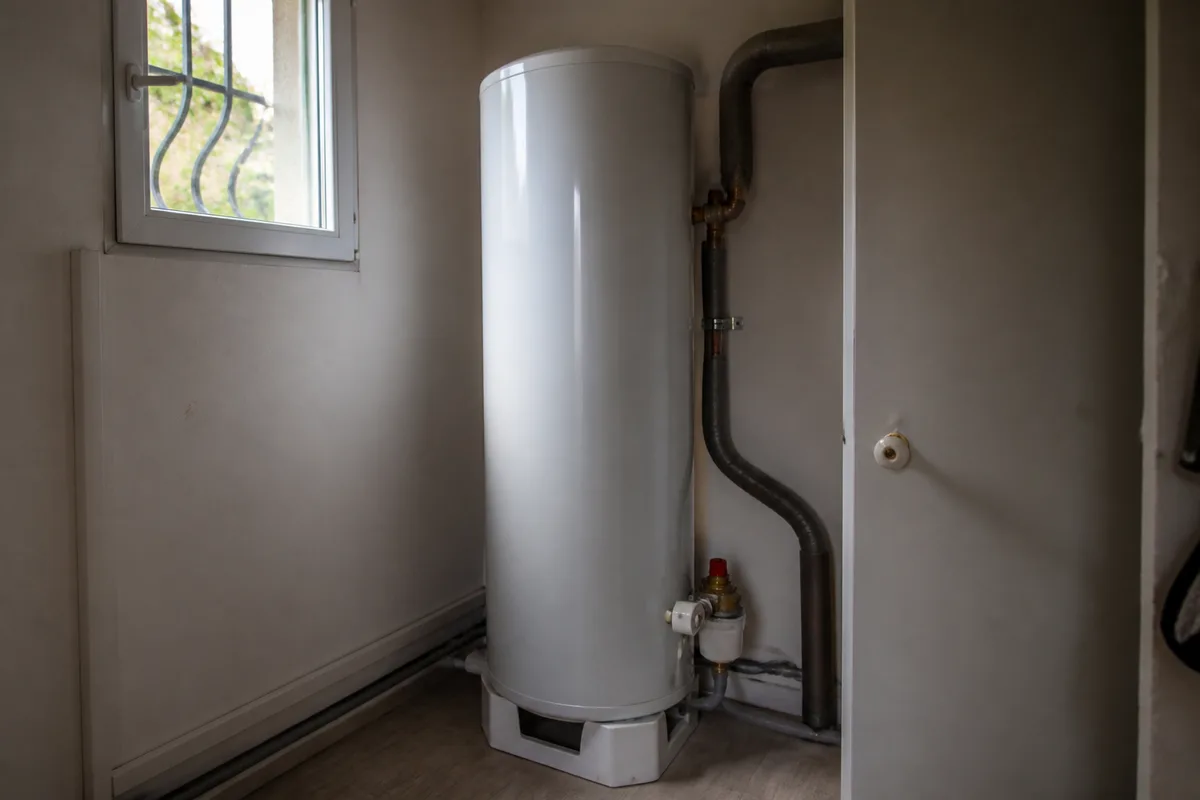
Do not disassemble the water heater to seek savings. Intervening on the heating element, anode, tank, safety group, or wiring can cause leaks, breakdowns, or accidents if done without proper qualifications.
- Unusual bubbling or knocking noises during heating.
- Less hot water despite unchanged consumption.
- Significantly longer heating times.
- Leak, continuous dripping, or corrosion around fittings.
- Repeated tripping or burnt smell near the installation.
If there is tripping, a burnt smell, or a significant leak, cut off power and water supply if you can do so safely, then contact a professional. The safety group may let some water out during heating, but a continuous flow should be checked.
Should the Water Heater Be Replaced to Save More?
No, it is not necessary to apply the initial measures. Replacement becomes a separate issue when the tank is very old, improperly sized, or defective; then you need to compare the investment, available space, work involved, and actual consumption rather than rely on an advertising percentage.
| Technology | Main Advantage | Limitation to Consider | Relevant Case |
|---|---|---|---|
| Electric Tank | Common installation and simple operation | Standby losses and dependence on electricity rates | Already equipped housing, when the appliance works properly |
| Thermodynamic Water Heater | Announced consumption lower than a classic electric tank in certain configurations | Price, noise, location, and maintenance | Replacement project studied over several years |
| Solar Water Heater | Use of solar energy | Investment, roof, backup, and local climate | Comprehensive renovation or adapted construction |
A heat pump water heater can announce up to 50% energy savings compared to a traditional electric model, but this result depends on operating conditions and the comparison made. The solar water heater can also significantly reduce auxiliary consumption, without its cost or relevance being deduced from a single percentage.
These solutions do not address the immediate goal of reducing consumption without changing the installation. For a broader reflection on the energy equipment of a house, also consult our article on the price of a heat pump for a 100 m² house, which concerns a different and more engaging project.
How to measure the actual savings obtained?
Measure one action at a time to avoid attributing the entire decrease to a single setting. Record the meter index or the consumption displayed by your supplier over several representative days, then compare a period of similar length with a similar number of occupants and habits.
- Note the consumption before modification during a stable period.
- Change only one parameter, for example the thermostat setting or Auto mode.
- Maintain the same shower habits as much as possible.
- Record the consumption after several weeks, rather than after a single day.
- Also compare the weather, number of occupants, and absences.
A decrease in euros can come from a variation in the price of electricity, while a decrease in kilowatt-hours more directly reflects a reduction in consumption. To obtain a usable result, keep the bills and distinguish the part related to the water heater from other household uses.
What mistakes to avoid to not worsen the situation?
The sought savings must not create an electrical, health, or material risk. The most common mistakes concern temperature, the contactor, poorly installed insulation, and improvised interventions.
- Lowering the temperature drastically: this can cause a lack of hot water and does not necessarily comply with the installation recommendations. Adjust gradually and seek advice if in doubt.
- Leaving forced operation permanently: the tank may heat outside the scheduled periods. Check the Auto mode without opening the panel.
- Covering the safety group: poorly placed insulation can hide a leak or hinder drainage. Leave necessary components accessible.
- Turning off the device for a few hours absence: the gain is generally limited and reheating can cancel the benefit. The shutdown is rather intended for a prolonged absence of more than two or three days, according to the manual.
- Intervening on the wiring: modifying connections or the contactor without qualification exposes to electrocution and breakdown. Entrust this operation to an electrician.
Durable savings are measured over several weeks and must never be achieved by removing an electrical protection or lowering the temperature without caution.
Key takeaways
- 🌡️ Adjust the thermostat cautiously around 50 to 55 °C if the manual and installation allow it.
- ⏱️ Check the contract, schedules, and the Auto position of the day-night contactor.
- 🧤 Insulate accessible pipes without covering the safety group or electrical components.
- 🚿 Reduce needs with shorter showers, aerators, and reasonable use of hot water.
- 🔧 Entrust wiring, descaling, and repairs to a qualified professional.
Frequently Asked Questions
Should the water heater be turned off during a short absence?
For an absence of a few hours, turning it off generally brings little benefit, as the tank will then have to reheat the water. For a prolonged absence of more than two or three days, a shutdown can be considered following the manufacturer’s instructions.
Do off-peak hours always allow savings?
No. The benefit depends on the difference between peak and off-peak rates, as well as contract fees. Check the current conditions of your offer and ensure that the contactor operates in Auto mode.
Can you lower the temperature of the water heater yourself?
A check or adjustment provided by the manual may be accessible, but you should never open the electrical part or modify the wiring. Proceed gradually, stay within the manufacturer’s recommendations, and seek advice if the temperature or operation becomes irregular.
How to know if a water heater consumes too much?
Compare the consumption in kilowatt-hours over several weeks with a similar period, taking into account the number of occupants and habits. Unusual noises, slow heating, less hot water, or a tripping breaker justify a professional check rather than a simple adjustment change.
Is insulation of the water heater always possible?
No. It depends on the design of the heater, its location, and the safety distances around the electrical components and the safety group. Insulating accessible pipes is often simpler, but it must be done with a suitable material and without hiding a leak.
Useful sources to consult
- EDF: consumption magnitudes and water heater adjustment advice.
- Sowee: programming practices and hot water saving tips.
- Thermor: general comparison of technologies and manufacturer maintenance recommendations.
- Alpiq: operation of Auto, Forced On, and Off positions of the contactor.