Removing Glue from a Wall Without Damaging the Paint: The Gentle and Effective Method
To remove glue from a painted wall without creating a halo or peeling off the finish, always start by identifying the mark and testing a gentle method on a less visible area. Dry glue is generally removed by softening it, then very lightly scraping it off using a non-aggressive tool.
This tutorial details the steps to remove an adhesive, double-sided tape residue, adhesive paste, or old wallpaper glue. You will also find products to avoid, precautions for matte paint or plasterboard partitions, as well as the procedure to follow if the paint has already come off.
In Brief
- 🧪 Always test the solution on a small hidden area before treating the mark.
- 🌡️ For thick glue, the heat from a hairdryer can soften it before delicate removal.
- 🧽 For residues, first use hot water, liquid soap, and possibly baking soda.
- ⚠️ On matte, powdery, or fragile paint, avoid repeated rubbing and strong solvents.
How to Identify the Glue and Paint Before Starting?
Observe the shape of the mark before choosing a product. A sticker residue often remains soft and sticky, while old glue or wallpaper glue tends to form a hard, matte, or irregular film. The nature of the paint matters as much as that of the glue: a washable satin finish generally withstands wet cleaning better than fragile matte paint.
The safety rule is simple: start with the solution that stresses the surface the least. If the paint powders on your finger, is already peeling, or shows bubbles, limit moisture and scraping. A local touch-up will sometimes be safer than prolonged cleaning.
Recognizing the Type of Mark
- Adhesive tape or sticker: thin residue, often greasy or sticky.
- Adhesive paste: soft ball or film that can sometimes be removed by dabbing with a piece of clean paste.
- Double-sided tape: foamy or fibrous thickness, generally more resistant.
- Wallpaper glue: extended film, sometimes whitish, which softens with water.
- Old strong glue: hard, compact, and sometimes shiny surface.
Checking the Fragility of the Painted Wall
Choose a discreet corner, behind a piece of furniture or near a baseboard. Apply a small amount of solution with a cotton swab, wait a few minutes, then wipe without pressing. Then check the color of the cloth, the paint’s gloss, and any possible halo appearing.
If the paint changes appearance, stop the test. For a very delicate finish, a painting professional can determine if the film is stable enough to be cleaned or if a touch-up is necessary.
What equipment is needed to remove glue without scratching the wall?
The necessary equipment remains limited, but each tool must be chosen to reduce the pressure exerted on the paint. Prepare the area before starting so as not to interrupt the work with a wet surface or furniture exposed to splashes.
| Equipment or product | Use | Precaution |
|---|---|---|
| Tarp or plastic sheet | Protect the floor and furniture | Secure the edges to prevent slipping |
| Clean cloths and absorbent paper | Wipe softened glue and rinse | Change side as soon as it becomes dirty |
| Non-abrasive sponge | Clean the residual film | Do not use the scrubbing side |
| Plastic putty knife | Lift the glue without cutting the paint | Keep a low angle and light pressure |
| Hairdryer | Soften thick glue or adhesive | Avoid heating the same spot for too long |
| Hot water, liquid soap, baking soda | Detach glue residues and films | Test on the finish before application |
Add gloves if you use a commercial product or solvent. Also protect outlets and switches from moisture, without applying liquid near a powered electrical installation.
How to remove a glue stain step by step?
The method below follows a progression from the gentlest action to more powerful solutions. It is especially suitable for small and medium stains on a painted wall, but prior testing remains essential, especially on matte paint.
Step 1: protect the room and remove the accessible part
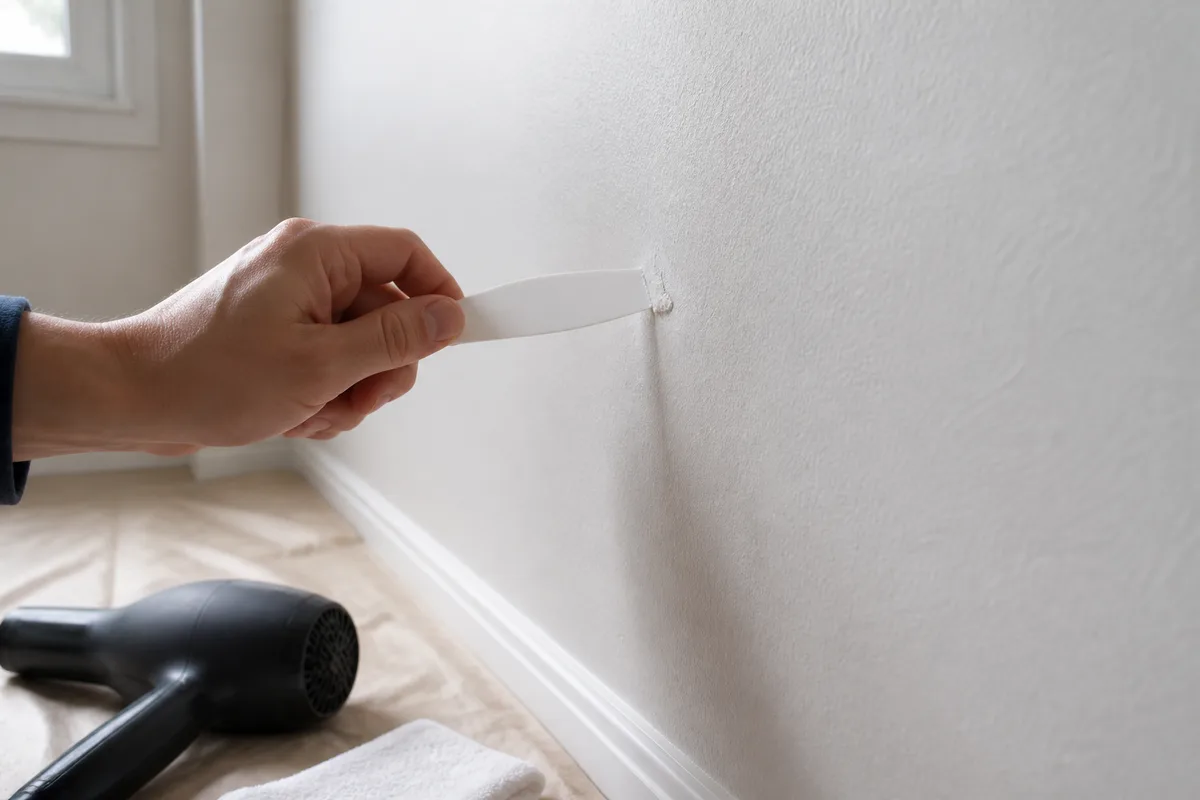
Move nearby furniture and cover the floor with a tarp or plastic sheet. Then remove the pieces that come off by hand, without pulling perpendicular to the wall: rather follow the residue in the direction of the surface to limit paint tearing.
For adhesive putty, dab the stain with a small piece of clean putty. This action can recover part of the residue without introducing water or solvent on the wall.
Step 2: soften dry residues without scratching the wall
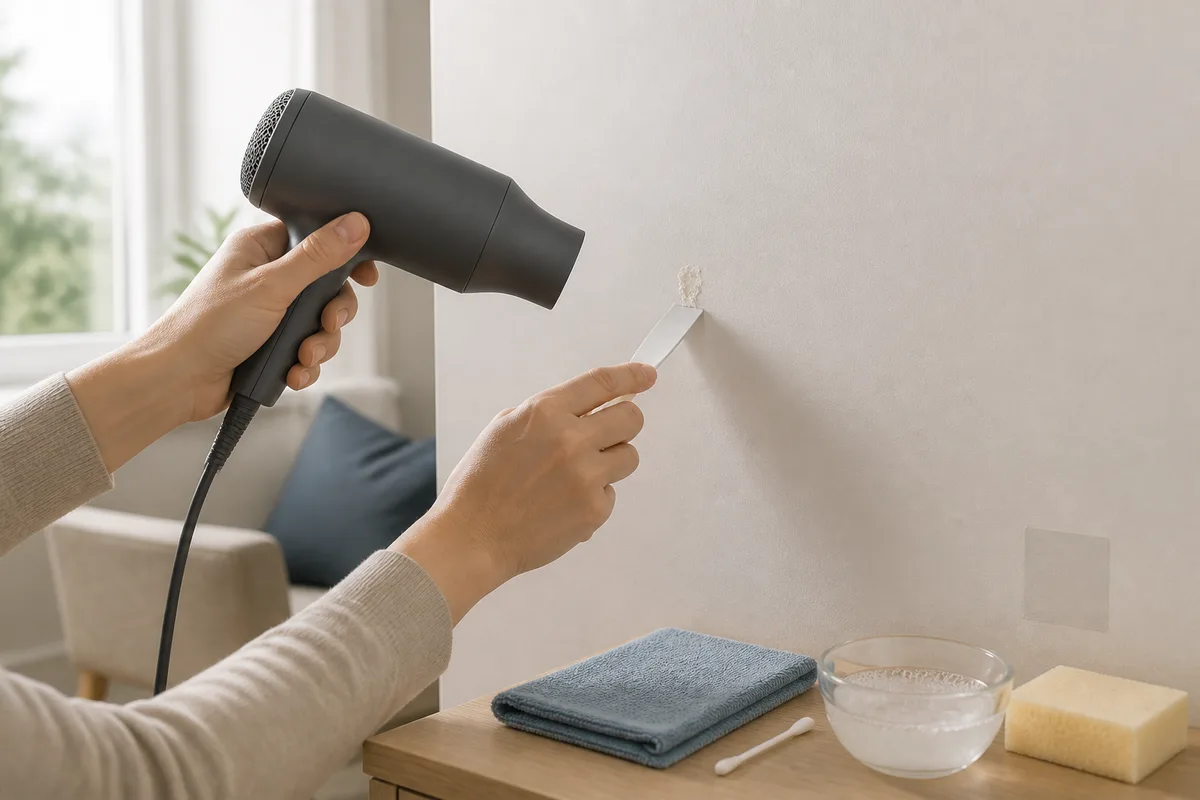
Direct a hairdryer at the glue for a few seconds, at a reasonable distance, with a constant movement. The heat should soften the residue, not strongly heat the paint. Immediately remove the softened part with absorbent paper or the edge of a plastic putty knife.
Stubborn glue is often better removed in several short passes than by forcing on a single area.
If you use a heat gun, greatly reduce the power and stay very mobile. This tool can burn, blister, or soften the paint; it is therefore preferable to reserve this solution for resistant surfaces and people who master the device.
Step 3: prepare a solution of hot water and soap
Pour hot water into a container, add liquid soap and a tablespoon of baking soda. Slightly soak a non-abrasive sponge or cloth, then apply the solution in small areas to control moisture.
On a drywall partition, do not leave the surface wet for more than 10 to 15 minutes. For resistant glue, a small amount of vinegar can be added to the solution, but this variant must first be tested, as acidity and moisture can alter certain finishes.
Step 4: Let it act then gently scrape
Let the solution work for about 2 to 3 minutes to soften the film. Then lift the glue in small touches with a putty knife held at about 30 to 45 degrees, without using the tip like a chisel.
Work from the edge towards the center of the mark. If the residue resists, slightly re-moisten the area and start again rather than increasing the pressure. Wipe frequently to see what actually remains on the wall.
Step 5: Clean the remaining film with clear water
Pass a clean, barely damp cloth to remove the soap, baking soda, and glue particles. Rinse the cloth regularly so as not to spread the residue over a larger surface.
Ventilate the room and let the wall dry completely before any painting or wallpapering. A delay of about 24 hours is often used as a guideline, but the actual time depends on the amount of water used, ventilation, and the substrate.
Step 6: Use a more powerful product only as a last resort
For glue that resists heat and soapy water, a specialized product like HG adhesive remover can be considered by strictly following its label. Apply it on a small area, ventilate the room, and wear appropriate gloves.
Acetone or a nail polish remover containing acetone should not be the first choice on paint. If its use is considered on a very small spot, prefer an extremely localized test with a cotton swab, without improvised mixing and away from a flame; stop as soon as the color or gloss changes.
On a painted wall, the most powerful product is not necessarily the most effective: dissolved or discolored paint may require a repair more visible than the original glue.
Which method to choose depending on the type of glue?
The right process depends on the thickness, age, and how the glue adheres to the wall. A sticker residue generally calls for thermal treatment or light degreasing, whereas wallpaper glue is rather treated by controlled moistening.
| Type of glue | First method | To avoid | Expected result |
|---|---|---|---|
| Adhesive tape or sticker | Gentle heat then wiping | Pulling abruptly | Remove the film without tearing the paint |
| Adhesive putty | Patting with a clean putty | Rubbing with a solvent | Recover the ball and small residues |
| Double-sided tape | Heat then lift progressively | Vertical metal blade | Detach the foam in small portions |
| Wallpaper glue | Warm soapy water, short action | Soaking a plasterboard for a long time | Soften the film before cleaning |
| Old strong glue | Local test, heat or specialized product | Pure acetone and aggressive rubbing | Reduce residue without attacking the finish |
Removing adhesive tape or a sticker
Gradually heat the adhesive with a hairdryer, then pull on an edge while keeping the tab almost parallel to the wall. Wipe the remaining film with absorbent paper before moving, if necessary, to a slightly soapy cloth.
Removing adhesive putty
Adhesive putty is often removed by pressure and patting. Avoid oil, petroleum jelly, or remover as long as the mechanical method works, because these products can leave a greasy area more difficult to repaint.
Removing double-sided tape on a painted wall
First lift a corner with a plastic tool, then heat the foam in short bursts. If the substrate comes off with the glue, stop: continuing risks tearing the paint layer or the facing of a plasterboard.
Treating strong or old glue
Reduce the mass with a putty knife, without trying to reach the paint immediately. For the last millimeters, a specialized product is generally more controllable than a household solvent used at random. Fine sandpaper should only be considered as a last resort, on a stabilized area, because it easily dulls the finish.
What mistakes should be avoided on a mural painting?
Damage often comes from an overly vigorous gesture or a product chosen before identifying the paint. These mistakes are particularly visible on matte finishes, dark walls, and already fragile surfaces.
- Scrubbing hard from the start: this can polish a matte paint or spread the residue. Soften the glue first.
- Using a metal blade at a right angle: it risks scratching the paint film. Prefer a plastic tool and a shallow angle.
- Wetting a plasterboard for too long: the facing can deform or weaken. Limit the wet action to 10-15 minutes.
- Applying pure acetone: it can alter the color or finish. Keep solvents for a very localized last resort.
- Painting directly on the glue: the residue can prevent adhesion and remain visible under the new coat.
Do not mix several products to “strengthen” their action. Clean, dry, and check the surface between two methods; this progression makes the result more predictable.
What to do if the paint comes off with the glue?
If the removal reveals the substrate, do not try to immediately hide the mark with paint. Remove unstable flakes, dust off, and check that the area shows no persistent moisture or detachment around the repair.
A discreet touch-up requires a clean, dry, and stable surface, not just a new coat of paint. On a small area, a filler or finishing putty may be necessary to even out the relief, followed by light sanding and a primer suitable for the substrate.
Clean and stabilize the area
Wipe off the last residues with a damp cloth, then let dry completely. If the wall remains powdery, crumbly, or swollen, stop finishing work and seek professional advice, especially if it is a damaged drywall partition.
Perform a discreet touch-up
Reproduce the existing preparation and finish as much as possible. A matte paint touched up with a brush can reveal a texture difference; in this case, a broader repainting, up to a natural boundary of the wall, sometimes gives a more homogeneous result.
To limit marks when repainting, also consult this guide dedicated to tools for painting without marks. The choice of tool and the amount of paint applied directly influence the visibility of the touch-up.
When should you stop DIY and ask for help?
Stop cleaning if the paint lifts off in patches, if the wall becomes soft, if a persistent chemical odor appears, or if the mark spreads despite localized attempts. Glue can also mask an old substrate degradation, but a simple stain should not automatically be equated with infiltration or mold.
Call in a professional if the surface is large, if the substrate is severely damaged, or if the glue comes from an old coating difficult to identify. For a larger repainting project, advice on choosing suitable paint can help distinguish substrate preparation from simple stain cleaning.
Key takeaways
- 🧤 Protect the floor, ventilate the room, and test each method in a discreet spot.
- 🌡️ Soften the glue first with gentle heat or a soapy solution.
- 🪛 Scrape with a plastic tool held at a low angle, without applying excessive pressure.
- 💧 Rinse lightly then dry completely before repainting or applying a coating.
- 🛑 Reserve solvents and sanding for very resistant marks, after a localized test.
Frequently Asked Questions
Can white vinegar be used on a painted wall?
Vinegar can be added in small amounts to a hot water and soap solution for resistant glue. First test the preparation on a hidden area and do not let it act for long, especially on matte paint or plasterboard.
Does oil remove sticker residue?
Oil can soften some greasy residues, but its effectiveness varies depending on the glue and it may leave a surface that is difficult to degrease. On a painted wall, first favor gentle heat, absorbent paper, and soapy water.
How to remove dry glue without repainting?
Heat the mark in short bursts with a hairdryer, then lift it with a plastic tool. If the paint is stable, finish with a slightly damp cloth; if it peels or changes shine, stop before worsening the mark.
Can nail polish remover be used to remove glue on matte paint?
This is not the first solution to choose, as acetone can dissolve or alter some paints. If a test becomes necessary, do it with a very small amount of acetone-containing remover, in a hidden area, with ventilation and gloves.
When should the wall be repainted after removing the glue?
Repaint only when the glue has disappeared, the wall is rinsed, dry, and stable. If the paint has been torn off, prepare the area with a suitable filler or primer before applying the finish.
Useful sources to consult
- Wall cleaning tips: protection, homemade solution, and drying.
- Pattex tips on glue marks: product variants and usage precautions.
- HG manufacturer’s advice: use of specialized products depending on the surface.
- Guide on wallpaper glue: moistening and gradual removal.