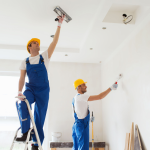
Plasterboard or drywall panel is among the most common construction and renovation materials. It is especially used for creating a suspended ceiling, a partition wall, and a self-supporting ceiling.
With its popularity, it comes in many varieties such as placostil, fire-resistant plasterboard, moisture-resistant plasterboard, and acoustic plasterboard. The latter offers countless advantages. That is why it continues to attract both professionals and individuals.
Also known as acoustic drywall panel, soundproof plasterboard helps improve the sound insulation of a room. To learn more, we invite you to discover this article summarizing the essentials to know about these panels.
📋 Key takeaway: Personally, I consider soundproof plasterboard an essential investment as it reduces noise disturbances by 50% compared to a standard panel. For me, it is the most effective solution to regain calm without losing too much space. This 3 dB gain may seem small on paper, but it truly halves the perception of noise in daily life.
What is soundproof plasterboard and what is it used for?
Definition of soundproof plasterboard
🍀 Pros:
– High acoustic insulation
– Increased mechanical resistance
– Same thickness as standard
🔻 Cons:
– Heavy weight for transport
– Higher price
– Requires internal insulation
As its name clearly suggests, soundproof plasterboard is primarily plasterboard. It is a healthy material made of plaster between two sheets of cardboard. This plaster is composed of gypsum and non-toxic elements.
Unlike other types of drywall panels, acoustic plasterboard is blue in color. It is specially designed to enhance the sound insulation of the home. That is why it contains insulating materials such as soft stone and gypsum.
Also called soundproof drywall panel, the soundproof plasterboard panel is distinguished by its structure capable of absorbing sounds and reducing noise propagation.
Its acoustic performance depends on the quality of the materials used in its composition and its thickness. The thicker the soundproof plasterboard facing, the better its noise reduction performance.
🗣️ My experience: In 2024, I insulated an office in Bordeaux with these panels costing 14 euros each. I made the mistake of not using resilient strips under the top and bottom rails. The lesson learned: soundproof plasterboard alone does not work miracles; it is the overall airtightness of the structure that guarantees total silence.

The Use of Acoustic Plasterboard
In general, acoustic plasterboard panels are suitable for any living space. They are always very useful during renovation work as well as new constructions.
They are used particularly to ensure the acoustic comfort of a house throughout its existence. They help to insulate it from neighborhood and street noise.
Acoustic plasterboard installation mainly depends on the location where it is placed. It is especially used in noisy rooms such as a playroom, a living room with home cinema, or a kitchen equipped with noisy appliances.
You can fix it to the ceiling or on the partition wall. If the soundproofed bedroom is on the upper floor, it is wise to place the panels on the ceiling of the lower bedroom, but not on the separating partition.
The acoustic plasterboard panel is used for countless types of work. It is an effective and aesthetic option for space separation. In renovation, it is used as a counter-partition to optimize the acoustic performance of a dwelling.
How to Install Acoustic Plasterboard on an Existing Wall?
Like standard plasterboard work, mounting the acoustic plasterboard panel is not a difficult task. Moreover, this material is valued for its lightness, which facilitates its installation.
Before getting started, it is necessary to detect the sources of noise. To do this properly, you must carry out an acoustic diagnosis of the house.
Once the origin of the noise and problematic areas are identified, it is easy to define solutions and choose the thickness of the panels to use.
It should be noted that soundproofing can vary depending on the thickness of the acoustic plasterboard. The denser it appears, the better the acoustic gain compared to standard plasterboard panels.
| Type of Panel | Color | Attenuation (dB) | Thickness (mm) |
|---|---|---|---|
| Standard plasterboard | Gray | 32 dB | 12.5 |
| Acoustic plasterboard | Blue | 35 dB | 12.5 |
| Standard double skin | Gray | 42 dB | 25 |
| Acoustic double skin | Blue | 47 dB | 25 |
Installing acoustic plasterboard on existing walls can be done using a special adhesive designed for this type of work. Simply stick the panels to clean, homogeneous, and sound walls. Then let the product dry for 24 hours.
If the surfaces do not appear flat, forget about gluing and replace it with installation on battens. To do this, first install these supports on the existing walls. The acoustic plasterboard cladding or facing is then positioned on them.
To hang a false ceiling or create a partition wall, in this case the acoustic plasterboard panel must be fixed on a metal frame. Cables or ducts can then be concealed inside.
Whether you use the gluing technique, batten mounting, or metal frame, know that the acoustic gain compared to standard work is always better with acoustic plasterboard panels.
Estimate the cost of plaques pour your project (hors ossature) :
What is the Difference Between Acoustic Plasterboard and Standard Plasterboard?
Since we have just discussed the installation of soundproof plasterboard, it is important to specify that the installation or work with standard plasterboard is done in the same way. Regardless of the composition of BA13 plasterboard, there is not much difference in the implementation principle.
For the exterior aspect, plasterboards are identifiable by their colors. If fire-resistant plasterboard is known for its pink shade, the moisture-resistant or water-repellent one is distinguished by its green hue.
As for the acoustic soundproof plasterboard, it is uniformly blue. And regarding the classic plasterboard, it is recognized by its gray facing.
Let us recall that the first category has a high fire resistance. The second one tolerates moisture and water splashes. And as we all know, the soundproof plasterboard ensures the sound insulation of a room or dwelling.
It is distinguished by its thickness ranging from 7 cm to 16 cm. Regarding its dimensions, it is often available in boards 2.50 m long and 1.60 m wide. The soundproof plasterboard with glass wool or rock wool can reduce noise intensity by up to 50 %.
How much does a square meter of soundproof plasterboard cost on average?
Regarding the price of acoustic plasterboard, it is available between 6 euros to 20 euros per square meter. The price depends on the acoustic gain to be achieved, the use, the thickness of the panels, and their dimensions. It is not surprising to find boards costing up to 25 euros each.
In addition, there is indeed the installation cost which generally ranges between 20 to 30 euros per square meter, excluding materials. The drywall installer is the most qualified specialist to install any model of soundproof plasterboard.
Besides that, this product can be easily found in any tool or DIY store. It is advisand to compare prices before making a purchase decision.
Compared to the price of moisture-resistant plasterboard, it is expensive. But compared to thermal insulation plasterboard, it is relatively affordable.
Purchasing the acoustic soundproof plasterboard offers better performance. To strengthen the sound insulation of a home, the work requires a significant investment.
However, the cost of the panels is accessible to everyone. Ordinary people can thus easily insulate their homes from external noise thanks to these materials.
How to ensure better insulation with soundproof plasterboard?
More and more French people keep complaining about noise from household equipment, the street, or neighbors. When these noise nuisances become repetitive, they cannot bear living at home.
To reduce stress and regain calm, installing soundproof plasterboard panels proves necessary. The acoustic gain from the board installation is excellent.
To enjoy better sound insulation, make sure to choose the ideal soundproof plasterboard. Its thickness greatly affects its acoustic performance. It can vary depending on the use.
In any case, one thing is certain. A thick acoustic plasterboard can offer you high performance.
Besides that, it is essential to respect the installation conditions of the plasterboard to obtain better results.
To limit the spread of sounds between two different rooms, the acoustic plasterboard must be installed in the partition between them. And if your goal is to insulate a room on the second floor, try to insulate the ceiling of the room below.
Is acoustic plasterboard effective against all types of noise?
Noise pollution comes either from inside or outside the home. When you live near a railway line or an airport, it comes from outside.
But these noise disturbances can also arise inside the rooms of a house. To optimize the comfort of the occupants, using acoustic plasterboard can prove essential.
Its effectiveness is impeccable for reducing impact noises caused by falls or object collisions. Likewise, it prevents the spread of airborne noises and those from devices used both inside and outside the home.
The acoustic plasterboard is similarly functional in buildings where noise nuisances from the upper floor become unbearable. It is recommended to install it on the ceiling to restore a peaceful atmosphere in the apartment.
How to hang heavy objects on acoustic plasterboard without compromising its effectiveness?
It is still possible to hang a heavy load on a partition made of acoustic plasterboard without affecting its acoustic performance.
The most effective solution is to double the partition. If the walls already have this but are not very sturdy, it is better to replace it. To do this, first dismantle the current doubling, then use a reinforced frame made of high-density plasterboard.
🌍 Did you know? Acoustic plasterboard is about 30% heavier than standard plasterboard. It is precisely this high-density mass, made of gypsum and glass fibers, that traps sound vibrations.
It is also possible to hang the heavy object on the metal stud. Since it is sturdy, it easily supports the weight. You just have to drill into it and you’re done.
Some DIYers use a fixing strip to distribute the load. Others prefer to use chemical anchoring.
Whatever technique you use, it is strongly recommended to carefully check and test the fixation of the heavy object after installation. If it moves and remains unstable, everything must be dismantled and another method applied.
⚠️ Common mistake: Installing electrical outlets directly opposite each other on both sides of the partition. This creates a hole in your acoustic insulation. You should always offset the boxes by at least 30 cm to avoid noise leaks.
Can acoustic plasterboard be combined with other insulators for better performance?
Of course, it is entirely possible to combine the acoustic plasterboard acoustic plasterboard with other insulating materials.
You can install them during the mounting of the plasterboard sheets. Together, they ensure excellent acoustic comfort in the house.
There are 3 types of insulating materials: mineral, natural, and synthetic insulators.
Glass wool acoustic plasterboard as well as rock wool are part of the top ranking. Besides being good sound insulators, they prevent the invasion of pests such as fungi or rodents.
For natural insulators, they are not only praised for their sound insulation quality but also for thermal insulation.
And finally, for synthetic insulators, they are both rot-proof and waterproof. Moreover, their lifespan is remarkable.
However, they can emit toxic components. These can be carcinogenic in some cases. To avoid risks, their use is not highly recommended.
Except for the use of acoustic plasterboard, there are many solutions to help reduce unpleasant noises. Installing a double or even triple glazed window is an excellent idea. It effectively blocks external noises.
Otherwise, opt for installing acoustic curtains. Some rugs are also made to absorb sounds. On walls, it is recommended to cover them with soundproof paint. The bookshelf and wardrobe are perfect for preventing the spread of noise.
💡 Practical tip: Use screws at least 35 mm long to fix your acoustic boards. Since they are denser, screwing requires a bit more power so that the screw head properly sinks into the plasterboard.