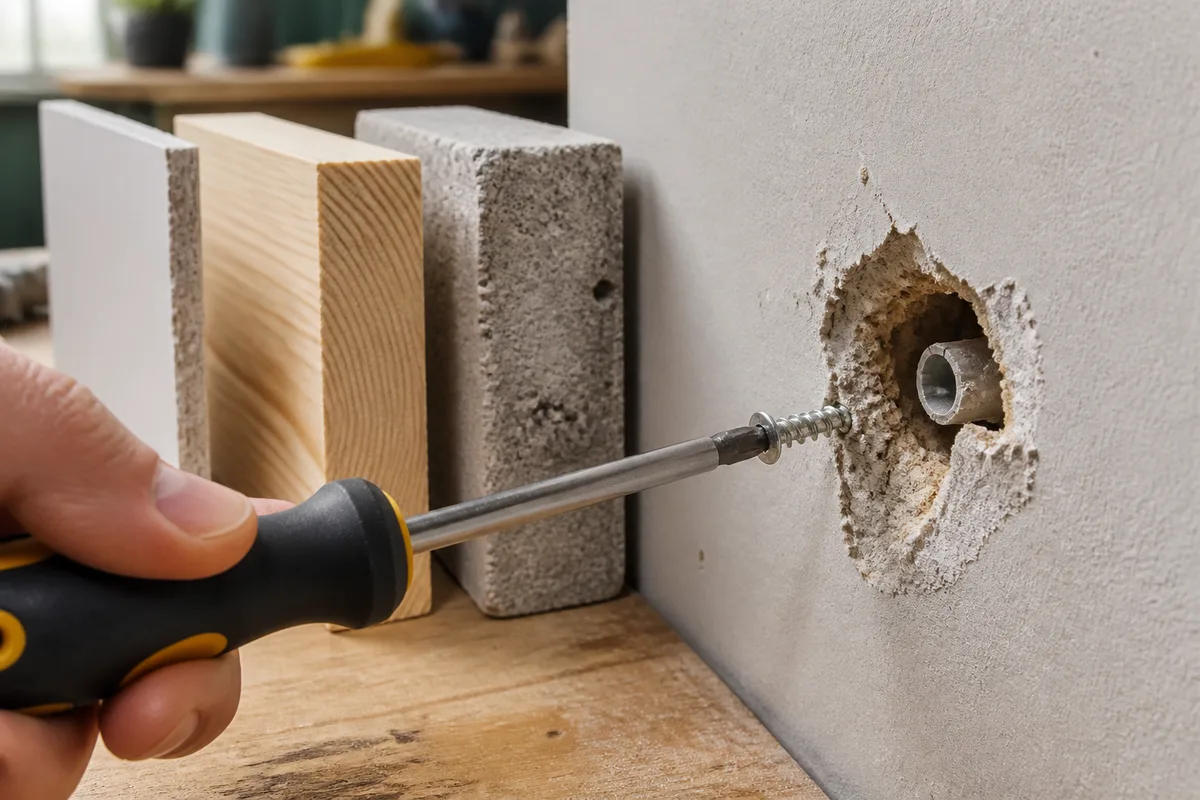
Screw spinning in place: causes and solutions according to the support
A screw spinning in place no longer tightens properly because the threading of the support is worn, the hole has become too large, or the fastening no longer grips the material. The problem may also come from a spinning anchor, an ill-fitting screw, or a damaged screw head slot.
The right repair depends on the support and the weight to be held. This guide explains how to diagnose the fault, remove a screw that spins without coming out, repair a damaged screw hole, and choose a stronger fastening without worsening the material.
In brief
- 🔧 To extract the screw, start with a magnetic bit, a slight lever effect, or pliers if the head protrudes.
- 🪵 In wood, a slightly enlarged hole can be tightened with glued matches; a dowel is better for a durable repair.
- 🧱 In a wall, do not automatically replace the anchor with a bigger screw: the fastening must be adapted to concrete, brick, or hollow material.
- ⚠️ A temporary repair is not suitable for heavy loads, a suspended shelf, a railing, or an element presenting a fall risk.
Understanding why a screw spins in place
When the screw spins without advancing or tightening, the threading no longer encounters sufficiently resistant material. In wood or particleboard, the hole may be stripped by excessive tightening; in a wall, the anchor may be too small, poorly installed, or damaged. The symptom is sometimes confused with a screw whose slot is simply damaged.
A slipping screw generally indicates that the connection between the screw and the support is broken. Therefore, there is no point in turning the screw more: this action can further enlarge the hole and make the repair more difficult.
“Before choosing a new screw, it is necessary to determine whether the problem comes from the screw, the anchor, or the material that was supposed to hold it.”
How to diagnose before repairing?
The diagnosis takes little time, but it avoids using an inappropriate method. Observe the movement of the screw, the shape of its head, and the condition of the support before pulling, drilling, or heating anything.
Check the condition of the screw and its slot
Place a screwdriver of the correct size in the slot. If the bit slips or pops out of the head, the problem may concern the damaged screw threading rather than the hole. A rusty, bent screw or one whose head is very worn often needs to be replaced after extraction.
Examine the hole and the support
Remove any debris around the fastening, then check if the head protrudes, if the anchor spins with the screw, or if the support has cracked. The available depth, hole diameter, and weight of the object to be fixed determine the acceptable solution.
| Observed symptom | Probable cause | Preferred solution | Limit |
|---|---|---|---|
| The head protrudes slightly | The screw no longer grips the threading | Use leverage by unscrewing gently | Avoid twisting the support |
| The anchor spins in the wall | Poorly blocked anchor or enlarged hole | Remove then choose an adapted fastening | Do not keep a deformed anchor |
| The wood crumbles around the hole | Support too soft or excessive tightening | Repair the hole with a dowel | Matches are only suitable for small loads |
| The screw is stuck in metal | Corrosion or seized threading | Penetrating product then extraction tool | Heat requires a risk-free environment |
| The plate deforms | Incorrect fastening chosen in hollow material | Replace with a suitable hollow wall anchor | The allowable load must be checked |
Remove a screw that spins without coming out
If the screw spins but stays in place, use a screwdriver or magnetic bit to pull it while unscrewing. When the head protrudes, slide a flat screwdriver under it and apply slight outward pressure while turning slowly.
A pair of pliers can grip the head if it is sufficiently accessible. For a heavily seized metal screw, a penetrating oil can be applied before trying again; let it act for about 30 minutes when the product and situation allow, according to its instructions.
How to remove a screw that spins freely?
To remove a screw that spins freely, start by holding its head outward with a magnetic bit or a flat tool. If it remains stuck, use pliers; on a seized metal screw, apply a penetrating product before considering a specialized tool.
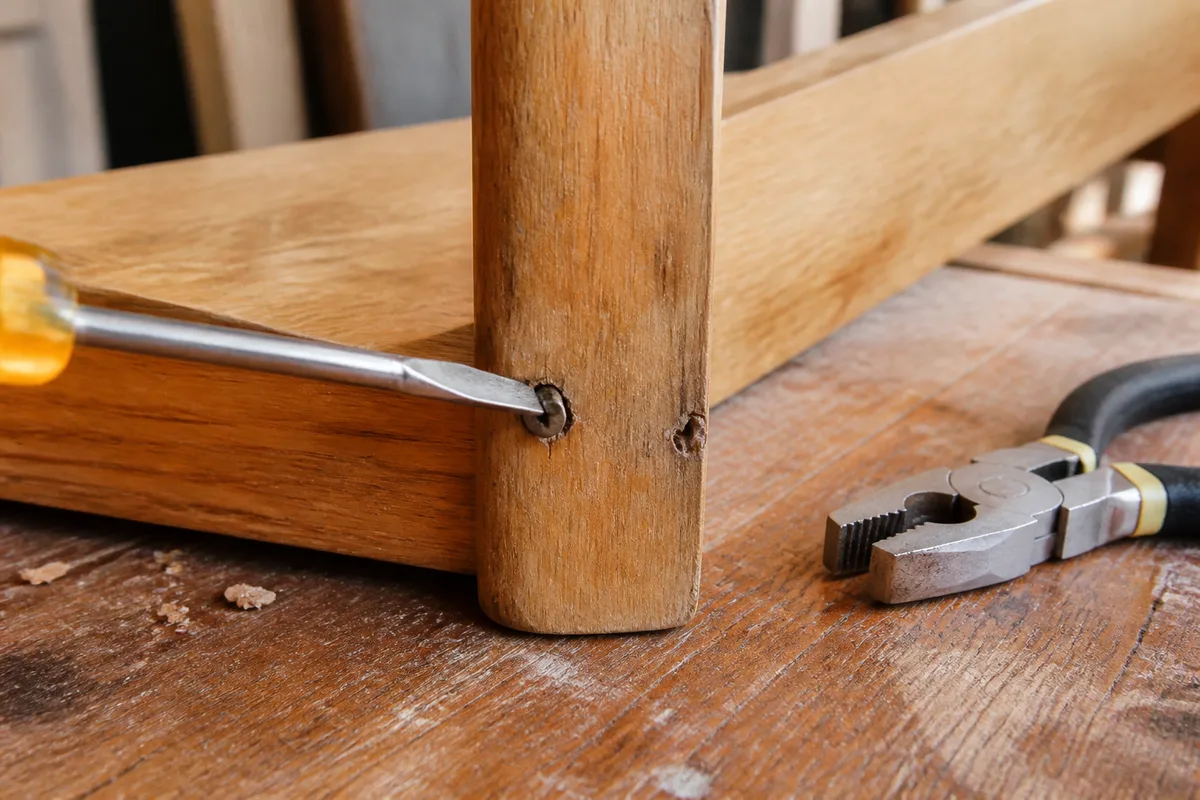
- Stop the screwing effort and select a bit perfectly suited to the slot.
- Attract or lift the head with a magnetic screwdriver, a flat screwdriver, or fine pliers.
- Turn slowly in the loosening direction while maintaining steady traction.
- Apply a penetrating oil if the screw is rusty or stuck in metal, then respect the indicated action time.
- Use an extractor if the head is damaged or if the screw is broken inside the support.
The impact screwdriver is another option for a stuck metal screw: its mechanism converts a vertical strike into a rotational movement. It must be used with safety glasses and on a support capable of absorbing shocks.
“The harder the screw is to extract, the more you must progressively increase the means used: traction, penetrating product, specialized tool, then drilling if necessary.”
When to use heat on a metal screw?
Heat can facilitate unscrewing a metal screw by causing metal expansion. This method only applies in an environment compatible with the temperature: it should be avoided near wood, plasterboard, insulation, flammable paints, cables, and pipes.
A blowtorch or heat gun must not be used without checking the nature of the support and the surrounding risks. If the screw is near an electrical installation, water or gas pipe, stop the repair and seek the advice of a qualified professional.
What are the causes depending on the type of support?
The same symptom is not repaired the same way in wood, concrete, or plasterboard. The material around the screw is the main factor that determines the holding of the new fastening.
In wood or particleboard
The hole can become too large after several removals, cross-threading, or overtightening. Fibers can also tear in a particleboard panel, especially near an edge or on a piece subjected to repeated stress.
For a small handle or a lightly used hinge, a local filling may suffice. For a heavy load or a hinge that works regularly, a dowel offers a stronger base than a simple surface repair.
In concrete or brick
In a solid wall, the problem often comes from a hole that is too large, poorly cleared dust, or an anchor that does not match the drill diameter. A screw in concrete must work with a fastening designed for this material; simply increasing the screw diameter does not necessarily restore anchoring.
In plaster and plasterboard
A fastening in plasterboard must take into account the thickness of the board, the possible presence of a stud, and the weight of the object. A standard anchor can spin or pull out if it is not suitable for hollow material.
For a hanging piece of furniture or a heavy load, locate a stud or plan a fastening designed for the weight to be supported. Our guide for choosing the right size Molly anchor for BA13 can help compare the necessary diameter and length.
In Metal
In metal, the threading can be worn, rusted, or stripped. A threaded insert, a repair tapping, or a self-tapping screw can be considered depending on the thickness and function of the part, but these solutions require knowing the diameter and pitch of the thread.
What solutions are there to repair a damaged screw hole?
The repair must restore material capable of holding the screw, not just mask the hole. A light solution may be suitable for a small decorative piece; a structural or suspended fixture requires a more complete and controlled repair.
Repairing a screw that no longer holds in wood
For a slightly enlarged hole in wood, insert pieces of matchstick or toothpick coated with glue, let dry, then trim the excess before screwing again. This method is reserved for small fixings and does not guarantee support for a heavy load.
For a durable repair, drill the hole to a regular diameter, glue in a wooden dowel, let harden, trim flush, then drill a new pilot hole. Pre-drilling with a bit slightly smaller than the screw limits fiber splitting and improves grip.
Redoing a fixture in a solid wall
Remove the remains of the old anchor, dust out the hole, and check the nature of the wall. If the hole is too deteriorated, shift the fixture when possible or use an anchor from a suitable system, following the manufacturer’s instructions.
For a shelf, a wall cabinet, or a load that could fall, do not settle for a soft filler. The fixture must be sized according to the weight, leverage, and the actual quality of the wall.
Repairing a fixture in a plasterboard
An anchor that spins in plasterboard usually needs to be removed and replaced with a fixture suitable for hollow material. A metal expansion anchor, a toggle anchor, or a fixture into a stud may be appropriate depending on the load and accessibility.
- For a light frame: a fixture adapted to the board may suffice.
- For a curtain rod or small shelf: check the tensile and pull-out forces.
- For a suspended piece of furniture: first look for a stud or reinforce the structure.
How to choose between a quick repair and a durable fixture?
A quick repair is only suitable when the load is light, the support remains sound, and the fixture is not subject to repeated movements. For a hinge, a shelf, or a suspended element, a durable repair is preferable as soon as the hole shows significant play or the material crumbles.
| Option | Suitable support | Advantage | To avoid for |
|---|---|---|---|
| New screw | Hole still slightly worn | Quick and inexpensive | Fragile support or heavy load |
| Glued matches | Wood, small fixture | Simple repair | Suspended furniture or heavily stressed hinge |
| Wooden dowel | Solid wood or thick panel | Solid base after re-drilling | Support too thin to be re-drilled |
| Suitable anchor | Concrete, brick, or plasterboard | Better anchoring according to material | Fragile hole or unchecked invisible network |
| Extractor or insert | Broken screw or threaded metal | Solution for complex cases | Intervention without proper tools or marking |
What practical cases do DIYers most often encounter?
A hinge screw that no longer holds in wood must be repaired with more care than a decorative screw, because repeated openings exert tension on the fibers. The dowel or moving the hinge is generally more reliable than a simple filler.
For a shelf screw that spins in the wall, first check the anchor and the nature of the wall. A fixture in concrete, hollow brick, or plasterboard is not replaced with the same model.
A handle or furniture screw that spins in empty space can sometimes be removed with pliers, then replaced with a screw of suitable length and diameter. If the support is a thin panel, a longer screw risks going through the piece or causing deformation.
What mistakes should be avoided with a slipping screw?
Poor repairs often worsen the damaged screw hole. They are particularly problematic when the fastener is above a person, supports a heavy object, or is part of the safety of equipment.
- Forcing the screwdriver: speed and torque can enlarge the hole or tear the fibers further.
- Using a much larger screw: it can split the wood, damage the anchor, or crack the brick.
- Using a standard anchor everywhere: a fastener for solid material does not work the same way in drywall.
- Heating without controlling the environment: wood, insulation, paints, and hidden networks present a risk.
- Confusing temporary repair with load-bearing fastening: matches or wood filler do not replace a fastener sized for a heavy load.
“A solid wall fastener depends first on the support, then on the weight and forces exerted on the object.”
When should the entire fastener be redone or help requested?
Completely redo the fastener if the support is cracked, crumbly, deeply torn, or if the screw turns with a deformed anchor. Seek professional advice for a railing, a heavy suspended piece of furniture, a fastener at height, or any work near a cable, water, or gas pipe.
Calling a professional is also wise when drilling a structure, creating a new thread in a metal part, or determining the load-bearing capacity of a wall. When in doubt, it is better to move the fastener or stop the work rather than test the hold with a real load.
Key points to remember
- 🔎 First identify the support, the condition of the screw, and that of the hole.
- 🧲 To remove the screw, combine gentle traction and slow unscrewing.
- 🪚 In wood, a dowel provides a more durable repair than matches.
- 🧱 In a wall or drywall, choose the anchor according to the material and the load.
- 🛑 Do not make a makeshift repair on a load-bearing or dangerous fastener.
Frequently Asked Questions
Why does a screw turn in empty space?
The threading of the support may be worn, the hole may have become too large, or the anchor may no longer be locked. A damaged screw recess can also prevent the screwdriver from properly transmitting force.
Can a bigger screw be used?
Sometimes, but it is not a universal solution. A bigger screw can split the wood, enlarge an anchor hole, or damage drywall; it must be compatible with the support and the fastener.
How to repair a screw that no longer holds in wood?
For a small load, glued matches or toothpicks can locally tighten the hole. For a stronger repair, glue in a dowel, let it harden, then drill a new pilot hole before screwing again.
Which fastener to choose in drywall?
Choose an anchor designed for hollow material, depending on the thickness of the panel and the weight of the object. For a suspended piece of furniture or a heavy load, favor a stud or suitable reinforcement rather than a simple light anchor.
How to remove a broken or very damaged screw?
A reverse-thread screw extractor can help when the head is damaged or broken. If the screw is deeply embedded or drilling risks damaging the part, specialized intervention is preferable.