When carrying out metalworking, bending a steel tube is often repetitive. When you are not a blacksmith, you most often encounter problems.
Quick recap: marking → clamping → progressive bending → radius control → angle touch-up → deburring/anti-corrosion protection.
To give you a helping hand, we have carefully written this article to serve as your guide. Discover the different methods to bend a tube according to best practices. But before getting to the heart of the matter, it is appropriate to explain the good reasons for bending a material.
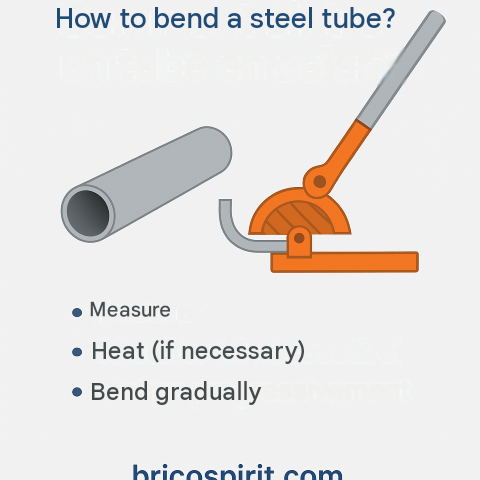
🗣️ My experience: In March 2026, I had to shape a series of custom curved stakes for a garden layout using locksmith tubes worth 120 euros. During my first cold trial without an internal template, the metal suddenly flattened at the center of the bend, instantly ruining the metal section. The real lesson I learned from this failure is that compacted fine sand combined with uniform heating by torch guarantees a flawless bending radius, even on hard steel.
Steps – Bending a steel tube
- Identify the tube: outer diameter (D), thickness (e), steel grade (S235, stainless, etc.).
- Choose the method: bending spring/mandrel (small diameters), roller bender (large radii), coiling bender (short radii), notching + welding (tight angles).
- Define the bending radius: aim for ≥ 3×D (standard steel) to limit ovalization, more if thin-walled.
- Mark the references: neutral line, start/end of arc, target angle (+2–5° to compensate springback).
- Prepare the interior: mandrel or compacted dry sand filling (plugs) to support the wall.
- Clamp and bend progressively: small regular passes, check radius with gauge/template.
- Check and correct: verify ovalization, final angle, straighten if needed by micro-passes.
- Finishing: deburring, cleaning, anti-rust primer/paint or appropriate treatment.
My anecdote (workshop feedback)
The first time, I “broke” a 26.9×2.6 mm tube by wanting too short a radius: flattened bend, ovalized tube. Since then, I compact dry sand (poor mandrel), I add +3° margin for springback, and I do the bending in several passes. Result: clean curve, no crushing, time saved in the end.
| Method | Uses / Advantages | Typical radius (min) | Required tooling | Key precautions |
|---|---|---|---|---|
| Internal spring/mandrel | Small diameters, light work sites | ≈ 3–4×D | Spring/mandrel, vise | Lubricate, bend in small passes |
| Roll bender (roller) | Large regular radii, guardrails, arches | ≥ 8–10×D | Roller, suitable sets of rollers | Multiple passes, check symmetry |
| Winding bender | Short radii, clean series | ≈ 2.5–3×D (depending on e) | Manual/hydraulic bender + dies | Die with correct D, firm clamping |
| Local heating (blowtorch) | Thick steel, low mechanical means | ≈ 2.5–4×D | Blowtorch, jig | Heat evenly, cool slowly |
| Notching + welding | Very tight angles/short segments | Almost zero radius (broken) | Saw/shavings, TIG/MAG station | Prepare V, tack, weld, grind, check |
🌍 Did you know?
When bending a tube, the metal on the outside of the curve stretches and thins, while the steel on the inside compresses and thickens. It is this difference in internal mechanical stress that causes the structural ovalization of the bar.
Why bend a steel tube?
Before consulting a specialist to ask how to waterproof a terrace, you first need to understand the reasons for the work. Likewise, it is important to gather information on the benefits of bending before you start.
🍀 Advantages
- Molecular structure of steel unchanged and preserved
- No heavy heating equipment required in the workshop
- Ideal for thin plumbing tubes in copper or mild steel
🔻 Limitations
- Requires very high physical or hydraulic force
- High risk of ovalization if metal thickness is low
This task is generally very useful during the assembly phases of a system. It is necessary to bend a tube so that it easily fits with other components.
This step must also be performed during DIY projects. These may require, for example, the construction of a steel structure such as a new sink, a shelter for reptiles or birds, a cage for a cat or dog, a vehicle bumper, a staircase railing, a garden arbor, or many others.
Also, it is necessary to bend a steel tube when replacing a worn component in an existing system. Multifunctional, this material has many possible uses.
It can be found in plumbing, industry, heating, sanitation, decoration, renovation projects, and much more.
⚠️ Common Mistake
Using wet sand to fill the tubing before applying the flame of a blowtorch is a common and extremely dangerous mistake. The trapped water instantly turns into high-pressure steam, which can cause the metal end caps to explode.
How to bend a steel tube?

Sometimes, plumbing problems are solved without a hitch. When wondering how to quickly unclog toilets, there are many tips that achieve this goal.
However, ironwork tasks are not for just anyone. To bend a steel pipe, it is advisable to use a special device called a bender.
Also called a bending machine, it is used to curve tubes or bars without folding them in order to create angles as well as U-shaped or T-shaped profiles.
There are 3 types of benders, you can choose between the manual, roller, and hydraulic models. Regardless of the type of equipment, it is fast and efficient for bending steel.
💡 Practical Tip
For a successful hot bending, heat the metal area with a blowtorch until you get a uniform cherry red color (about 850 degrees). It is at this precise temperature that steel reaches its maximum malleability.
How to curve steel?
In the previous section, we used the machine dedicated to bending. But here we will discover how to deform steel without it.
Since we are not using a sophisticated tool, you still need to be a good handyman and have a minimum of equipment such as a blowtorch, sand, a vise, and a device to block the material.
The first step is to prepare it. To do this, plug one end then fill it with ultra-fine sand. Make sure this powder is well packed so that the inside of the material is rigid.
Now plug the other end. Once done, place the tube in a vise. Heat the area to be bent using the welding lamp or the blowtorch.
That said, use another large tube which can serve as a bender. Insert this second tube around the one to be bent. All that remains is to bend it.
Calculate target over-bend angle to compensate for steel elastic springback.
How to bend an iron pipe?
Unlike with a PVC, aluminum, or copper pipe, bending or curving an iron pipe is not at all an easy task. You need to apply the right techniques and properly equip yourself to get better finishes.
It should be noted that not all pipes can necessarily be bent manually. It mainly depends on their diameter and wall thickness. The thicker it is, the more difficult it is to straighten.
Only thin iron tubes can be handled manually. Whether they are square, flat, or round in shape, they can be bent once they have a small cross-section. Otherwise, you need to use a bender.
Which steel tube for bending?
Steel tubes come in many different thicknesses. For thin-walled models, they can be bent using the manual technique. However, thick ones should only be bent with benders.
In general, almost all profiles can be straightened with this device. Likewise, you can use round steel tubes with a diameter from 4 to 139.7. If you have rectangular and square section tubes, they also pose no problem for you.
In any case, if you have doubts, it is best to seek advice from a professional. They can indicate the tube suitable for bending.
Anyway, this product is easy to find in stores. Many distributors sell it at a competitive price.
How to bend a tube? (with or without a bender)
The technique to use depends on the thickness of the material. For small sections, the traditional sand method will do the job. On the other hand, thick materials require an advanced bending device.
For bars with a thickness of 4 mm and a diameter of 88 mm, you can use the welded bend technique.
To do this, simply cut the tube halfway so as to bend it and weld it again. Be sure to use an angle grinder or cut-off tool to make an effective cut without completely severing the tube.
Like any cutting tool, the cut-off wheel is dangerous to handle. If you do not know how to use it properly, it is better to entrust the task to a professional in the field to limit risks.
To learn how to bend a steel tube, also discover our tips for efficiently sanding metal, learn the steps to build a concrete access ramp, and get inspired by our advice on planing a board.
FAQ – Steel tube bending
<!– wp:rank-math/faq-block {"questions":[{"id":"faq-question-1759322790013","title":"u003cstrongu003eHow to prevent tube flattening?u003c/strongu003e","content":"Support the inside (mandrel or compacted dry sand), use the right die and maintain a radius ≥ 3×D for standard steel.”,”visible”:true},{“id”:”faq-question-1759322794619″,”title”:”u003cstrongu003eIs heating necessary?u003c/strongu003e”,”content”:”Not mandatory. Cold is cleaner. Heating is useful for thick walls or tight radius, but beware of deformations and metallurgy (uniform heating, controlled cooling).”,”visible”:true}]} –>