When undertaking renovation work or building a home, choosing the type of ceiling can become a real headache. Among the options that often come up, the brick hollow-core ceiling has earned its reputation thanks to its robustness and its benefits for thermal insulation as well as for the structure. Whether you plan to create a cozier room or to reinforce insulation, understanding how this type of ceiling works, as well as its installation and its constraints, is already half the job done!
📋 The essentials at a glance: Personally, I consider that this type of traditional hollow-core element made of terracotta offers excellent inertia and durability performance compared to modern polystyrene solutions. In 100% of renovations of old floors, brick preserves excellent thermal comfort in summer while limiting the risk of sound bridges between levels. It is a robust structure that nevertheless requires strict precautions when installing hangers or heavy fixings.
What is a brick hollow-core ceiling?
The brick hollow-core ceiling relies on load-bearing concrete elements (beams) between which special hollow bricks called hollow-cores are inserted. This assembly creates a solid structure while leaving space to place insulation or easily run technical conduits.
🗣️ My experience: During the creation of a villa extension near Marseille last February, the client absolutely wanted an upper floor slab capable of regulating the natural humidity of the lower living area. We opted for terracotta hollow-cores rather than prefabricated concrete. The lesson I take from this is that you have to be extremely meticulous during shoring before pouring the compression slab, as the weight of the fresh concrete puts the hollow brick under severe strain.
Having already participated in a few projects where these ceilings had to be replaced or reinforced, I can tell you that despite their weight and massive appearance at first, they can offer excellent insulation and strength performance for housing if installed properly.
To go further, understanding the installation of a suspended ceiling provides useful clues to neatly finish the underside of your floor. And to reinforce a heavy separating structure, our guide on the IPN beam offers interesting insight.
Advantages of the brick hollow-core ceiling
👍 Strengths
• Excellent thermal inertia in summer and winter.
• Exceptional fire resistance and durability.
• Healthy, breathable, and 100% natural material.
🔻 Limitations
• High total weight of the structure for the framework.
• Delicate drilling due to the fragility of the walls.
• Cost of supplies higher than polystyrene.
Before moving on to the installation steps or discussing suspension rods, let’s see why choose this system over another. Many hesitate to take the plunge due to a lack of precise information: so let’s see how it performs on site.
A real advantage for thermal and acoustic insulation
The combination of concrete beams and hollow bricks naturally multiplies the thermal and acoustic barriers. This is particularly appreciated if you want to limit resonance between floors or keep the heat in the upstairs bedrooms.
The insertion of additional insulations remains possible, for example by adding a layer under the hollow core ceiling, then finishing with a false ceiling. This approach greatly facilitates improving overall comfort at a lower cost.
🌍 Did you know? The terracotta used for manufacturing floor elements has a unique natural hygrometric regulation coefficient. It can absorb excess moisture from indoor air without degrading, then gradually release it when the air becomes too dry.
Robustness and ease of integrating a false ceiling
The brick hollow core ceiling offers a high load capacity, ideal for easily supporting a suspended ceiling made of plasterboard (drywall). Rails can be easily fixed, sturdy suspension rods installed, and all necessary electrical work added without fear of weakening the structure.
Moreover, installing a false ceiling under this type of structure allows discreet integration of spotlights, additional insulation, or even inserting access hatches for maintenance. For those who often tinker in their attic or want flexibility, this is a significant advantage.
Installation steps for a brick hollow core ceiling
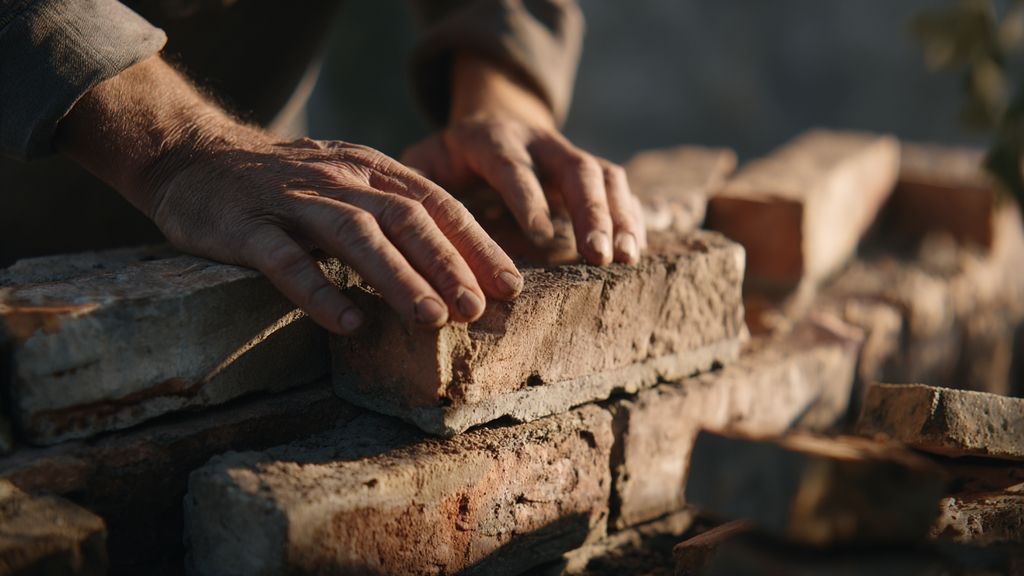
Successful installation always starts with a solid foundation. Neglecting a step risks problems… I still remember a site where the beam alignment wasn’t checked, and we had to redo everything. Here’s exactly how to proceed for a durable installation.
Preparation and implementation of the beams
Start by placing the reinforced concrete beams parallel, spaced according to the manufacturer’s instructions. Make sure they are perfectly wedged, as all subsequent elements depend on the accuracy of this alignment.
Once the beams are well fixed, carefully check the flatness using a laser or long level. Too much deviation and you risk issues during the installation of the hollow blocks, as well as later during finishing.
Installation of hollow blocks and pouring of the slab
| Hollow block material | Weight per square meter | Acoustic insulation | Fire resistance |
|---|---|---|---|
| Terracotta (Brick) | High (about 90 kg) | Excellent | Excellent (REI 120) |
| Prefabricated concrete | Very high (about 120 kg) | Average | Excellent (REI 60) |
| Expanded polystyrene | Very low (about 5 kg) | Poor | Poor (requires drywall) |
The hollow bricks or hollow blocks are then inserted between the joists. It is essential to choose the appropriate models according to the span of the ceiling, as some types support the load better than others. The key word here: regularity.
After the complete installation, the ends are stabilized and the compression slab can be poured. This concrete mixture firmly unites the whole and guarantees the rigidity of the ceiling once dry.
⚠️ Common mistake: Using the hammer mode of your drill to perforate the underside of the bricks. The force of the impacts will break the internal alveolar partitions of the terracotta, thus destroying all the local mechanical resistance at the fixing point.
Installing a false ceiling under a brick hollow block
It often happens that insulation or aesthetic logic leads to improving the raw ceiling made of hollow bricks with a false ceiling. The operation requires method and appropriate equipment, especially when it comes to selecting the right fixing systems.
Use of hangers and choice of suitable anchors
To effectively suspend drywall or plasterboard sheets under a hollow brick ceiling, it is better to use hangers specially designed for these materials. These threaded rods or specific supports prevent any risk of tearing out.
The fixing requires suitable anchors: favor expansion or metal versions designed for hollow brick. The wrong anchor guarantees long-term hassle, trust my experience…
Essential assembly steps
Start by carefully marking the future location of the false ceiling, then install the hangers ensuring proper penetration into the brick alveoli. Space them regularly to guarantee stability and grip of the panels.
Next, fix the rails around the perimeter and gradually install each plasterboard sheet. A powerful screwdriver saves a lot of time at this stage, especially when the surface exceeds 20 m² or when working alone.
💡 Practical tip: Before applying a traditional plaster coat directly onto the bricks, thoroughly moisten the support using a sprayer. Dry terracotta absorbs the plaster’s water too quickly, causing premature drying and the appearance of shrinkage cracks.
How much does a hollow brick ceiling cost?
It is difficult to give a single figure, as price variations are frequent in this market. However, some benchmarks help avoid going in blind when preparing the budget.
Basically, the cost per square meter depends on the type of hollow brick chosen, the section of the joists, and the thickness of the slab. Added to this are the prices of hangers, rails for the suspended ceiling, as well as that of thermal or acoustic insulation if one adds any.
- Main supplies (bricks, joists): expect between 45 and 60 €/m²
- Installation (excluding possible labor): about 15 to 20 €/m² extra
- False ceiling in plasterboard: 25 to 40 €/m², excluding insulation
- Additional insulation (thermal/acoustic): variable depending on the chosen thickness
Warning, these amounts are indicative and strongly depend on the location, the volumes ordered, and especially the complexity of the site (presence of technical rooms, difficult access, etc.). Always take the time to compare several quotes before starting to purchase the material.
Brick hollow-core ceiling concrete & material calculator
Estimate required concrete volume, hourdis count, and material budget based on floor surface.
Estimated clay hourdis blocks required:
Blocks
Estimated concrete topping volume:
m³
Estimated total system budget:
$
Answers to your questions about terracotta floor structures
What type of anchor should be used to fix into hollow brick?
It is essential to use deformation anchors or metal toggle anchors that anchor into the inner partition of the brick, or opt for chemical anchoring for heavy loads.
Can the bricks be left exposed on the underside?
Yes, after careful brushing and the application of a clear fixing varnish, the terracotta appearance brings a highly sought-after industrial or rustic style in living spaces.
What is the minimum thickness of the concrete compression slab?
According to building calculation rules, the reinforced concrete slab poured above the elements must have a minimum thickness of 4 to 5 centimeters at the highest point.