.en-bref { max-width: 640px; margin: 2em auto; padding: 1.5em 1.8em; color: #78350f; font-family: “Inter”, “Segoe UI”, sans-serif; text-align: left; position: relative; box-sizing: border-box; background: #fffaf0; border: 1px solid #b45309; border-left: 6px solid #b45309; border-radius: 8px; box-shadow: 0 8px 24px rgba(251, 191, 36, 0.15); }
.en-bref h2, .en-bref .en-bref-header { font-size: 1.15em; font-weight: 700; margin-bottom: 0.6em; color: #b45309; }
.en-bref p, .en-bref li { font-size: 1em; line-height: 1.65; margin: 10px; }
.en-bref strong { color: #451a03; }
.key-takeaways { max-width: 640px; margin: 2em auto; padding: 1.5em 1.8em; color: #78350f; font-family: “Inter”, “Segoe UI”, sans-serif; text-align: left; position: relative; box-sizing: border-box; background: #fffaf0; border: 1px solid #b45309; border-left: 6px solid #b45309; border-radius: 8px; box-shadow: 0 8px 24px rgba(251, 191, 36, 0.15); }
.key-takeaways h2, .key-takeaways .key-takeaways-header { font-size: 1.15em; font-weight: 700; margin-bottom: 0.6em; color: #b45309; }
.key-takeaways p, .key-takeaways li { font-size: 1em; line-height: 1.65; margin: 10px; }
.key-takeaways strong { color: #451a03; }
.key-takeaways ul { list-style: none; padding-left: 0; }
.key-takeaways li { margin: 0.45em 0; padding-left: 0.2em; }
.mg-callout{margin:1.5em 0;padding:.9em 1.1em;border:1px solid;border-left-width:4px;border-radius:10px;font-size:.97em;line-height:1.65}.mg-callout>:first-child{margin-top:0}.mg-callout>:last-child{margin-bottom:0}.mg-callout__label{display:block;margin:0 0 .35em;font-weight:700;font-size:.82em;letter-spacing:.03em;text-transform:uppercase}.mg-callout__label::before{margin-right:.45em;font-size:1.05em;vertical-align:-.06em}.mg-callout–info{background:#eff6ff;border-color:#bfdbfe;color:#1e3a5f}.mg-callout–info .mg-callout__label{color:#2563eb}.mg-callout–info .mg-callout__label::before{content:”2139FE0F”}.mg-callout–tip{background:#f0fdf4;border-color:#bbf7d0;color:#14532d}.mg-callout–tip .mg-callout__label{color:#15803d}.mg-callout–tip .mg-callout__label::before{content:”1F4A1″}.mg-callout–warning{background:#fffbeb;border-color:#fde68a;color:#7a4a10}.mg-callout–warning .mg-callout__label{color:#b45309}.mg-callout–warning .mg-callout__label::before{content:”26A0FE0F”}.mg-callout–danger{background:#fef2f2;border-color:#fecaca;color:#7f1d1d}.mg-callout–danger .mg-callout__label{color:#dc2626}.mg-callout–danger .mg-callout__label::before{content:”1F6D1″}.mg-proscons{display:grid;grid-template-columns:1fr 1fr;gap:16px;margin:1.5em 0}@media(max-width:560px){.mg-proscons{grid-template-columns:1fr}}.mg-proscons__col{padding:.9em 1.1em;border:1px solid;border-radius:10px}.mg-proscons__title{display:flex;align-items:center;gap:.4em;margin:0 0 .5em;font-weight:700;font-size:.9em;letter-spacing:.02em}.mg-proscons__col ul{margin:.3em 0 0;padding-left:1.15em}.mg-proscons__col li{margin:.3em 0;line-height:1.55}.mg-proscons__col–pro{background:#f0fdf4;border-color:#bbf7d0;color:#14532d}.mg-proscons__col–pro .mg-proscons__title{color:#15803d}.mg-proscons__col–pro .mg-proscons__title::before{content:”2705″}.mg-proscons__col–con{background:#fef2f2;border-color:#fecaca;color:#7f1d1d}.mg-proscons__col–con .mg-proscons__title{color:#dc2626}.mg-proscons__col–con .mg-proscons__title::before{content:”274C”}.mg-steps{list-style:none;counter-reset:mgstep;margin:1.5em 0;padding:0}.mg-steps__item{counter-increment:mgstep;position:relative;padding:0 0 1.1em 3.2em;min-height:2.4em}.mg-steps__item:last-child{padding-bottom:0}.mg-steps__item::before{content:counter(mgstep);position:absolute;left:0;top:0;width:2.2em;height:2.2em;line-height:2.2em;text-align:center;border-radius:50%;background:#2563eb;color:#fff;font-weight:700;font-size:.95em}.mg-steps__title{margin:.15em 0 .3em;font-weight:700}.mg-steps__item>:last-child{margin-bottom:0}.mg-kpis{display:grid;grid-template-columns:repeat(auto-fit,minmax(140px,1fr));gap:14px;margin:1.5em 0}.mg-kpi{padding:1em .9em;border:1px solid #e5e7eb;border-radius:12px;background:#f9fafb;text-align:center}.mg-kpi__value{display:block;font-size:1.7em;font-weight:800;line-height:1.15;color:#111827}.mg-kpi__label{display:block;margin-top:.35em;font-size:.85em;color:#6b7280;line-height:1.35}
.wp-block-image,.ai-image{margin-bottom:1.75em}.wp-block-image>figcaption,.ai-image>figcaption{margin-top:.5em}
The choice between Maisons du Monde small room and custom furniture depends less on the desired style than on the actual available dimensions, budget, and circulation constraints. A standard piece of furniture can be purchased quickly and suit a simple layout, while storage designed for the room makes better use of an alcove, a sloping ceiling, or a difficult-to-furnish wall.
This comparison examines the two solutions according to concrete criteria: depth, height, openings, storage, indicative price, lead time, maintenance, and level of customization. The goal is to help you avoid a piece of furniture that is too bulky and to determine, room by room, whether a standard piece, a custom arrangement, or a combination of both is the most proportionate decision.
In brief
- 📏 First measure the usable area, taking into account doors, windows, radiators, and passageways.
- 🪑 A standard piece of furniture is suitable if the room accommodates its dimensions and if quick purchase is a priority.
- 🧰 Custom furniture becomes relevant for an alcove, a sloping ceiling, shallow depth, or a significant storage need.
- 💶 Custom prices vary greatly depending on materials, design, delivery, and installation; a starting example of €500 is provided by a service provider but does not represent a general rate.
What criteria to check before furnishing a small room?
Before choosing between Maisons du Monde and custom furniture, check the compatibility of the furniture with the room, not the other way around. A correct width is not enough: depth, height, door openings, and the space needed to move around can turn an apparently suitable piece into a daily obstacle.
Measure the actually usable surface
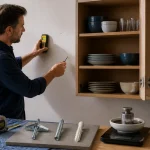
Take the width of each wall, the ceiling height, and the available depth. Also note the baseboards, outlets, switches, radiators, windows, and any wall irregularities. In a narrow room, a few centimeters can determine whether a drawer opens fully or a door blocks the passage.
The useful measurement is that of the free area after deducting fixed obstacles. For a piece placed near a window, measure the space up to the sill and check that the furniture does not interfere with opening or ventilation. The guide dedicated to the installation direction of a ventilation grille reminds of the importance of not blocking ventilation.
Define the primary function of the furniture
A piece of furniture for a small room should not only fill a wall. It can be used to store clothes, hide a television, hold books, separate a sleeping area, or offer a work surface. Write down the main function before selecting a finish: this avoids favoring an attractive piece that is insufficient for daily use.
- For a bedroom: vertical storage, storage bed, or wardrobe with sliding doors.
- For a compact living room: low furniture with storage, equipped coffee table, or convertible sofa.
- For an entryway: shallow depth, hooks, seating, and closed storage.
- For an alcove: bookshelf, dressing room, or closet adjusted to irregularities.
Plan circulation and openings
Simulate floor space with masking tape or cardboard. Test the opening of a door, drawer, convertible sofa, or storage bed. This check is particularly important in a multifunction room, where the furniture must remain compatible with several uses.
In a small room, the best furniture is not the one that occupies the entire wall, but the one that fulfills its function without interrupting essential movements.
Is Maisons du Monde suitable for a small room?
Yes, a Maisons du Monde piece can suit a small room when its dimensions, opening mode, and use exactly match the available configuration. The main advantage lies in the simplicity of selection and access to ready-to-buy furniture, but each reference must be checked on a case-by-case basis.
Advantages of a Standard Piece of Furniture
Standard furniture allows you to immediately visualize the style, composition, and stated dimensions. It can be practical in a room with regular walls, without sloping ceilings or difficult corners, especially when you are looking for a quickly available or easily replaceable solution.
- Simplified purchase: you choose from existing models without fully developing the project.
- Clearer budget: the product price is generally displayed before any delivery or assembly fees.
- Coordinated style: collections allow you to seek coherence between several pieces of furniture.
- Mobility: a standalone piece of furniture can be moved during a layout change.
For a small living room, a sofa bed, a coffee table with storage, or an extendable table can meet several needs without multiplying the furniture. In a bedroom, a storage bed or a compact wardrobe can free up part of the floor, provided the dimensions and access to storage remain practical.
Limitations to Anticipate
A standard piece of furniture imposes its dimensions. Even when it seems shallow, it can leave unused space above, on the side, or behind a door. Lost corners and walls that are not perfectly straight are rarely exploited as precisely as with a project designed for the room.
Also check the weight, the passage required for delivery, and the possibility of fixing. A tall piece of furniture or a bookshelf must be installed according to the manufacturer’s recommendations and the wall support. For a plasterboard partition, consult this guide if necessary to choose a suitable anchor for BA13.
Why Choose Custom Furniture for a Small Room?
Custom furniture is relevant when atypical dimensions or storage needs justify a personalized design. It allows you to choose the width, height, depth, materials, colors, and design of the furniture, but this freedom involves a longer project, a detailed quote, and careful validation of technical constraints.
Benefits of Personalized Design
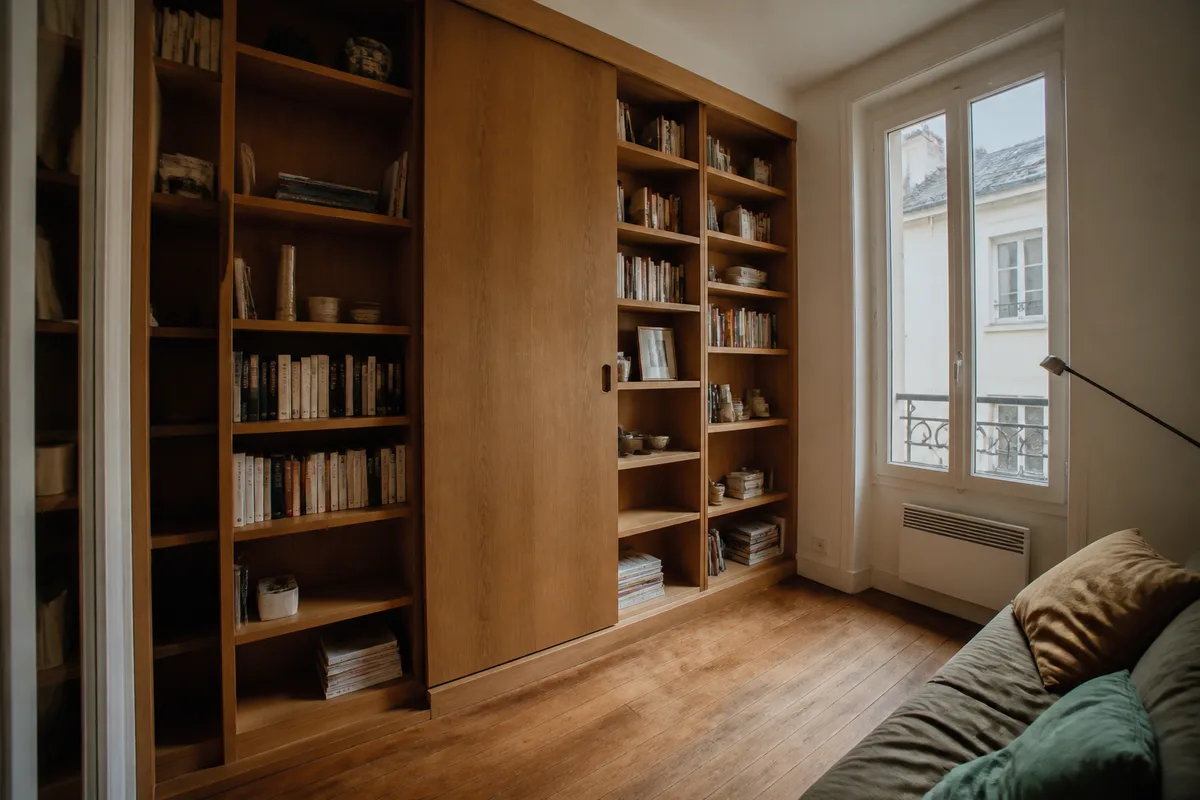
Custom storage can fit a sloping ceiling, a narrow staircase shaft, or an alcove. It can also incorporate a niche, sliding doors, a fold-down desk, or shelves up to the ceiling. The space saving therefore does not come from an abstract promise, but from the ability to adapt each part of the furniture to the identified constraints.
Custom work is especially interesting when the lost space would cost more in comfort than the personalized design. In a small bedroom, a closet that uses the available height can reduce the need for a separate dresser. In a studio, a piece of furniture can combine storage, visual separation, and support for equipment.
Materials, Quality, and Maintenance
The materials offered can include MDF, a waterproof compressed panel, a higher-quality panel, wood veneer, or solid wood, depending on the manufacturer and the project. These solutions do not have the same appearance, weight, or resistance to moisture or shocks. Ask for the precise composition of the panels and the planned finish rather than just accepting the term “wood.”
Custom furniture is not automatically more durable. The lifespan depends on the design, the quality of the joints, usage, maintenance, and the room conditions. Ask about warranty conditions, repair procedures, and availability of replaceable parts. Some providers display their own commitments: for example, Centimetre.com indicates a 10-year warranty and an announced lead time of 3 to 4 weeks, information to be confirmed at the time of the quote.
The Constraints of Custom-Made Furniture
Design requires preparing a specifications document, validating plans, and sometimes coordinating manufacturing, delivery, and installation. The furniture may also be less easy to move or reuse in another home. A measurement error is more penalizing than with standard furniture, especially if the project is made for a unique location.
Before signing, have what is included specified: measuring, design, samples, delivery, assembly, fixing, possible adjustments, and removal of packaging. The budget announced by a provider is not an average market price. Ynspir communicates a starting price of €500 for certain custom-made furniture, but the actual amount depends on the type of furniture and the services chosen.
Maisons du Monde or Custom Furniture: What Difference According to Criteria?
For a standard room and an immediate need, ready-to-buy furniture is often simpler. For an irregular space, significant storage, or very constrained depth, custom-made offers more precision. The table below provides a decision grid; it does not replace checking dimensions, the quote, and the conditions specific to each model.
| Criterion | Standard Furniture | Custom Furniture |
|---|---|---|
| Budget | Price of known model, excluding options and services | Variable amount depending on design, materials, delivery, and installation |
| Space Saving | Adapted to available dimensions from the catalog | Optimized for specific walls, corners, heights, and depths |
| Lead Time | Purchase and availability to be checked for the chosen reference | Manufacturing and delivery require time; estimated 3 to 4 weeks with a provider, to be confirmed |
| Customization | Limited choice to proposed variants | Dimensions, materials, colors, and layout to be defined in the project |
| Installation | Assembly sometimes to be planned separately | Installation possible depending on the professional and the quote |
| Evolution | Easier to move or replace | Designed for a specific location, thus less flexible in case of moving |
Total Budget
Compare the overall cost, not just the price of the furniture. Add necessary accessories, delivery, assembly, fixing, any cutting, and preparatory work. For a custom project, request at least two quotes describing the same services to avoid comparing a “furniture only” price with an all-inclusive offer.
An indicative example helps understand the logic: if furniture advertised at €500 requires €100 for delivery and €150 for installation, the estimated budget reaches €750. This calculation is hypothetical and does not constitute an average rate or a personalized estimate. Amounts must be confirmed by the professionals involved.
Space Saving
Standard furniture wins when its dimensions already fit the room. Custom becomes more relevant if a significant residual space remains around the furniture, if shallow depth is essential, or if height can accommodate additional storage. Sliding doors can also avoid the swing of a classic door, but they require adapted design and hardware.
Lead Times and Ease of Purchase
A standard purchase requires fewer technical decisions. A custom project offers more control but demands exchanges, validations, and coordination. If the room must be used quickly, check the actual availability of the standard model or the manufacturer’s contractual lead time before committing.
Style, customization, and maintenance
Maisons du Monde makes it easy to find a coherent decorative universe, while custom-made allows you to adjust the appearance to the room and the materials already present. In both cases, prioritize a finish that is easy to clean and compatible with the use: a heavily used entryway, a child’s bedroom, and a living room do not impose the same requirements.
Customization has value when it solves a measurable constraint: a reduced depth, an unused corner, or storage that cannot be found in standard dimensions.
Which furniture to choose for a bedroom, a studio, or an alcove?
The choice depends more on the layout than on the brand name. A rectangular bedroom can accommodate a well-sized standard piece of furniture, whereas an alcove or a sloping ceiling favors custom-made more. In a studio, multifunctionality counts as much as storage capacity, because each piece of furniture sometimes has to fulfill several roles.
Small bedroom
For a small bedroom, start with the bed and the circulation around it. A storage bed, a modular wardrobe, or high-level storage can reduce floor clutter. A standard piece of furniture may suffice if the available wall accepts its dimensions; custom-made is more convincing when the wardrobe must fit between two obstacles or reach up to the ceiling.
Studio or compact living room
In a studio, look for a light and reversible partition. A shallow bookshelf, a low piece of furniture with closed storage, or a solution integrating a desk can structure the space without creating a massive partition. A convertible sofa and an extendable table are standard options to consider, but their mechanism must be tested in-store or checked in the manufacturer’s documentation.
Narrow entryway, nook, or sloping ceiling
These configurations are the most favorable for custom-made. A piece of furniture for an alcove can exploit an irregular width, while a closet under a slope follows the available height instead of leaving an unused volume. If the need remains limited to a few coats or shoes, a shallow standard composition with wall elements can, however, be more proportionate.
In a humid room or near a water point, check the resistance of the materials and ventilation. The furniture must not cover an air grille, a technical hatch, or equipment requiring regular access.
Is the hybrid solution relevant for a small room?
Yes, the hybrid approach can reduce the budget while addressing the most difficult constraints. It consists of using a standard piece of furniture for the easily available part, then completing it with a shelf, a cladding, a niche, or storage designed for a specific space. However, the junction must be anticipated to avoid an unstable or visually incoherent result.
When to combine standard and custom-made?
- When the main piece of furniture exists in an adapted width but leaves a small lateral gap.
- When custom shelves can exploit the height without modifying the entire room.
- When the budget does not allow manufacturing the entire storage.
- When you want to keep a movable piece of furniture while fitting a fixed alcove.
Precautions to take
Compare thicknesses, shades, edges, and levels of finish. A custom-made complement may seem different from the standard piece even if both are announced in a close color. Also check the wall fixing and the support capacity, especially for high shelves or elements installed on a partition.
How to choose between Maisons du Monde and custom-made: the five steps
A reliable decision is based on a simple sequence: measure, prioritize, compare, check, then choose. This method avoids starting from a photo or a crush before knowing if the furniture can really fit into the room and work daily.
- Take measurements: note width, height, depth, obstacles, openings, and passageways. Photograph the walls and indicate outlets, radiators, and baseboards.
- Rank priorities: decide if the main need is storage, versatility, circulation, aesthetics, or speed of installation.
- Compare two or three solutions: examine a standard reference, a modular option if it exists, and a custom quote for the same function.
- Check practical constraints: verify passage during delivery, door and drawer openings, mounting, ventilation, and access to equipment.
- Choose the proportionate solution: opt for custom-made if the spatial constraint is real and costly in comfort; otherwise, favor the simplicity of a standard piece of furniture.
For a project involving modification of a countertop or a fixed element, precisely identify the necessary intervention before ordering the furniture. The question of who can change a countertop illustrates the importance of distinguishing furniture purchase from adaptation work.
Maisons du Monde or custom furniture for a small room: what verdict according to your profile?
For a quick and reasonable choice, opt for standard furniture when the room is regular and the available dimensions match the model. Turn to custom-made when storage must fit a specific constraint. The hybrid solution is often the most balanced to address a single difficult corner without redoing the entire layout.
| Your situation | Generally more suitable solution | Point to check |
|---|---|---|
| Tight budget and immediate need | Standard furniture | Dimensions, availability, and delivery fees |
| Regular wall and moderate storage | Maisons du Monde or other standard furniture | Depth and circulation |
| Alcove, under slope or irregular corner | Custom furniture | Measured plan, ventilation, and installation |
| Need for very vertical storage | Custom or hybrid solution | Mounting and access to upper parts |
| Evolving project or probable move | Independent standard furniture | Weight, disassembly, and reuse |
What mistakes to avoid before buying furniture for a small room?
The most costly mistakes are not always about price. They often appear after delivery, when the furniture blocks an opening, reduces circulation, or does not allow access to storage. A methodical check before purchase avoids most of these disappointments.
- Measuring only the width: depth and door swing can make the furniture unusable. Draw its footprint on the floor and test openings.
- Filling the entire height without planning access: very tall storage is impractical without a step stool and can visually weigh down the room. Reserve high areas for rarely used items.
- Forgetting delivery: furniture that fits on paper may not pass through the stairs, hallway, or elevator shaft. Measure the entire route.
- Blocking ventilation or equipment: moving air flow, a radiator, or a hatch can cause operational problems. Leave the planned access and clearances.
- Comparing an incomplete price: a quote without installation, delivery, or finishing cannot be directly compared to an all-inclusive offer. Request the details of each item.
Space-saving furniture is only useful if storage remains accessible and the room maintains comfortable circulation.
Useful Sources to Consult
Dimensions, availability, and services vary depending on the references and suppliers. To verify information before purchase, consult the product sheet or the corresponding quote, then check the following points:
- Manufacturer or brand sheet: dimensions, materials, assembly, availability, and delivery conditions.
- Professional quote: design, measurements, manufacturing, installation, fixing, lead time, and warranties.
- Material documentation: moisture resistance, maintenance, finish, and repair possibilities.
- Housing constraints: wall support, ventilation, technical access, and any condominium regulations.
The information cited about the starting price of €500, the announced 10-year warranty, and the 3 to 4 weeks lead time correspond to indications provided by specific providers, notably Ynspir and Centimetre.com. They do not constitute a general pricing grid and must be confirmed for your project.
Key Takeaways
- 📐 Measure the room and delivery route before comparing furniture.
- 🛋️ Choose the standard if its dimensions already fit and if a quick purchase matters.
- 🧱 Prefer custom-made for an alcove, a sloping ceiling, shallow depth, or complex vertical storage.
- ⚖️ Consider the hybrid to adapt only difficult areas without financing a complete setup.
Frequently Asked Questions
Is custom-made furniture always more expensive?
No, there is no single price: the cost depends on the furniture, materials, finishes, design, delivery, and installation. A starting price announced by a provider therefore does not allow estimating all projects.
Is a Maisons du Monde piece of furniture suitable for a very narrow room?
It can be suitable if its depth, floor footprint, and opening mode allow sufficient circulation. Check the sheet of the chosen reference and simulate its placement before purchase.
How to save space with standard furniture?
Favor shallow depth, sliding doors, multifunctional furniture, and vertical storage. However, avoid placing furniture in front of ventilation, a radiator, or a necessary opening.
When to request a custom quote?
Request one when the room has an alcove, a sloping ceiling, an irregular wall, or a storage need difficult to satisfy with available dimensions. Provide precise measurements and ask for details of included services.
Is custom-made furniture more durable than standard furniture?
Not automatically. Durability depends on materials, design, joints, usage, and maintenance; compare technical characteristics and warranty conditions rather than the manufacturing method alone.
.magic-lb-overlay{position:fixed;inset:0;background:rgba(15,23,42,.92);display:none;align-items:center;justify-content:center;z-index:99999;cursor:zoom-out;padding:20px}
.magic-lb-overlay.open{display:flex}
.magic-lb-overlay img{max-width:95vw;max-height:95vh;object-fit:contain;border-radius:8px;box-shadow:0 8px 32px rgba(0,0,0,.5)}
.magic-lb-close{position:absolute;top:16px;right:20px;color:#fff;background:rgba(0,0,0,.5);border:none;width:40px;height:40px;border-radius:50%;font-size:24px;cursor:pointer;display:flex;align-items:center;justify-content:center}
.magic-lb-close:hover{background:rgba(0,0,0,.8)}
.wp-block-image img{cursor:zoom-in;transition:transform .15s ease}
.wp-block-image img:hover{transform:scale(1.01)}
.magic-img-link{display:inline-block;text-decoration:none}
(function(){
var ov=document.getElementById(‘magic-lb’);if(!ov)return;
var img=ov.querySelector(‘img’),btn=ov.querySelector(‘.magic-lb-close’);
function open(src){img.src=src;ov.classList.add(‘open’);document.body.style.overflow=’hidden’}
function close(){ov.classList.remove(‘open’);img.src=”;document.body.style.overflow=”}
document.addEventListener(‘click’,function(e){
var a=e.target.closest(‘a.magic-img-link’);
if(a){e.preventDefault();open(a.getAttribute(‘href’));return}
var i=e.target.closest(‘.wp-block-image img’);
if(i&&!e.target.closest(‘a’)){e.preventDefault();open(i.currentSrc||i.src)}
});
ov.addEventListener(‘click’,function(e){if(e.target===ov||e.target===btn)close()});
document.addEventListener(‘keydown’,function(e){if(e.key===’Escape’)close()});
})();