.en-bref { max-width: 640px; margin: 2em auto; padding: 1.5em 1.8em; color: #78350f; font-family: “Inter”, “Segoe UI”, sans-serif; text-align: left; position: relative; box-sizing: border-box; background: #fffaf0; border: 1px solid #b45309; border-left: 6px solid #b45309; border-radius: 8px; box-shadow: 0 8px 24px rgba(251, 191, 36, 0.15); }
.en-bref h2, .en-bref .en-bref-header { font-size: 1.15em; font-weight: 700; margin-bottom: 0.6em; color: #b45309; }
.en-bref p, .en-bref li { font-size: 1em; line-height: 1.65; margin: 10px; }
.en-bref strong { color: #451a03; }
.key-takeaways { max-width: 640px; margin: 2em auto; padding: 1.5em 1.8em; color: #78350f; font-family: “Inter”, “Segoe UI”, sans-serif; text-align: left; position: relative; box-sizing: border-box; background: #fffaf0; border: 1px solid #b45309; border-left: 6px solid #b45309; border-radius: 8px; box-shadow: 0 8px 24px rgba(251, 191, 36, 0.15); }
.key-takeaways h2, .key-takeaways .key-takeaways-header { font-size: 1.15em; font-weight: 700; margin-bottom: 0.6em; color: #b45309; }
.key-takeaways p, .key-takeaways li { font-size: 1em; line-height: 1.65; margin: 10px; }
.key-takeaways strong { color: #451a03; }
.key-takeaways ul { list-style: none; padding-left: 0; }
.key-takeaways li { margin: 0.45em 0; padding-left: 0.2em; }
.mg-callout{margin:1.5em 0;padding:.9em 1.1em;border:1px solid;border-left-width:4px;border-radius:10px;font-size:.97em;line-height:1.65}.mg-callout>:first-child{margin-top:0}.mg-callout>:last-child{margin-bottom:0}.mg-callout__label{display:block;margin:0 0 .35em;font-weight:700;font-size:.82em;letter-spacing:.03em;text-transform:uppercase}.mg-callout__label::before{margin-right:.45em;font-size:1.05em;vertical-align:-.06em}.mg-callout–info{background:#eff6ff;border-color:#bfdbfe;color:#1e3a5f}.mg-callout–info .mg-callout__label{color:#2563eb}.mg-callout–info .mg-callout__label::before{content:”2139FE0F”}.mg-callout–tip{background:#f0fdf4;border-color:#bbf7d0;color:#14532d}.mg-callout–tip .mg-callout__label{color:#15803d}.mg-callout–tip .mg-callout__label::before{content:”1F4A1″}.mg-callout–warning{background:#fffbeb;border-color:#fde68a;color:#7a4a10}.mg-callout–warning .mg-callout__label{color:#b45309}.mg-callout–warning .mg-callout__label::before{content:”26A0FE0F”}.mg-callout–danger{background:#fef2f2;border-color:#fecaca;color:#7f1d1d}.mg-callout–danger .mg-callout__label{color:#dc2626}.mg-callout–danger .mg-callout__label::before{content:”1F6D1″}.mg-proscons{display:grid;grid-template-columns:1fr 1fr;gap:16px;margin:1.5em 0}@media(max-width:560px){.mg-proscons{grid-template-columns:1fr}}.mg-proscons__col{padding:.9em 1.1em;border:1px solid;border-radius:10px}.mg-proscons__title{display:flex;align-items:center;gap:.4em;margin:0 0 .5em;font-weight:700;font-size:.9em;letter-spacing:.02em}.mg-proscons__col ul{margin:.3em 0 0;padding-left:1.15em}.mg-proscons__col li{margin:.3em 0;line-height:1.55}.mg-proscons__col–pro{background:#f0fdf4;border-color:#bbf7d0;color:#14532d}.mg-proscons__col–pro .mg-proscons__title{color:#15803d}.mg-proscons__col–pro .mg-proscons__title::before{content:”2705″}.mg-proscons__col–con{background:#fef2f2;border-color:#fecaca;color:#7f1d1d}.mg-proscons__col–con .mg-proscons__title{color:#dc2626}.mg-proscons__col–con .mg-proscons__title::before{content:”274C”}.mg-steps{list-style:none;counter-reset:mgstep;margin:1.5em 0;padding:0}.mg-steps__item{counter-increment:mgstep;position:relative;padding:0 0 1.1em 3.2em;min-height:2.4em}.mg-steps__item:last-child{padding-bottom:0}.mg-steps__item::before{content:counter(mgstep);position:absolute;left:0;top:0;width:2.2em;height:2.2em;line-height:2.2em;text-align:center;border-radius:50%;background:#2563eb;color:#fff;font-weight:700;font-size:.95em}.mg-steps__title{margin:.15em 0 .3em;font-weight:700}.mg-steps__item>:last-child{margin-bottom:0}.mg-kpis{display:grid;grid-template-columns:repeat(auto-fit,minmax(140px,1fr));gap:14px;margin:1.5em 0}.mg-kpi{padding:1em .9em;border:1px solid #e5e7eb;border-radius:12px;background:#f9fafb;text-align:center}.mg-kpi__value{display:block;font-size:1.7em;font-weight:800;line-height:1.15;color:#111827}.mg-kpi__label{display:block;margin-top:.35em;font-size:.85em;color:#6b7280;line-height:1.35}
.wp-block-image,.ai-image{margin-bottom:1.75em}.wp-block-image>figcaption,.ai-image>figcaption{margin-top:.5em}
How much paint is needed to repaint a room without waste?
The amount of paint per m2 depends on the actual surface to be covered, the coverage indicated on the can, and the number of coats planned. To get a reliable estimate, you need to measure the walls and ceiling involved, then apply a simple formula rather than relying solely on the floor area.
This guide explains how to calculate the surface to be painted, interpret the coverage in m²/L, adjust the volume according to the substrate, and buy a reasonable margin. You will also find numerical examples, an estimation table, and mistakes to avoid to limit unused cans.
In brief
🎨 The basic formula is to divide the surface to be painted by the coverage indicated on the can, then multiply the result by the number of coats.
📏 With an indicative coverage of 10 m²/L, a surface of 20 m² to cover in two coats requires about 4 liters, before adjustment according to the substrate.
🧱 A new, porous, or highly contrasting wall may consume more than a wall already painted and properly prepared.
🛒 A margin of about 10% can limit the risk of running out of paint, but it must remain adapted to the project to avoid waste.
Which formula should be used to calculate the amount of paint?
To estimate the required volume, add up the actual painted surfaces, divide them by the coverage in m²/L stated on the can, then multiply by the number of coats. The result corresponds to a theoretical estimate, to be adjusted if the substrate absorbs a lot or if the color has poor coverage.
Factors to consider
Calculating the paint for a room is based on four data points: the surface of the walls, the surface of the ceiling if included, the product’s coverage, and the number of coats. Openings can be deducted when they are significant, but a small door or window sometimes only slightly changes the result.
The final quantity must be calculated from the surface to be painted, not just the floor area. A room with 10 m² of floor space can have more than 30 m² of walls depending on its dimensions and ceiling height.
The formula to remember
The formula is as follows:
Amount of paint in liters = (surface to be painted in m² × number of coats) ÷ coverage in m²/L
Example: for 20 m² of surface, two coats, and a coverage of 10 m²/L, the calculation is: (20 × 2) ÷ 10 = 4 liters. This volume is indicative and does not yet take into account possible excessive absorption, losses in the tray, or a touch-up margin.
The most important data to note on the can is not just the volume, but the coverage announced in square meters per liter.
How to measure the surface of a room before painting?
Measure each wall separately, then add the ceiling if you are painting it as well. For the walls, multiply the total width by the ceiling height; for the ceiling, simply multiply the length of the room by its width.
Calculating the surface of the walls
In a rectangular room, add the length and width, then multiply this sum by two to get the perimeter. Then multiply the perimeter by the height of the walls.
For a room 4 m by 3 m with a height of 2.50 m, the theoretical wall surface is (4 + 3) × 2 × 2.50, or 35 m². If a large bay window measures 2.40 m² and a door 1.68 m², the net surface approaches 30.92 m².
Calculating the surface of the ceiling
The ceiling of a room 4 m by 3 m represents 12 m². If you apply two coats with a coverage of 10 m²/L, about 2.4 liters are needed before margin, generally a larger size allowing to cover losses and touch-ups.
Measurement mistakes to avoid
- Confusing the floor surface with the total surface of the walls.
- Forgetting the ceiling height, especially in an old or attic room.
- Deducting small openings to the centimeter when the paint will also be used for touch-ups.
- Not distinguishing the areas actually painted: walls, ceiling, baseboard, or alcove.
How many liters are needed for a typical room?
For a 20 m² area to be painted, two coats and a coverage of 10 m²/L lead to an estimate of 4 liters. This value is an example calculation, not a universal quantity: the nature of the surface, the existing shade, and the chosen product can alter consumption.
Example with four walls
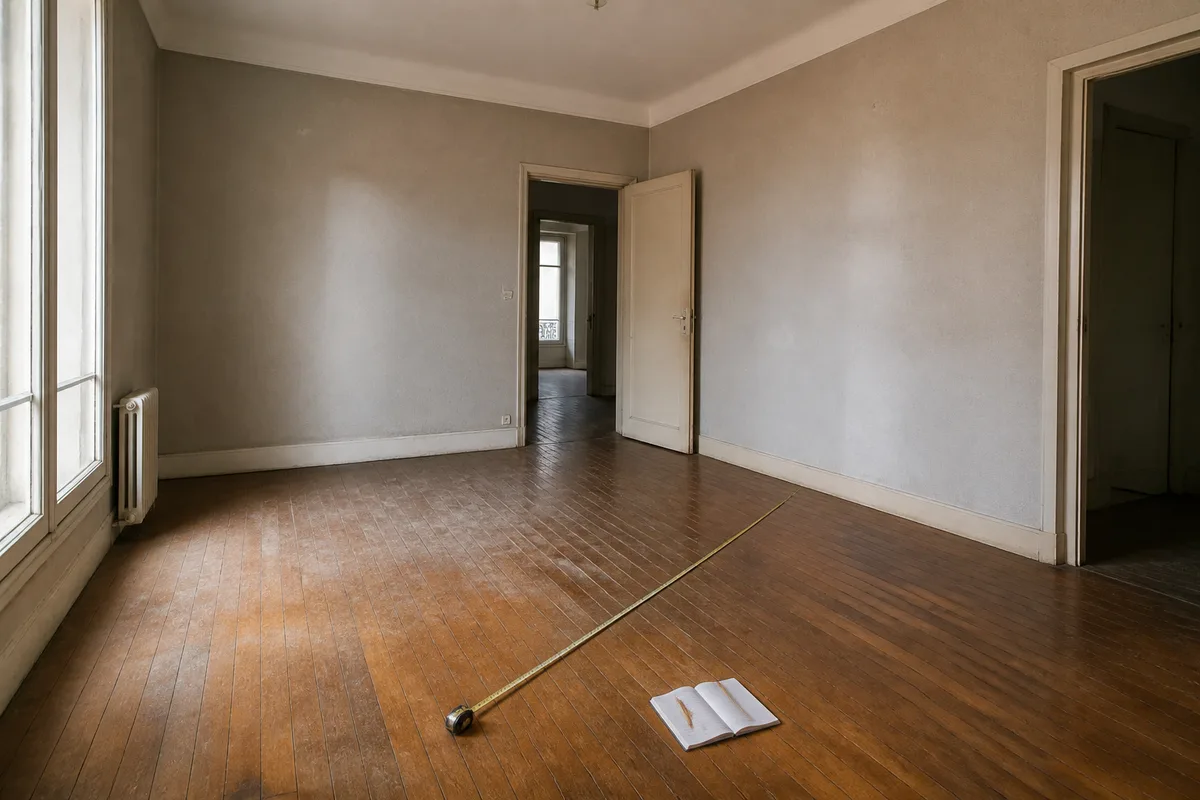
Imagine a room measuring 4 m by 3 m, 2.50 m high, with a door and a window of standard dimensions. The net surface of the walls can be estimated at about 31 m² after deducting the main openings.
For two coats and a coverage of 10 m²/L, the calculation yields about 6.2 liters. With an indicative margin of 10%, the theoretical need reaches nearly 6.8 liters; a 7.5-liter container may then be more consistent than a purchase limited to 6 liters.
Example with walls and ceiling
Adding the 12 m² of the ceiling, the total surface approaches 43 m². For two coats at the same coverage, about 8.6 liters are needed before margin, then nearly 9.5 liters with an indicative 10% reserve.
The difference between 6.2 liters for walls alone and 8.6 liters including the ceiling shows why each area must be calculated separately. The ceiling may also require a specific paint, whose coverage and number of coats should be checked on the label.
What paint coverage should be used to know the quantity per m²?
Coverage corresponds to the surface that one liter can cover for one coat under the conditions specified by the manufacturer. An approximate value of 10 m²/L is often used for an example of interior paint, but only the indication on the chosen product’s can should serve as a reference for purchase.
Understanding the manufacturer’s indication
If the can indicates 10 m²/L and the total surface to cover for one coat is 30 m², theoretically 3 liters are needed for one coat. Two coats bring the need to 6 liters, before accounting for porosity, losses, and a margin.
Check if the stated coverage concerns one coat, a prepared surface, or an application made with a specific tool. An online calculator offered by a manufacturer or distributor can help verify the result, but it does not replace the technical data sheet of the purchased product.
Why actual coverage may be lower
A porous wall absorbs more paint than a smooth surface already sealed. The roller, the pressure applied, the consistency of the application, and the texture of the surface also influence consumption.
A coverage displayed on the packaging is a calculation basis; it does not guarantee identical coverage on all walls.
How many coats of paint should be planned?
Two coats are a common benchmark for a regular interior finish, but the exact number depends on the surface and the contrast between the old and new color. A primer followed by two finishing coats may be necessary on a new, highly absorbent, or particularly uneven surface.
Wall already painted and in good condition
A clean, smooth, and properly prepared wall can often be treated with two finishing coats. If the new shade is close to the old one and the paint is sufficiently covering, the result can be achieved with less consumption, without exempting from following the manufacturer’s instructions.
New or porous wall
An appropriate wall primer reduces the absorption of the surface and makes the finish more uniform. However, it adds a step and a volume of product to plan: calculate the concerned surface separately and check the primer’s coverage.
Marked color change
Switching from a very dark wall to a light shade, or vice versa, may require an additional coat. The color, opacity, and finish chosen should be verified on the technical data sheet; a “one-coat” mention does not necessarily mean the product will cover every surface in a single application.
Which type of paint to choose according to the surface and the project?
The type of paint mainly influences the preparation, adhesion, and number of coats required, but there is no identical coverage for all acrylic, alkyd, or single-coat paints. Compare the product according to its actual use, compatible surface, and stated coverage.
| Option | Common use | Point of caution | Relevant choice if… |
|---|---|---|---|
| Acrylic paint | Interior walls and ceilings | Clean, dry, and properly prepared surface | You are looking for a common interior application and tool cleaning with water |
| Alkyd paint | Surfaces requiring a resistant finish depending on the product | Ventilation, drying time, and compatibility to check | The technical data sheet recommends it for the concerned surface |
| Single-coat paint | Project on a regular surface and compatible shade | Actual coverage may require a second coat | The manufacturer confirms the intended use under your conditions |
For heavily used surfaces, such as a garage floor, ordinary wall paint is not suitable by default. The choice must take into account mechanical constraints and humidity; the criteria differ from those of a dry room, as explained in this guide on paint for a garage floor.
What margin to allow to avoid paint waste?
An indicative margin of 10% can cover application losses, unforeseen absorption, and touch-ups. It should be calculated after considering the number of coats and the product’s coverage, then rounded to the actual available packaging.
Adjusting the margin to the surface
A smooth wall already painted generally requires less reserve than a porous, textured, or poorly prepared surface. For a homogeneous job, a margin around 10% can serve as a guideline; on a highly absorbent surface, it is safer to check consumption after a first test area.
Why keep some leftover
Keep a small amount in an airtight container, labeled with the shade name and the room concerned. This leftover can be used to repair a mark or a rubbed area, as a new batch of paint may be slightly different.
How to limit leftovers
- Take the measurements of each wall and note them before starting.
- Check the coverage and recommended number of coats on the can.
- Calculate separately for walls, ceiling, and any specific areas.
- Add a reasonable margin, then choose the closest packaging size.
- Keep the label and close the can immediately after each use.
What volume to plan according to the surface to be painted?
The following table provides indicative volumes with a hypothetical coverage of 10 m²/L and two coats. These figures serve to understand the order of magnitude; they must be recalculated with the coverage of the chosen product and the actual surface of the room.
| Surface to paint | One coat | Two coats | Two coats + 10% indicative |
|---|---|---|---|
| 10 m² | 1 L | 2 L | 2.2 L |
| 20 m² | 2 L | 4 L | 4.4 L |
| 30 m² | 3 L | 6 L | 6.6 L |
| 40 m² | 4 L | 8 L | 8.8 L |
| 50 m² | 5 L | 10 L | 11 L |
To use this table, replace the coverage of 10 m²/L with that of your can. With a coverage of 8 m²/L, for example, a surface of 20 m² with two coats would require (20 × 2) ÷ 8, i.e., 5 liters before margin.
Should you compare single-coat paint and two-coat paint?
Single-coat paint may seem more economical because the calculation assumes only one application, but this saving depends on the actual coverage obtained. Traditional two-coat paint is often easier to budget when the surface or the base color is irregular.
| Solution | Theoretical calculation | Advantage | Limit |
|---|---|---|---|
| Single coat | Surface ÷ yield | Less product if a single coat really covers | A second coat may become necessary |
| Two-coat paint | (Surface × 2) ÷ yield | More cautious estimate for a color change | Higher initial volume |
| Primer + finish | Separate calculation for each product | Better absorption control on new substrate | Two products and multiple applications to plan for |
Acrylic paint is often suitable for interior walls and ceilings, while alkyd paint meets other finishing and application constraints. To compare a specific reference, consult its technical specifications rather than deducing its yield from its chemical family.
What mistakes increase paint consumption?
The most costly mistakes occur even before opening the can: incorrect measurement, unprepared substrate, or overly optimistic interpretation of the yield. Correcting these often avoids insufficient purchase and the resulting uneven touch-ups.
- Calculating based on floor area: wall height is forgotten, which greatly underestimates the need.
- Assuming only one coat by default: a highly contrasting color or uneven background may require an additional application.
- Ignoring porosity: a new or crumbly wall absorbs more; an appropriate primer may be necessary.
- Subtracting all small openings: the gain is sometimes less than the volume used for touch-ups and losses.
- Mixing cans of different shades: even a close shade can produce a visible demarcation.
The best way to avoid waste is to calculate the actual surface, then adjust the result to the substrate and product rather than adding a large reserve reflexively.
How to buy the right amount of paint at once?
When several walls must receive the same shade, buying the cans at once reduces the risk of variation between batches. Compare the calculated volume with the available formats, keeping in mind that the nominal volume does not guarantee identical coverage if the substrates differ.
Before paying, check the exact reference, shade, finish, yield, recommended number of coats, and compatibility with the substrate. For a project combining painting and surface preparation, sanding or repair operations must be completed before the final consumption calculation.
Available reviews on a range can help identify uses and limitations mentioned by users, but they do not replace the technical data sheet. You can notably consult this comparison dedicated to reviews and characteristics of Zolpan paints before selecting a specific product.
Key takeaways
- 📏 Measure walls and ceiling separately, then only subtract significant openings.
- 🧮 Apply the formula: surface × number of coats ÷ yield in m²/L.
- 🧱 Adjust the result for a porous substrate, a highly contrasting shade, or insufficient preparation.
- 🛒 Plan an indicative margin of about 10%, without buying an excessive volume.
- 🫙 Keep an identified remainder for later touch-ups.
Frequently asked questions
How much is needed for a room with 10 m² floor area?
The floor area alone is not enough to answer, as the surface of the walls and possibly the ceiling must be calculated. With 30 m² to paint, two coats, and a yield of 10 m²/L, the theoretical estimate is 6 liters before margin.
How many liters are needed to paint a single wall?
Multiply the width of the wall by its height, then divide the obtained surface by the can’s yield. For a wall 4 m wide by 2.5 m high, two coats with a yield of 10 m²/L give about 2 liters before adjustment.
Is a paint advertised as single coat really enough?
Not necessarily. Coverage depends on the base color, the condition of the surface, the preparation, and the product; plan for a second coat if the result after drying is not uniform.
Should doors and windows always be deducted?
Deduct large openings when their surface area actually affects the calculation. For a small door or window, keeping a slightly larger estimate can be more practical to cover edges, touch-ups, and losses.
What to do if there is leftover paint?
Close the can carefully, note the shade, and store it away from frost and strong heat. This leftover can be used for touch-ups, provided the paint is still homogeneous and complies with the manufacturer’s storage recommendations.
Useful sources to consult
Coverage and coat indications should be verified on the product’s technical data sheet. Calculation methods can be compared with advice from Tollens on paint quantity, Castorama on paint needs, and Dulux Valentine on volume calculation. These resources remain complementary: the label and documentation of the product actually purchased take precedence for coverage, preparation, and number of coats.
.magic-lb-overlay{position:fixed;inset:0;background:rgba(15,23,42,.92);display:none;align-items:center;justify-content:center;z-index:99999;cursor:zoom-out;padding:20px}
.magic-lb-overlay.open{display:flex}
.magic-lb-overlay img{max-width:95vw;max-height:95vh;object-fit:contain;border-radius:8px;box-shadow:0 8px 32px rgba(0,0,0,.5)}
.magic-lb-close{position:absolute;top:16px;right:20px;color:#fff;background:rgba(0,0,0,.5);border:none;width:40px;height:40px;border-radius:50%;font-size:24px;cursor:pointer;display:flex;align-items:center;justify-content:center}
.magic-lb-close:hover{background:rgba(0,0,0,.8)}
.wp-block-image img{cursor:zoom-in;transition:transform .15s ease}
.wp-block-image img:hover{transform:scale(1.01)}
.magic-img-link{display:inline-block;text-decoration:none}
(function(){
var ov=document.getElementById(‘magic-lb’);if(!ov)return;
var img=ov.querySelector(‘img’),btn=ov.querySelector(‘.magic-lb-close’);
function open(src){img.src=src;ov.classList.add(‘open’);document.body.style.overflow=’hidden’}
function close(){ov.classList.remove(‘open’);img.src=”;document.body.style.overflow=”}
document.addEventListener(‘click’,function(e){
var a=e.target.closest(‘a.magic-img-link’);
if(a){e.preventDefault();open(a.getAttribute(‘href’));return}
var i=e.target.closest(‘.wp-block-image img’);
if(i&&!e.target.closest(‘a’)){e.preventDefault();open(i.currentSrc||i.src)}
});
ov.addEventListener(‘click’,function(e){if(e.target===ov||e.target===btn)close()});
document.addEventListener(‘keydown’,function(e){if(e.key===’Escape’)close()});
})();