An access ramp can prove essential to facilitate movement. It is particularly suitable for people with reduced mobility.

Compared to the removable model, the fixed ramp offers many advantages, especially since it is made of concrete.
If you want to benefit from it, this article offers you a complete guide to building it according to the rules of the art. Before getting to the heart of the matter, it is important to detail the key points to know about the access ramp.
📋 Essential to remember: Personally, I consider a slope gradient under 8% essential for safe wheelchair accessibility and vehicle traction. In my project experience, installing steel rebar grid reinforcement prevents long-term cracking under heavy daily loads. Proper surface brooming ensures non-slip traction during wet weather conditions.
Key points to remember about the access ramp
🛠️ My experience: Last September, I poured a 4-meter outdoor concrete ramp for a garden driveway shed costing around $350 in materials. After skipping a damp gravel sub-base on an earlier pathway project, I learned that thorough ground compaction prevents future settling and structural fractures.
You have probably seen it everywhere right in front of commercial buildings or opposite neighborhood houses. Know that this construction must comply with current legislation:
To dive deeper, I recommend checking ready mix concrete options for accurate job site delivery. Understanding proper concrete mixing techniques guarantees optimal slab strength. And for larger structural projects, discovering how to cut concrete slabs helps when modifying existing driveways.
Regulations on the access ramp
If we provide a definition of the access ramp, it is an effective means to simplify access. It is particularly interesting if you frequently use wheeled equipment. It is mandatory for those who have a Public Access Building or ERP. When there is a level difference in front of the premises, it is required to create an access ramp reserved for people with disabilities or reduced mobility.
Thanks to this construction, access to the site can be done without external assistance. It can be reached effortlessly. The regulations require a maximum level difference. It should be noted that a level difference represents the slope and this is expressed in %.
To calculate the slope percentage, you just have to divide the height of the step by the length of the ramp.
In general, a 5% slope is dedicated to any access. If it exceeds 10%, it is already prohibited according to the rules.
| Ramp application | Maximum slope (%) | Minimum thickness (cm) | Rebar size |
|---|---|---|---|
| Wheelchair access | 5% – 8% | 10 cm | 6 mm mesh |
| Pedestrian walkway | 10% – 12% | 10 cm | 6 mm mesh |
| Light vehicle driveway | 12% – 15% | 15 cm | 8 mm mesh |
| Heavy equipment access | 10% – 12% | 20 cm | 10 mm mesh |
💡 Do you know? Adding a textured broom finish to wet concrete increases surface traction by over 50%, reducing slip hazards dramatically during winter conditions.
The different types of access ramps
🍀 Advantages
Extreme durability capable of supporting heavy vehicle weight.
Low long-term maintenance requirements compared to timber ramps.
Customizable surface finishes for optimal weather resistance.
🔻 Weaknesses
Requires heavy manual labor and formwork construction.
Long curing period before taking heavy loads.
There are many materials to make an access ramp. We find steel models which turn out to be heavy. As such, they support heavy loads.
Their drawback lies in their intolerance to rust. If you do not maintain them regularly, they lose their original condition.
For the aluminum ramp, it is more expensive compared to the previous category. It remains easy to install due to its lightness.
If needed, you can dismantle it without difficulty. That is why its installation does not require a building permit, as it is not permanently fixed to the site. During humid climates, it is very slippery. Therefore, a separate non-slip walking surface must be used to prevent falls.
As for the wooden ramp, it differs by its aesthetic side. This category is pleasant to look at. However, it does not withstand the test of time. This natural material requires frequent maintenance. Otherwise, it deteriorates over the years.
There is nothing like choosing a concrete access ramp. Even if it is among the most expensive options, it demonstrates remarkable robustness and great longevity.
During construction, you can insert a special non-slip surface. It should be noted that the ramp requires a building permit. It has a permanent fixation.
⚠️ Common mistake: Pouring concrete directly onto loose soil without a compacted gravel foundation. Uncompacted soil absorbs water and shifts, causing the concrete ramp to crack and tilt over time. Always lay a 10 cm base of crushed gravel before pouring.
The steps to build a concrete access ramp
Of course, everyone knows an access ramp. However, its construction is not necessarily within everyone’s reach.
If you are asked how to plane a board, or even how to install an extra-flat shower tray, you might master the steps. But that is not always the case with a ramp. Discover the phases to follow to build it correctly.
Preparation
Any ramp must be installed on a sturdy support. To begin, it is essential to create a layer of gravel to level the base of the ramp. For unstable ground, a concrete slab is recommended. This operation also prevents the ramp from spreading the construction over time.
That said, the next step is to determine the slope. Define the desired height for the new ramp. Then install the ledger board.
Pouring the concrete
To make concrete, you need cement, sand, gravel, and water. Make sure it is not too liquid. Otherwise, the shrinkage will be significant once the material dries.
If it appears dry, it lacks strength and homogeneity. You must therefore find the right balance during mixing.
As soon as the concrete is well prepared, wet the ground for better adhesion of the material. Use a trowel to facilitate application. You can also use it to smooth the surface.
For smoothing, use a float. If your tools or equipment are incomplete, you can easily find them in the tool store in your city.
Constructing the handrail
If you want to add a handrail with your access ramp, its height is generally between 80 cm and 100 cm. You can adjust the posts during installation.
Before starting the operation, gather all your tools. You will need a circular saw or hacksaw. A hammer drill is also very useful for drilling quickly and with great power.
Additionally, a self-drilling screw allows you to fix the handrail to the support. Nuts, screws, and bolts help you attach the bases to the ground.
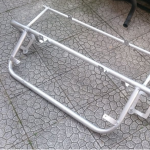
Before erecting the handrail, cut all the tubes. Assemble the barrier and use a arc welding machine to weld the steel parts. If necessary, deburr using your angle grinder.
💡 Practical tip: Keep the newly poured concrete damp for 48 hours by covering it with plastic sheeting to ensure maximum curing strength and prevent surface hairline cracks.
The cost of building an access ramp

There are several access ramps dedicated to people with mobility difficulties. Between the removable model and the fixed one, the latter requires significant expenses.
If you have a limited budget, you can choose between the retractable ramp, the threshold ramp, and the folding device. They have the advantage of being practical. After each use, you can remove them to save space.But if you are looking for a long-term solution, nothing beats opting for a concrete ramp. Indeed, it is expensive to build. However, it will accompany your building for countless years.
To give you an idea of construction costs, a concrete access ramp costs between €140 and €420 per linear meter. The price of a concrete landing per unit ranges from €240 to €1200.
If you consult a qualified professional, they will offer you a custom concrete ramp 10 m long for between €4,000 and €5,000 excluding tax.
Calculate required concrete volume and 25kg pre-mix bags needed.